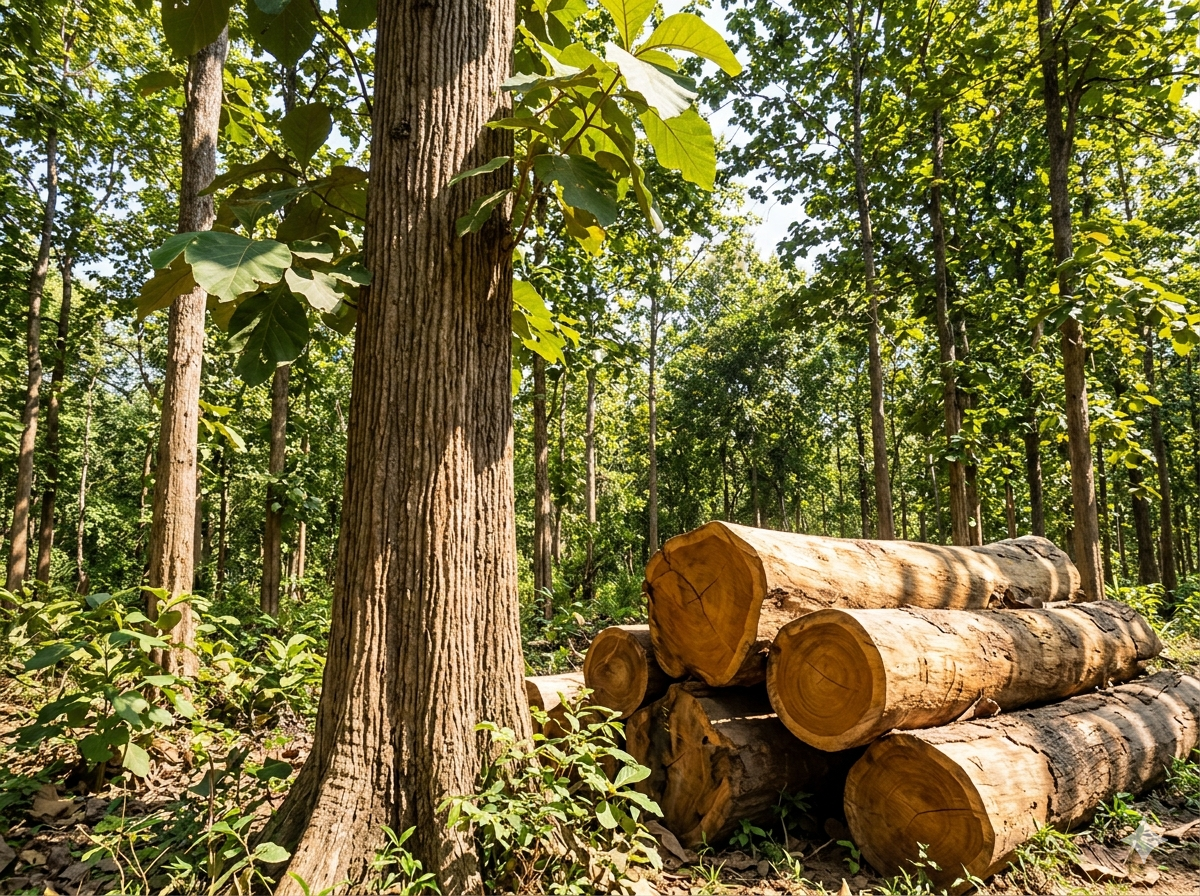
Teak Sagwan King of Timbers India Plantation — PlantCare
📷 PlantCare
🪵 Timber, Shade & Agroforestry Trees

Teak / Sagwan / King of Timbers सागवान / सागौन / टीक

Tectona grandis Family: Lamiaceae

Teak / Sagwan — "King of Timbers." Class I 100+ year durability. Natural oil = no treatment needed. Plantation 1 ha = Rs.1.5-2 crore in 25 years! ⚠️ Transit permit MANDATORY for ALL movement even own land. Natural forest: STRICTLY PROTECTED.

📏 20–40 metres | Straight trunk — excellent timber form ⏳ 100–200+ years | Commercial harvest 25-40 years plantation 📈 Moderate — 2–3 ft/year | Clonal: 30-40% faster 📍 Tropical — MP, Maharashtra, Karnataka, Kerala, AP, TN primary. NOT cold or very dry. ⚠️ Natural forest: STRICTLY PROTECTED — illegal to cut. Plantation private land: FREELY ALLOWED. Transit permit ALL movement MANDATORY. 💰 Rs.1,500–5,000+/cubic foot | Plantation grade: Rs.2,000-3,500 | Forest grade: Rs.3,000-5,000+
📤 WhatsApp
Teak Sagwan King of Timbers Class I 100yr Durability Natural Tectoquinone Oil Plantation Rs1.5-2Cr 25yr Transit Permit ALL Mandatory Clonal 30-40% Faster

सागवान — "King of Timbers।" Class I 100+ year durability। Natural oil = no treatment। Plantation 1 ha = 25 years में Rs.1.5-2 crore! ⚠️ Transit permit ALL movement mandatory। Natural forest: STRICTLY PROTECTED।

Teak (Tectona grandis) — Sagwan / Sagun / Indian Teak / Burma Teak — is India's most commercially valuable and internationally famous timber tree, often called the "King of Timbers." Teak wood is the gold standard of tropical hardwood globally — it combines extraordinary durability (Class I, 100+ year lifespan in outdoor use), natural oil content that repels water and insects without treatment, beautiful golden-brown color that weathers to silver-grey, and workability that allows fine furniture, boat decking, and architectural elements. India has the world's largest natural teak forests — primarily in Madhya Pradesh, Maharashtra, Karnataka and Kerala — and has been the primary global supplier of teak timber for centuries. British colonial India exported massive quantities of teak for Royal Navy shipbuilding. Today, India's natural teak forests are strictly protected, but plantation teak (grown on private and government land) is legal, actively promoted, and one of the most profitable long-term timber investments available. A mature teak plantation (25-30 years) on one hectare can yield Rs.50-2 crore depending on management, with the wood commanding Rs.1,500-5,000+ per cubic foot for premium grades. Teak is also one of Ayurveda's most important medicinal trees — the bark, flowers, leaves and roots all have documented applications.

Teak (Tectona grandis) — सागवान / सागौन — India का most commercially valuable और internationally famous timber tree — "King of Timbers।" Tropical hardwood का gold standard — extraordinary durability (Class I, 100+ years outdoor), natural oil (water + insects repel, no treatment), golden-brown color, excellent workability। India = world के largest natural teak forests — MP, Maharashtra, Karnataka, Kerala primarily। Centuries से global supplier। British Royal Navy shipbuilding। Natural forests: strictly protected। Plantation teak: legal, actively promoted, most profitable long-term timber investment। Mature plantation (25-30 years, 1 hectare) = Rs.50 lakh-2 crore। Premium grades Rs.1,500-5,000+/cubic foot। Ayurveda में भी important — bark, flowers, leaves, roots।

🌳 Overview & Quick Facts / परिचय और मुख्य तथ्य

🔬 Scientific NameTectona grandis — Family: Lamiaceae (Mint family)
📏 Height / ऊंचाई20–40 metres | Straight trunk — excellent timber form / Straight trunk excellent timber
Lifespan / आयु100–200+ years | Commercial harvest 25-40 years plantation
📈 Growth Rate / वृद्धि दरModerate — 2–3 ft/year (slow for quality, fast for some clonal varieties)
🌸 Flowers / फूलJuly–September — small white fragrant clusters. Honey source. / July-September — small white fragrant
🌡️ Climate / जलवायुTropical — 700-2,500mm rainfall. MP, Maharashtra, Karnataka, Kerala, AP, TN primary. NOT for cold or very dry areas.
⚖️ Legal Status / कानूनीNatural forests: STRICTLY PROTECTED — illegal to cut. Plantation on private land: FREELY ALLOWED. Transit permit for ALL teak movement even from own land.
💰 Timber Value / लकड़ी मूल्यRs.1,500–5,000+/cubic foot premium | Grade A plantation: Rs.2,000-3,500 | Forest grade: Rs.3,000-5,000+

🌿 Parts & Their Uses — हर अंग का उपयोग

🪵
Wood / लकड़ी (King of Timbers)
THE primary value. Class I durability — outdoor use 100+ years without treatment. Natural teak oil (tectoquinone): repels water, termites, marine borers. Uses: premium furniture, boat decking, flooring, window frames, railway coaches, bridge decking, sculptures. Market: Rs.1,500-5,000+/cubic foot. Transit permit from Forest Dept mandatory for ALL teak movement.

Primary value। Class I durability — outdoor 100+ years बिना treatment। Teak oil (tectoquinone): water, termites, marine borers repel। Uses: premium furniture, boat decking, flooring, window frames, railway coaches। Market: Rs.1,500-5,000+/cubic foot। ALL movement के लिए Forest Dept transit permit mandatory।
🍃
Leaves / पत्ते
Very large leaves (30-60cm) — one of India's largest tree leaves. Traditional: leaf used as natural plates and food wrappers. Leaf extract: anti-inflammatory, anti-oxidant, mild anti-bacterial research. Natural dye: leaves give reddish-brown dye. Leaf litter: excellent mulch, improves soil rapidly. Teak leaf powder: exported as organic farming soil conditioner.

Very large (30-60cm) — India के largest tree leaves में। Natural plates, food wrappers। Leaf extract: anti-inflammatory, anti-oxidant, anti-bacterial research। Natural dye: reddish-brown। Leaf litter: excellent mulch। Teak leaf powder: organic farming soil conditioner export।
🟫
Bark / छाल
Bark decoction: anti-inflammatory, anti-pyretic, anti-microbial. Traditional: fever, dysentery, urinary conditions. Contains tectograndol, tectol, lapachol. Anti-cancer preliminary research on bark compounds. MFP: Rs.15-25/kg. Bark tannins: leather tanning industry use. Traditional wound healing — bark paste applied externally.

Bark decoction: anti-inflammatory, anti-pyretic, anti-microbial। Traditional: fever, dysentery, urinary। Tectograndol, tectol, lapachol। Anti-cancer preliminary research। MFP: Rs.15-25/kg। Tanning industry। Wound healing — bark paste।
🌸
Flowers / फूल
Small white fragrant flower clusters (July-September). Good honey source — important monsoon nectar in teak forests. Flower extract: mild anti-oxidant research. Used in traditional medicine for dysentery and urinary conditions. Teak forest honey: distinctive mild flavor — premium forest honey from MP, Karnataka teak regions.

Small white fragrant clusters (July-September)। Honey source — monsoon nectar। Flower extract: mild anti-oxidant। Traditional: dysentery, urinary। Teak forest honey: distinctive mild — MP, Karnataka premium forest honey।
🌱
Roots / जड़ें
Root bark: anti-inflammatory, anti-pyretic. Traditional medicine for fever and skin diseases. Root extract: anti-diabetic activity in preliminary research. Teak roots are deep non-invasive — can plant close to structures compared to many other large trees. Root system improves soil structure over plantation lifecycle.

Root bark: anti-inflammatory, anti-pyretic। Fever और skin diseases। Anti-diabetic preliminary research। Teak roots: deep non-invasive — many other large trees compared close to structures plant कर सकते। Plantation lifecycle में soil structure improve।
🫘
Seeds & Fruits / बीज और फल
Hard stony fruits with 4 seeds. Seed germination notoriously difficult — requires scarification or pre-soaking in water for 4-7 days. Seed collection: October-November from fallen fruits. Seeds traded for plantation establishment. Market: Rs.200-500/kg quality seeds. Clonal planting material (from tissue culture) increasingly used for faster, uniform growth.

Hard stony fruits, 4 seeds। Germination notoriously difficult — scarification या 4-7 days water soaking। Collection: October-November fallen। Market: Rs.200-500/kg। Clonal planting material (tissue culture) increasingly — faster, uniform growth।

🌍 King of Timbers & Plantation Investment / King of Timbers और Plantation Investment

⚡ Key Facts / मुख्य तथ्य
👑 King of Timbers
Global gold standard tropical hardwood. Natural oil = no treatment needed. 100+ year outdoor durability.
Global gold standard tropical hardwood। Natural oil = no treatment। 100+ year outdoor durability।
💰 Best Investment
1 hectare plantation (25-30 yr): Rs.50 lakh-2 crore. India's best legal long-term land investment.
1 hectare plantation (25-30 yr): Rs.50 lakh-2 crore। India का best legal long-term land investment।
⚖️ Transit Permit
Even from OWN plantation — transit permit from Forest Dept MANDATORY for ALL teak movement. Plan ahead!
OWN plantation से भी — ALL teak movement के लिए Forest Dept transit permit MANDATORY। Plan ahead!
🧬 Clonal Planting
Tissue culture clonal saplings give 30-40% faster growth + uniform quality. Recommended over seed.
Tissue culture clonal saplings = 30-40% faster growth + uniform quality। Seed से recommended।
🚫 Natural Forest
STRICTLY PROTECTED — cutting natural teak illegal under Indian Forest Act. Only plantation teak is legal.
STRICTLY PROTECTED — natural teak cutting illegal। Only plantation teak legal।
🌿 Teak Oil
Natural tectoquinone oil in heartwood — self-preserving. The reason teak outlasts all other tropical timbers.
Natural tectoquinone oil heartwood में — self-preserving। इसीलिए teak सब tropical timbers से outlasts।

🌱 Plantation Guide / सागवान plantation कैसे करें

ParameterEnglishHindi / हिंदी
🌱 Planting materialClonal saplings (tissue culture) STRONGLY preferred over seeds — 30-40% faster growth, uniform quality, better form. Buy from certified nurseries (KFDC, TFRI, state forest depts).Clonal saplings (tissue culture) STRONGLY preferred — 30-40% faster, uniform, better form। Certified nurseries से buy (KFDC, TFRI, state forest depts)।
📏 Spacing2×2m initial (2,500 plants/ha). Thin progressively: Year 5 → 4×4m (625/ha), Year 10 → 6×6m (278/ha). Final Year 25+ at 8×8m (156/ha).2×2m initial (2,500/ha)। Progressive thinning: Year 5 → 4×4m, Year 10 → 6×6m। Final Year 25+ → 8×8m (156/ha)।
🌡️ Climate700-2,500mm rainfall. Moist deciduous zone. MP, Maharashtra, Karnataka, Kerala, AP, TN ideal. NOT for dry Rajasthan/UP plains or cold Himalayan.700-2,500mm rainfall। Moist deciduous zone। MP, MH, Karnataka, Kerala, AP, TN ideal। Dry Rajasthan/UP या cold Himalayan: नहीं।
🪴 SoilDeep well-draining loamy to laterite. pH 6.0–8.0. High calcium content preferred. Avoid waterlogged. Red laterite soils of Deccan: ideal.Deep well-draining loamy to laterite। pH 6.0-8.0। High calcium preferred। Waterlogged avoid। Deccan red laterite: ideal।
✂️ ManagementAnnual weeding first 3 years critical. Pruning lower branches for clear bole development (Years 1-8). Thinning at regular intervals increases quality of remaining trees.पहले 3 साल annual weeding critical। Pruning lower branches Years 1-8 — clear bole develop। Regular thinning = remaining trees quality increase।
💰 Returns1 ha, 156 trees at Year 25: 156 × 1.5 cubic metre × 35.3 ft × Rs.2,500 = Rs.2.07 crore gross. Net after costs: Rs.1.5-1.8 crore. India's best legal land return.1 ha, 156 trees Year 25: 156 × 1.5 cubic metre × 35.3 × Rs.2,500 = Rs.2.07 crore gross। Net: Rs.1.5-1.8 crore। India का best legal land return।

💰 Market Value & Legal Status / बाज़ार मूल्य और कानूनी स्थिति

Product / उत्पादValue / मूल्यLegal / कानूनी
🪵 Plantation TimberRs.1,500–3,500/cubic foot | Grade A: Rs.2,500-3,500Transit permit from State Forest Dept MANDATORY even own land. Apply in advance.
🪵 Forest Grade TeakRs.3,000–5,000+/cubic foot — premiumNatural forest: ILLEGAL to cut under Indian Forest Act. Only government auction.
🌱 Thinnings (early harvest)Rs.400–800/cubic foot (small diameter timber)Transit permit required. Thinning income covers plantation costs.
🍯 Honey / शहदRs.400–700/kg teak forest honey / teak honeyFreely traded / freely
❓ Frequently Asked Questions / अक्सर पूछे जाने वाले सवाल
Teak plantation economics — realistic 25-year projection: Investment (1 hectare): Clonal saplings (2,500 × Rs.25): Rs.62,500. Land preparation + planting: Rs.30,000. Annual maintenance (weeding, pruning) Years 1-5 (Rs.15,000/yr): Rs.75,000. Years 6-25 maintenance (minimal, Rs.5,000/yr): Rs.1,00,000. Total investment over 25 years: approximately Rs.2.7 lakh. Revenue: Thinnings Year 5 (1,875 trees removed): Rs.30,000-50,000. Thinnings Year 10 (347 trees removed): Rs.80,000-1,20,000. Thinnings Year 15 (122 trees removed): Rs.1,50,000-2,50,000. Final harvest Year 25 (156 trees, ~1.5 cubic metre each): 156 × 1.5 × 35.3 × Rs.2,500 = Rs.2.07 crore. Total revenue: Rs.2.3-2.5 crore over 25 years from Rs.2.7 lakh investment. ROI: approximately 850x over 25 years. Important factors: (1) Clonal vs seed — clonal gives 30-40% more volume. (2) Management intensity — pruning + thinning dramatically improves final timber quality. (3) Market timing — teak prices historically increase 5-8% per year. (4) Transit permit — get in advance. (5) Government support: NABARD, CAMPA funds plantation subsidies available in teak growing states. CAUTION: 25 years is long. Land security, family commitment needed. Verify local Forest Dept transit permit process before starting.

Teak plantation economics (1 hectare, 25 years): Investment: clonal saplings Rs.62,500 + land prep Rs.30,000 + maintenance Rs.1,75,000 = Total ~Rs.2.7 lakh। Revenue: Thinnings Year 5 Rs.30-50k + Year 10 Rs.80k-1.2L + Year 15 Rs.1.5-2.5L + Final harvest Year 25 Rs.2.07 crore = Total Rs.2.3-2.5 crore। ROI: ~850x। Important: clonal preferred, management intensity matters, prices 5-8%/yr increase historical। NABARD, CAMPA subsidies। CAUTION: 25 year commitment, land security, transit permit advance।
Clonal vs seed teak — why clonal is preferred: Seed teak problems: seeds have very variable germination (20-60%). Growth rate varies enormously between seedlings from same tree (genetic variation). Some seedlings grow fast, some slow — creates uneven plantation. Form varies — some trees develop good straight form, others are crooked. Heartwood development varies. In a seed-grown plantation, 25-30% trees may be of poor form or slow growth. Clonal teak advantages: all plants genetically identical to the selected parent clone. Selected clones have proven superior traits: fast growth, straight form, good heartwood, disease resistance. Growth is 30-40% faster than average seed teak. Uniformity allows better spacing and management decisions. Better heartwood to sapwood ratio. Best clones in India: Kerala Forest Research Institute (KFRI) clones T1, T2, T3, T6. KFDC (Karnataka Forest Development Corporation) approved clones. Tamil Nadu Forest Dept approved clones. Where to buy: KFRI Peechi (Kerala), KFDC nurseries (Karnataka), state forest development corporations. Price: Rs.20-40/clonal sapling vs Rs.5-10/seed sapling. The premium is worth paying — better returns over 25 years. Caution: many private nurseries claim to sell "clonal" teak but are selling seed-grown. Always buy from certified government or recognized research institution nurseries. Ask for clone identification documentation.

Clonal vs seed teak: Seed problems: germination 20-60% variable। Growth rate enormous variation। Form varies — some crooked। 25-30% poor form/slow growth। Clonal advantages: genetically identical to selected parent। Proven traits: fast growth, straight form, good heartwood, disease resistance। 30-40% faster than average seed। Uniformity = better management। Better heartwood ratio। Best India clones: KFRI (Kerala) T1, T2, T3, T6। KFDC (Karnataka) approved। TN Forest Dept। Where buy: KFRI Peechi, KFDC nurseries, state forest development corporations। Price: Rs.20-40/clonal vs Rs.5-10/seed। Premium worth paying। Caution: many private nurseries claim "clonal" — seed-grown बेचते। Certified government/research institution से buy। Clone documentation ask।
Teak transit permit — complete guide: All teak wood movement in India requires a transit permit from the State Forest Department — even from your own private plantation. This is one of the most important practical issues for teak plantation farmers. Why mandatory: Teak (Tectona grandis) is listed as a "specified tree" under most state forest acts. This means even privately grown teak requires documentation to prevent illegal forest teak from mixing with legal plantation teak. Process (varies by state, general outline): (1) Register your plantation: approach local Forest Range Officer (FRO) or Divisional Forest Officer (DFO) with land documents. Get plantation registered in Forest Dept records. This is best done when planting — not at harvest time. (2) Before felling: apply to DFO for felling permission and transit permit. Provide: plantation registration, land documents, estimated timber volume. (3) Inspection: Forest Dept official inspects plantation, verifies trees, estimates volume. Trees may be hammer-marked (numbered stamp on each tree to be felled). (4) Transit permit issued: valid for specific route, time period, quantity. Must accompany timber at ALL times during transport. (5) Payment: royalty paid to Forest Dept (varies by state, typically Rs.200-600/cubic metre). State-specific process: Karnataka (KFDC handles): relatively streamlined. Kerala: KFD process, well-documented. MP: check with DFO office, state-specific rules. Maharashtra: Forest Range Officer first contact. Advance planning: start transit permit process 6-12 months before planned harvest. Do NOT fell trees before permit is in hand — illegal felling of registered plantation teak is also an offense.

Teak transit permit: ALL teak wood movement = State Forest Dept permit required — own plantation से भी। "Specified tree" under most state forest acts। Why: illegal forest teak को legal plantation teak से mix prevent। Process: (1) Plantation register करें — FRO/DFO के पास land documents के साथ। Planting के time best। (2) Before felling: DFO को apply — plantation registration, land documents, estimated volume। (3) Inspection: Forest Dept official verify, volume estimate। Trees hammer-mark। (4) Transit permit: specific route, time, quantity। ALL times during transport। (5) Royalty payment: Rs.200-600/cubic metre (state-wise vary)। State-specific: Karnataka (KFDC — streamlined)। Kerala (KFD, well-documented)। Advance: 6-12 months पहले process start। Permit बिना trees fell NEVER — illegal offense।
Authentic teak identification — avoiding fakes: The premium price of teak (Rs.1,500-5,000+/cubic foot) has created a massive market for substitutes and fakes. Common substitutes sold as "teak": (1) Gamhar (Gmelina arborea) — similar yellowish color but much softer, no teak oil, far less durable. (2) Eucalyptus — harder but completely different grain, no teak fragrance, interlocked grain. (3) Plantation Acacia (Acacia mangium) — cheaper, darker, inferior durability. (4) Burma/Myanmar teak — sold as genuine teak at premium, often from illegal sources. How to identify genuine teak: (1) Color: freshly cut teak = rich golden-yellow to brown. Develops honey-golden color with age. Darker than Gamhar, lighter than Sheesham. (2) Grain: straight, even grain with distinct large pores visible. Ring porous. (3) Weight: heavy (Janka 1155 lbf, density 650-750 kg/cubic metre). Pick up a piece — it should feel substantial. (4) Oil: fresh-cut teak surface has faint oily feel when touched. No other common timber has this. The teak oil smell is distinctive — slightly earthy, oily. (5) Silica: teak contains silica — when running a saw or plane, blunts tools quickly. Quality tools needed. (6) Scientific test: take a small sample to a wood testing lab (Forest Research Institute Dehradun, or state FRI labs). They can confirm species. For buyers: purchase from Forest Dept depots (Kerala Timber Depot, KFDC outlets, KFD depots) — guaranteed authentic. Always ask for transit permit accompanying the wood — legitimate plantation teak must have one.

Authentic teak identification: Common fakes: (1) Gamhar — similar color, much softer, no oil। (2) Eucalyptus — different grain, no fragrance। (3) Acacia mangium — darker, inferior। (4) Myanmar teak — often illegal। Genuine teak ID: (1) Color: fresh-cut = rich golden-yellow। Age = honey-golden। (2) Grain: straight, even, distinct large pores। Ring porous। (3) Weight: heavy (Janka 1155 lbf)। Substantial feel। (4) Oil: fresh-cut surface faint oily feel। Distinctive earthy oily smell। (5) Silica: tools quickly blunt। (6) Scientific test: FRI Dehradun या state FRI labs। For buyers: Forest Dept depots से purchase — guaranteed authentic। Transit permit request — legitimate plantation teak must have।
Teak Ayurvedic applications — the medicinal tree: While teak is primarily known as a timber tree, Tectona grandis has significant Ayurvedic applications documented in classical texts and modern research. Sanskrit name: "Saka" or "Shaka" — one of the most important woods in classical Indian medicine. Bark: Contains tectoquinone (anti-fungal, anti-bacterial), tectol and tectograndol (naphthoquinones). Applications: (1) Fever: bark decoction (10g + 400ml → 200ml) — anti-pyretic, anti-inflammatory. (2) Dysentery and diarrhea: bark decoction reduces intestinal inflammation. (3) Urinary conditions: bark used for difficulty in urination. (4) Skin conditions: bark paste for eczema, skin infections. (5) Hair health: teak leaf paste applied to scalp — traditional treatment for hair loss, dandruff. Leaves: very large leaves heated and applied as poultice for rheumatic joints, body pain. Leaf extract: research confirms anti-diabetic activity (glucose uptake improvement). Flowers: flower extract anti-oxidant, used traditionally for headache and as cooling medicine. Traditional preparation: Saka Dashanga Lepa — classical Ayurvedic external application formula containing teak bark. Available from traditional Ayurvedic vaidyas. Modern research: lapachol found in teak bark (same as Tabebuia bark) — anti-tumor preliminary activity. Multiple studies on teak bark anti-microbial and anti-oxidant properties from Indian institutions. Note: given teak's value as timber, medicinal use is secondary and the bark should only be collected sustainably from plantation trees (thinned or pruned material).

Teak Ayurvedic applications: Sanskrit "Saka/Shaka" — classical Indian medicine में important। Bark: tectoquinone (anti-fungal, anti-bacterial), tectol, tectograndol। Applications: (1) Fever: bark decoction anti-pyretic, anti-inflammatory। (2) Dysentery: intestinal inflammation reduce। (3) Urinary conditions। (4) Skin: eczema, infections। (5) Hair: leaf paste scalp — hair loss, dandruff। Leaves: heated poultice — rheumatic joints, body pain। Leaf extract: anti-diabetic research (glucose uptake)। Flowers: anti-oxidant, headache, cooling। Traditional: Saka Dashanga Lepa — classical external application। Modern research: lapachol (Tabebuia जैसा) — anti-tumor preliminary। Anti-microbial, anti-oxidant confirmed। Note: timber value primary — bark only from plantation pruning/thinning sustainably।
⚠️
AI-Assisted Content — Please Read
AI-सहायता से बनाई गई सामग्री — कृपया पढ़ें

All tools, plant encyclopedias, edible growing guides and blog content on PlantCare are created with the assistance of AI (Artificial Intelligence) and are intended for general informational and educational purposes only. While we strive for accuracy, the information provided may not be complete, current or suitable for every situation, region or individual plant variety.

For health, medical or serious agricultural decisions — always consult a qualified horticulturist, agronomist, Ayurvedic practitioner, medical professional or relevant expert. PlantCare does not take responsibility for outcomes arising from use of this information. Identification results from AI tools (plant identifier, pest identifier etc.) should be verified before taking any action.

इस वेबसाइट पर सभी tools, plant encyclopedias, edible guides और blog content AI (Artificial Intelligence) की सहायता से बनाए गए हैं और केवल सामान्य जानकारी और शिक्षा के उद्देश्य से हैं। स्वास्थ्य, चिकित्सा या गंभीर कृषि निर्णयों के लिए कृपया किसी योग्य विशेषज्ञ से संपर्क करें। PlantCare इस जानकारी के उपयोग से होने वाले परिणामों के लिए जिम्मेदार नहीं है।