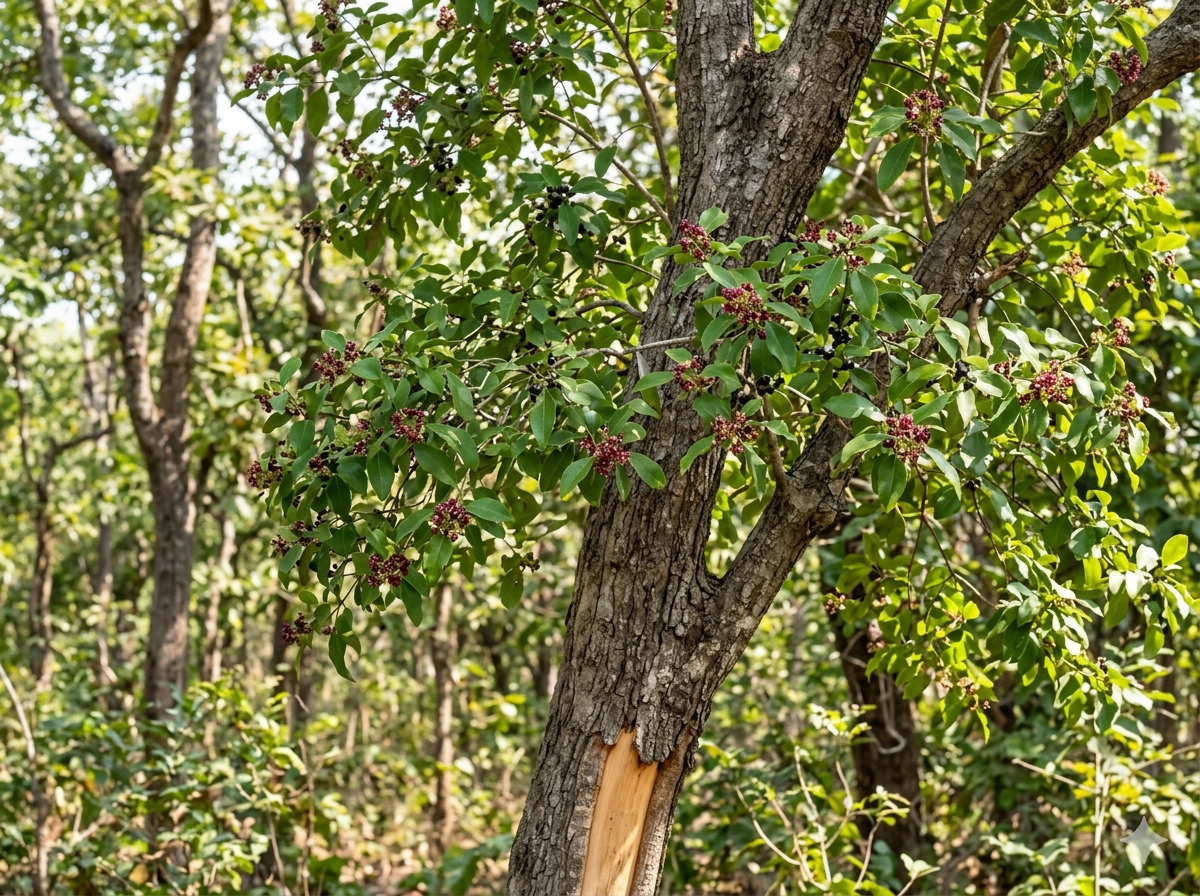
Sandalwood Chandan Tree India Karnataka Mysore — PlantCare
📷 PlantCare
🪵 Timber, Shade & Agroforestry Trees

Sandalwood / Chandan / White Sandalwood चंदन / सफेद चंदन / श्रीगंध

Santalum album Family: Santalaceae (Semi-parasitic hemi-parasite!)

Sandalwood / Chandan — world's most valuable tree (Rs.50,000-2L/litre oil!). Single mature tree = Rs.5-25 lakh. ⚠️ Karnataka: GOVT OWNS trees on private land. Hemi-parasitic: NEEDS HOST PLANTS. Mysore Sandalwood GI. Face pack + tilak traditional.

📏 4–10 metres | Small-medium tree | Semi-parasitic needs host plants ⏳ 100+ years | Commercial value Year 15-30 | Older = exponentially more valuable 📈 Slow-moderate | Semi-parasitic needs host companion plants always 📍 Deccan plateau — Karnataka, TN, AP, MH Marathwada. 500-1,000mm rainfall ideal. ✅ VERY COMPLEX: Karnataka State Tree — GOVT OWNS trees even on private land. TN, AP: similar restrictions. CHECK STATE LAWS BEFORE PLANTING. 💰 Heartwood: Rs.10,000–30,000/kg | Oil: Rs.50,000–2,00,000/litre | Single mature tree: Rs.5–25 lakh
📤 WhatsApp
Sandalwood Chandan Rs50000-2L Litre Oil World Valuable Karnataka Govt Owns Private Land Hemi-Parasitic Host Plants Essential Mysore GI Premium Single Tree Rs5-25L Cannot Be Synthesized

चंदन — दुनिया का most valuable tree (Rs.50,000-2L/litre oil!)। Single mature tree = Rs.5-25 lakh। ⚠️ Karnataka: private land पर भी GOVT OWNS। Hemi-parasitic: HOST PLANTS ESSENTIAL। Mysore GI। Face pack + tilak।

Sandalwood (Santalum album) — Chandan / White Sandalwood / Indian Sandalwood — is one of the world's most valuable trees per kilogram, producing the most prized natural fragrance in global perfumery and one of the most important materials in Ayurvedic medicine, Hindu and Buddhist ritual. Indian Sandalwood heartwood oil commands Rs.50,000-2,00,000 per litre in international markets — making it among the world's most expensive natural materials alongside saffron and gold. The tree is unique among economically important trees because its primary value comes from the heartwood — the inner dark wood that accumulates the precious sandalwood oil (santalols) over the tree's lifetime. The older the tree, the more heartwood, the more oil, the higher the value. A single mature sandalwood tree (25-30 years, 30+ cm diameter) can yield Rs.5-25 lakh worth of heartwood. The tree is native to peninsular India — Karnataka, Tamil Nadu, Andhra Pradesh — and was once found abundantly across the Deccan. It is now Karnataka's State Tree and one of India's most strictly protected trees. Sandalwood is a semi-parasitic plant — it is a hemi-parasite that attaches its roots to those of host plants and draws nutrients, which means cultivation requires companion plants. India's sandalwood industry is one of the oldest and most valuable in the world — sandalwood from Karnataka's Mysore region ("Mysore Sandalwood") is GI-protected and internationally recognized as the finest quality.

Sandalwood (Santalum album) — चंदन / White Sandalwood — दुनिया के most valuable trees per kilogram। Global perfumery में most prized natural fragrance + Ayurvedic medicine + Hindu-Buddhist ritual। Sandalwood heartwood oil: Rs.50,000-2,00,000/litre — world के most expensive natural materials में। Primary value: heartwood (inner dark wood) में precious sandalwood oil (santalols)। पेड़ जितना पुराना → ज़्यादा heartwood → ज़्यादा oil → ज़्यादा value। Single mature tree (25-30 yr): Rs.5-25 lakh। Karnataka, Tamil Nadu, AP — native। Karnataka का State Tree। India का most strictly protected tree। Semi-parasitic: hemi-parasite — host plant roots से nutrients draw। Mysore Sandalwood GI protected — internationally finest quality।

🌳 Overview & Quick Facts / परिचय और मुख्य तथ्य

🔬 Scientific NameSantalum album — Family: Santalaceae (Semi-parasitic!)
⚠️ CRITICALKarnataka State Tree — MOST STRICTLY PROTECTED tree in India. Even on private land: state govt owns the tree! Karnataka, TN, AP: private cultivation allowed but complex regulations.
📏 Height / ऊंचाई4–10 metres | Small-medium tree with spreading crown
Lifespan / आयु100+ years | Commercial harvest 15-30 years | Older = more valuable heartwood
🌸 Flowers / फूलMarch–May — small reddish-purple/cream clusters. Fragrant. / March-May — small fragrant reddish-purple
🌡️ Climate / जलवायुTropical dry — Deccan plateau primary. 500-1,000mm rainfall ideal. Karnataka, Tamil Nadu, AP, MH Marathwada.
⚖️ Legal Status / कानूनीVERY COMPLEX — Karnataka: State Tree, govt owns trees even on private land, cutting requires state permission + auction. TN, AP: similar restrictions. Check state-specific laws BEFORE planting.
💰 Heartwood Value / चंदन मूल्यHeartwood: Rs.10,000–30,000/kg | Oil: Rs.50,000–2,00,000/litre | Single mature tree: Rs.5–25 lakh

🌿 Parts & Their Uses — हर अंग का उपयोग

🪵
Heartwood / सारकाष्ठ (Chandan)
THE primary value — yellow to golden-brown inner wood. 3-6% essential oil content in mature heartwood. Uses: direct carving (sculptures, religious items, boxes), powder for paste (tilak, puja, cooling), essential oil distillation. Market: Rs.10,000-30,000/kg heartwood. Mysore Sandalwood GI certified: premium. Root heartwood: highest oil content of all plant parts.

Primary value — yellow to golden-brown inner wood। 3-6% essential oil mature heartwood में। Uses: direct carving (sculptures, religious, boxes), powder (tilak, puja, cooling), oil distillation। Market: Rs.10,000-30,000/kg। Mysore Sandalwood GI certified: premium। Root heartwood: highest oil content।
💧
Sandalwood Oil / चंदन तेल
Most valuable product — Rs.50,000-2,00,000/litre steam distilled from heartwood chips. Composition: α-santalol (45-55%), β-santalol (18-28%) — the primary fragrance compounds. Uses: high-end perfumery (Chanel, Dior use Indian sandalwood), cosmetics, aromatherapy, pharmaceutical, religious. Indian sandalwood oil legally sold internationally by Karnataka Soaps and Detergents Ltd (KSDL) — monopoly.

Most valuable — Rs.50,000-2,00,000/litre। α-santalol (45-55%), β-santalol (18-28%) — primary fragrance compounds। Uses: high-end perfumery (Chanel, Dior), cosmetics, aromatherapy, pharmaceutical, religious। KSDL (Karnataka) — international monopoly legally।
🟤
Sandalwood Powder / चंदन पाउडर
Ground heartwood powder — traditional face pack (cooling, anti-acne, brightening), tilak (Hindu puja forehead mark), religious paste, incense sticks base. Market: Rs.500-3,000/100g depending on purity. Mass-market "sandalwood powder" often mixed with inferior wood or synthetic fragrance. Pure Indian sandalwood powder = premium product. Anti-microbial and anti-inflammatory confirmed.

Ground heartwood — traditional face pack (cooling, anti-acne, brightening), tilak, religious paste, incense base। Market: Rs.500-3,000/100g depending on purity। Mass-market often mixed/synthetic। Pure Indian = premium। Anti-microbial, anti-inflammatory confirmed।
🍃
Leaves / पत्ते
Small oval leaves. Leaf extract: anti-inflammatory, mild anti-microbial. Traditional: leaf decoction for headache, skin disorders. Not commercially traded. Leaf essential oil: minor amounts, different composition from heartwood oil. Leaves used in traditional Ayurvedic formulations for skin conditions (anti-inflammatory + anti-bacterial combination).

Small oval leaves। Leaf extract: anti-inflammatory, mild anti-microbial। Traditional: headache, skin disorders। Commercially traded नहीं। Leaf essential oil: minor, different from heartwood। Ayurvedic formulations skin conditions में।
🌸
Flowers & Fruits / फूल और फल
Small reddish-purple fragrant flowers — honey source, traditional puja. Fruits: small drupes (1cm), red to purple-black when ripe. Seeds contain sandalwood seed oil (different from heartwood oil). Birds eat fruits — important seed dispersal. Fruit extract: mild anti-oxidant research. Not significantly traded.

Small reddish-purple fragrant — honey source, puja। Fruits: small drupes (1cm), red to purple-black। Seeds: sandalwood seed oil (heartwood oil से different)। Birds fruits खाते — seed dispersal। Fruit extract: mild anti-oxidant। Significantly traded नहीं।
🌱
Semi-Parasitism / अर्ध-परजीविता
Unique hemi-parasitic nature: sandalwood connects root haustoria to roots of host plants — drawing water and nutrients from hosts. NOT fully parasitic (has green leaves, does own photosynthesis). Host plants: required for survival. Best hosts: Casuarina, Pongamia (Karanj), Cassia, various legumes. Multiple hosts (3-5 different species) recommended in plantation.

Unique hemi-parasitic: sandalwood root haustoria → host plant roots connect — water + nutrients draw। NOT fully parasitic (green leaves, own photosynthesis)। Host plants: survival के लिए required। Best hosts: Casuarina, Pongamia (Karanj), Cassia, various legumes। Multiple hosts (3-5 species) plantation में recommended।

🌍 World's Most Valuable Timber & Legal Complexity / World's Most Valuable Timber और Legal Complexity

⚡ Key Facts / मुख्य तथ्य
💰 Most Valuable
Rs.50,000-2,00,000/litre oil. Single mature tree Rs.5-25 lakh. World's highest per-kg value tree.
Rs.50,000-2,00,000/litre oil। Single mature tree Rs.5-25 lakh। World का highest per-kg value tree।
⚠️ Govt Owns
Karnataka: government OWNS sandalwood trees even on private land. Cannot sell without state permission.
Karnataka: government private land पर भी sandalwood trees OWNS। State permission बिना sell नहीं।
🌱 Hemi-Parasite
Semi-parasitic — needs host plants to survive. Multiple companion species required in plantation.
Semi-parasitic — host plants needed। Multiple companion species plantation में required।
🏆 Mysore GI
Mysore Sandalwood — GI protected. World's finest quality. KSDL international monopoly exporter.
Mysore Sandalwood — GI protected। World's finest। KSDL international monopoly exporter।
⏳ Patience
15-30 years to develop heartwood. Older = more heartwood = more value. Long-term wealth creation.
15-30 years heartwood develop। Older = more heartwood = more value। Long-term wealth creation।
🔒 Strictly Protected
Karnataka State Tree. Most strictly protected tree in India. Severe penalties for illegal cutting.
Karnataka State Tree। India का most strictly protected tree। Illegal cutting = severe penalties।

🌱 Cultivation Guide / चंदन cultivation कैसे करें

ParameterEnglishHindi / हिंदी
⚖️ LEGAL FIRSTCHECK STATE LAWS before planting. Karnataka, TN, AP have complex regulations. Get written confirmation from DFO on private cultivation rules BEFORE planting.Plant करने से पहले STATE LAWS CHECK करें। Karnataka, TN, AP complex regulations। DFO से written confirmation BEFORE planting।
🌱 PropagationSeed (collect ripe dark purple fruits, remove pulp, sow immediately). Germination 30-60 days. Tissue culture saplings also available from IWST (Bengaluru) and state forest nurseries.Seeds (ripe dark purple fruits, pulp remove, immediately sow)। 30-60 days germination। IWST Bengaluru + state forest nurseries से tissue culture।
🌿 Host plantsESSENTIAL. Plant 3-5 host species around each sandalwood: Pongamia (Karanj), Casuarina, Cassia siamea, Acacia species, Tephrosia. Plant hosts 6 months before or simultaneously with sandalwood.ESSENTIAL। Each sandalwood के around 3-5 host species: Pongamia, Casuarina, Cassia siamea, Acacia, Tephrosia। Hosts 6 months पहले या simultaneously plant।
🌡️ ClimateDeccan plateau ideal — 500-1,000mm rainfall, rocky/red laterite soils, 18-35°C. Karnataka, TN, AP, Maharashtra Marathwada. NOT humid Western Ghats or very cold areas.Deccan plateau ideal — 500-1,000mm, rocky/red laterite, 18-35°C। Karnataka, TN, AP, MH Marathwada। Humid Western Ghats या cold: नहीं।
Heartwood timelineYear 1-10: sapwood only, minimal oil. Year 15: heartwood begins forming (5-10cm). Year 20-25: substantial heartwood (15-20cm). Year 30+: maximum value heartwood.Year 1-10: sapwood only, minimal oil। Year 15: heartwood begin (5-10cm)। Year 20-25: substantial (15-20cm)। Year 30+: maximum value।
💰 Harvest valueYear 20, 1 ha, 400 trees (if all survive): Rs.2-5 crore. Year 30: Rs.5-15 crore. Patience pays exponentially — 30-year-old tree worth 5-10x the 20-year-old tree.Year 20, 1 ha, 400 trees: Rs.2-5 crore। Year 30: Rs.5-15 crore। Patience exponentially pays — 30yr tree = 5-10x value of 20yr।

💰 Market Value & Legal Status / बाज़ार मूल्य और कानूनी स्थिति

Product / उत्पादValue / मूल्यLegal / कानूनी
🪵 Heartwood / सारकाष्ठRs.10,000–30,000/kg | GI certified Mysore: premiumKarnataka: state sells at auction — private cannot sell directly. TN, AP: state-controlled. Complex — check state rules.
💧 Sandalwood OilRs.50,000–2,00,000/litre | KSDL monopoly exportKSDL (Karnataka) primary legal exporter. Strict CITES regulations for international trade.
🟤 Powder / पाउडरRs.500–3,000/100g pure | Mass market Rs.50-200/100g mixedKSDL regulated. Pure Indian sandalwood powder: check authenticity.
🌱 Seedlings / पौधेRs.50–200/plant from certified nurseriesState forest nurseries. IWST Bengaluru. Check state cultivation rules before buying.
❓ Frequently Asked Questions / अक्सर पूछे जाने वाले सवाल
Sandalwood private cultivation — state-by-state legal reality: This is the most important question and the answer varies significantly by state. Karnataka (most complex): Karnataka has a specific law — the Karnataka Forest Act — under which sandalwood trees, even grown on private land by private citizens, belong to the state government. The farmer cannot sell the harvested wood directly. When trees are ready for harvest, the farmer must notify the Forest Department, trees are felled under Forest Dept supervision, and the wood is auctioned by the Forest Dept. The farmer receives a share (typically 70-80% of auction proceeds) but has no direct sale rights. Recent reform: Karnataka government has been working on reforms to make private cultivation more farmer-friendly — check current rules with DFO as these may have changed. Tamil Nadu: similar to Karnataka — state retains rights. TN has slightly more streamlined process for private cultivators. Check TN Forest Dept for current rules. Andhra Pradesh: AP allows private sandalwood cultivation with registration. AP State Forest Development Corporation assists. Telangana: similar to AP. Other states (MP, UP, Rajasthan): sandalwood is NOT native and not widely cultivated — but no specific state ownership law. In theory cultivable, but check local forest department rules. Recommendation: (1) BEFORE planting, visit your state DFO office and get written clarity on current cultivation rules. (2) Register the plantation with Forest Dept from the beginning. (3) Keep all documentation — land records, planting records, nursery receipts. (4) Join a sandalwood farmers' association in your state — they provide legal guidance and collective negotiation with Forest Dept. Despite legal complexity, private sandalwood cultivation IS happening successfully in Karnataka, TN and AP — the legal issues are manageable with proper documentation.

Private sandalwood cultivation — state-by-state: Karnataka (most complex): Karnataka Forest Act — private land का chandan भी STATE की property। Farmer directly sell नहीं कर सकता। Forest Dept supervision में fell → Forest Dept auction। Farmer को 70-80% auction proceeds। Reform work ongoing। Recent changes: current DFO से check। Tamil Nadu: similar — state retains rights। TN slightly streamlined। TN Forest Dept से current rules। Andhra Pradesh: private cultivation with registration allowed। AP State Forest Development Corporation assist। Telangana: similar AP। Other states (MP, UP, RJ): not native, no specific ownership law। Theory में cultivable — local FD rules check। Recommendation: (1) DFO visit, BEFORE planting written clarity। (2) Plantation register from beginning। (3) Documentation keep। (4) State sandalwood farmers' association join। Legal issues manageable with proper documentation।
Why sandalwood oil is so expensive — supply-demand-quality analysis: Price: Indian sandalwood oil (Santalum album oil) commands Rs.50,000-2,00,000/litre. This makes it one of the world's most expensive essential oils. Reasons: (1) Yield is extremely low: you need 100-150 kg of dried heartwood chips to produce 1 litre of oil by steam distillation. At Rs.10,000/kg heartwood, that's Rs.10-15 lakh in raw material for 1 litre of oil. (2) Age = quality: the highest quality oil comes from trees 30-60 years old with maximum heartwood. Young plantation trees produce lower quality oil with less santalol content. (3) Supply severely restricted: India's natural sandalwood forests are protected — no legal commercial harvest. Only plantation wood (limited) and Karnataka government auctions (strictly limited quantities). (4) Santalol cannot be synthesized: the primary fragrance compounds (α-santalol + β-santalol) cannot be perfectly replicated synthetically — synthetic substitutes (like Sandalore, Javanol) exist but lack the complexity and depth of natural Indian sandalwood. Perfumers specifically seek natural Santalum album. (5) Global demand: Indian sandalwood is considered the finest quality globally. French perfume houses (Chanel, Dior, Hermès) and global fragrance industry specifically want Santalum album. (6) Adulteration: given the price, adulteration is rampant. Much "sandalwood oil" sold commercially is heavily adulterated with synthetic substitutes, cheaper sandalwood species (Santalum spicatum from Australia), or other oils. Pure Santalum album oil is increasingly rare. The combination of minimal supply + irreplaceable quality + impossibility of synthesis + global demand = extraordinarily high prices that will likely only increase.

Why sandalwood oil expensive: Rs.50,000-2,00,000/litre — world's most expensive essential oils में। Reasons: (1) Low yield: 100-150 kg dried heartwood → 1 litre oil। Rs.10-15 lakh raw material per litre। (2) Age = quality: 30-60 year trees highest quality। Young plantation = lower santalol। (3) Supply restricted: natural forests protected। Only plantation + Karnataka government auctions। Limited। (4) Santalol cannot be synthesized: α-santalol + β-santalol synthetic substitutes (Sandalore, Javanol) exist but lack depth। Perfumers specifically seek natural। (5) Global demand: French perfume houses (Chanel, Dior, Hermès) specifically want Santalum album। (6) Adulteration: rampant। "Sandalwood oil" often — synthetic substitutes + cheaper Santalum spicatum (Australia) + other oils। Pure Santalum album increasingly rare। Minimal supply + irreplaceable quality + no synthesis + global demand = prices only increasing।
Sandalwood face pack — traditional and effective: Sandalwood (chandan) has been used in Indian skin care for 5,000+ years. Its primary properties for skin: anti-inflammatory, anti-microbial, astringent, cooling, anti-acne, complexion-brightening, UV-protective. Authentic vs adulterated: for face packs, use powder from a trusted source — much commercial sandalwood powder is adulterated. The pure powder should be pale yellow to golden cream color with the distinctive sandalwood fragrance. Red-colored "sandalwood powder" often contains other wood or red sandalwood (Pterocarpus santalinus — different tree). Classic recipes: (1) Basic anti-acne: sandalwood powder (1 tsp) + rose water (2 tsp) → thin paste. Apply on face 15-20 minutes. Rinse with cool water. (2) Cooling and brightening: sandalwood (1 tsp) + milk (1 tsp) + turmeric (pinch) → paste. Apply 15 minutes. Rinse. (3) Oily skin: sandalwood (1 tsp) + neem powder (1/2 tsp) + rose water → paste. Anti-acne, anti-sebum. (4) Dry skin: sandalwood (1 tsp) + aloe vera gel (1 tsp) + honey (1/4 tsp) → paste. Moisturizing. (5) Anti-aging: sandalwood + papaya pulp + honey → paste. Anti-oxidant combination. (6) Traditional bridal: sandalwood + turmeric + milk cream (malai) — applied for weeks before wedding for brightening. Frequency: 2-3 times weekly. Scientific basis: α-santalol (primary compound) confirmed anti-inflammatory (COX inhibitor), anti-microbial, and mild UV-absorbing properties. Research confirms improvement in acne and skin inflammation with regular use. Important: use pure sandalwood powder from authenticated source for best results.

Sandalwood face pack: 5,000+ years Indian skin care। Properties: anti-inflammatory, anti-microbial, astringent, cooling, anti-acne, brightening, UV-protective। Authentic: pale yellow to golden cream color + distinctive fragrance। Red = adulterated often। Recipes: (1) Basic anti-acne: 1 tsp powder + 2 tsp rose water। 15-20 min। (2) Cooling + brightening: + milk + turmeric pinch। (3) Oily skin: + neem powder + rose water। Anti-acne, anti-sebum। (4) Dry skin: + aloe vera + honey। (5) Anti-aging: + papaya pulp + honey। (6) Traditional bridal: + turmeric + malai। Weeks before wedding। 2-3x/week। Scientific: α-santalol — COX inhibitor anti-inflammatory, anti-microbial, mild UV-absorbing। Acne + skin inflammation improvement confirmed।
Sandalwood hemi-parasitism — how it works: Santalum album is one of the world's most famous hemi-parasites (half-parasites). Unlike true parasites that have no photosynthesis, sandalwood has green leaves and does its own photosynthesis — but supplements this by connecting to the roots of other plants (hosts) through specialized root structures called haustoria. Haustorium mechanism: the sandalwood root tip sends out a specialized structure (haustorium) that invades the root of a nearby host plant. The haustorium penetrates the host root's vascular tissue (xylem) and draws water and minerals directly from the host's water-conducting system. This gives sandalwood a significant supplementary supply of water and mineral nutrients beyond what it absorbs from soil directly. Why sandalwood needs hosts: in its natural Deccan habitat, sandalwood grows in nutrient-poor, drought-prone rocky soils where competition for water is intense. The hemi-parasitic strategy allows it to access water and nutrients from multiple sources simultaneously — its own roots in soil + multiple host plants' vascular systems. This competitive advantage allows sandalwood to survive and accumulate the expensive heartwood oils that other plants in the same conditions cannot. Host relationships: sandalwood is not host-specific — it can attach to many different plant species. Best hosts (those that support sandalwood growth most effectively): Pongamia pinnata (Karanj), Casuarina equisetifolia, Cassia siamea, various Acacia species, Tephrosia purpurea. Multiple hosts recommended: research shows sandalwood with 3-5 different host species in its vicinity grows better and produces more heartwood than sandalwood with only 1 host species. This is because different hosts provide complementary nutrients and the sandalwood can draw from the strongest host at any time.

Sandalwood hemi-parasitism: World's most famous hemi-parasites में। Green leaves + own photosynthesis (true parasite unlike) + host plant roots से supplement। Haustoria mechanism: sandalwood root tip → specialized haustorium → nearby host root penetrate → host root vascular tissue (xylem) में invade → water + minerals directly draw। Why: Deccan habitat = nutrient-poor, drought-prone, rocky। Hemi-parasitic strategy = multiple sources simultaneously: own soil roots + multiple host vascular systems। Heartwood oils accumulation possible। Host relationships: not host-specific। Best hosts: Pongamia pinnata (Karanj), Casuarina, Cassia siamea, Acacia species, Tephrosia। Multiple hosts (3-5 different species) = better growth + more heartwood। Different hosts = complementary nutrients + strongest host से draw any time।
Authentic vs fake sandalwood — identification guide: The high value of sandalwood makes adulteration extremely common. Being able to identify genuine sandalwood protects you from paying premium prices for inferior products. Genuine Indian Sandalwood (Santalum album) heartwood: Color: pale yellow to golden-brown. NOT deep red (that's Red Sandalwood = Pterocarpus santalinus, completely different tree with different uses). Fragrance: distinctive warm, woody, sweet, creamy-milky-smooth fragrance that is unmistakable. The fragrance should be: lasting (24+ hours on skin), smooth (not sharp or harsh), complex (not single-note). Weight: heavy for its size. Grain: fine, even grain. Surface: slight natural oil sheen — you can feel the waxy quality when you rub the wood. Common fakes and substitutes: (1) Pterocarpus santalinus (Red Sandalwood/Lal Chandan): reddish-brown, sharp medicinal fragrance, very different from true sandalwood. Used for red tilak paste in South India. Different medicinal properties. (2) Santalum spicatum (Australian sandalwood): lower quality, different fragrance profile, much cheaper. Legally sold but inferior. (3) Santalum austrocaledonicum (Pacific sandalwood): similar but different. (4) Synthetic fragrance + cheap wood: no natural oiliness, fragrance is sharp and fades quickly (hours not days). Testing: (1) Rub a small piece on your wrist — genuine sandalwood should leave a lasting warm fragrance for 12-24+ hours. (2) Drop water on a cut surface — genuine heartwood is hydrophobic (oil repels water — water beads up). (3) Feel the surface — genuine heartwood has a smooth, slightly waxy feel. For oil: genuine α-santalol heavy oil (thick, viscous). Synthetic substitutes are thinner and have sharper, less complex fragrance.

Authentic vs fake sandalwood: Genuine Santalum album heartwood: Color: pale yellow to golden-brown। NOT deep red (Red Sandalwood = Pterocarpus santalinus — different tree)। Fragrance: warm, woody, sweet, creamy-milky-smooth — unmistakable। Lasting (24+ hours skin)। Smooth, complex। Weight: heavy। Fine even grain। Natural oil sheen। Common fakes: (1) Pterocarpus santalinus (Red Sandalwood): reddish-brown, sharp medicinal fragrance। South India red tilak। Different। (2) Santalum spicatum (Australian): lower quality, cheaper, different profile। (3) Pacific sandalwood। (4) Synthetic + cheap wood: no oiliness, fragrance hours fade। Testing: (1) Wrist rub — 12-24+ hours lasting genuine। (2) Water drop: hydrophobic (beads up) genuine। (3) Surface feel: smooth, slightly waxy। Oil: genuine = thick, viscous α-santalol। Synthetic = thinner, sharper, less complex।
⚠️
AI-Assisted Content — Please Read
AI-सहायता से बनाई गई सामग्री — कृपया पढ़ें

All tools, plant encyclopedias, edible growing guides and blog content on PlantCare are created with the assistance of AI (Artificial Intelligence) and are intended for general informational and educational purposes only. While we strive for accuracy, the information provided may not be complete, current or suitable for every situation, region or individual plant variety.

For health, medical or serious agricultural decisions — always consult a qualified horticulturist, agronomist, Ayurvedic practitioner, medical professional or relevant expert. PlantCare does not take responsibility for outcomes arising from use of this information. Identification results from AI tools (plant identifier, pest identifier etc.) should be verified before taking any action.

इस वेबसाइट पर सभी tools, plant encyclopedias, edible guides और blog content AI (Artificial Intelligence) की सहायता से बनाए गए हैं और केवल सामान्य जानकारी और शिक्षा के उद्देश्य से हैं। स्वास्थ्य, चिकित्सा या गंभीर कृषि निर्णयों के लिए कृपया किसी योग्य विशेषज्ञ से संपर्क करें। PlantCare इस जानकारी के उपयोग से होने वाले परिणामों के लिए जिम्मेदार नहीं है।