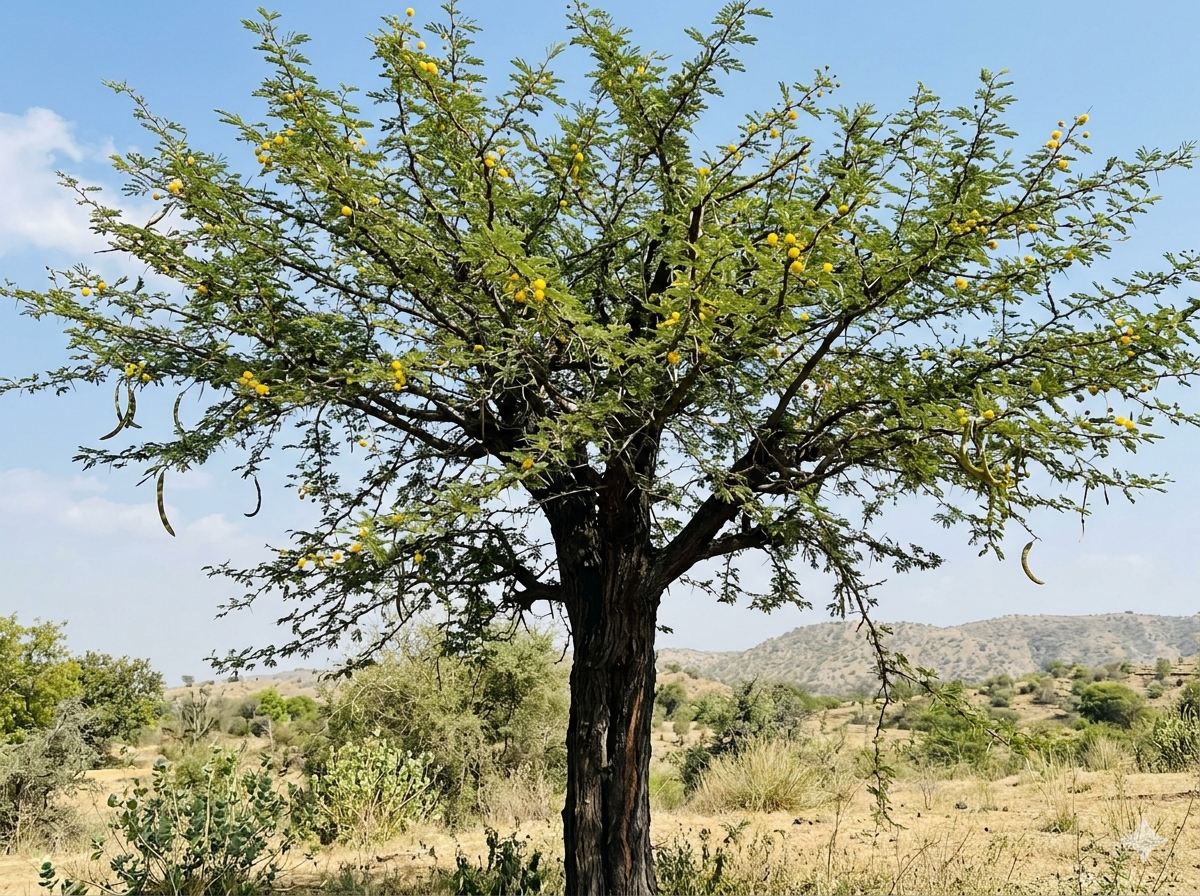
Kikar Babool Acacia nilotica Gum Arabic India Rajasthan — PlantCare
📷 PlantCare
🪵 Timber, Shade & Agroforestry Trees

Kikar / Babool / Indian Gum Arabic Tree कीकर / बबूल / देसी बबूल

Acacia nilotica (syn. Vachellia nilotica) Family: Fabaceae (N-fixing legume)

Kikar / Babool — India's gum arabic tree (Rs.40-120/kg E414 food emulsifier). BEST commercial honey tree — Babool honey India's most exported single-source. Traditional dental toothbrush (datun). Rajasthan drought champion. ⚠️ Golden pompom = Kikar (native). Cream spike = Vilayati Babool (invasive eradicate!).

📏 5–15 metres | Thorny spreading | Paired white spines distinctive ⏳ 50–150 years 📈 Moderate — 1.5–2.5 ft/year | Drought tolerant — grows where little else survives 📍 Pan-India dry. Rajasthan, UP, Punjab, MP, AP primary. Extreme drought tolerance. ⚠️ Native. Not protected. Freely managed. Transit permit timber movement. 💰 Rs.600–1,200/cubic foot | Rs.2,500-4,000/tonne fuelwood | Very hard dense
📤 WhatsApp
Kikar Babool Indian Gum Arabic E414 Rs40-120 India Best Commercial Honey Babool Traditional Dental Datun Toothbrush 18-20% Tannin Most Astringent Rajasthan Drought Champion Arid Golden Pompom Native vs Cream Spike Invasive

कीकर — India का gum arabic tree (Rs.40-120/kg E414)। BEST commercial honey — Babool honey India का most exported single-source। Traditional dental toothbrush (datun)। Rajasthan drought champion। ⚠️ Golden pompom = Kikar (native)। Cream spike = Vilayati Babool (invasive eradicate!)।

Kikar (Acacia nilotica) — Kikar / Babool / Indian Gum Arabic Tree / Prickly Acacia / Desi Babool — is one of India's most widespread and utilitarian native trees, found across the dry plains, agricultural boundaries and riverbanks of North India from Punjab to Tamil Nadu. The Kikar is perhaps India's most thorny and drought-resistant native tree — its sharp paired spines make impenetrable living fences, its pods are excellent cattle fodder, its gum (Indian gum arabic) is commercially traded for food and pharmaceutical applications, its bark is one of the most astringent and medicinally important in Ayurveda, its wood is one of the hardest and most durable for agricultural implements, and its flowers produce exceptional honey during the critical February-April pre-monsoon period. In Rajasthan and other arid zones, Kikar is the most important tree of the agricultural landscape — providing shade, fodder, gum income, fuelwood, and boundary protection simultaneously on the most marginal soils where almost nothing else grows. The tree is also ecologically controversial in some contexts — it has naturalized aggressively in some ecosystems and can displace native vegetation in drylands. However, in its native North Indian range, Kikar is a deeply integrated part of the agricultural ecosystem that has been managed by farmers for millennia.

Kikar (Acacia nilotica) — कीकर / बबूल / Desi Babool — India के most widespread + utilitarian native trees में। Punjab से Tamil Nadu तक dry plains, agricultural boundaries, riverbanks। India का most thorny + drought-resistant native tree। Uses: sharp spines = impenetrable living fences, pods = cattle fodder, gum = Indian gum arabic (food + pharmaceutical), bark = Ayurveda में most astringent medicinal, wood = hardest agricultural implements, flowers = exceptional honey Feb-April। Rajasthan + arid zones में most important agricultural tree — marginal soils पर shade + fodder + gum + fuelwood + boundary protection। Ecologically controversial कुछ contexts में — लेकिन native North Indian range में millennia से agricultural ecosystem में deeply integrated।

🌳 Overview & Quick Facts / परिचय और मुख्य तथ्य

🔬 Scientific NameAcacia nilotica (syn. Vachellia nilotica) — Family: Fabaceae (N-fixing legume)
📏 Height / ऊंचाई5–15 metres | Thorny spreading crown | Paired white spines distinctive
Lifespan / आयु50–150 years / 50-150 वर्ष
📈 Growth Rate / वृद्धि दरModerate — 1.5–2.5 ft/year | Drought tolerant — grows where little else survives
🌸 Flowers / फूलFeb–April — bright golden-yellow pompoms. EXCEPTIONAL honey! / Feb-April — golden pompoms। Exceptional honey!
🌡️ Climate / जलवायुTropical dry to semi-arid. Pan-India. Rajasthan, UP, Punjab, MP, AP primary. Extreme drought tolerance.
⚖️ Legal Status / कानूनीNative. Not protected. Freely managed. Some states list as invasive in specific ecosystems. Transit permit for timber movement.
💰 Value / मूल्यGum (Indian gum arabic): Rs.40–120/kg | Bark: Rs.10-20/kg | Honey: Rs.350-600/kg | Fuelwood: Rs.2,500-4,000/tonne

🌿 Parts & Their Uses — हर अंग का उपयोग

💧
Gum / गोंद (Indian Gum Arabic)
Exudate from bark wounds/natural cracks. Indian gum arabic (same category as Acacia senegal African gum arabic). Food industry: emulsifier, stabilizer in candies, soft drinks (E414). Pharmaceutical: tablet binder, coating. Textile: fabric sizing. Cosmetics: hair gel base. Market: Rs.40-120/kg — cleaned grade higher. One mature tree: 1-2 kg gum/year naturally, 3-5 kg with tapping.

Bark wounds/cracks से exudate। Indian gum arabic (Acacia senegal African जैसी category)। Food: emulsifier, stabilizer candies, soft drinks (E414)। Pharmaceutical: tablet binder, coating। Textile: fabric sizing। Cosmetics: hair gel। Market: Rs.40-120/kg। One mature tree: natural 1-2 kg, tapping से 3-5 kg/year।
🟫
Bark / छाल (Ayurvedic Astringent)
One of India's most astringent barks — 18-20% tannin. Ayurvedic: anti-diarrheal, anti-dysenteric, anti-hemorrhagic, wound healing, gonorrhoea, leucorrhoea. Contains tannins, gallic acid, catechins. Traditional dentistry: bark chewed for gum disease, tooth strengthening. Market: Rs.10-20/kg. Important MFP in Rajasthan, MP tribal communities.

India के most astringent barks — 18-20% tannin। Ayurvedic: anti-diarrheal, anti-dysenteric, anti-hemorrhagic, wound healing, gonorrhoea, leucorrhoea। Tannins, gallic acid, catechins। Traditional dentistry: gum disease, tooth strengthening। Market: Rs.10-20/kg। Rajasthan, MP tribal MFP।
🌸
Flowers / फूल (Premium Honey)
Bright golden-yellow pompom flowers (Feb-April) — EXCEPTIONAL honey source. Kikar/Babool honey: India's most commercially important single-source honey — light golden color, mild sweet flavor, high demand in export market. Bees visit Kikar flowers intensively. Market: Rs.350-600/kg Kikar honey. Major honey belt: Rajasthan, Punjab, Haryana Kikar forests.

Bright golden-yellow pompom (Feb-April) — EXCEPTIONAL honey source। Kikar/Babool honey: India का most commercially important single-source honey — light golden, mild sweet, high export demand। Bees intensively। Market: Rs.350-600/kg। Major honey belt: Rajasthan, Punjab, Haryana Kikar forests।
🫘
Pods / फलियां (Fodder)
Long straight pods (10-20cm) with seeds — excellent cattle and goat fodder. Nutritious: 12-15% protein, good digestibility. Fallen pods collected from under trees — free fodder resource. Traditional: pods ground into flour as famine food. Seeds also edible when roasted (nutty flavor). N-fixing root bacteria improve soil where Kikar grows. Market: Rs.5-10/kg pods.

Long straight pods (10-20cm) — excellent cattle + goat fodder। 12-15% protein, good digestibility। Fallen pods free fodder। Traditional: pods flour as famine food। Seeds roasted edible (nutty)। N-fixing roots soil improve। Market: Rs.5-10/kg।
🌵
Thorns / कांटे (Living Fence)
Sharp paired white spines (2-8cm) — among India's most effective natural fencing material. Kikar hedge: impenetrable to cattle, goats, even camels. Used for centuries as field boundary protection in North India. Living fence planting: 50cm apart single row. Effective protection in 3-4 years. Free — no recurring cost unlike barbed wire. N-fixing soil improvement bonus.

Sharp paired white spines (2-8cm) — India's most effective natural fencing। Kikar hedge: cattle, goats, camels को impenetrable। Centuries से North India field boundary। 50cm apart single row। 3-4 years effective। Free — barbed wire unlike no recurring cost। N-fixing bonus।
🪵
Wood / लकड़ी
Extremely hard, heavy, durable — one of North India's hardest woods. Traditional: agricultural implements (ploughs, yokes), well-curbs, furniture, fuel. Very high calorific fuelwood. Charcoal: excellent quality. Market: Rs.600-1,200/cubic foot timber, Rs.2,500-4,000/tonne fuelwood. FD transit permit. Roots: can be invasive near structures — manage distance.

Extremely hard, heavy, durable — North India के hardest woods में। Agricultural implements (ploughs, yokes), well-curbs, furniture। Very high calorific fuelwood। Excellent charcoal। Market: Rs.600-1,200/cubic foot timber। Rs.2,500-4,000/tonne fuelwood। Roots: structures के near invasive।

🌍 India's Gum Arabic & Arid Zone Lifeline / India's Gum Arabic और Arid Zone Lifeline

⚡ Key Facts / मुख्य तथ्य
💧 Gum Arabic
Indian gum arabic — food E414, pharmaceutical tablet binder. Rs.40-120/kg. One mature tree 1-5 kg/year.
Indian gum arabic — food E414, pharmaceutical tablet binder। Rs.40-120/kg। One tree 1-5 kg/year।
🍯 Best Honey
Kikar/Babool honey = India's most commercially important single-source honey. Export demand high.
Kikar/Babool honey = India का most commercially important single-source honey। Export demand high।
🌵 Impenetrable Fence
Sharp paired spines — centuries-old North India field boundary. Free, effective, N-fixing.
Sharp paired spines — centuries-old North India field boundary। Free, effective, N-fixing।
🏜️ Drought King
Survives Rajasthan droughts where almost nothing else grows. Critical arid zone livelihood tree.
Rajasthan droughts में survives — almost nothing else grows। Critical arid zone livelihood।
🦷 Dental
Traditional dentistry — bark chewed for gum disease, tooth strengthening. Classic desi toothbrush.
Traditional dentistry — bark chewed, gum disease, tooth strengthening। Classic desi toothbrush।
🌿 N-Fixing
Legume N-fixing root bacteria — improves marginal soils. 50-80 kg N/ha/year.
Legume N-fixing — marginal soils improve। 50-80 kg N/ha/year।

🌱 Growing Guide / कीकर कैसे उगाएं

ParameterEnglishHindi / हिंदी
🌱 PropagationSeeds from dry pods (easy, 80%+). Nick seed coat or hot water soak 5 min. Germination 7-15 days. Direct sowing in field works well.Dry pods से seeds (80%+)। Seed coat nick या hot water 5 min। 7-15 days germination। Field में direct sowing well।
🌡️ Climate + SoilExtremely adaptable — dry sandy to black cotton soil. pH 5.5-9.5. Extreme drought tolerant. Saline-alkaline tolerant. The dryer the better — less competition from other species.Extremely adaptable — dry sandy से black cotton। pH 5.5-9.5। Extreme drought। Saline-alkaline tolerant। Dryer = better (less competition)।
💧 Gum tappingNatural gum exudes from bark wounds. Tapping: make 5-8 shallow incisions in bark (not deep — just through outer bark). Collect exudate every 3-4 weeks during dry season (Oct-March). Rest tree in monsoon.Natural wounds से gum exude। Tapping: 5-8 shallow bark incisions (not deep)। Every 3-4 weeks dry season (Oct-March) collect। Monsoon में tree rest।
🌵 Fence systemPlant 50cm apart single line for living fence. Initial wiring for first 2 years to guide growth. After 3-4 years: no cattle can penetrate. Annual trimming maintains height.50cm apart single line। First 2 years initial wiring guide। 3-4 years: cattle penetrate नहीं। Annual trimming height maintain।
💰 Income modelPer tree/year: Gum Rs.100-200 + Honey contribution Rs.50 + Pods Rs.30 + Fuelwood pruning Rs.50 = Rs.230-330/tree. 200 boundary trees = Rs.46,000-66,000/year from boundary alone.Per tree/year: Gum Rs.100-200 + Honey Rs.50 + Pods Rs.30 + Fuelwood Rs.50 = Rs.230-330/tree। 200 boundary trees = Rs.46,000-66,000/year।
⚠️ ManagementManage near crops — roots can be aggressive. Don't plant within 5m of irrigation channels. Control seedling regeneration to prevent unwanted spread in fields.Crops के near manage। Irrigation channels से 5m के within plant नहीं। Field में unwanted seedling regeneration control।

💰 Market Value & Legal Status / बाज़ार मूल्य और कानूनी स्थिति

Product / उत्पादValue / मूल्यLegal / कानूनी
💧 Gum (gum arabic)Rs.40–120/kg | Food + pharma grade higherFreely collected own trees. Forest: FRA 2006 tribal. Some states regulate collection.
🍯 Honey / शहदRs.350–600/kg Kikar/Babool premiumFreely traded / freely
🟫 Bark / छालRs.10–20/kg MFP Ayurvedic tanningOwn trees sustainably. Forest: FRA 2006.
🪵 Fuelwood + TimberRs.2,500–4,000/tonne fuelwood | Rs.600-1,200/cubic ft timberTransit permit. Own trees: farmer manages.
❓ Frequently Asked Questions / अक्सर पूछे जाने वाले सवाल
Kikar gum arabic collection — complete guide: Acacia nilotica produces gum arabic (Indian gum arabic) naturally from wounds and cracks in the bark, particularly during the dry season (October to March). The gum appears as amber-colored, glassy, hard nodules on the bark surface. Natural collection: simply walk under trees and pick up naturally fallen gum nodules from the ground, or scrape them off the bark where they have accumulated. No damage to tree. Tapping for higher yield: make 5-8 shallow incisions in the bark using a sharp knife — cut only through the outer bark (do not cut into the wood). Each incision 5-10cm long. The tree responds by producing more gum from the wound as a defense reaction. Check every 3-4 weeks and collect the hardened gum. Rest the tree for 3-4 months after tapping before tapping again. Avoid tapping during monsoon — wounds get infected. Cleaning: collected gum often has bark fragments and dirt. Clean by dissolving in warm water, filtering through cloth, then re-drying. Cleaned grade: Rs.80-120/kg vs uncleaned Rs.40-60/kg. Market: sell to local spice/herb traders, Rajasthan and Haryana gum traders are primary buyers. Online market developing (Indiamart). Uses: food emulsifier E414, pharmaceutical tablet binder, textile sizing. Sustainable tapping: maximum 25-30% of bark circumference per tapping session. Allow recovery time. Healthy trees produce more gum — well-managed trees outperform neglected ones.

Kikar gum collection: October-March dry season। Amber-colored glassy hard nodules on bark। Natural: fallen nodules collect + bark से scrape। No tree damage। Tapping higher yield: 5-8 shallow bark incisions (outer bark only — wood नहीं)। 5-10cm each। 3-4 weeks check + collect hardened gum। 3-4 months rest before re-tapping। Monsoon: wound infection — avoid। Cleaning: warm water dissolve + cloth filter + re-dry। Cleaned: Rs.80-120/kg vs uncleaned Rs.40-60/kg। Market: local spice/herb traders, Rajasthan + Haryana gum traders। Indiamart online। Uses: food E414, pharma tablet binder, textile sizing। Sustainable: max 25-30% bark circumference/session। Recovery time। Healthy trees = more gum।
Babool/Kikar honey — why India's premier commercial honey: Babool honey (from Acacia nilotica flowers) is India's most exported and commercially recognized single-source honey, and holds a special place in both domestic and international markets. Characteristics: color: light golden to water-white (almost colorless) — one of the lightest-colored honeys available. This light color is highly prized in international honey markets where lighter color = higher premium. Flavor: mild, clean, sweet with very subtle floral notes — not overpowering. This mildness makes it versatile for cooking, beverages, and direct consumption without competing with food flavors. Crystallization: Babool honey crystallizes very slowly (high fructose to glucose ratio) — it stays liquid for months to years. This is a major commercial advantage as many consumers dislike crystallized honey. Anti-bacterial: confirmed high anti-bacterial activity compared to many other honey varieties. Lower water activity + high hydrogen peroxide production. Export market: Babool honey is specifically named and sought by European and Middle Eastern buyers. India's Rajasthan and Punjab Babool honey has GI potential and is promoted by APEDA as a premium Indian export. Collecting season: beekeepers migrate their hives to follow Kikar bloom across Rajasthan → Punjab → HP (February to April). This migratory beekeeping is a traditional occupation of dedicated honey-farming communities in North India. Income: 200 hive-boxes following Kikar bloom: 3-5 kg honey/box/season × 200 boxes × Rs.450/kg = Rs.2.7-4.5 lakh/season from Kikar alone. Authenticity: many Indian honeys labeled "Babool" are blends. True single-source Babool from verified apiaries commands premium — lighter color and slow crystallization are key authenticators.

Babool/Kikar honey — India's premier: Most exported + commercially recognized single-source honey। Characteristics: light golden to water-white color — international markets lightest color = highest premium। Flavor: mild, clean, sweet, very subtle floral — versatile। Crystallization: very slow (high fructose ratio) — months to years liquid stays। Major commercial advantage। Anti-bacterial: high confirmed। Export: European + Middle Eastern buyers specifically named। APEDA premium promotion। Rajasthan + Punjab GI potential। Collecting season: beekeepers migrate Rajasthan → Punjab → HP (Feb-April)। Migratory beekeeping traditional occupation। Income: 200 hive-boxes × 3-5 kg × Rs.450 = Rs.2.7-4.5 lakh/season। Authenticity: many blends "Babool" labeled। True single-source: lighter color + slow crystallization = key authenticators।
Kikar bark for dental health — traditional and scientific: Acacia nilotica bark has been used as traditional dental medicine across North India, Pakistan, and Africa for millennia. The bark twig is the original "desi toothbrush" (datun) — chewed on one end to create a brush, then used to clean teeth. Scientific basis: bark contains 18-20% tannins (gallic acid, ellagic acid, catechins). These tannins: inhibit Streptococcus mutans and other oral bacteria responsible for tooth decay and gum disease. Reduce gingival inflammation. Strengthen gum tissue through astringent action. Research: multiple studies from Indian dental research institutions confirm anti-bacterial effect against oral pathogens. Some studies show Kikar bark extract as effective as chlorhexidine (standard dental anti-bacterial) against specific bacteria. Applications: (1) Datun (chewing stick): fresh Kikar twig 15-20cm. Chew one end until fibrous brush forms. Use as toothbrush — gentle circular motion. Spit. Rinse. The tannins + mild abrasive fibers clean + protect simultaneously. (2) Bark decoction mouthwash: 10g dried bark + 300ml water, boil to 200ml, cool. Gargle and swish for 1-2 minutes, spit. Twice daily. For gum disease, bleeding gums, mouth ulcers. (3) Bark powder: mix with coconut oil to paste, apply to gums for 5 minutes, rinse. Anti-gingivitis application. (4) Gum strengthening: regular bark datun use documented to reduce gum bleeding and sensitivity over 4-6 weeks. Caution: if you have very sensitive teeth, the tannins' astringency may cause temporary discomfort initially. Reduce frequency (every other day) until accustomed. Not a replacement for regular dental check-ups for active dental problems.

Kikar bark dental: North India, Pakistan, Africa में millennia से traditional dental medicine। Original "desi toothbrush" (datun) — chewed end = brush। Scientific: 18-20% tannins (gallic acid, ellagic acid, catechins)। Streptococcus mutans + oral bacteria inhibit। Gingival inflammation reduce। Gum tissue strengthen। Research: Indian dental institutions = chlorhexidine comparable specific bacteria। Applications: (1) Datun: fresh twig 15-20cm। One end chew → fibrous brush। Circular motion। Tannins + mild abrasive = clean + protect। (2) Mouthwash: 10g + 300ml → 200ml। Gargle 1-2 min 2x daily। Gum disease, bleeding gums। (3) Bark powder + coconut oil paste → gums 5 min। Anti-gingivitis। (4) Regular datun → 4-6 weeks gum bleeding + sensitivity reduce। Caution: sensitive teeth में initially astringency discomfort। Every other day start। Active dental problems: dental check-up replace नहीं।
Kikar in Rajasthan — the arid zone champion: Rajasthan is India's most arid state — 60% desert (Thar Desert), average rainfall 100-400mm, extreme temperature range (-2°C to 48°C), poor sandy soils, high evapotranspiration. In this challenging environment, Kikar (Acacia nilotica) is the single most important multipurpose tree, providing services that no other tree can reliably provide. Why Kikar thrives where others fail: (1) Deep taproot: Kikar develops a taproot 10-20m deep in Rajasthan's hard pan soils — accessing deep groundwater unreachable by other plants. (2) CAM-like drought response: dramatically reduces transpiration during drought by closing stomata and shedding leaves. (3) Nitrogen-fixing: even in poor sandy soils, Kikar maintains growth through its own N-fixation — doesn't depend on soil fertility. (4) Salt tolerance: tolerates the saline-alkaline conditions common in Rajasthan's arid plains. Services in Rajasthan: (1) Fodder for sheep and camels during drought — pods and leaves are critical livestock survival feed when grass fails completely. (2) Gum arabic: Rs.40-120/kg — significant income from marginal land. (3) Kikar honey: migratory beekeepers bring hives to Rajasthan Kikar forests every February — one of India's primary Babool honey zones. (4) Fuelwood: in areas where wood is scarce, Kikar provides dense hardwood fuel. (5) Shade: in desert conditions, Kikar shade measurably reduces animal heat stress and increases crop microclimate temperature by 5-8°C reduction. Cultural importance: Bishnoi community (famous for tree protection) specifically protects Kikar trees along with other native trees. Khejri (Prosopis cineraria) is more sacred, but Kikar is more widely found. The two together define Rajasthan's cultural landscape.

Kikar Rajasthan: 60% desert, 100-400mm rainfall, -2 to 48°C, poor sandy soils। Most important multipurpose tree। Why thrives: (1) Deep taproot 10-20m — hard pan soils groundwater access। (2) Drought response: stomata close + leaves shed। (3) N-fixing poor soils में। (4) Salt tolerance saline-alkaline। Services: (1) Sheep + camel fodder drought में — livestock survival critical। (2) Gum arabic Rs.40-120/kg। (3) Kikar honey: migratory beekeepers February। India's primary Babool honey zone। (4) Fuelwood scarce areas। (5) Shade: 5-8°C microclimate reduce। Cultural: Bishnoi community specifically protect। Khejri (more sacred) + Kikar (more widespread) = Rajasthan's cultural landscape।
Kikar (Desi Babool) vs Vilayati Babool (Prosopis juliflora) — the crucial distinction: These two thorny trees are both called "Babool" in common usage across North India and Rajasthan, leading to significant confusion. They are completely different species with different properties, origins, and ecological impacts. Kikar / Desi Babool (Acacia nilotica): Native to India and Africa. Paired white spines (straight, 2-8cm). Leaves: bipinnate, feathery — more finely divided. Flowers: bright golden-yellow pompoms. Pods: straight, long (10-20cm), slightly constricted between seeds. Ecology: native, ecologically integrated, manageable. Not listed as highly invasive in India's native range. Gum: produces good quality gum arabic. Medicinal: excellent bark medicine, highly regarded in Ayurveda. Vilayati Babool / Ganda Babool (Prosopis juliflora): Introduced from Mexico/Central America — colonial era. NOT native. Spines: single or paired, shorter, sometimes curved. Leaves: bipinnate but different leaflet pattern. Flowers: cream-yellow cylindrical spikes (very different from Kikar's pompoms). Pods: yellowish, elongated, straight with visible seeds. Ecology: HIGHLY INVASIVE in India — declared invasive pest species by many Indian states. Spreads aggressively in dry ecosystems, displaces native vegetation. Gum: different composition, lower quality gum arabic. Medicinal: minimal Indian traditional use, some alkaloids (pipecolinic acid) potentially toxic in large quantities. Simple identification: golden pompom flowers = Kikar (Desi Babool, Acacia nilotica). Cream cylindrical spike flowers = Vilayati Babool (Prosopis juliflora). Pod shape also confirms: long narrow slightly beaded = Kikar. Shorter yellowish flat = Prosopis. This distinction matters: Kikar management is beneficial. Prosopis juliflora management requires eradication in many ecosystems.

Kikar vs Vilayati Babool: Both "Babool" — completely different। Kikar (Desi Babool, Acacia nilotica): Native India + Africa। Paired white straight spines (2-8cm)। Leaves: bipinnate feathery। Flowers: BRIGHT GOLDEN-YELLOW POMPOMS। Pods: straight long (10-20cm), slightly constricted। Ecology: native, ecologically integrated, manageable। Gum: good quality arabic। Medicinal: excellent bark, highly Ayurvedic regarded। Vilayati Babool (Prosopis juliflora): Mexico/Central America introduced। NOT native। Spines: shorter sometimes curved। Flowers: CREAM-YELLOW CYLINDRICAL SPIKES (pompoms नहीं!)। Pods: yellowish elongated flat। Ecology: HIGHLY INVASIVE — many states invasive pest। Dry ecosystems displace। Gum: different, lower quality। Medicinal: minimal Indian traditional। Simple ID: GOLDEN POMPOM = Kikar। CREAM CYLINDRICAL SPIKE = Vilayati Babool (Prosopis)। Pod: long narrow beaded = Kikar। Shorter yellowish flat = Prosopis। Kikar management = beneficial। Prosopis management = eradication many ecosystems।
⚠️
AI-Assisted Content — Please Read
AI-सहायता से बनाई गई सामग्री — कृपया पढ़ें

All tools, plant encyclopedias, edible growing guides and blog content on PlantCare are created with the assistance of AI (Artificial Intelligence) and are intended for general informational and educational purposes only. While we strive for accuracy, the information provided may not be complete, current or suitable for every situation, region or individual plant variety.

For health, medical or serious agricultural decisions — always consult a qualified horticulturist, agronomist, Ayurvedic practitioner, medical professional or relevant expert. PlantCare does not take responsibility for outcomes arising from use of this information. Identification results from AI tools (plant identifier, pest identifier etc.) should be verified before taking any action.

इस वेबसाइट पर सभी tools, plant encyclopedias, edible guides और blog content AI (Artificial Intelligence) की सहायता से बनाए गए हैं और केवल सामान्य जानकारी और शिक्षा के उद्देश्य से हैं। स्वास्थ्य, चिकित्सा या गंभीर कृषि निर्णयों के लिए कृपया किसी योग्य विशेषज्ञ से संपर्क करें। PlantCare इस जानकारी के उपयोग से होने वाले परिणामों के लिए जिम्मेदार नहीं है।