Khejri Jand Shami Prosopis cineraria Rajasthan Desert Tree — PlantCare
📷 PlantCare
🪵 Timber, Shade & Agroforestry Trees

Khejri / Jand / Shami / Ghaf खेजड़ी / जांड / शमी / जंड

Prosopis cineraria Family: Fabaceae (N-fixing legume)

Khejri / Jand — Rajasthan's sacred State Tree (363 Bishnoi lives sacrificed to protect!). Sangri pods Rs.200-600/kg — Rajasthan's most iconic cuisine. UAE National Tree "Ghaf" (same species!). Sacred Shami Dussehra fire. 30-40m deep roots reach Thar Desert groundwater.

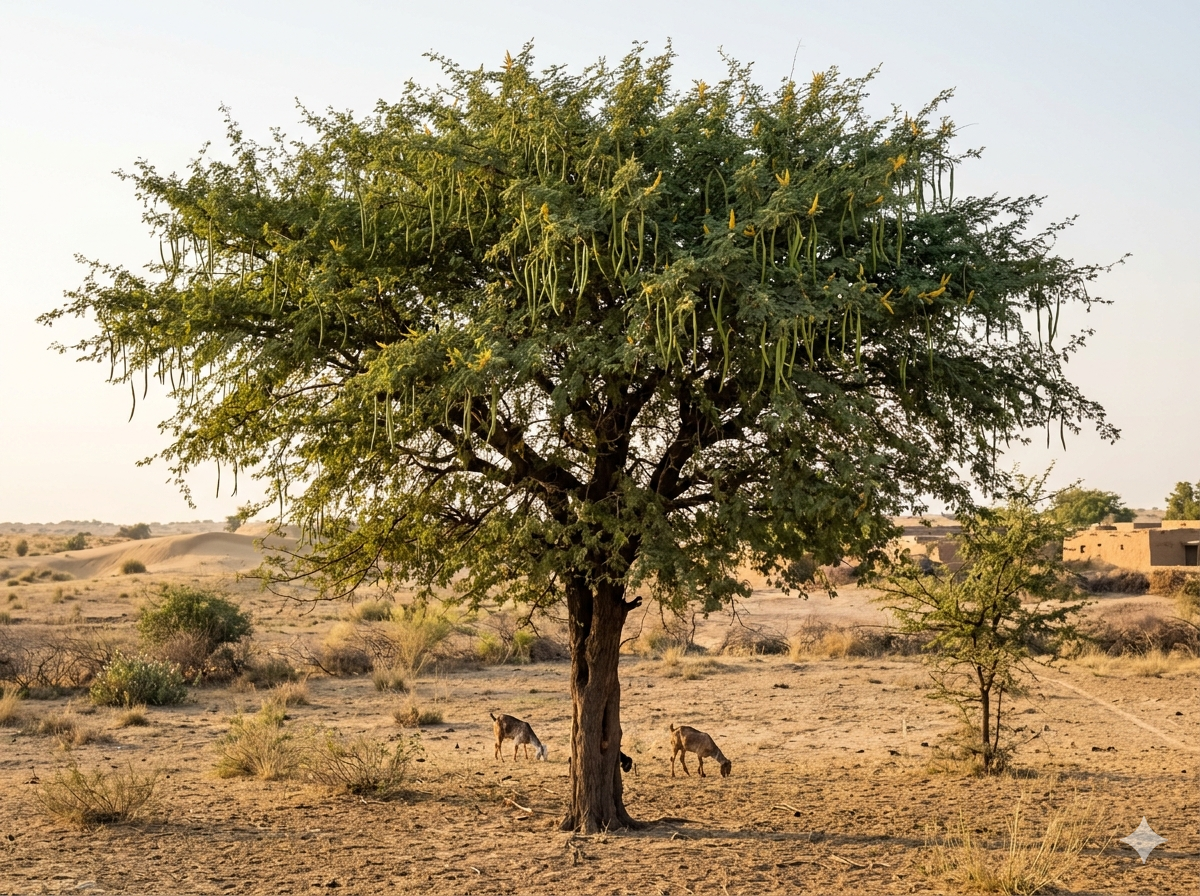
📏 3–10 metres | Thorny gnarled spreading | Beautiful silhouette desert sky ⏳ 100–400+ years — ancient trees documented Rajasthan 📈 Slow — 0.5–1.5 ft/year | Worth every year | 30-40m deep taproot desert 📍 Hyper-arid Rajasthan (Thar Desert), semi-arid Gujarat, Haryana. 100-500mm rainfall. ⚠️ STATE TREE RAJASTHAN — PROTECTED. Cannot cut without FD permission in Rajasthan. FRA 2006 collection rights. 💰 Protected — not commercial timber. Sacred + ecological value >> timber. Fallen wood only.
📤 WhatsApp
Khejri Jand Shami 363 Bishnoi Lives Sacrificed First Chipko Sangri Rs200-600 Rajasthan Iconic Cuisine UAE National Tree Ghaf Same Species Sacred Shami Dussehra Vedic 30-40m Deep Desert Roots Rajasthan State Tree Protected

खेजड़ी — Rajasthan का sacred State Tree (363 Bishnoi lives sacrifice!)। Sangri pods Rs.200-600/kg — Rajasthan का most iconic cuisine। UAE National Tree "Ghaf" (same species!)। Sacred Shami Dussehra fire। 30-40m deep roots Thar Desert groundwater reach।

Khejri (Prosopis cineraria) — Khejri / Jand / Shami / Sami / Jandi / Ghaf — is Rajasthan's State Tree and one of India's most revered and ecologically important arid zone trees, considered so sacred that the Bishnoi community has historically laid down their lives to protect Khejri trees from being felled — the famous Chipko-precursor Khejarli massacre of 1730 CE where 363 Bishnoi community members sacrificed their lives protecting Khejri trees. The tree is the lifeline of Rajasthan's desert ecosystem — it grows on extremely arid sandy Thar Desert soils where virtually no other tree survives, fixes nitrogen through root bacteria, provides the most important pods (sangri) that are a delicacy in Rajasthan cuisine (sold at Rs.200-600/kg dried), provides green pods and leaves as the primary livestock fodder in the desert, yields gum, and provides valuable fuelwood. Khejri is also the most ecologically important tree of Rajasthan's desert agri-silvi system — farmers traditionally never cut Khejri trees from their fields, instead farming around them. The tree provides shade and creates a microclimate that improves crop yields in the scorching Rajasthan summer. In UAE and Middle East, the same species (called Ghaf) is the UAE's National Tree — evidence of the tree's extraordinary adaptation to extreme aridity across the Arabian and Thar deserts.

Khejri (Prosopis cineraria) — खेजड़ी / जांड / शमी — Rajasthan का State Tree। India का most revered + ecologically important arid zone tree। 1730 CE Khejarli massacre: 363 Bishnoi community members ने Khejri trees को बचाने के लिए जान दी — Chipko movement का precursor। Rajasthan का desert ecosystem lifeline — Thar Desert sandy soils पर जहां virtually कुछ नहीं उगता। N-fixation। Sangri pods = Rajasthan cuisine delicacy (Rs.200-600/kg dried)। Primary livestock fodder desert। Gum। Fuelwood। Traditional Rajasthan agri-silvi system — farmers field में Khejri trees को कभी नहीं काटते। UAE + Middle East में same species = Ghaf = UAE's National Tree।

🌳 Overview & Quick Facts / परिचय और मुख्य तथ्य

🔬 Scientific NameProsopis cineraria — Family: Fabaceae (N-fixing legume)
🏆 StatusSTATE TREE OF RAJASTHAN | UAE National Tree (as "Ghaf") | Sacred to Bishnoi community | 363 lives sacrificed to protect
📏 Height / ऊंचाई3–10 metres | Thorny, gnarled, spreading | Beautiful silhouette against desert sky
Lifespan / आयु100–400+ years — ancient trees documented in Rajasthan
📈 Growth Rate / वृद्धि दरSlow — 0.5–1.5 ft/year | Slow because: extreme drought, poor soil. Worth every year.
🌡️ Climate / जलवायुHyper-arid to semi-arid. Rajasthan (Thar Desert) primary. Gujarat, Haryana, Punjab also. NOT for humid or cold areas.
⚖️ Legal Status / कानूनीState Tree Rajasthan — PROTECTED. Cannot be cut without Forest Dept permission in Rajasthan. Sacred status = community protection. Transit permit.
💰 Value / मूल्यSangri pods: Rs.200–600/kg dried | Ker (fruits): Rs.80-200/kg | Gum: Rs.30-80/kg | Honey: Rs.350-550/kg | Fodder: Rs.5-12/kg

🌿 Parts & Their Uses — हर अंग का उपयोग

🫘
Sangri Pods / सांगरी (Rajasthan Cuisine)
THE most famous product. Young green pods (3-8cm) called "Sangri" — harvested April-June before maturity. Dried: cream-colored dried sangri. THE iconic ingredient in Panchkuta (five-desert-plant dish) + ker-sangri pickle. Market: dried sangri Rs.200-600/kg. Exported globally to Rajasthani diaspora. Nutritious: protein, fiber, iron. One mature Khejri: 5-15 kg sangri/year.

Most famous product। Young green pods (3-8cm) = "Sangri" — April-June harvest। Dried: cream-colored। Panchkuta + ker-sangri pickle THE iconic ingredient। Market: Rs.200-600/kg dried। Rajasthani diaspora globally export। Protein, fiber, iron। One mature Khejri: 5-15 kg sangri/year।
🔴
Ker Fruits / केर
Small red-orange berries (1-2cm) — "Ker" in Rajasthani. THE other half of "Ker-Sangri" — Rajasthan's most famous dish. Harvested May-July when ripe. Pickled: ker pickle (traditional preservation). Tangy, slightly bitter flavor. Nutritious: Vitamin C, anti-oxidants. Market: dried ker Rs.80-200/kg. Growing demand from Rajasthani restaurants globally. Collection from wild trees only (no commercial plantation).

Small red-orange berries (1-2cm) = "Ker।" "Ker-Sangri" का THE other half। May-July harvest ripe। Pickled: traditional preservation। Tangy, slightly bitter। Vitamin C, anti-oxidants। Market: dried ker Rs.80-200/kg। Rajasthani restaurants globally growing demand। Wild trees से only (commercial plantation नहीं)।
🍃
Leaves / पत्ते (Desert Fodder)
THE most important desert livestock fodder — camels, goats, sheep, cattle eat Khejri leaves as primary diet supplement during drought. Loharoo (leaf fodder) collection: branches cut, leaves and pods stripped. Protein: 12-16%. In drought years when grass fails completely, Khejri leaves are THE lifeline for Rajasthan livestock. Young leaves also edible for humans — cooked as vegetable in some communities.

THE most important desert livestock fodder — camels, goats, sheep, cattle। Drought में grass fails = Khejri leaves THE lifeline। Loharoo: branches cut, leaves + pods strip। Protein: 12-16%। Young leaves human edible — cooked as vegetable कुछ communities।
💧
Gum / गोंद
Khejri gum — pale yellowish exudate from bark. Less commercially significant than Kikar gum but locally traded. Traditional: gum eaten as energy food in Rajasthan. Medicinal: gum decoction for cough, respiratory conditions. Market: Rs.30-80/kg local Rajasthan markets. Gum also used as natural adhesive. High sugar content — energy-dense traditional food.

Pale yellowish bark exudate। Kikar gum से less commercially significant — locally traded। Traditional: energy food Rajasthan। Medicinal: cough, respiratory। Market: Rs.30-80/kg local। Natural adhesive। High sugar = energy-dense traditional food।
🌸
Flowers / फूल (Desert Honey)
Small cream-yellow spike flowers (February-April). Important honey source in desert areas. Khejri honey — mild flavor, golden color. One of the few flowering trees in Thar Desert during pre-monsoon period when pollinators desperately need nectar. Sacred flowers: used in Bishnoi puja, traditional ceremonies. N-fixing legume — improves soil wherever it grows.

Small cream-yellow spikes (Feb-April)। Desert areas में important honey source। Khejri honey — mild, golden। Thar Desert में pre-monsoon pollinators के लिए few flowering trees में। Sacred: Bishnoi puja, traditional ceremonies। N-fixing legume — soil improve।
🪵
Wood / लकड़ी (Sacred + Practical)
Hard, dense, durable wood. Traditional: agricultural implements, furniture. SACRED: Shami wood used in Dussehra fire ceremony (Shami puja), Vedic yagna, Navratri rituals. In Rajasthan: protected — cannot be commercially harvested. Fallen wood collected for fuelwood. Not commercially marketed due to protection status. The sacred and ecological value far exceeds any timber value.

Hard, dense, durable। Agricultural implements, furniture। SACRED: Shami wood Dussehra fire ceremony (Shami puja), Vedic yagna, Navratri। Rajasthan: protected — commercially harvest नहीं। Fallen wood fuelwood। Protection status = commercially marketed नहीं। Sacred + ecological value >> timber।

🌍 Bishnoi Sacrifice & Desert Lifeline / Bishnoi Sacrifice और Desert Lifeline

⚡ Key Facts / मुख्य तथ्य
🕊️ 363 Lives
1730 CE — 363 Bishnoi community members sacrificed lives to protect Khejri. First Chipko in history.
1730 CE — 363 Bishnoi community members ने Khejri बचाने के लिए जान दी। History का first Chipko।
🍽️ Sangri
Sangri + Ker = Rajasthan's most iconic dish. Rs.200-600/kg dried pods. Global Rajasthani diaspora demand.
Sangri + Ker = Rajasthan का most iconic dish। Rs.200-600/kg dried pods। Global Rajasthani diaspora demand।
🏜️ Thar Survivor
Grows where virtually nothing else survives in Thar Desert. Deep roots reach groundwater 30-40m deep.
Thar Desert में virtually nothing else survives वहां grows। Deep roots 30-40m groundwater reach।
🇦🇪 UAE National
Same species = UAE National Tree "Ghaf." Proof of extraordinary arid adaptation across Thar + Arabian Desert.
Same species = UAE National Tree "Ghaf।" Thar + Arabian Desert across extraordinary adaptation proof।
🕉️ Shami Sacred
Shami = Dussehra sacred fire tree. Vedic yagna wood. Navratri rituals. Pan-Hindu sacred significance.
Shami = Dussehra sacred fire tree। Vedic yagna wood। Navratri। Pan-Hindu sacred significance।
🐪 Camel Fodder
Camels' primary tree fodder — leaves, pods. Desert livestock cannot survive without Khejri.
Camels का primary tree fodder — leaves, pods। Khejri के बिना desert livestock survive नहीं।

🌱 Growing Guide / खेजड़ी कैसे उगाएं

Hyper-arid Rajasthan, semi-arid Gujarat, Haryana. 100-500mm rainfall. Extreme heat (50°C) tolerant. Deep taproot reaches groundwater 30-40m in desert conditions.State Tree = protected. In Rajasthan: must get permission before cutting even YOUR OWN Khejri tree. Register existing trees with local Forest Range Officer. Document all trees on land.NEVER cut Khejri from agricultural fields — farm around it. 1 Khejri per 100-200 sq metres provides: shade, microclimate improvement, N-fixation, annual sangri + fodder harvest. Classic Rajasthan silvi-agri system.Mature Khejri (20yr+): 10 kg sangri × Rs.400 = Rs.4,000 + 5 kg ker × Rs.120 = Rs.600 + gum Rs.200 + fodder value Rs.300 = Rs.5,100/tree/year. 50 trees = Rs.2.55 lakh/year.
ParameterEnglishHindi / हिंदी
🌱 PropagationSeeds from dry pods. Soak 24 hours. Germination 10-20 days. OR transplant wild seedlings from under existing trees — traditional Rajasthan method. Direct sowing in monsoon most successful.Dry pods से seeds। 24 hours soak। 10-20 days germination। OR existing trees के नीचे wild seedlings transplant — traditional Rajasthan। Monsoon में direct sowing most successful।
🌡️ ClimateHyper-arid Rajasthan, semi-arid Gujarat, Haryana। 100-500mm। 50°C heat tolerant। Deep taproot: desert में 30-40m groundwater reach।
Patience requiredSlow growth — 10-15 years for significant sangri production. But trees live 100-400 years. A Khejri planted today provides for 5-10 generations. Long-term family wealth.Slow — 10-15 years significant sangri। But trees 100-400 years live। Today planted Khejri = 5-10 generations के लिए। Long-term family wealth।
⚖️ Legal (Rajasthan)State Tree = protected। Rajasthan: OWN Khejri tree भी cut करने से पहले permission। Local Forest Range Officer के साथ existing trees register। Land पर all trees document।
🌾 Traditional systemAgricultural fields में Khejri NEVER cut — around farm। 1 Khejri per 100-200 sq metres: shade, microclimate, N-fixation, annual sangri + fodder। Classic Rajasthan silvi-agri।
💰 IncomeMature Khejri (20yr+): sangri Rs.4,000 + ker Rs.600 + gum Rs.200 + fodder Rs.300 = Rs.5,100/tree/year। 50 trees = Rs.2.55 lakh/year।

💰 Market Value & Legal Status / बाज़ार मूल्य और कानूनी स्थिति

Product / उत्पादValue / मूल्यLegal / कानूनी
🫘 Sangri (dried pods)Rs.200–600/kg | Global Rajasthani diaspora demandFreely collected own trees. Protected tree — permission before any cutting.
🔴 Ker (dried berries)Rs.80–200/kg | Rajasthani restaurants premiumWild collection traditionally. FRA 2006 local communities.
💧 Gum / गोंदRs.30–80/kg local markets / localOwn trees sustainably / sustainably
🍯 Honey / शहदRs.350–550/kg Khejri/desert honeyFreely traded / freely
❓ Frequently Asked Questions / अक्सर पूछे जाने वाले सवाल
Ker Sangri — Rajasthan's most famous dish: Ker Sangri (also spelled Ker Sangri / Kair Sangri) is THE signature dish of Rajasthani cuisine and one of India's most uniquely regional vegetarian dishes. Both ingredients are from the Thar Desert — ker (Prosopis cineraria fruits) and sangri (Prosopis cineraria pods). Preparation: dried sangri (100g) + dried ker (30g) — both need soaking overnight in water (or at minimum 4-6 hours). Change water once during soaking as first soaking water is slightly bitter. Drain and boil separately in salted water until tender (sangri: 20-25 min, ker: 15-20 min) — or pressure cook (2 whistles). Recipe: heat oil or ghee (3 tbsp) in kadhai. Add cumin (1 tsp), asafoetida (pinch). Add dried red chilies (3-4, whole). Add ginger-garlic paste (1 tbsp). Add: turmeric (1/2 tsp), red chili powder (1.5 tsp), coriander powder (2 tsp), amchur (1 tsp — sour note), salt. Mix well. Add boiled sangri + ker. Mix with masala. Cook covered on low flame 10-15 minutes. Add raw mango powder if available. Finish with garam masala. Garnish with fresh coriander. Serve with bajra roti (millet flatbread) — the traditional accompaniment. Why amchur: ker has natural sourness. Use amchur sparingly. Panchkuta variation: adds 3 more desert ingredients — peepal, kumtiya (Acacia pods), and Sangri, Ker, and a 5th ingredient (varies by region). Nutritional: high protein, high fiber, low glycemic — traditional Rajasthan diet is remarkably healthy despite harsh climate.

Ker Sangri recipe: Rajasthan's THE signature dish। Both Thar Desert ingredients। Preparation: dried sangri 100g + dried ker 30g। Overnight soak (minimum 4-6 hours)। First soaking water change (slightly bitter)। Drain + boil separately salted water until tender (sangri 20-25 min, ker 15-20 min) या pressure cook। Recipe: oil/ghee 3 tbsp + cumin + hing। Dried red chilies whole। Ginger-garlic paste। Turmeric + red chili + coriander + amchur + salt। Boiled sangri + ker mix। Low flame covered 10-15 min। Garam masala + coriander। Bajra roti के साथ serve। Why amchur: ker natural sourness, sparingly। Panchkuta: + peepal + kumtiya + 2 more desert। Nutritional: high protein, high fiber, low glycemic।
Bishnoi and Khejri — the 300-year story: The Bishnoi community of Rajasthan is one of India's oldest and most dedicated environmental protection communities — their 29 principles (bis-noi = 29 rules) established by Guru Jambheshwar in 1485 CE include specific rules for protecting trees and wildlife. Khejri is their most sacred tree. The 1730 massacre: In 1730 CE, the Maharaja of Jodhpur sent men to cut Khejri trees to burn for lime mortar for his new palace. The Bishnoi community of Khejarli village (near Jodhpur) resisted. Led by Amrita Devi, a woman, the community hugged the trees to prevent cutting. The soldiers cut through them — killing Amrita Devi and then proceeding to kill 363 Bishnoi community members who continued to resist. This event — the first documented "tree hugging" mass protest in history — predates the Chipko movement by 242 years. The Maharaja, upon hearing of this, is said to have repented and issued a royal decree protecting all trees and animals in Bishnoi villages — a protection that the Bishnoi community has maintained to this day. Why Khejri is sacred: in Bishnoi theology, Khejri represents the life-giving property of nature — in the desert, it literally gives life to people, livestock, and soil when nothing else can. It is the physical embodiment of the Bishnoi principle of living in harmony with nature. Today: Bishnoi villages are notable for their wildlife — blackbuck herds graze freely near villages, trees are protected. Even today, if someone cuts a Khejri tree in a Bishnoi village area, the community actively protests and seeks legal action. The Bishnoi environmental tradition is one of India's greatest conservation legacies.

Bishnoi + Khejri: Bishnoi = India's oldest dedicated environmental protection community। 29 principles (bis-noi) Guru Jambheshwar 1485 CE — trees + wildlife protect। Khejri = most sacred tree। 1730 massacre: Maharaja of Jodhpur ने palace lime mortar के लिए Khejri cut करने भेजा। Khejarli village Bishnoi resist। Amrita Devi (woman) lead — trees hug। Soldiers cut through — Amrita Devi kill + 363 Bishnoi members kill। First documented "tree hugging" mass protest in history — Chipko से 242 years पहले। Maharaja repent → royal decree protecting trees + animals in Bishnoi villages। Today तक maintained। Why Khejri sacred: desert में life-giving = Bishnoi theology में nature के life-giving property। Bishnoi villages: blackbuck freely graze, trees protected। Today: Khejri cut = Bishnoi community protest + legal action। India's greatest conservation legacy।
Khejri/Ghaf as UAE National Tree — the desert connection: Prosopis cineraria (Khejri in India, Ghaf in Arabic) was declared UAE's National Tree in 2008. The same species grows across the Arabian desert (UAE, Oman, Saudi Arabia) and the Thar Desert (Rajasthan, Gujarat) — evidence of a contiguous ancient desert ecosystem that once stretched from Rajasthan to Arabia. Why Ghaf is UAE's national symbol: (1) Most resilient tree in Arabian desert — the only tree that naturally grows in UAE's hyper-arid conditions (average rainfall less than 100mm/year, extreme temperatures). (2) Deep roots (up to 30-40m) access ancient fossil groundwater aquifers. No irrigation needed. (3) Ecological keystone: provides shade, habitat, food for wildlife in an otherwise barren landscape. (4) Historical significance: Bedouin communities depended on Ghaf for fodder (camels, goats), gum, medicine for millennia. (5) Carbon storage: despite being a small tree, Ghaf's deep root system stores significant carbon in desert soil. Conservation status in UAE: Ghaf was heavily depleted in UAE in the 20th century due to overgrazing and development. UAE government has made Ghaf planting a national conservation priority — millions of Ghaf trees planted across UAE, mandatory Ghaf inclusion in landscaping projects. India-UAE connection: the tree's status as both Rajasthan's State Tree and UAE's National Tree creates an extraordinary botanical-cultural bridge between India and Arabia. When Emirati visitors come to Rajasthan, they recognize Khejri as "their" tree — the same species from their desert homeland. This shared tree is a natural cultural connection between Rajasthan and the Arabian Peninsula.

Khejri/Ghaf UAE National Tree: Prosopis cineraria = UAE National Tree 2008। Same species Arabian desert (UAE, Oman, Saudi) + Thar Desert (Rajasthan, Gujarat) — contiguous ancient desert ecosystem। Why UAE national symbol: (1) Most resilient Arabian desert tree — UAE 100mm/year rainfall में naturally grows। (2) 30-40m deep roots — fossil groundwater aquifers। No irrigation। (3) Wildlife shade + habitat + food। (4) Historical: Bedouin fodder, gum, medicine। (5) Deep root carbon storage desert soil। Conservation UAE: 20th century heavily depleted। Government: millions Ghaf planted, mandatory landscaping। India-UAE connection: Rajasthan State Tree + UAE National Tree = botanical-cultural bridge। Emirati visitors Rajasthan में Khejri = "their" tree recognize। Shared tree = natural Rajasthan-Arabian Peninsula connection।
Buying Khejri (sangri, ker) legally and sustainably: For sangri and ker (the food products), buying is straightforward — they are freely sold in Rajasthan markets and no legal restriction applies to the dried food products. Buying fresh sangri in season (April-June): available at local bazaars in Jodhpur, Bikaner, Barmer, Jaisalmer, Nagaur, Churu districts. Price varies by season and quality. Buying dried sangri year-round: available in Rajasthan provision stores (kirana shops) across the state. Online: available on Amazon India, Big Basket, regional e-commerce with Rajasthani food focus. Rajasthani diaspora shops in Mumbai, Delhi, Pune, Bengaluru. For the plant/seeds (to grow your own): Rajasthan Forest Department nurseries provide Khejri seedlings under social forestry programs — often free or subsidized. Contact Rajasthan Forest Dept range office in your district. CAZRI (Central Arid Zone Research Institute, Jodhpur): leading research institution on arid zone plants including Khejri. They distribute germplasm for research and farming. Some progressive farmers in Barmer, Jaisalmer, Jodhpur districts maintain Khejri trees with high sangri productivity — seeds/seedlings may be available from agricultural universities (MPUAT Udaipur, RCA Bikaner). Caution regarding cutting: In Rajasthan, Khejri is a protected State Tree. If you own land with Khejri trees, you CANNOT cut them without Forest Dept permission. However, you CAN collect sangri, ker, gum, and fallen branches freely from your own trees. This collection right is protected under traditional rights and FRA 2006 in forest areas.

Buying Khejri products legally: Food products (sangri, ker): freely sold, no legal restriction। Fresh sangri April-June: Jodhpur, Bikaner, Barmer, Jaisalmer, Nagaur, Churu bazaars। Dried year-round: Rajasthan kirana shops। Online: Amazon India, Big Basket, Rajasthani food e-commerce। Diaspora shops Mumbai, Delhi, Pune, Bengaluru। Plant/seeds: Rajasthan Forest Dept nurseries — social forestry free/subsidized। District range office contact। CAZRI Jodhpur: arid zone research, germplasm distribute। MPUAT Udaipur, RCA Bikaner agricultural universities। Caution: Rajasthan में Khejri = protected State Tree। Own land trees = Forest Dept permission बिना cut नहीं। BUT: sangri, ker, gum, fallen branches collection = freely। Traditional rights + FRA 2006 forest areas।
Khejri root system — desert engineering marvel: Prosopis cineraria has one of the most extraordinary root systems of any tree in the world, specifically adapted to the Thar Desert's extreme conditions. Root depth: studies at CAZRI Jodhpur have documented Khejri roots reaching 30-40 metres (100-130 feet) depth in Rajasthan's sandy soils — among the deepest recorded for any tree species. The tap root follows the water table — if the water table recedes, the roots grow deeper. In areas of Rajasthan where groundwater is 35-40m deep, Khejri roots reach it. Lateral roots: spread 15-20 metres from trunk at shallow depth (0.5-2m) — collecting every drop of rainfall before it evaporates from the sandy soil. The combined deep + lateral root system creates a comprehensive water-harvesting architecture that no human-designed desert water harvesting system can match. Why this matters: in Thar Desert soils, rainfall evaporates within days from surface soil. Only trees with deep roots can survive between monsoon seasons (9-10 months of near-zero rainfall). Khejri's root system allows it to access water that evaporated from surface long ago — drawing from deep groundwater reserves. Soil improvement: the extensive root network continuously pumps N-rich organic matter from deep soil layers to the surface through decomposing root material. This is one reason Khejri trees improve the soil around them significantly over decades. Agricultural benefit: research at Jodhpur Agricultural Research Station documents that crops grown within 10-15m of Khejri trees yield 10-20% more than crops further away — attributed to: shade (temperature reduction), N-fixation, water retention improvement from root channel creation, and reduced wind erosion. This is the scientific basis of the traditional Rajasthan practice of never removing Khejri from agricultural fields.

Khejri root system: CAZRI Jodhpur studies: 30-40 metres (100-130 feet) depth। World के any tree species में among deepest recorded। Tap root follows water table — table recedes = roots grow deeper। 35-40m groundwater = roots reach। Lateral roots: 15-20 metres from trunk, 0.5-2m shallow depth — every rainfall drop collect। Combined deep + lateral = comprehensive water-harvesting architecture। Why matters: Thar Desert soil में rainfall days में evaporate। Only deep roots = between monsoon survive (9-10 months near-zero rainfall)। Deep groundwater reserves access। Soil improvement: extensive root network continuously N-rich organic matter deep → surface pump। Decades में soil significantly improve। Agricultural benefit: Jodhpur Agricultural Research Station: Khejri trees से 10-15m के within crops = 10-20% higher yield। Reasons: shade (temperature reduce), N-fixation, water retention, wind erosion reduce। Traditional practice scientific basis — agricultural fields में Khejri NEVER remove।
⚠️
AI-Assisted Content — Please Read
AI-सहायता से बनाई गई सामग्री — कृपया पढ़ें

All tools, plant encyclopedias, edible growing guides and blog content on PlantCare are created with the assistance of AI (Artificial Intelligence) and are intended for general informational and educational purposes only. While we strive for accuracy, the information provided may not be complete, current or suitable for every situation, region or individual plant variety.

For health, medical or serious agricultural decisions — always consult a qualified horticulturist, agronomist, Ayurvedic practitioner, medical professional or relevant expert. PlantCare does not take responsibility for outcomes arising from use of this information. Identification results from AI tools (plant identifier, pest identifier etc.) should be verified before taking any action.

इस वेबसाइट पर सभी tools, plant encyclopedias, edible guides और blog content AI (Artificial Intelligence) की सहायता से बनाए गए हैं और केवल सामान्य जानकारी और शिक्षा के उद्देश्य से हैं। स्वास्थ्य, चिकित्सा या गंभीर कृषि निर्णयों के लिए कृपया किसी योग्य विशेषज्ञ से संपर्क करें। PlantCare इस जानकारी के उपयोग से होने वाले परिणामों के लिए जिम्मेदार नहीं है।