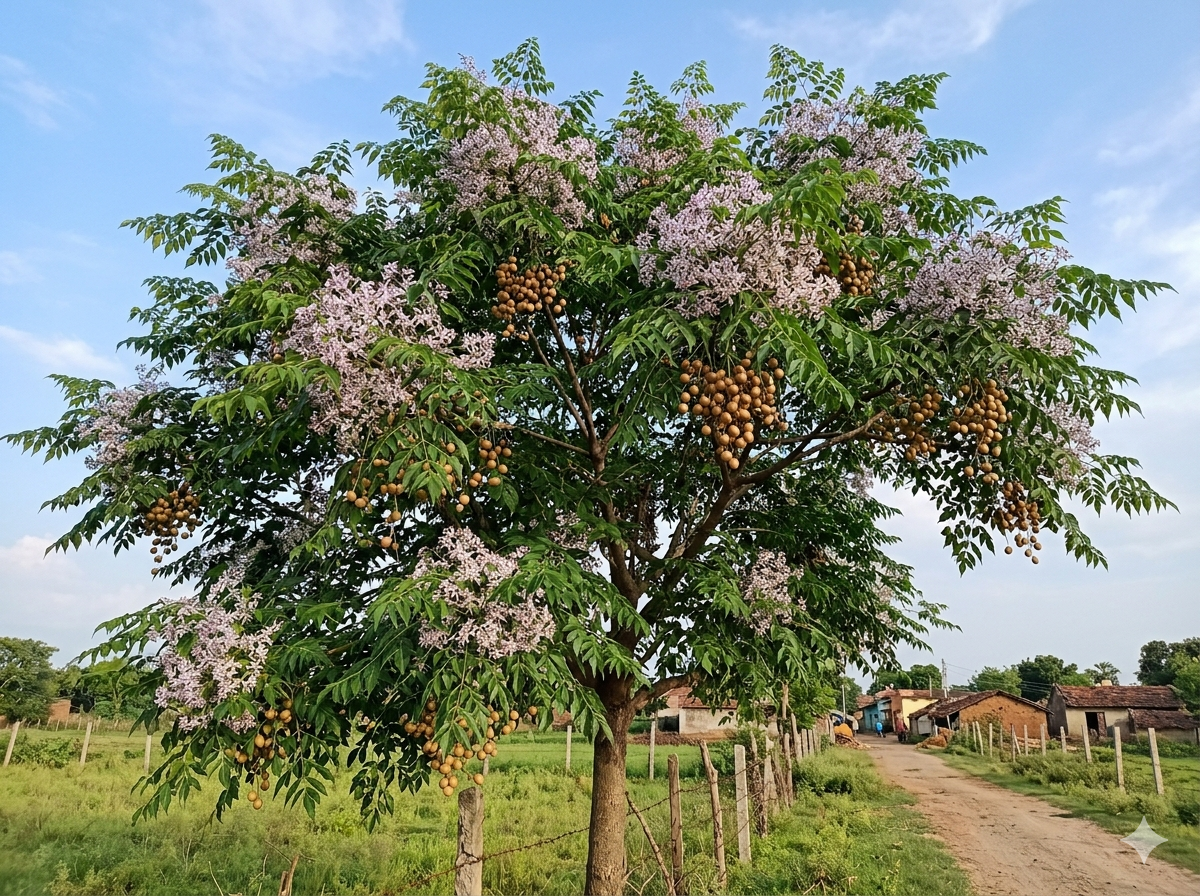
Bakain Melia azedarach Persian Lilac Purple Flowers India — PlantCare
📷 PlantCare
🪵 Timber, Shade & Agroforestry Trees

Bakain / Persian Lilac / False Neem बकाइन / देसी नीम / फारसी बकाइन

Melia azedarach Family: Meliaceae (same family as Neem, Mahogany)

Bakain / Persian Lilac — ⚠️ YELLOW BERRIES TOXIC (children keep away!). April-May: SPECTACULAR lilac-purple fragrant flowers (North India's most fragrant spring tree!). Anti-worm bark (narrow dose — Ayurvedic guidance). Faster than Neem. NOT true Neem — bipinnate leaves, clustered toxic berries.

📏 10–20 metres | Fast growing | Spreading crown ⏳ 50–100 years | Commercial timber 8-12 years 📈 FAST — 4–6 ft/year | Faster than Neem | More waterlogging tolerant 📍 Pan-India tropical to subtropical. Very adaptable. More waterlogging tolerant than Neem. ⚠️ Not protected. Freely planted. Transit permit timber. ⚠️ Fruits TOXIC — plant away from children. 💰 Rs.400–900/cubic foot | WIMCO matchstick demand | 8-10 year rotation
📤 WhatsApp
Bakain Persian Lilac Yellow Berries TOXIC Children WARNING Spectacular Lilac-Purple April-May Fragrant Anti-Helminthic Narrow Dose WARNING Faster Than Neem More Waterlogging NOT True Neem Bipinnate Matchstick 8-12yr WIMCO

बकाइन — ⚠️ YELLOW BERRIES TOXIC (children को दूर रखें!)। April-May: SPECTACULAR lilac-purple fragrant flowers (North India का most fragrant spring tree!)। Anti-worm bark (narrow dose — Ayurvedic guidance)। Neem से faster। True Neem नहीं — bipinnate leaves, clustered toxic berries।

Bakain (Melia azedarach) — Bakain / Persian Lilac / Drek / Chinaberry / Indian Lilac / Dhumba — is one of India's most widely naturalized and utilitarian shade trees, found on virtually every roadside, village boundary and fallow land across tropical and subtropical India. Often confused with Neem (Melia azedarach is sometimes called "Desi Neem" or "False Neem"), Bakain is actually a different species in the same Meliaceae family with partially overlapping but distinct properties. The tree produces extraordinarily beautiful lilac-purple fragrant flowers in April-May that transform the tree into a purple cloud — these flowers produce the distinctive sweet fragrance that gives the tree its Persian Lilac name. The tree is significantly faster-growing than Neem, more tolerant of waterlogging and diverse soils, and produces commercial timber in 8-12 years. The fruits (yellow berries) are toxic to humans but the seed kernels yield neem-like pesticide oil. The bark, leaves and fruit have significant Ayurvedic applications — Bakain bark is one of the most important anti-helminthic (de-worming) medicines in traditional Indian medicine. Melia azedarach has been used across South and Southeast Asia for centuries as a village shade tree, temple tree, and multi-purpose agricultural support tree. The wood, while lighter than Neem, is valuable for furniture, matchstick and plywood manufacture.

Bakain (Melia azedarach) — बकाइन / Persian Lilac / चिनारी / Drek — India के most widely naturalized + utilitarian shade trees में। Virtually every roadside, village boundary, fallow land। "Desi Neem" या "False Neem" कहते — actually different species, same Meliaceae family। April-May में extraordinary beautiful lilac-purple fragrant flowers — पूरा tree purple cloud बन जाता। "Persian Lilac" नाम इसीलिए। Neem से significantly faster-growing। Waterlogging + diverse soils tolerant। Commercial timber 8-12 years। Fruits toxic humans। Seed kernels: neem-like pesticide oil। Bark, leaves, fruits: significant Ayurvedic — especially anti-helminthic (de-worming)। South + SE Asia में centuries से village shade, temple, agricultural support। Wood: furniture, matchstick, plywood।

🌳 Overview & Quick Facts / परिचय और मुख्य तथ्य

🔬 Scientific NameMelia azedarach — Family: Meliaceae (same family as Neem, Mahogany)
⚠️ TOXIC WARNINGFruits (yellow berries) TOXIC to humans and birds if eaten in quantity. Children: keep away from ripe fallen berries. Seeds/fruits: not edible.
📏 Height / ऊंचाई10–20 metres | Fast growing, spreading crown
Lifespan / आयु50–100 years | Commercial timber 8-12 years
📈 Growth Rate / वृद्धि दरFAST — 4–6 ft/year | Faster than Neem | Good for quick shade + timber
🌸 Flowers / फूलApril–May — SPECTACULAR lilac-purple fragrant clusters. "Persian Lilac" spectacle! / April-May — SPECTACULAR lilac-purple fragrant!
🌡️ Climate / जलवायुTropical to subtropical. Pan-India. More waterlogging tolerant than Neem. Very adaptable.
⚖️ Legal Status / कानूनीNot protected. Freely planted. Transit permit for timber movement. Some invasive concern in some ecosystems.
💰 Value / मूल्यTimber: Rs.400–900/cubic ft | Matchwood: Rs.400-700/cubic ft | Seed oil: Rs.50-150/litre | Bark: Rs.10-18/kg

🌿 Parts & Their Uses — हर अंग का उपयोग

🌸
Flowers / फूल (Persian Lilac Spectacle)
Lilac-purple fragrant flower clusters (April-May) — one of India's most fragrant spring trees. The sweet honeysuckle-like fragrance fills entire neighborhoods. Honey source — bees attracted. Flower extract: anti-inflammatory, anti-oxidant research. Traditional: flower garlands, puja offering. The flower spectacle + fragrance makes Bakain one of North India's most recognizable spring trees. Not commercially traded.

Lilac-purple fragrant clusters (April-May) — India के most fragrant spring trees में। Sweet honeysuckle-like fragrance entire neighborhoods। Honey source। Flower extract: anti-inflammatory, anti-oxidant। Traditional: garlands, puja। Flower spectacle + fragrance = North India's most recognizable spring trees। Commercially traded नहीं।
🟫
Bark / छाल (Anti-Helminthic)
PRIMARY medicinal use. Bark: anti-helminthic (kills intestinal worms) — IMPORTANT Ayurvedic anti-parasitic medicine. Contains meliantriol, toosendanin (limonoids). Traditional: bark decoction for roundworm, tapeworm, malaria (anti-malarial activity confirmed). Anti-inflammatory, anti-pyretic. CAUTION: higher doses toxic. Use under guidance. Market: Rs.10-18/kg MFP.

PRIMARY medicinal। Bark: anti-helminthic (intestinal worms kill) — IMPORTANT Ayurvedic anti-parasitic। Meliantriol, toosendanin (limonoids)। Traditional: roundworm, tapeworm, malaria (anti-malarial confirmed)। Anti-inflammatory, anti-pyretic। CAUTION: higher doses toxic। Guidance में use। Market: Rs.10-18/kg।
⚠️
Fruits / फल (TOXIC — Seed Oil Only)
Yellow berries — TOXIC to humans and poultry if eaten in quantity (contain tetranortriterpenes + azadirachtin-like compounds). Do NOT eat. However: seed kernels yield biopesticide oil similar to neem oil — anti-insect, anti-fungal. Traditional: fruit paste as external insect repellent. Market: seed oil Rs.50-150/litre for agricultural biopesticide use. Birds: some birds eat small quantities without harm (detoxification ability).

Yellow berries — humans + poultry को TOXIC large quantities (tetranortriterpenes + azadirachtin-like)। NOT eat। But: seed kernels = biopesticide oil (neem oil similar) — anti-insect, anti-fungal। Traditional: fruit paste external insect repellent। Market: seed oil Rs.50-150/litre agricultural biopesticide। Birds: small quantities — some detoxification ability।
🍃
Leaves / पत्ते
Bipinnate large leaves — significant shade. Leaf extract: anti-bacterial, anti-inflammatory research. Traditional: leaf paste applied to skin diseases, wounds (anti-microbial). Cattle fodder (moderate — bitter taste limits palatability). Leaf litter: good mulch, decomposes faster than Neem. Natural insect repellent: dried leaves placed in grain storage (similar to Neem). Not as effective as Neem for this purpose.

Bipinnate large leaves — significant shade। Leaf extract: anti-bacterial, anti-inflammatory। Leaf paste: skin diseases, wounds। Cattle fodder (moderate — bitter limits palatability)। Leaf litter: mulch, decomposes faster than Neem। Natural insect repellent: grain storage dried leaves (Neem similar — less effective)।
🌱
Roots / जड़ें
Root bark: anti-helminthic (primary use with stem bark). Root bark decoction: traditional for fevers, skin diseases. Roots: moderately invasive — plant 4-5m from structures. Not recommended for waterside planting — roots damage canal banks. N-fixation: NOT a legume — no significant N-fixation (unlike Neem claim, Bakain doesn't fix N).

Root bark: anti-helminthic (stem bark के साथ primary use)। Root bark decoction: fever, skin diseases। Roots: moderately invasive — structures से 4-5m। Waterside planting NOT recommended — canal bank damage। N-fixation: NOT legume — significant N-fixation नहीं।
🪵
Wood / लकड़ी
Moderately hard, light weight, uniform grain — excellent for peeling (plywood) and matchstick manufacture. Lighter than Neem but faster growing. Commercial timber in 8-12 years. Market: Rs.400-900/cubic foot. Used by matchstick industry (WIMCO and others buy in areas where Poplar not available). Plywood core material. FD transit permit required.

Moderately hard, light weight, uniform grain — peeling (plywood) + matchstick के लिए excellent। Neem से lighter लेकिन faster growing। Commercial timber 8-12 years। Market: Rs.400-900/cubic foot। Matchstick industry (WIMCO Poplar unavailable areas में)। Plywood core। FD transit permit।

🌍 Persian Lilac Spectacle & Anti-Parasitic / Persian Lilac और Anti-Parasitic

⚡ Key Facts / मुख्य तथ्य
🌸 Purple Spectacle
April-May: entire tree covered in fragrant lilac-purple flowers. North India's most fragrant spring tree.
April-May: entire tree fragrant lilac-purple। North India का most fragrant spring tree।
🐛 Anti-Worm
Bark: anti-helminthic — important Ayurvedic de-worming medicine. Meliantriol, toosendanin limonoids.
Bark: anti-helminthic — important Ayurvedic de-worming। Meliantriol, toosendanin limonoids।
⚡ Faster Than Neem
4-6 ft/year — significantly faster than Neem. Commercial timber in 8-12 years.
4-6 ft/year — Neem से significantly faster। Commercial timber 8-12 years।
⚠️ Toxic Fruits
Yellow berries TOXIC to humans + poultry. Children keep away from fallen berries. Seeds only for oil.
Yellow berries humans + poultry को TOXIC। Children fallen berries से दूर। Seeds only for oil।
🔄 Waterlogging
More waterlogging tolerant than Neem — grows in wetter soils where Neem struggles.
Neem से more waterlogging tolerant — Neem struggle करती वहाँ भी grows।
🪵 Matchwood
Light uniform grain — matchstick industry use where Poplar unavailable. 8-12 year commercial rotation.
Light uniform grain — Poplar unavailable areas में matchstick। 8-12 year commercial rotation।

🌱 Growing Guide / बकाइन कैसे उगाएं

Timber: 3×3m (1,111/ha). Shade avenue: 6-8m. Boundary: 4-5m. Roots: plant 4-5m from structures — moderately invasive.1 ha, 10 years: 1,000 trees × 0.3 cubic metre × 35.3 × Rs.600 = Rs.63.5 lakh. Less costs Rs.5 lakh = Rs.58 lakh net. Good for 10-year rotation. Faster than Teak, lower price per unit.Bark for Ayurvedic anti-helminthic: harvest from pruned branches only (not main trunk — damages tree). Dry in shade. Market: Rs.10-18/kg. Sustainable from plantation without damaging trees.
ParameterEnglishHindi / हिंदी
🌱 PropagationSeeds from fruits (remove yellow flesh, clean pit, sow). Germination 20-30 days. OR root cuttings (excellent success). Hard seed coat — soak 24 hours before sowing.Fruits से seeds (yellow flesh remove, pit clean, sow)। 20-30 days germination। OR root cuttings (excellent)। Hard coat — 24 hours soak।
🌡️ Climate + SoilPan-India tropical to subtropical. Very adaptable — sandy to heavy clay. pH 5.5-9.5. More waterlogging tolerant than Neem. Drought tolerant once established.Pan-India tropical to subtropical। Sandy से heavy clay। pH 5.5-9.5। Neem से more waterlogging tolerant। Established के बाद drought tolerant।
⚠️ Children safetyPlant away from children's play areas. Fallen yellow berries are TOXIC. If planting near homes, regularly clean fallen fruits from ground. Educate children not to eat.Children's play areas से दूर plant। Fallen yellow berries TOXIC। Homes के near: regularly fallen fruits clean। Children को educate — न खाएं।
📏 SpacingTimber: 3×3m। Shade avenue: 6-8m। Boundary: 4-5m। Roots: structures से 4-5m।
💰 Returns1 ha, 10 years: 1,000 × 0.3 cubic metre × 35.3 × Rs.600 = Rs.63.5 lakh। Costs Rs.5 lakh = Rs.58 lakh net। 10-year rotation। Teak से faster, lower price per unit।
🐛 Bark harvestAnti-helminthic bark: pruned branches से only (main trunk नहीं — tree damage)। Shade dry। Market: Rs.10-18/kg। Plantation से sustainable without damage।

💰 Market Value & Legal Status / बाज़ार मूल्य और कानूनी स्थिति

Product / उत्पादValue / मूल्यLegal / कानूनी
🪵 Timber / MatchwoodRs.400–900/cubic foot | WIMCO matchstick demandTransit permit FD. Farmer owns private trees.
🟫 Bark / छालRs.10–18/kg MFP anti-helminthicOwn trees sustainably (pruned branches). MFP freely.
🌱 Seed oil (biopesticide)Rs.50–150/litre agricultural biopesticideFreely produced own trees / freely
🍯 Honey / शहदRs.300–500/kg Bakain honeyFreely traded / freely
❓ Frequently Asked Questions / अक्सर पूछे जाने वाले सवाल
Bakain vs Neem — the common confusion: Bakain (Melia azedarach) is frequently called "Desi Neem" or "Jangli Neem" in North India, creating confusion with true Neem (Azadirachta indica). Both are in the Meliaceae family and share some properties, but are different species. Identification: Neem leaves: pinnate, 12-16 pairs of leaflets per leaf, leaflets sickle-shaped with toothed margin. Bakain leaves: BIPINNATE (twice compound) — each primary pinna has multiple leaflets. More fern-like appearance than Neem. Fruits: Neem = single green drupe (1-2cm), yellow when ripe, single large seed. Bakain = clusters of small yellow berries (1-1.5cm), 4-5 seeds inside. Neem fruits: edible (very bitter). Bakain fruits: TOXIC — do not eat! Bark smell: Neem bark has distinctly bitter neem smell. Bakain bark: less intense, different compound profile. Flowers: Neem = small white fragrant clusters (March-May). Bakain = larger, more showy LILAC-PURPLE clusters (April-May) — Bakain flowers are MORE spectacular. Properties comparison: Neem bark: anti-diabetic (azadirachtin), anti-bacterial, anti-fungal, anti-malarial — very broad spectrum. Bakain bark: primarily anti-helminthic (de-worming), anti-malarial — narrower but important spectrum. Neem seed oil (nimba oil): world's most researched biopesticide (azadirachtin). Bakain seed oil: similar but less researched, less effective. For Ayurvedic use: true Neem (Azadirachta indica) is the preferred and more researched species. Bakain is sometimes used as a lower-cost substitute but should be specifically labeled. Growth: Bakain grows faster than Neem and tolerates more waterlogging. Where you might see "Neem" trees that aren't: many trees labeled as "Neem" in North India are actually Bakain — particularly in wetter areas where true Neem doesn't thrive as well. Simple check: bipinnate leaves + lilac flowers + yellow clustered berries = Bakain, not Neem.

Bakain vs Neem: Meliaceae family both — different species। Identification: Neem leaves: pinnate, 12-16 pairs, sickle-shaped toothed। Bakain leaves: BIPINNATE (twice compound) — more fern-like। Fruits: Neem = single green drupe, edible (bitter)। Bakain = CLUSTERS of small yellow berries, TOXIC (don't eat!)। Bark smell: Neem = distinctly bitter। Bakain = less intense। Flowers: Neem = small white। Bakain = LARGER LILAC-PURPLE (more spectacular)। Properties: Neem bark = anti-diabetic, anti-bacterial, anti-fungal, anti-malarial broad spectrum। Bakain bark = primarily anti-helminthic, anti-malarial (narrower)। Neem oil = world's most researched biopesticide। Bakain oil = similar, less researched। Ayurvedic: Azadirachta indica preferred + more researched। Growth: Bakain faster + waterlogging tolerant। Simple check: bipinnate + lilac flowers + yellow clustered berries = Bakain, NOT Neem।
Bakain bark for intestinal worms — cautious traditional use: Melia azedarach bark has been used as an anti-helminthic (de-worming) medicine across South Asia, Southeast Asia, and tropical Africa for centuries. It is effective against roundworms (Ascaris lumbricoides) and tapeworms (Taenia). Active compounds: Toosendanin (also called melianodiol) — potent anti-parasitic compound that disrupts worm neuromuscular function. Also meliantriol, salannin — all limonoid class compounds similar to neem's azadirachtin. IMPORTANT SAFETY NOTE: Melia azedarach contains toxic compounds — the therapeutic window is narrow. Higher doses can cause vomiting, diarrhea, convulsions, and in severe cases, death. Traditional preparations use small measured doses. Do NOT self-medicate with large quantities. Traditional preparation (under Ayurvedic practitioner guidance): Bark decoction: 5g dried bark (NOT more) + 300ml water, boil to 150ml, strain. Drink 50ml on empty stomach morning for 3 consecutive days. Then purge (take mild laxative — castor oil traditionally) on Day 3 to remove dead worms. Do NOT give to: children under 12 years, pregnant women, breastfeeding women, elderly with weak constitution, anyone with liver disease. Alternative safer anti-helminthics: Vidanga (Embelia ribes) — gentler Ayurvedic anti-parasitic. Papaya seeds: confirmed anti-parasitic. For clinical diagnosis and treatment: consult doctor for stool examination and appropriate anti-helminthic medication (albendazole, mebendazole — highly effective, safe, single dose). Bakain bark use is traditional folk medicine — not recommended as first-line treatment when pharmaceutical options are available and safe.

Bakain bark anti-helminthic — cautious use: South Asia, SE Asia, Africa में centuries से anti-parasitic। Effective: roundworms (Ascaris), tapeworms (Taenia)। Active: Toosendanin (melianodiol) — anti-parasitic, worm neuromuscular disrupt। Meliantriol, salannin — limonoids। SAFETY: therapeutic window NARROW। Higher doses: vomiting, diarrhea, convulsions, death possible। Large quantities self-medicate NOT। Traditional (Ayurvedic practitioner guidance): Bark decoction: 5g dried bark (NOT more) + 300ml → 150ml। 50ml empty stomach morning, 3 consecutive days। Day 3: mild laxative (castor oil) purge। Do NOT give: children under 12, pregnant, breastfeeding, elderly weak constitution, liver disease। Safer alternatives: Vidanga (Embelia ribes) — gentler। Papaya seeds — confirmed। Clinical: doctor stool examination + albendazole/mebendazole (effective, safe, single dose)। Bakain = folk medicine, not first-line when pharma available।
Bakain spring identification — the lilac spectacle: In April-May, Bakain is one of North India's most recognizable trees because of its spectacular lilac-purple fragrant flower display. The flowers appear simultaneously with or just before new leaves — creating a purple cloud effect on the bare or lightly-leafed tree. Flower identification: Individual flowers: 1-2cm, 5 petals, color: lilac to pale purple (occasionally whitish in some specimens). Center: distinctive dark purple-violet staminal tube (cylindrical column of fused stamens) protruding from center — the "paintbrush" center. Clusters: flowers in large, branched, upright panicles (clusters) 15-25cm long — creating a full, lush display. Fragrance: intensely sweet, reminiscent of honeysuckle — one of North India's most pleasant spring tree fragrances. Best detected in evening and early morning. Season: peaks in April in plains, May at higher altitudes. Duration: 3-4 weeks. Other spring identification features: New leaves: bright fresh green, bipinnate, emerging simultaneously with flowers. Previous year's dried fruits: old yellowish-brown dried fruits may still be on tree while new flowers bloom — gives mixed fruit + flower appearance. Year-round identification: bipinnate leaves are distinctive — each leaf looks more complex and fern-like than Neem. Yellow berries in large pendulous clusters in October-November (when berries ripen — TOXIC stage — keep children away). Small size, many berries per cluster unlike Neem's single-fruit structure. After flowering: the fragrance around a blooming Bakain tree is one of the most pleasant spring experiences in Indian villages and towns — the tree is beloved for its scent even by people who don't know its name.

Bakain spring identification: April-May North India में most recognizable — lilac-purple fragrant display। Flowers: 1-2cm, 5 petals, lilac to pale purple। Center: distinctive dark purple-violet staminal tube (cylindrical) protruding — "paintbrush" center। Clusters: large branched upright panicles (15-25cm)। Fragrance: intensely sweet honeysuckle-like — evening + morning best। Plains: April peak। Higher altitudes: May। Duration: 3-4 weeks। Other features: bright fresh green bipinnate new leaves simultaneously। Old dried fruits still on tree sometimes। Year-round: bipinnate leaves distinctive — Neem से more complex fern-like। Yellow berries large pendulous clusters Oct-Nov (TOXIC — children away)। Many berries per cluster vs Neem single-fruit। Post-flowering: Bakain tree के around fragrance = one of most pleasant spring experiences Indian villages/towns।
Bakain wood for matchstick industry — the supply chain: India's matchstick industry (primarily concentrated in Tamil Nadu's Sivakasi district, and other manufacturing centers in UP, Rajasthan) requires a specific type of wood for matchstick splints: light, uniform grain, smooth burning, non-toxic when ignited, easy to split into uniform thin pieces, and available in large quantities at low cost. Bakain (Melia azedarach) meets these requirements reasonably well and is used in areas where Poplar (the preferred species) is not available. Wood properties for matchstick use: density: 400-500 kg/cubic metre — light enough for clean burning. Grain: straight to slightly interlocked — splits cleanly into uniform splints. Burning characteristics: clean burn, no toxic fumes (unlike many resinous woods). Knot-free: plantation-grown Bakain with proper pruning produces long, knot-free sections. Processing: logs peeled on rotary lathe similar to Poplar processing → veneer sheets → cut into splints → dried → chemically treated → packaged. Where WIMCO and other manufacturers buy: areas of Madhya Pradesh, Uttar Pradesh, Rajasthan, and Bihar where Poplar is not well-established. Bakain is a common alternative in these regions. Price: typically Rs.400-700/cubic foot for matchwood grade — lower than Poplar plywood grade (Rs.700-1,200) because matchstick use is less demanding. For farmers: Bakain for matchstick is a viable income source in non-Poplar zones, with 8-10 year rotation being commercially practical. Contact local WIMCO representatives or matchstick manufacturer associations in your region for current buyback prices and specifications.

Bakain matchstick industry: India matchstick: Tamil Nadu Sivakasi primary + UP, Rajasthan, MP। Requirements: light, uniform grain, smooth burning, non-toxic, easy split, large quantities low cost। Bakain properties: Density 400-500 kg/cubic metre — light, clean burning। Grain: straight to slightly interlocked, cleanly split। Clean burn, no toxic fumes। Plantation-grown: knot-free long sections। Processing: rotary lathe peel → veneer sheets → splints cut → dry → chemical treat → package। WIMCO + manufacturers buy: MP, UP, Rajasthan, Bihar (Poplar not well-established areas)। Price: Rs.400-700/cubic foot matchwood grade। Poplar plywood grade (Rs.700-1,200) से lower। Farmers: non-Poplar zones में viable income। 8-10 year rotation। Local WIMCO representatives या matchstick manufacturer associations contact for current prices।
Bakain vs Neem seed oil — the biopesticide comparison: Both Bakain (Melia azedarach) and Neem (Azadirachta indica) are in the Meliaceae family and both produce insecticidal seed oils. However, they are not equivalent. Neem seed oil: contains azadirachtin (the world's most studied natural insecticide), nimbin, salanin, gedunin. Azadirachtin specifically disrupts insect growth hormone systems — prevents molting, reduces feeding, impairs reproduction. Highly effective against 200+ insect species. Well-established formulations with APEDA-certified export market. Rs.200-500/litre commercial grade. Extensively used in organic agriculture globally. Bakain seed oil: contains toosendanin, meliantriol, salannin — different limonoid profile. Anti-insect properties confirmed but less potent than Neem for most applications. More effective for some specific pests (some studies show better efficacy against specific caterpillars). Has anti-fungal properties. Rs.50-150/litre — cheaper than Neem oil. Local use primarily. How to extract Bakain seed oil: Collect fallen ripe yellow fruits. Remove yellow fruit pulp. Dry seeds in sun. Cold-press or solvent extract the kernels inside the hard pit. Traditional: grind kernels, boil in water, skim oil from surface. Yield: approximately 30-40% oil from kernel weight. Application: dilute 3-5% in water + emulsifier (liquid soap 0.5%). Spray on crop pests. Avoid during flower period (affects pollinators). Practical assessment: Bakain seed oil is a reasonable, cheaper substitute for Neem oil for farm-level biopesticide use — particularly where Neem trees are less available. Not equivalent for commercial organic certification purposes where Neem oil specifically is required.

Bakain vs Neem seed oil: Both Meliaceae — not equivalent। Neem: azadirachtin (world's most studied natural insecticide), nimbin, salanin, gedunin। Insect growth hormone disrupt — molting prevent, feeding reduce, reproduction impair। 200+ insect species effective। APEDA-certified export। Rs.200-500/litre commercial। Global organic agriculture। Bakain: toosendanin, meliantriol, salannin — different limonoids। Anti-insect confirmed लेकिन Neem से less potent most applications। Some specific caterpillars में better। Anti-fungal properties। Rs.50-150/litre cheaper। Local use primarily। Extraction: ripe yellow fruits collect। Yellow pulp remove। Sun dry seeds। Hard pit के inside kernels cold-press या solvent। Traditional: kernels grind + boil water + oil skim। Yield: kernel weight का 30-40%। Application: 3-5% water + liquid soap 0.5% emulsifier। Spray crop pests। Flower period avoid (pollinators)। Practical: Bakain = reasonable cheaper Neem oil substitute farm-level। Commercial organic certification में Neem specifically required — Bakain not equivalent।
⚠️
AI-Assisted Content — Please Read
AI-सहायता से बनाई गई सामग्री — कृपया पढ़ें

All tools, plant encyclopedias, edible growing guides and blog content on PlantCare are created with the assistance of AI (Artificial Intelligence) and are intended for general informational and educational purposes only. While we strive for accuracy, the information provided may not be complete, current or suitable for every situation, region or individual plant variety.

For health, medical or serious agricultural decisions — always consult a qualified horticulturist, agronomist, Ayurvedic practitioner, medical professional or relevant expert. PlantCare does not take responsibility for outcomes arising from use of this information. Identification results from AI tools (plant identifier, pest identifier etc.) should be verified before taking any action.

इस वेबसाइट पर सभी tools, plant encyclopedias, edible guides और blog content AI (Artificial Intelligence) की सहायता से बनाए गए हैं और केवल सामान्य जानकारी और शिक्षा के उद्देश्य से हैं। स्वास्थ्य, चिकित्सा या गंभीर कृषि निर्णयों के लिए कृपया किसी योग्य विशेषज्ञ से संपर्क करें। PlantCare इस जानकारी के उपयोग से होने वाले परिणामों के लिए जिम्मेदार नहीं है।