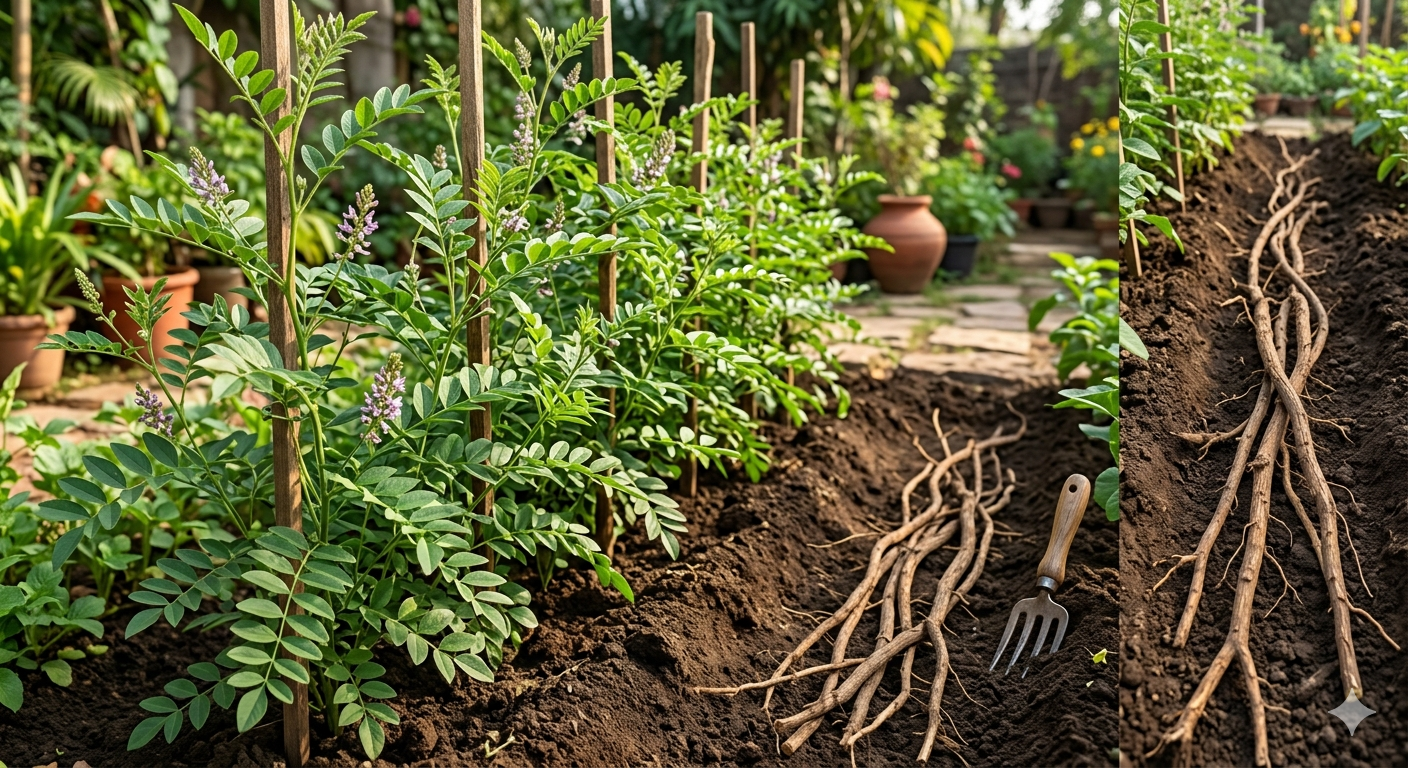
Grow mulethi at home — deep container for roots, 3-year root harvest, throat sore remedy and skin brightening paste preparation.
Mulethi घर पर उगाएं — deep container, 3-year root harvest, throat sore remedy और skin brightening paste।
Mulethi (Glycyrrhiza glabra) — Liquorice or Licorice root — is one of the world's oldest and most widely used medicinal herbs, with a documented history of use spanning 4,000+ years across Ayurveda, Chinese medicine, Egyptian medicine and European herbal traditions. Known as Yashtimadhu in Sanskrit ("sweet stick"), mulethi's natural sweetness comes from glycyrrhizin — a compound 30–50 times sweeter than sugar — which is also its primary active medicinal compound. Growing mulethi at home in India is possible in most regions, though it requires patience — roots become medicinally useful after 2–3 years of growth.
Mulethi (Glycyrrhiza glabra) — Yashtimadhu — 4,000+ years की documented history। Glycyrrhizin 30–50 times sweeter than sugar। India में grow करना possible है — roots 2–3 years में medicinally useful बनती हैं।
🌿 Mulethi Quick Reference
💊 Health Benefits of Mulethi
Mulethi के Health Benefits
| Condition | How Mulethi Helps | Use |
|---|---|---|
| 🗣️ Sore Throat & Cough | Demulcent and expectorant — soothes inflamed throat, loosens mucus, reduces cough. Most widely known use in India | Chew mulethi stick. Mulethi + ginger + honey tea. |
| 🫀 Liver Protection | Glycyrrhizin is hepatoprotective — used in Japan as standard treatment for liver disease. Reduces liver inflammation | Mulethi powder with warm water daily |
| 🫃 Gastric Ulcers & Acidity | DGL (deglycyrrhizinated licorice) form heals gastric mucosa. Reduces acid reflux and ulcer pain | Mulethi powder before meals |
| 🌸 Hormonal Balance (Women) | Phytoestrogens support estrogen balance — used in PCOS, menopausal symptoms | Mulethi tea regularly |
| 🧴 Skin — Brightening | Glabridin inhibits melanin production — natural skin brightener. Anti-inflammatory for eczema and psoriasis | Mulethi powder paste on skin |
| 🦷 Dental Health | Antibacterial against Streptococcus mutans — chewing mulethi stick reduces tooth decay | Chew stick as natural toothbrush |
🌱 Growing Mulethi in India
India में Mulethi Growing
🌱 Soil, Container & Climate
Soil, Container और Climate
- Deep, well-drained alkaline soil: 40% garden soil + 30% cocopeat + 20% coarse sand + 10% vermicompost. Mulethi is a Mediterranean plant — prefers slightly alkaline soil (pH 7.0–8.0). Add 1 tbsp garden lime per container to maintain alkaline pH. Excellent drainage is critical — root rot in wet conditions.
- Best Indian regions: Punjab, Haryana, Rajasthan, Gujarat, UP — the drier, semi-arid zones of North and Northwest India match mulethi's natural Mediterranean habitat best. High humidity coastal regions (Kerala, Mumbai) are more challenging but possible in containers with excellent drainage.
- Cool dry winters help: Mulethi benefits from winter dormancy (cool + dry) followed by warm spring — this cycle improves root quality and glycyrrhizin concentration. North Indian winters are excellent for this.
💧 Watering, Fertilizing & Care
Watering, Fertilizing और Care
- Deep, infrequent watering: Water thoroughly every 7–10 days in growing season. Let top 3–4 inches dry between waterings. In winter dormancy — once every 3–4 weeks only (enough to prevent complete desiccation). Deep watering encourages roots to grow deeper — producing longer, more medicinal roots.
- Light phosphorus fertilization for root development: Bone meal or SSP (2 tbsp per container) once in February and once in September. Excess nitrogen produces lush foliage but reduces root development and glycyrrhizin concentration. Minimal nitrogen is the rule for mulethi.
- Annual stem pruning: Cut all above-ground stems to 10–15 cm in November as plants go dormant. This redirects all plant energy into root development through winter rather than maintaining foliage.
✂️ Harvesting Mulethi Roots
Mulethi Roots Harvest करना
- Harvest in autumn — Year 3+: October–November after foliage yellows is ideal harvest time. Carefully dig around the plant, extract lateral roots (leave central crown for regrowth). Select roots 0.5–1 cm diameter — these have highest glycyrrhizin content.
- Clean and dry: Wash roots thoroughly, scrub outer bark lightly (don't peel completely — much active compound is in bark). Slice into 5–10 cm pieces. Dry in shade 2–3 weeks until completely hard. Store in cloth bag or glass jar — up to 2 years shelf life.
- Quality test: Good mulethi root has intense, characteristic sweet earthy smell. Cross-section should show yellow-brown fibrous interior. Chewing a piece should give distinctly sweet, slightly bitter, lingering aftertaste.
🍵 Home Uses & Preparations
| Preparation | Method | Best For |
|---|---|---|
| 🍵 Mulethi tea | Boil 1 tsp mulethi powder or 2 pieces root in 2 cups water 10 min, strain, add honey | Throat, cough, acidity, daily tonic |
| 🪥 Chew stick | Chew 3–5 cm piece of dried root — suck out sweet juice | Throat soothing, dental health |
| 🧴 Skin brightening paste | Mix mulethi powder with rose water into paste, apply 20 min | Dark spots, tan, uneven skin tone |
| 💊 Mulethi + Ginger + Honey | Equal parts powder, mix, take 1/2 tsp with warm water | Cold, sore throat, immunity |
🔧 Common Problems & Fixes
| Problem | Cause | Fix |
|---|---|---|
| 🍃 Foliage dies back in winter | Normal dormancy | Normal. Cut stems short, water minimally. Regrowth in March. |
| 🦟 Root rot | Waterlogging — most common killer | Improve drainage drastically. Mulethi cannot tolerate wet roots. |
| 📏 Thin, sparse roots after 3 years | Too much nitrogen or container too small | Switch to deeper container. Minimize nitrogen fertilizer. |
| 🐛 Aphids on new spring growth | Common in spring flush | Neem oil spray. They disappear once leaves mature. |