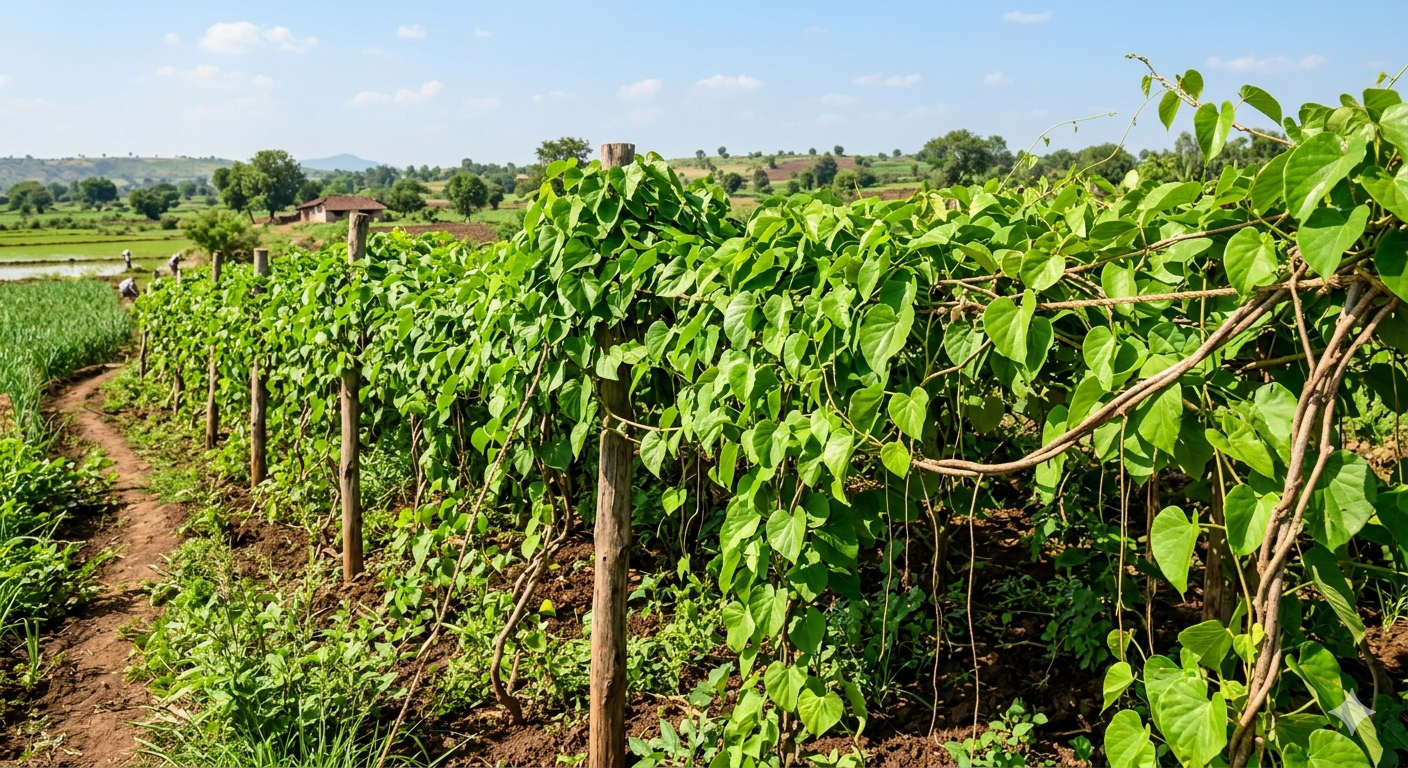
Grow giloy at home — stem cuttings, climbing support, neem tree giloy tip, kadha/juice preparation and year-round harvest.
Giloy घर पर उगाएं — stem cuttings, climbing support, neem tree giloy benefit, kadha/juice preparation।
Giloy (Tinospora cordifolia) — also called Guduchi, Amrita or Heart-leaved Moonseed — is India's most celebrated Ayurvedic immunity herb. Called "Amrita" (divine nectar) in ancient texts, giloy has been used for 3,000+ years in Indian medicine for fever, dengue, malaria, diabetes, arthritis, liver health and general immunity. The COVID-19 pandemic created an extraordinary surge in giloy awareness and demand across India — and the good news is that giloy is one of the easiest Ayurvedic herbs to grow at home. A single cutting in a pot or on a balcony railing can provide a continuous fresh supply of stems for kadha, juice or powder throughout the year.
Giloy (Tinospora cordifolia) — Guduchi, Amrita — India का most celebrated Ayurvedic immunity herb है। COVID-19 pandemic ने giloy awareness extraordinary surge create की। Good news: giloy घर पर grow करना easiest Ayurvedic herbs में से एक है। एक single cutting पूरे साल fresh stems provide करती है।
🌿 Giloy Quick Reference
💊 Health Benefits of Giloy — Why Grow It
Giloy के Health Benefits — क्यों Grow करें
| Health Use | How Giloy Helps | Traditional Use |
|---|---|---|
| 🛡️ Immunity Boost | Immunomodulatory — stimulates WBC production, strengthens immune response | Daily giloy kadha — 2 tbsp stem juice morning |
| 🌡️ Fever (including dengue) | Antipyretic properties — reduces fever, dengue platelet support | Giloy + tulsi + black pepper kadha |
| 🩸 Diabetes | Hypoglycaemic — helps regulate blood sugar | Fresh stem juice on empty stomach |
| 🦴 Arthritis | Anti-inflammatory — reduces joint pain and swelling | Giloy powder with warm milk |
| 🫀 Liver Health | Hepatoprotective — protects liver from toxins | Giloy juice regularly |
| 🧠 Stress & Anxiety | Adaptogenic — reduces stress, improves mental clarity | Giloy powder with ashwagandha |
🌱 How to Grow Giloy at Home
Giloy घर पर कैसे Grow करें
🌱 Soil Mix & Container
Soil Mix और Container
- Giloy is extremely forgiving about soil: It grows in virtually any well-draining soil. Best mix: 40% garden soil + 30% vermicompost + 20% cocopeat + 10% sand. However, giloy also grows adequately in plain garden soil — it's one of the least fussy plants about growing medium.
- Container size: Minimum 12-inch pot for single plant. 16–20 inch for vigorous growth. Giloy's roots are moderate and don't need very large containers. Can also grow directly in ground where it spreads generously.
- Outdoor ground planting: Giloy thrives in ground planting around compound walls, fences and trees. In ground, it needs zero supplemental care once established and provides unlimited harvest.
💧 Watering & Sunlight
Watering और Sunlight
- Full sun to partial shade — highly adaptable: Giloy grows in full sun (best growth, most potent stems) and tolerates partial shade. North-facing balconies with 3–4 hours indirect light produce adequate plants, though growth is slower. South or east-facing positions with 5+ hours sun give the most vigorous growth.
- Drought tolerant once established: After the first 2–3 months, established giloy handles dry spells very well. Water every 5–7 days in summer. Every 10–14 days in winter and monsoon. It is almost impossible to kill an established giloy through underwatering.
- Monsoon — giloy thrives: Indian monsoon is giloy's favourite season — it grows most vigorously in July–September with abundant rain and warmth. No supplemental irrigation needed during monsoon.
✂️ Harvesting Giloy at Home
Giloy Harvest करना
- Harvest mature stems — not young growth: Harvest stems that are at least pencil-thick (5–8 mm diameter) and greenish-brown in color. Young thin green shoots are less potent. Mature stems have the highest concentration of tinosporin and other active compounds.
- Cut with clean scissors — 1/3 rule: Never harvest more than 1/3 of the plant at once. Cut stems at a node — the plant regrows from the node below the cut. A well-established plant provides continuous harvests every 6–8 weeks.
- Aerial roots also usable: Giloy produces numerous aerial roots hanging from stems — these are particularly valued in Ayurveda. Collect them when they grow 10+ cm long.
- Best harvest time: October–February when alkaloid content is highest (cool weather concentrates active compounds). Stems harvested in this period are most potent.
🍵 How to Use Home-Grown Giloy
Home-Grown Giloy कैसे Use करें
| Preparation | How to Make | Dose | Best For |
|---|---|---|---|
| 🍵 Kadha (decoction) | Boil 6 inch stem (chopped) in 2 cups water, reduce to 1 cup, strain | 1/2 cup twice daily | Fever, immunity, general health |
| 🥤 Fresh stem juice | Blend 10–15 cm fresh stem with 1/2 cup water, strain through cloth | 2–3 tbsp morning empty stomach | Diabetes, liver health, dengue recovery |
| 🌿 Dried powder | Dry stems in shade 2 weeks, grind to fine powder | 1/2 tsp with warm water or milk | Daily tonic, arthritis, immunity |
| 🍯 Giloy + Honey | Mix fresh juice with equal honey | 1 tbsp morning | Children's immunity (palatability) |
🔧 Common Problems & Fixes
| Problem | Cause | Fix |
|---|---|---|
| 🍃 Cutting not rooting | Too dry or wrong season | Keep soil consistently moist for first 3 weeks. Plant in monsoon or spring for best success. |
| 🟡 Yellow leaves | Overwatering or low light | Reduce watering. Move to brighter spot. |
| 🐛 Mealybugs on stems | Common on giloy in dry season | Neem oil spray 5ml/L weekly × 3 weeks. |
| 🌿 Slow growth indoors | Insufficient light | Move to brightest available spot or outdoor railing. |
| 🍃 Leaves drop in winter | Normal seasonal behavior | Giloy is semi-deciduous — leaf drop in cool dry winter is normal. New growth resumes in spring. |