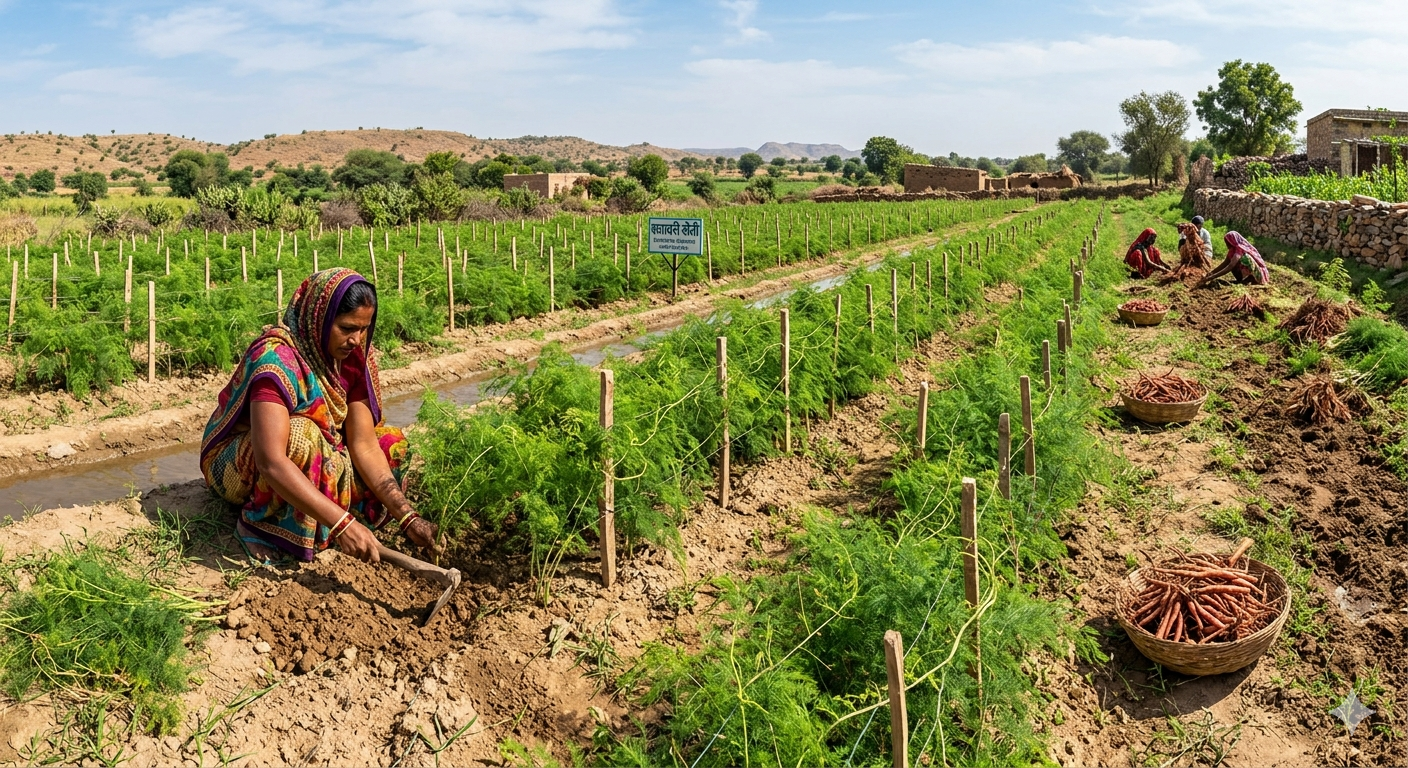
Grow shatavari at home — deep container for tuberous roots, climbing vine, root harvest from Year 2 and shatavari milk preparation.
Shatavari घर पर उगाएं — deep container, climbing vine, Year 2 root harvest और shatavari milk preparation।
Shatavari (Asparagus racemosus) — meaning "she who has a hundred husbands" in Sanskrit, referring to its legendary vitality-giving properties — is Ayurveda's most important herb for women's health. A climbing plant with feathery, needle-like foliage and small white flowers, shatavari's thick tuberous roots are the medicinal part, used for hormonal balance, fertility support, lactation enhancement, menopausal symptoms and general vitality. It is also deeply valued for men's health, digestive issues and as a general rejuvenating tonic (rasayana). Shatavari grows well across India and can be grown in large containers or garden plots.
Shatavari (Asparagus racemosus) — Ayurveda का most important herb for women's health है। Hormonal balance, fertility support, lactation, menopausal symptoms और general vitality के लिए। Tuberous roots medicinal part हैं। India भर में grows well — large containers या garden plots में।
🌿 Shatavari Quick Reference
💊 Health Benefits of Shatavari
Shatavari के Health Benefits
| Use | How It Helps | Who Benefits |
|---|---|---|
| 🌸 Hormonal Balance | Phytoestrogens regulate estrogen levels, supporting menstrual regularity, PMS and hormonal fluctuations | Women of all ages |
| 🤱 Lactation Support | Galactagogue — increases breast milk production. One of Ayurveda's primary herbs for nursing mothers | Breastfeeding mothers |
| 🌡️ Menopause | Reduces hot flashes, mood swings and dryness symptoms through phytoestrogenic action | Perimenopausal and menopausal women |
| 💪 General Vitality (Rasayana) | Adaptogenic — improves physical strength, stamina, stress tolerance in both men and women | All adults |
| 🫃 Digestive Health | Soothes gastrointestinal tract — helpful in acidity, gastritis, IBD. Prebiotic-like effect | Digestive issues |
| 👶 Fertility Support | Improves reproductive health in both men and women — supports healthy sperm and ovarian function | Couples trying to conceive |
🌱 How to Grow Shatavari at Home
Shatavari घर पर कैसे Grow करें
🌱 Soil, Container & Climate
Soil, Container और Climate
- Well-drained deep soil is critical: 35% garden soil + 30% vermicompost + 25% cocopeat + 10% coarse sand. Deep, well-drained, rich in organic matter. Root rot in waterlogged conditions is the main risk — excellent drainage is essential.
- All India suitable: Shatavari grows from Kerala and Tamil Nadu to Rajasthan, UP and Himachal Pradesh. Tolerates heat (up to 42°C), moderate cold (down to 5°C), drought and humidity. One of India's most geographically widespread medicinal plants.
- Annual dying back is normal: In cooler months (October–January in North India) and in dry season, shatavari's aerial vine dies back while roots remain healthy underground. Don't discard the "dead" pot — new shoots emerge with warmth and rain.
💧 Watering & Fertilizing
Watering और Fertilizing
- Moderate watering — drought tolerant: Water every 7 days in summer. Every 10–14 days in monsoon and winter. Shatavari handles dry spells well once established — the thick tuberous roots store water and nutrients. Never let container soil stay waterlogged for more than 24 hours.
- Phosphorus for root development: Apply bone meal or SSP (2 tbsp per pot) in February and June to encourage thick root development — phosphorus directly drives tuberous root growth. Monthly balanced liquid fertilizer (NPK 20:20:20 at half strength) during growing season supports vigorous vine growth.
✂️ Harvesting — Roots, Leaves & Berries
Harvesting — Roots, Leaves और Berries
- Root harvest — Year 2 onwards: Shatavari roots are medicinally mature after 1.5–2 years. Harvest roots in October–November when vine dies back naturally. Carefully dig, extract thick tuberous roots, wash clean. Replant thin roots to regenerate the plant. Thick roots (1–2 cm diameter): peel, slice, dry in shade 5–7 days. Store dried root slices in airtight container.
- Young leaf/shoot harvest — Year 1: Tender young shoots can be used as asparagus substitute (Shatavari is wild asparagus) — lightly sauté or add to curries. Edible and mildly medicinal.
- Berries: Red berries on mature plants — edible, sweet-tart. Seeds inside used for new propagation. Berries traditionally given to children as a mild tonic.
🍵 Traditional Uses & Preparations
| Preparation | How to Make | Use |
|---|---|---|
| 🥛 Shatavari Milk (Ksheer Pak) | Boil 1 tsp shatavari powder in 1 cup milk + honey to taste | Women's tonic, lactation, general vitality |
| 🌿 Shatavari Ghee | Cook fresh root paste in ghee on low heat 30 min, strain | Reproductive health, strength, digestion |
| 💊 Root powder | Dried root ground fine — 1/2–1 tsp with warm water | Daily tonic, hormonal balance |
| 🧃 Fresh root juice | Blend fresh root with water, strain — 2 tbsp daily | Immediate potency, summer cooling |
🔧 Common Problems & Fixes
| Problem | Cause | Fix |
|---|---|---|
| 🍃 Vine dies back completely | Normal seasonal behavior — roots alive | Don't discard. Water once a week. New shoots emerge with warmth. |
| 🟡 Yellow thin new growth | Nitrogen deficiency or root rot | Check soil drainage. Apply balanced fertilizer. |
| 🐛 Caterpillars on foliage | Common on feathery asparagus-type foliage | Hand pick. Bt spray. Neem oil. |
| 📏 No thick roots after 2 years | Container too small or insufficient phosphorus | Move to deeper 40L container. Add bone meal/SSP. |