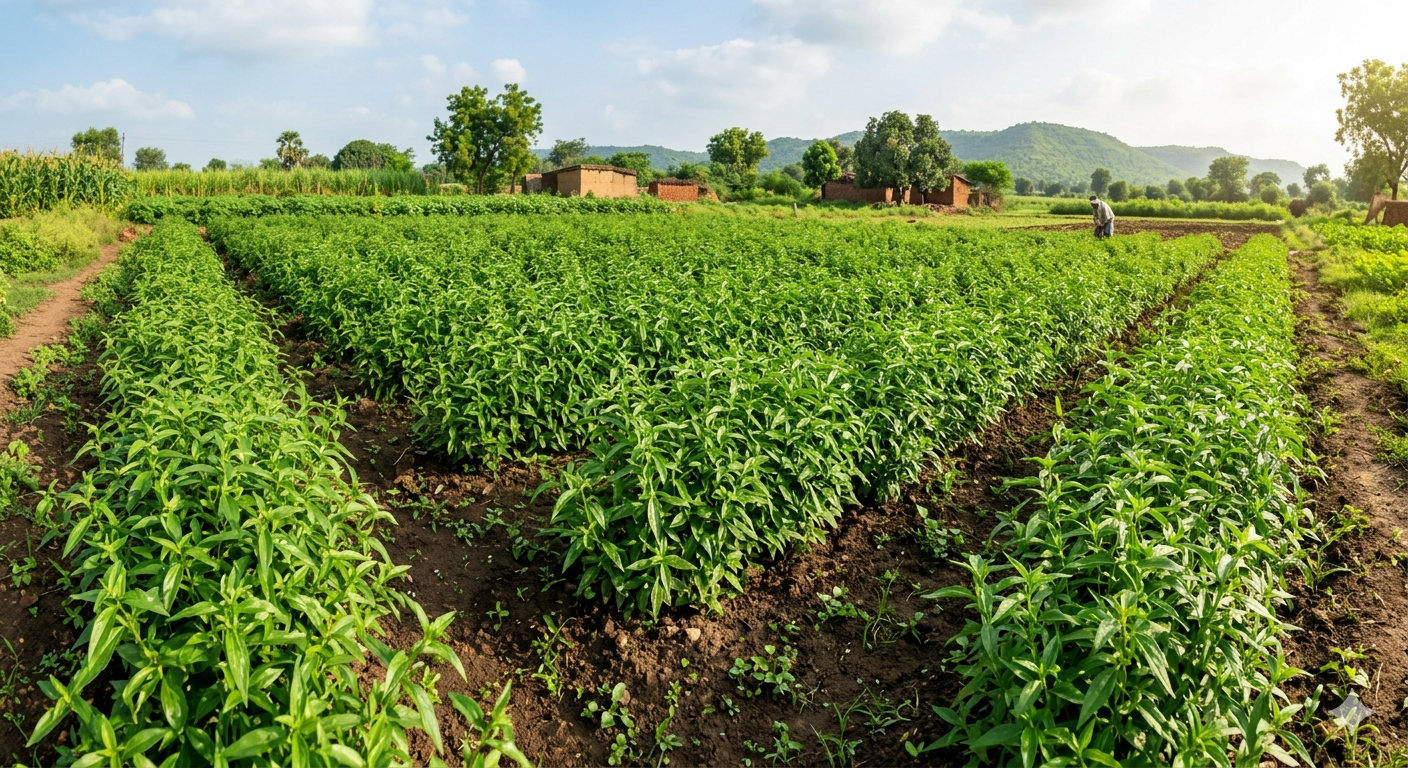
Grow kalmegh at home — annual sowing, pre-flower harvest timing for max potency, liver protection and immunity benefits.
Kalmegh घर पर उगाएं — annual sowing, pre-flower harvest for max potency, liver और immunity benefits।
Kalmegh (Andrographis paniculata) — also called Green Chiretta, Bhunimba, Kirayat or the "King of Bitters" — is one of India's most important medicinal herbs for liver health, viral infections, fever and immunity. Its extraordinary bitterness (among the most bitter plants known) is itself the medicinal property — the diterpene andrographolide responsible for this intense bitterness is the active compound that gives kalmegh its powerful antiviral, hepatoprotective, anti-inflammatory and immunostimulatory effects. During the COVID-19 pandemic, AYUSH recommended kalmegh-based formulations (Coronil, Divya Coronil) bringing this previously lesser-known herb into mainstream Indian health consciousness.
Kalmegh (Andrographis paniculata) — Green Chiretta, Bhunimba, "King of Bitters" — India का most important medicinal herb for liver health, viral infections और immunity है। Extreme bitterness ही medicinal property है — andrographolide active compound। COVID-19 pandemic के दौरान AYUSH ने recommend किया।
🌿 Kalmegh Quick Reference
💊 Health Benefits — Liver, Immunity & Viral Infections
Health Benefits — Liver, Immunity और Viral Infections
| Condition | How Kalmegh Helps | Traditional Use |
|---|---|---|
| 🫀 Liver Protection | Hepatoprotective — andrographolide protects liver cells from toxins, alcohol damage and fatty liver. Comparable to silymarin (milk thistle) in studies | Kalmegh juice/kadha for jaundice and liver disorders |
| 🦠 Viral Infections | Strong antiviral activity against influenza, common cold, respiratory viruses. Multiple clinical trials confirm faster recovery from upper respiratory infections | At first sign of cold/fever — kalmegh kadha |
| 🌡️ Fever | Potent antipyretic — reduces fever naturally. Particularly effective for malarial fever in traditional use | Kalmegh decoction for fever of all types |
| 🛡️ Immunity | Immunostimulatory — increases WBC count, activates immune response. Regular use as seasonal preventive | Monsoon season immunity preparation |
| 🫃 Digestive Health | Bitter taste stimulates bile production, improves digestion, treats constipation and intestinal worms | Kalmegh powder with warm water for digestion |
🌱 How to Grow Kalmegh at Home
Kalmegh घर पर कैसे Grow करें
🌱 Soil, Container & Light
Soil, Container और Light
- Soil mix: 35% garden soil + 30% vermicompost + 25% cocopeat + 10% perlite. Well-drained but moisture-retaining. Kalmegh in nutrient-poor soil actually produces higher andrographolide content (mild stress = more active compounds) — don't over-fertilize.
- Light: 4–6 hours direct sun is ideal. Tolerates partial shade but produces more bitter (more potent) leaves in full sun. Morning sun with afternoon shade — acceptable.
- Multiple sowings for continuous supply: Sow a new pot every 4–6 weeks from March–July. This staggered sowing ensures continuous pre-flowering harvest supply throughout the monsoon and post-monsoon season when respiratory infections peak.
💧 Watering & Care
Watering और Care
- Moderate watering — avoid waterlogging: Water every 5–7 days in summer. Every 7–10 days in monsoon. Let top inch dry before watering. Kalmegh is more susceptible to root rot than drought — err on the dry side.
- Minimal fertilizer: One light application of balanced NPK (half strength) at 30 days after transplanting is sufficient. Over-fertilizing produces lush growth but reduces andrographolide (bitterness) concentration — the exact opposite of what you want medicinally.
- Pinch growing tips at 6 weeks: Pinching the main growing tip at 6 weeks encourages branching — more stems = more harvest biomass. Do this once only.
✂️ Harvesting & Preparations
Harvesting और Preparations
- Fresh leaf juice: Extract juice from 10–15 fresh leaves — 2 tbsp with honey on empty stomach. Extremely bitter — honey is essential. Use for fever, cold onset, liver health.
- Kadha (decoction): Boil 5–6 dried leaves in 2 cups water, reduce to 1 cup, strain, add honey and ginger. Drink hot twice daily during active illness.
- Drying and powder: Dry harvested stems and leaves in shade 7–10 days. Grind to fine powder. Store airtight. 1/4–1/2 tsp with honey or warm water. Dried powder retains potency 6–12 months.
- Kalmegh tincture: Soak 50g dried herb in 200ml food-grade alcohol (vodka) for 4 weeks, strain. 1 ml (20 drops) in water — convenient concentrated form.
🔧 Common Problems & Fixes
| Problem | Cause | Fix |
|---|---|---|
| 🟡 Yellow leaves | Overwatering or nutrient excess | Reduce watering, skip fertilizer. Slight stress improves potency. |
| 🌸 Flowers before expected harvest | Heat stress or normal progression | Harvest immediately at first bud — don't wait. |
| 🐛 Aphids on young growth | Common on tender kalmegh tips | Neem oil 5ml/L spray. Water jet blast. |
| 🌱 Poor germination | Old seeds or low temperature | Use fresh seeds. Maintain 25–30°C for germination. Sow in March–June only. |