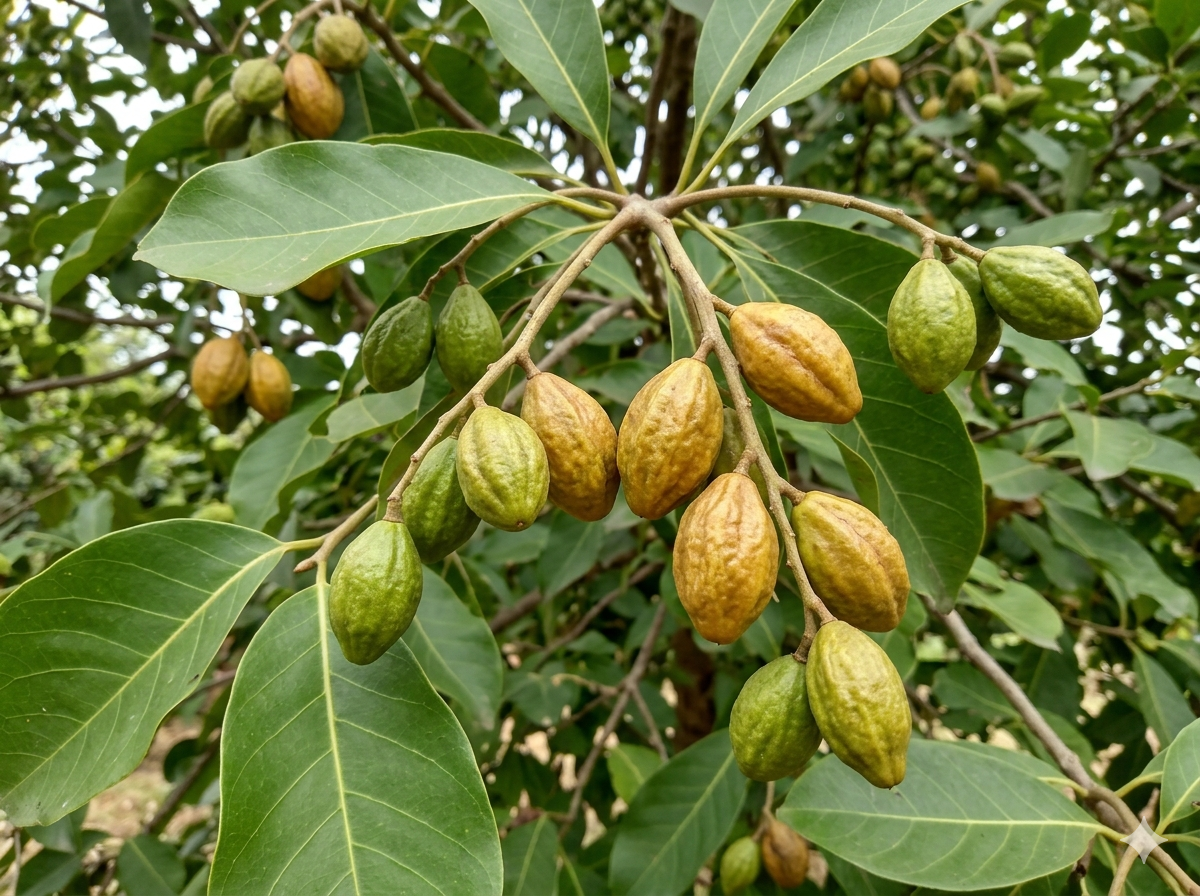
हरड़ — King of Medicines (Tibetan)। Medicine Buddha हाथ में रखते हैं। 5 tastes। Blueberries से ज़्यादा antioxidant। Anti-HIV gallic acid confirmed। Dental > chlorhexidine। Rasayana seasonal protocol।
Haritaki (Terminalia chebula) — Harad / Harar / Chebulic Myrobalan / Black Myrobalan — is considered the "King of Medicines" in Tibetan medicine and one of Ayurveda's most revered healing fruits. Called "Abhaya" (fearless one) in Sanskrit — it bestows the fearlessness of perfect health. The fruit of Haritaki is one of Ayurveda's most complex medicines, uniquely containing all six tastes (sweet, sour, salty, pungent, bitter, astringent) except salty — making it one of the rare herbs that can be used for all three doshas simultaneously. In Tibetan Thangka paintings, the Medicine Buddha (Sangye Menla) is depicted holding a Haritaki fruit — demonstrating this tree's supreme status in Buddhist medicine. Haritaki is one of the three fruits of Triphala, where it serves as the Vata-balancing component. Modern phytochemical research has confirmed Haritaki as one of the most antioxidant-rich fruits in the world — significantly richer than blueberries, açaí and most other "superfruits." It contains chebulic acid, chebulanin, corilagin, gallic acid, ellagic acid and over 30 other bioactive compounds with confirmed anti-microbial, anti-fungal, anti-viral, anti-diabetic and anti-tumor activity.
Haritaki (Terminalia chebula) — हरड़ / हरर — Tibetan medicine में "King of Medicines।" Sanskrit में "Abhaya" (निडर) — perfect health की निडरता प्रदान करता है। Six में से पांच tastes — sweet, sour, pungent, bitter, astringent — सब एक फल में। Medicine Buddha Thangka paintings में Haritaki fruit हाथ में। Triphala का Vata-balancing component। Modern research: world के most antioxidant-rich fruits में — blueberries और açaí से significantly richer। 30+ bioactive compounds — anti-microbial, anti-fungal, anti-viral, anti-diabetic, anti-tumor।
🌳 Overview & Quick Facts / परिचय और मुख्य तथ्य
| 🔬 Scientific Name | Terminalia chebula — Family: Combretaceae |
| 📏 Height / ऊंचाई | 15–25 metres | Spreading deciduous tree / Spreading deciduous tree |
| ⏳ Lifespan / आयु | 100–200+ years | Productive for 80-100 years / 80-100 साल productive |
| 🍎 Fruits / फल | November–January — oval, ribbed, yellow-brown to black. 7 types recognized in Ayurveda. / November-January — 7 types |
| 🌡️ Climate / जलवायु | Tropical dry forests. Pan-India below 1,500m. Very drought tolerant once established. |
| 🌍 Native Range / मूल क्षेत्र | Pan-India — dry deciduous forests. Nepal, Sri Lanka, SE Asia. Himalayas up to 1,500m. |
| ⚖️ Legal Status / कानूनी | MFP — tribal FRA 2006 rights on forest land. Private land: freely cultivate. Timber: Forest Dept permit. |
| 💰 Fruit Value / फल मूल्य | Rs.20–50/kg dried | Rs.60–120/kg powder | Premium varieties Rs.100-200/kg | MSP declared |
🌿 Parts & Their Uses — हर अंग का उपयोग
Primary medicinal हिस्सा। 7 varieties — Vijaya (सर्वोत्तम), Rohini (wound healing), Putana (बाल), Amrita (Dosha-balancing), Abhaya (आंख), Jivanti (त्वचा), Chetaki (purgative)। Market: Rs.20-50/kg dried, Rs.60-120/kg powder।
छाल काढ़ा: anti-diarrheal, wound wash, gum disease (gargling)। High tannins — commercial tanning। Bark paste: skin infections, ulcers। MFP: Rs.10-20/kg। Leather tanning industry।
Leaves: food plates। Young leaves: anti-inflammatory। Leaf paste: skin irritations। Gargle throat infections। Traditional natural dyeing — iron mordant के साथ black dye। Fallen leaves: mulch, soil improver।
Seed kernel: mucilaginous — skin care और binding agent। Seed oil: hair oil, skin। Commercially widely traded नहीं। Seed powder: mild anti-microbial। Ayurvedic use के लिए seed remove करते हैं — seed-free pericarp standard formulation।
Small white/yellow fragrant spikes (March-June)। Honey source dry deciduous forests में। Flower extract: mild anti-oxidant। Spring season में bees को nectar — forest honey production और ecosystem pollination।
लकड़ी: heavy, hard, durable dark heartwood। कृषि औज़ार, निर्माण, furniture, printing blocks। Commercial: Rs.600-1,000/cubic foot। Forest Dept permit required। Historically: traditional black ink के लिए। Printing block carving।
🌍 Ayurvedic Significance & Research / Ayurvedic महत्व और अनुसंधान
🌱 Growing Guide / हरड़ कैसे उगाएं
| Parameter | English | Hindi / हिंदी |
|---|---|---|
| 🌱 Propagation | Seeds from ripe fallen fruits (Dec-Jan). Hard endocarp — scarify or crack carefully. Germination 20-30 days. | Ripe fallen fruits (Dec-Jan) से बीज। Hard endocarp — scarify या carefully crack। 20-30 दिन germination। |
| 🪴 Soil | Well-draining loamy to sandy loam. pH 5.5–8.0. Highly drought tolerant. Rocky soil: tolerates. Avoid waterlogged. | Well-draining loamy। pH 5.5-8.0। Highly drought tolerant। Rocky soil tolerate। Waterlogged avoid। |
| 📅 Best Time | Monsoon June-July for best establishment. | Monsoon June-July — best establishment। |
| 📏 Spacing | 8 metres fruit production. 5-6 metres timber plantation. Roots moderately spreading. | Fruit production: 8 मीटर। Timber: 5-6 मीटर। Roots moderately spreading। |
| 🍎 First Fruits | Year 7–10 from seed. Commercial harvest from Year 12-15. | बीज से Year 7-10 में फल। Commercial harvest Year 12-15। |
| 💰 Income | Mature tree 20-60 kg fruits/year × Rs.30/kg = Rs.600-1,800/tree. 100 trees = Rs.60,000-1,80,000/year. | 20-60 kg fruits/year × Rs.30 = Rs.600-1,800/tree। 100 trees = Rs.60,000-1,80,000/year। |
💰 Market Value & Legal Status / बाज़ार मूल्य और कानूनी स्थिति
| Product / उत्पाद | Value / मूल्य | Legal / कानूनी |
|---|---|---|
| 🍎 Dried Fruit / सूखे फल | Rs.20–50/kg | MSP Rs.35/kg declared / MSP declared | FRA 2006 tribal forest rights. Private: freely. TRIFED MSP procurement. |
| 💊 Fruit Powder | Rs.60–120/kg | Premium variety Rs.100-200/kg | Freely tradeable / freely |
| 🌍 Export | Rs.80–150/kg FOB | USA, EU herbal supplement market | APEDA export certification required / APEDA certification |
| 🪵 Timber / लकड़ी | Rs.600–1,000/cubic foot | Forest Dept permit / permit required |
Haritaki 7 types — Ayurvedic classification: (1) Vijaya — Vindhya। Round, heavy, black। Best overall — all three Doshas balance। (2) Rohini — Sindh। Round, full। Wound healing। (3) Putana — small, thin flesh। Purgation + external। (4) Amrita — thick flesh। Detoxification। (5) Abhaya — five-lobed, black। Eye health। (6) Jivanti — yellow। Skin health। (7) Chetaki — distinct ridges। Purgative। Modern market: mostly simply "T. chebula" — general use के लिए कोई भी good quality। Specific applications के लिए experienced Ayurvedic vaidya। Practical: Vijaya = larger, heavier, darker, five lobes well-developed।
Haritaki timing — ancient recommendation की science: Ayurvedic texts: universally bedtime। Reasons: (1) Mild laxative: रात को gentle peristalsis stimulation — morning effortless bowel movement। Primary practical reason। (2) Tannin absorption: post-dinner, near-empty stomach पर better absorption। (3) Liver function: रात में liver detoxification (10 PM-2 AM) — hepatoprotective compounds synergize। (4) Rasayana effect: winter में rock salt, summer में sugar, monsoon में ghee, autumn में jaggery के साथ। Dosage: 3-5g powder + warm water OR Triphala tablets। Lower dose से start। Adjust if too loose। Contraindication: pregnancy नहीं (uterine stimulant)। Diarrhea में नहीं। Fever में नहीं।
Haritaki dental health — strongest evidence areas में: Research: Haritaki extract Streptococcus mutans के against effective — कुछ studies में chlorhexidine से superior without side effects। Methods: (1) Haritaki powder teeth cleaning: 1 tsp powder + mustard oil + turmeric। Gums massage, rinse। (2) Haritaki mouthwash: 5g powder + 200ml warm water। Gargle 2-3 minutes। (3) Triphala mouthwash: Haritaki + Baheda + Amla। Research: 60-patient RCT — Triphala mouthwash plaque 67% reduce in 15 days। Chlorhexidine comparable but without staining side effects। (4) Haritaki gum pack: powder + ghee paste, 10 minutes gums पर। Haritaki temporarily saliva yellow-brown stain — normal, rinse करें।
Haritaki Rasayana protocol — Charaka Samhita seasonal: Winter (Nov-Feb): Haritaki + rock salt (saindhava)। Salt warmth, digestion। Summer (May-June): Haritaki + sugar (mishri)। Sugar heat reduce। Monsoon (July-Aug): Haritaki + ghee। Ghee absorption, Vata। Autumn (Sep-Oct): Haritaki + jaggery (guda)। Spring (Mar-Apr): Haritaki + honey (madhu)। Interpretation: हर carrier specific organ/Dosha के लिए — empirically derived। Modern: different carriers different active compounds की bioavailability affect कर सकते हैं। Practical: 3-5g powder + carrier, रात को once daily, minimum 3 months। Traditional: 1-year seasonal cycle = full Rasayana।
Haritaki anti-HIV research — honest assessment: Research: (1) Gallic acid: HIV-1 integrase enzyme inhibit (HIV DNA insert करने के लिए)। (2) Chebulagic acid: HIV viral lifecycle के multiple steps inhibit। (3) Ellagic acid: anti-retroviral activity। Research context: ALL in-vitro — test tubes और cell cultures। कोई clinical trials (human studies) नहीं। In-vitro results ≠ clinical efficacy। Practically: (1) Haritaki HIV treatment नहीं है। ART बंद मत करें — life-threatening। (2) Research interesting, future clinical investigation warrant। (3) General immune support (anti-oxidant, anti-inflammatory) ART पर HIV-positive individuals को supportive benefits — but HIV physician से discuss। (4) Pharmaceutical companies Haritaki-derived compounds investigate कर रहे हैं। Bottom line: test tubes में interesting। Treatment नहीं। Prescribed ART continue करें।