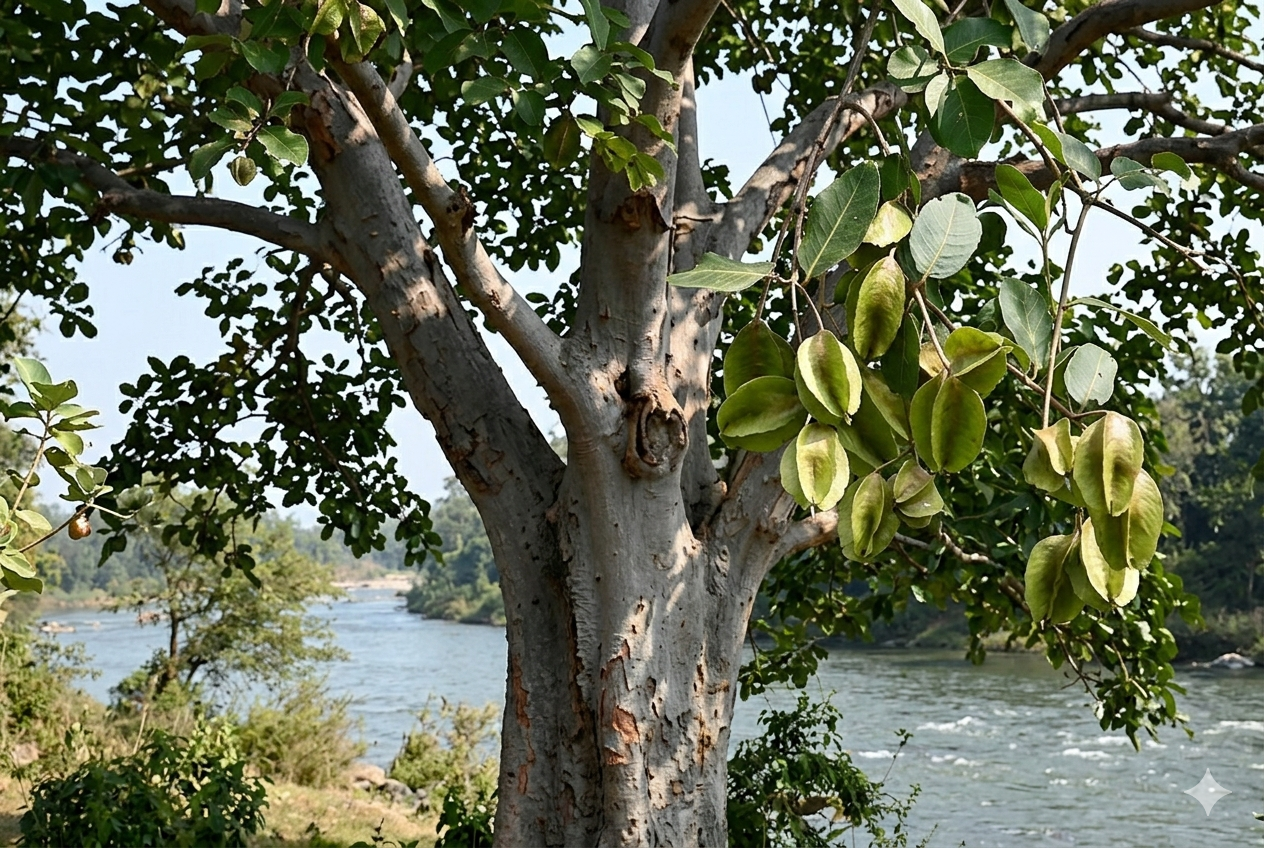
अर्जुन — India का heart tree। White smooth peeling bark = सबसे distinctive ID। Multiple RCTs confirm: angina ↓, heart failure ↑, BP ↓। Muga silk food tree (Assam)। Riverbank keystone। छाल: Rs.40-80/kg।
Arjuna (Terminalia arjuna) — Arjun / Koha / White Marudah — is India's most important cardiac tree and one of Ayurveda's greatest contributions to cardiovascular medicine. Named after the Mahabharata hero Arjuna (meaning "pure white" — referring to its distinctive pale white smooth bark), this large riverine tree has been used for heart disease treatment in India for over 2,500 years. Vagbhata's Ashtanga Hridayam (7th century CE) describes Arjuna bark as the primary cardiac medicine. Modern clinical research has produced some of the strongest evidence of any Ayurvedic herb — multiple randomized controlled trials confirm that Arjuna bark extract significantly reduces chest pain (angina), improves cardiac function in heart failure, reduces blood pressure, and has anti-platelet activity. The bark contains unique glycosides (arjunine, arjunetin) and flavonoids that have been shown to strengthen cardiac muscle, improve coronary artery blood flow and have direct cardioprotective effects. India's rivers — Ganga, Yamuna, Godavari, Krishna, Mahanadi — are lined with Arjuna trees, which also play a critical ecological role in riverbank stabilization.
Arjun (Terminalia arjuna) — अर्जुन / कोहा — India का सबसे महत्वपूर्ण cardiac tree और Ayurveda का हृदय रोग में सबसे बड़ा योगदान। Mahabharata के नायक अर्जुन के नाम पर — distinctive pale white smooth bark के कारण। 2,500+ वर्षों से हृदय रोग उपचार में। Vagbhata की Ashtanga Hridayam (7वीं शताब्दी) में primary cardiac medicine। Modern clinical research में multiple RCTs — angina, heart failure, blood pressure, anti-platelet activity सब confirm। India की नदियां — गंगा, यमुना, गोदावरी — अर्जुन वृक्षों से सजी हैं।
🌳 Overview & Quick Facts / परिचय और मुख्य तथ्य
| 🔬 Scientific Name | Terminalia arjuna — Family: Combretaceae |
| 📏 Height / ऊंचाई | 20–25 metres | Spread: 10–15m | Large riverine tree / बड़ा नदी किनारे का वृक्ष |
| ⏳ Lifespan / आयु | 100–200+ years / 100-200+ वर्ष |
| 📈 Growth Rate / वृद्धि दर | Moderate — 1.5–2 ft/year / मध्यम |
| 🌸 Flowers / फूल | March–June — small white/yellowish spikes. Fragrant. / मार्च-जून — छोटे सफेद/पीले spikes |
| 🌡️ Climate / जलवायु | Tropical — prefers riverbanks, moist areas. 20–40°C. Pan-India plains. |
| ⚖️ Legal Status / कानूनी | Not federally protected but state restrictions in some areas. Wild bark collection regulated. Cultivation freely allowed. |
| 💰 Bark Value / छाल मूल्य | Rs.40–80/kg dried bark — high cardiac medicine demand / Rs.40-80/kg सूखी — उच्च cardiac मांग |
🌿 Parts & Their Uses — हर अंग का उपयोग
Primary medicinal हिस्सा — pale white, smooth, पतली sheets में छिलती। Arjunine, arjunetin glycosides, flavonoids, tannins, calcium, zinc। Clinical evidence: angina कम, heart failure सुधार, BP कम, anti-platelet। Market: Rs.40-80/kg सूखी।
Leaves: anti-inflammatory extract। Leaf decoction: त्वचा, घाव में external। युवा पत्ते: Assam में Antheraea paphia (muga silkworm) को खिलाते हैं — Arjuna primary muga silk food tree। Tribal Chhattisgarh, Jharkhand में food plates।
छोटे fragrant white/yellow flower spikes — अच्छा honey source (apiculture)। Flower extract: mild anti-oxidant। मंदिर offerings। Riparian zones में bees के लिए महत्वपूर्ण nectar source।
5-winged fibrous fruits (2-5cm) — मनुष्यों के लिए edible नहीं। Wildlife food। Anti-microbial research। Traditional tanning industry — high tannin। गिरे fruits: natural fertilizer।
Root system: fibrous, extensive, riverbank anchor — critical ecological erosion prevention। Root extract: mild cardiac activity (छाल से कमज़ोर)। Collection recommended नहीं — tree और riverbank stabilization को नुकसान।
लकड़ी: कठोर, भारी, durable, लाल-भूरा heartwood। पारंपरिक: कृषि औज़ार, नाव निर्माण (riverine communities), furniture। Commercial timber: Rs.600-1,000/cubic foot। Legal: transit permit required। Muga silk industry में use।
🌍 Cardiac Medicine Research & Ecology / हृदय चिकित्सा अनुसंधान और पारिस्थितिकी
🌱 Growing Guide / अर्जुन कैसे उगाएं
| Parameter | English | Hindi / हिंदी |
|---|---|---|
| 🌱 Propagation | Seeds from ripe 5-winged fruits (October-November). Soak 24 hours before sowing. Germination 15-20 days. | पके 5-winged fruits से बीज (October-November)। बोने से पहले 24 घंटे भिगोएं। 15-20 दिन germination। |
| 🪴 Soil | Deep alluvial or loamy soil. Moist riverine conditions ideal. pH 6.0–8.0. Cannot tolerate very dry or waterlogged. | गहरी alluvial या loamy मिट्टी। Moist riverine conditions ideal। pH 6.0-8.0। बहुत सूखा या waterlogged नहीं। |
| 💧 Water | Moderate to high. Riverbank planting ideal — natural moisture. Regular irrigation first 3 years. | Moderate से high। Riverbank planting ideal — natural moisture। पहले 3 साल नियमित irrigation। |
| 📏 Spacing | 8–10 metres between trees. Roots extensive but not as invasive as Peepal/Banyan. | पेड़ों के बीच 8-10 मीटर। जड़ें extensive लेकिन पीपल/बरगद जितनी invasive नहीं। |
| 🟫 Bark harvest | Starts Year 8–10. Harvest max 25% bark circumference sustainably. Bark regrows in 2–3 years. | Year 8-10 से शुरू। Max 25% bark circumference sustainably harvest करें। 2-3 साल में दोबारा उगती। |
| 💰 Income | Bark from Year 10: Rs.40–80/kg × 5 kg/tree/year = Rs.200–400/tree/year. Plus timber Year 20+. | Year 10 से छाल: Rs.40-80/kg × 5 kg/tree/year = Rs.200-400/tree/year। Plus timber Year 20+। |
💰 Market Value & Legal Status / बाज़ार मूल्य और कानूनी स्थिति
| Product / उत्पाद | Value / मूल्य | Legal / कानूनी |
|---|---|---|
| 🟫 Bark / छाल | Rs.40–80/kg dried / सूखी। High cardiac Ayurvedic demand. | Wild: regulated. Own cultivated trees: freely harvest sustainably. / Wild: regulated। Cultivated: freely। |
| 🍯 Honey (from flowers) | Arjuna honey premium — Rs.400–800/kg / Arjuna शहद premium | Freely tradeable / freely |
| 🦋 Muga silk support | Arjuna leaves for silkworms — Rs.5–10/kg in Assam | Freely tradeable / freely |
| 🪵 Timber / लकड़ी | Rs.600–1,000/cubic foot / Rs.600-1,000/cubic foot | Transit permit required from Forest Dept / Forest Dept transit permit |
Arjuna छाल हृदय के लिए — evidence और method: Multiple RCTs — medical evidence का gold standard — ने Arjuna छाल test किया। Key studies: (1) angina (chest pain) में significant सुधार। (2) Heart failure में cardiac output improved। (3) ACE inhibition (BP), anti-platelet activity, cardiac muscle strengthening। Preparation: (1) Arjuna tea: 1 tsp छाल पाउडर + 1 कप दूध + 1 कप पानी, 1 कप बचने तक उबालें। सुबह खाली पेट। (2) Bark powder capsule: 500mg-1g, दिन में दो बार। (3) Arjunarishta: fermented liquid formulation। Important: Heart medication replace नहीं करता। Complementary supplement। Cardiologist को ज़रूर बताएं। BP और pulse monitor करें।
Arjuna पहचान — सबसे distinctive feature: छाल। छाल: smooth, pale white से light grey, पतली flat layers/sheets में naturally peeling — white paper जैसी। यह किसी अन्य common Indian tree जैसी नहीं। Habitat: लगभग exclusively riverbanks, water bodies के पास। अगर river के पास white-barked बड़ा पेड़ दिखे — बहुत likely Arjuna। Leaves: oblong, 10-20cm, rounded tip, leaf stalk base पर 2 छोटे glands। Fruit: distinctive 5-winged samara (2-5cm)। Confusion: Terminalia bellirica (Baheda) — larger leaves, rough grey bark (smooth white नहीं)। Simple rule: smooth white peeling bark near river = Arjuna।
Arjuna-muga silk connection India के सबसे interesting ecological-economic relationships में। Muga silk: Antheraea paphia silkworm — केवल Assam में (geographical monopoly)। Golden-colored, naturally lustrous — दुनिया के सबसे expensive silks में। GI-tagged Assam product। Silkworm-tree connection: Antheraea paphia larvae specific trees पर — Som primary, Arjuna ("Soalu" Assam में) most important secondary food tree। Arjuna plantation Assam में: govt-promoted specifically for muga silk। Farmers earn: (1) Arjuna छाल (Ayurvedic)। (2) Silkworm leaf supply। (3) Timber Year 20+। Triple income — एक पेड़ से। Assam muga silk: 200,000+ weaver families।
Arjunarishta = classical Ayurvedic fermented tonic — Arjuna छाल primary ingredient। Composition: Arjuna छाल काढ़ा + dhataki flowers + other cardiac herbs + fermentation। Indications: (1) Chronic stable angina। (2) Hypertension adjunct। (3) Heart failure adjunct। (4) Palpitations। (5) Post-heart attack recovery। (6) General cardiac tonic। Dosage: 15-30ml + बराबर गर्म पानी, दिन में दो बार खाने के बाद। Available: Dabur, Baidyanath, Patanjali — Rs.100-200 per 450ml। Duration: cardiac conditions के लिए minimum 3 months। Doctor के बिना use न करें: active heart attack में, multiple cardiac medications पर (interaction risk)।
Arjuna riverbank के लिए — ecological और economic case: Ecological benefits: (1) Bank stabilization: Arjuna root system fibrous और extensive — riverbank soil bind करता है, erosion prevent। India annually millions tonnes fertile topsoil खोता है — Arjuna plantation सबसे effective biological solution। (2) Flood buffer: floodwater slow, sediment deposition। (3) Riparian ecosystem: March-June flowers — bees के लिए nectar। Fruits — birds। Fallen leaves — riverside soil। (4) Water table: deep roots। Govt programs: MNREGS, Namami Gange, state forest dept riparian schemes — Arjuna specifically included। Economic: 500 Arjuna trees river strip पर। Year 10: bark Rs.1-2 lakh/year। Year 25: timber Rs.25-40 lakh। Plus beekeeping। Land protect करता है + income देता है।