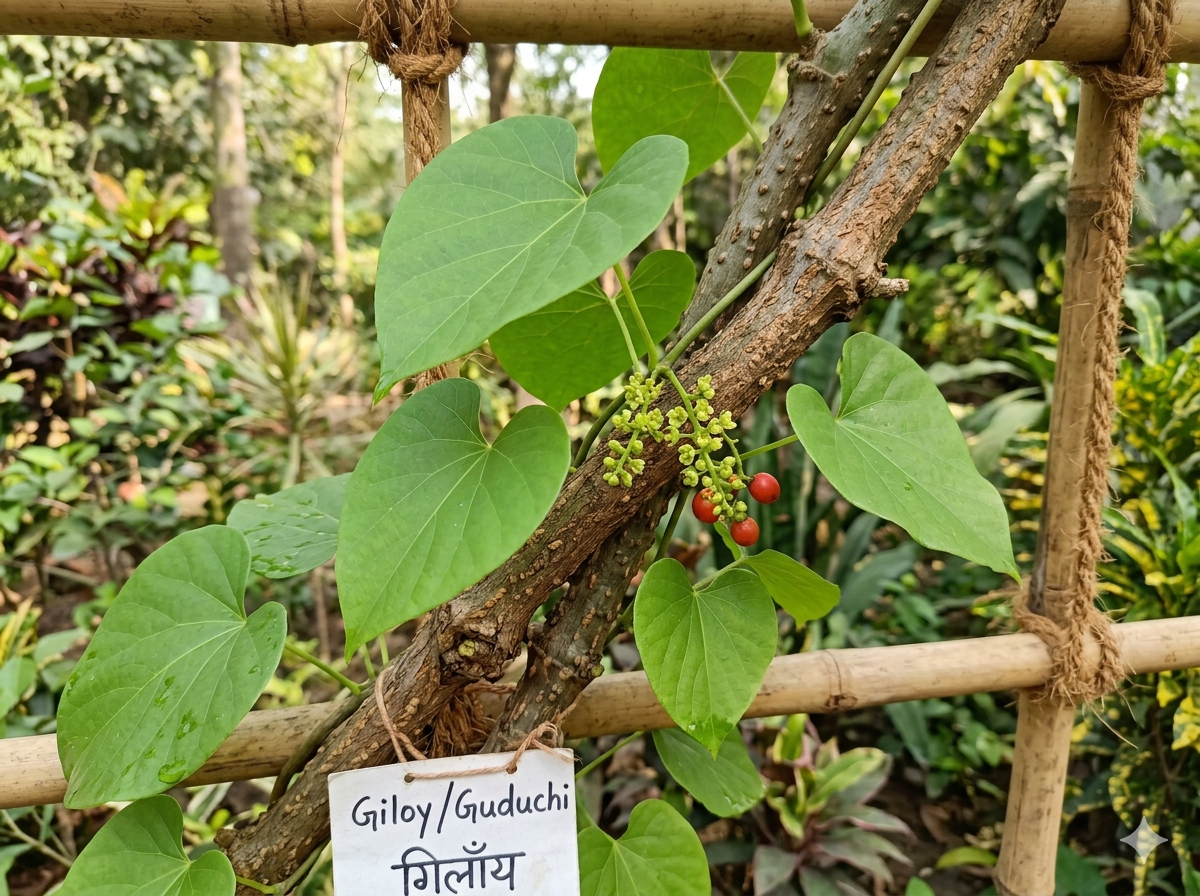
🌱 Year-round from stem cutting | Plant near NEEM for maximum potency!⏱️ Pencil-thick mature green stems | Continuous perennial harvest🌿 Easy Grow✅ Edible Safe
Photo: PlantCare
GiloyGuduchiAmritaNeem-Giloy Most PotentVirtually UnkillableDengue PlateletsImmunomodulator
Giloy / Guduchi — "Amrita" (nectar of immortality). Plant near NEEM = Neem-Giloy (most potent!). Virtually unkillable. Dengue platelet support clinically studied. Autoimmune: caution.
Giloy / Guduchi — "Amrita" (nectar of immortality)। NEEM के पास plant = Neem-Giloy (most potent!)। Virtually unkillable। Dengue platelet support clinically studied। Autoimmune: caution।
⚡ Quick Reference / एक नज़र में
🌱 Sowing Season
Year-round from stem cutting | Plant near NEEM for maximum potency!
⏱️ Harvest Time
Pencil-thick mature green stems | Continuous perennial harvest
🍽️ Edible Parts
Mature green stems (pencil-thick best) — neem-grown most potent
☀️ Light
Full sun to partial shade — very adaptable
💧 Water
Every 7-14 days — drought tolerant, virtually unkillable
🌡️ Temperature
15-45°C — widest range of any herb India
💊
Key Nutrition / पोषण
Tinosporine+Berberine (immunomodulator), Dengue platelet support (clinical), Liver protection
🍳
Indian Kitchen Uses / भारतीय रसोई
Giloy kwath (decoction), fresh juice 30ml, giloy+tulsi+ginger immunity trio
Giloy (Tinospora cordifolia) — Guduchi / Amrita — is Ayurveda's most important immunomodulatory herb and experienced a global spotlight during the COVID-19 pandemic when India's Ministry of AYUSH recommended it as an immunity booster. Its Sanskrit name "Amrita" literally means "nectar of immortality" — reflecting the extraordinary reverence in which Indian traditional medicine holds this climbing vine. Native to the Indian subcontinent, giloy grows wild across India from the Himalayas to southern tip, climbing trees, walls and trellises. The remarkable property of giloy: it absorbs medicinal properties from the tree it climbs — giloy growing on neem trees is traditionally considered the most potent medicinal variety (Neem-Giloy). For home gardeners, giloy is one of the easiest medicinal plants to grow — it is virtually unkillable once established, spreads aggressively, tolerates any condition, and provides unlimited fresh stem for daily immunity support year-round.
Giloy (Tinospora cordifolia) — Guduchi / Amrita — Ayurveda का most important immunomodulatory herb। COVID-19 pandemic में AYUSH Ministry ने recommend किया। Sanskrit "Amrita" = nectar of immortality। India में wild grows — Himalayas से southern tip तक। Neem tree पर grow = most potent (Neem-Giloy)। Home garden में: virtually unkillable, aggressively spreads, any condition tolerant।
🌿 Overview, History & Varieties
🔬 Scientific Name
Tinospora cordifolia
🌍 Origin
Indian subcontinent — native. Wild across India. Ancient Ayurvedic texts.
🧬 Classification
Rasayana herb — Ayurveda's highest category for rejuvenating, life-extending plants
🌡️ Temperature
15-45°C — extraordinary range, one of India's most climate-adaptable herbs
🌿 Growth
Vigorous climbing vine — grows 3-5m in one season. Perennial, regrows annually.
💡 Key Fact
Grows on neem = Neem-Giloy (most potent). Host tree's properties absorbed.
Type
Source
Potency
🌿 Neem-Giloy
Giloy growing on neem tree
Highest — absorbs neem's bitter antimicrobial compounds. Traditional first choice.
🌿 Mango-Giloy
Giloy growing on mango tree
Good — absorbs mango's polyphenols
🌿 Standard Giloy
Trellis/wall grown
Good standard potency — all medicinal properties present
🌿 Wild Giloy
Forest/wild collection
Variable — stress-grown has higher active compounds
💊 Nutrition & Health — Giloy ke Fayde
Compound
Amount
Health Benefit
🛡️ Tinosporine + Berberine
Primary alkaloids
Immunomodulation, antimicrobial, anti-inflammatory, anti-cancer research
🌿 Tinosporaside
Unique to Tinospora
Hepatoprotective (liver protection), antioxidant
🩸 Giloin + Giloinin
Glycosides
Blood sugar reduction — anti-diabetic mechanism
🔥 Cordioside
Stem — significant
Anti-fever (antipyretic), anti-inflammatory
🧬 Polysaccharides
High in stem
Immunostimulant — activates macrophages and lymphocytes
🌿 Arabinogalactan
Present
Prebiotic, immune system primer — gut-immunity axis
Immunity modulation — not just stimulation: Giloy is classified as an immunomodulator, not just an immunostimulant. This distinction is crucial: it both stimulates immunity when low (infections, post-illness recovery) AND suppresses it when overactive (autoimmune conditions, allergies). This bidirectional effect — rare in medicinal plants — explains why giloy is prescribed both for recurrent infections (boost immunity) and for conditions like rheumatoid arthritis (reduce autoimmune activity). Several clinical trials show giloy increases natural killer cell activity, macrophage function and immunoglobulin levels in healthy subjects.
Fever and dengue: Giloy is India's most traditional anti-fever herb — used for thousands of years for all fevers including malarial fever. Clinical relevance today: giloy juice has shown platelet-increasing effects in dengue fever (multiple Indian clinical studies). During dengue outbreaks: fresh giloy stem juice (30ml) twice daily alongside medical treatment is widely practiced across India with some clinical support.
Liver protection: Multiple animal and some human studies show giloy protects the liver from toxin-induced damage and supports liver enzyme normalization. Traditional use for liver conditions (jaundice, hepatitis recovery) has pharmacological basis — tinosporaside and other compounds have direct hepatoprotective activity.
🌱 Growing Guide — India ka Immortal Vine
✂️
Stem Cutting — Easiest
Giloy grows from any stem cutting with near-100% success. Take 15-30 cm stem with 2-3 nodes. Plant in any soil — even dry sandy ground. Water once. Roots emerge in 10-14 days. Success: near-guaranteed. You can literally push a giloy stem into soil, water occasionally, and it will grow. Find a neighbor with giloy: ask for stem cutting — free and immediately effective. Most medicinal plant nurseries sell giloy (Rs.30-80 per plant).
🌳
Plant Near Neem Tree
For maximum potency: plant giloy at base of neem tree. The vine climbs neem naturally, absorbs neem's alkaloids (nimbin, azadirachtin) through xylem — creating the revered Neem-Giloy combination. Plant in July-August monsoon. Giloy reaches neem canopy in 1-2 growing seasons. Harvest stems from neem-climbing portions specifically. Alternative: plant near any established tree — mango, peepal, amla — for enhanced properties from respective hosts.
🏠
Container + Trellis
Large container (30L+) with 1.5-2m trellis or bamboo support. Giloy climbs aggressively — provide substantial support. Full sun to partial shade — very adaptable. Water every 7-10 days. Monthly compost. Container giloy: slower than ground but productive in 4-6 months. Excellent for apartment terrace where ground planting not possible. One container with trellis provides year-round stem supply for daily kwath (decoction).
⚠️
Containment Important
Giloy is invasive — spreads vigorously via stem rooting wherever vines touch soil. Garden bed planting: giloy will colonize entire garden within 1-2 seasons. Management: regular pruning of wandering vines, clear defined trellis or tree support. Annual hard pruning after winter: cut entire vine to knee height — vigorous spring regrowth. Don't be intimidated — more growth = more harvest, but manage direction and spread.
💧 Growing & Care
⚡ Quick Care Reference
☀️ Light
Full sun to partial shade
Extremely adaptable
💧 Water
Every 7-14 days
Drought tolerant — very forgiving
🌡️ Temperature
15-45°C — widest herb range
Pan-India adaptable
🪴 Soil
Any — truly any soil
Rocky, sandy, clay — all fine
🧪 Fertilizer
Annual compost — unfussy
Grows with zero inputs
✂️ Harvest
Mature stems pencil-thick
Thumb-thick older stems most potent
Virtually zero pest or disease issues: Giloy is one of India's most pest-resistant plants — its own alkaloids deter most insects and pathogens. Mealy bugs occasionally on young growth — neem oil spray. Otherwise: plant and harvest, no management needed. This makes giloy ideal for low-attention gardening.
Which stems to harvest: Pencil-thick to thumb-thick mature green stems are most medicinal — maximum alkaloid content. Very thin young stems: lower potency. Very old thick woody stems: still useful but tougher to process. Fresh green semi-mature stems from middle of the vine: ideal for daily kwath.
🌿 Harvest, Processing & Medicinal Uses
Cut pencil-thick stems: Cut mature green stems 30-45 cm long. Wash thoroughly. Use fresh (most potent) or shade-dry for storage. Dried stems: store 6-12 months. Giloy powder: dry stems completely, grind. Fresh stem juice: crush + squeeze + strain. Kwath (decoction): most traditional method — boil in water. Standard dose: fresh 5-7cm stem piece per day or 30ml juice or 1 tsp powder in warm water.
Preparation
Method
Best For
🌿 Giloy Kwath (Decoction)
5-7 cm stem boiled in 400ml water, reduce to 100ml, strain
Daily immunity, fever, dengue support
🥤 Fresh Stem Juice
Crush fresh stem, squeeze through cloth — 30ml twice daily
Dengue platelets, acute fever, detox
🌿 Giloy + Tulsi + Ginger
Combined decoction — classic immunity trio
Monsoon immunity, respiratory infections
🍯 Giloy Sat
Starch extracted from soaked stem — white powder. Highly concentrated.
Pitta conditions, high potency use
💊 Tablet/Capsule
Commercial standardized extract when fresh unavailable
Convenience, travel, winter immunity
❓ FAQ
Daily giloy — safety profile: Generally safe at traditional doses for healthy adults for extended periods. Documented concerns: (1) Autoimmune conditions: giloy is immunostimulant — may worsen autoimmune conditions (lupus, RA, multiple sclerosis) in some individuals. Paradoxically, it's also used for RA in Ayurveda — the dose and preparation matter. Consult Ayurvedic physician. (2) Diabetes medication: giloy lowers blood glucose — those on diabetes medications should monitor glucose closely (additive hypoglycemic effect). (3) Surgery: stop 2 weeks before surgery — may interfere with blood sugar control during/after. (4) Pregnancy: limited data — traditional use suggests caution, particularly in first trimester. (5) Liver: rare reports of hepatotoxicity with giloy supplements (especially commercial tablets) — some cases reported post-COVID supplementation. Fresh home-grown stem kwath: generally safer than commercial concentrated extracts. (6) Over-consumption: very high doses may cause constipation. Traditional dose (5cm stem daily or 30ml fresh juice): well within safe range for healthy adults. Ayurvedic recommendation: use seasonally (monsoon + winter immunity seasons) rather than 365-day continuous.
Creating Neem-Giloy at home: (1) Ensure you have a neem tree — even a young 2-3 year old neem works. (2) June-July: take a healthy giloy stem cutting (30 cm with nodes). (3) Plant in soil at base of neem tree, 30 cm from trunk. (4) Water regularly during establishment (first 3-4 weeks). (5) Loosely tie giloy stem to neem trunk to guide climbing direction. (6) Within 4-8 weeks: giloy begins climbing neem trunk via adventitious roots. (7) Growing season: giloy climbs extensively through neem canopy. (8) After 6-12 months: stems that have been growing on neem for extended period are considered Neem-Giloy. (9) Identify: neem-grown giloy stems sometimes slightly more bitter than non-neem grown. Harvest these stems preferentially. The scientific mechanism: vascular connection between host tree and giloy through haustoria-like structures allows compound exchange — validated by research showing different alkaloid profiles in giloy grown on different hosts.
Dengue support protocol with giloy: (1) Fresh giloy stem juice: 30ml twice daily (morning and evening). Preparation: take 15-20 cm fresh stem, crush well, extract juice through cloth. (2) Alternatively: giloy kwath (decoction) — 5 cm stem boiled in 400ml water, reduced to 100ml, strained. (3) Add 5-7 fresh tulsi leaves to the same decoction for synergistic effect. (4) Papaya leaf juice: combine with giloy — papaya leaf has independent platelet-supporting evidence. (5) Duration: continue throughout dengue illness (usually 5-10 days). Important caveats: (1) Giloy is SUPPORTIVE treatment — not replacement for medical care. Severe dengue requires hospitalization. (2) Evidence: multiple Indian clinical studies show platelet count recovery improvement but this is clinical context with concurrent medical management. (3) Report all home remedies to treating doctor — interaction awareness important. Giloy + papaya leaf combo has become the standard Indian home dengue protocol alongside hospital treatment — evidence-based at this point.
Honest evidence assessment: COVID-19 context: During COVID-19, AYUSH Ministry of India recommended giloy as immunity booster — creating massive interest. What evidence shows: (1) Giloy genuinely modulates immune response — macrophage activation, natural killer cell enhancement, immunoglobulin increase. These non-specific immunity effects are real and documented pre-COVID. (2) Specific anti-SARS-CoV-2 activity: in-vitro (lab dish) studies showed some inhibition. Human clinical evidence: very limited, poorly designed studies during COVID rush. (3) Prevention: no robust clinical trial demonstrating giloy prevents COVID-19 infection. (4) Treatment: no evidence giloy treats active COVID-19 significantly. (5) Post-COVID recovery: anecdotally popular for fatigue and immune rebuilding post-illness — physiologically plausible but clinical evidence thin. Balanced view: giloy's general immunomodulatory properties make it a reasonable supportive supplement for general immune health. Specific COVID-19 claims were overstated. Growing controversy: some hepatotoxicity reports during COVID-era mass supplementation — emphasizing that even traditional herbs have risks at high doses or with commercial extracts.
Container giloy setup: (1) 30-40L container with well-draining mix (any garden soil works). (2) Install 1.5-2m bamboo trellis or place container near wall/railing for climbing support. (3) June-July or March-April: plant 2-3 stem cuttings (15-20 cm, any nodes). (4) Water every 7-10 days — no pampering needed. (5) Zero fertilizer requirement (monthly compost if you have it). (6) Within 6-8 weeks: established climbing vine begins. (7) First harvest: 3-4 months (pencil-thick stems). (8) Year-round: trim and harvest regularly — the more you harvest, the more vigorously it regrows. (9) Annual care: November-January — cut back severely (to 30 cm above soil), let regenerate spring. Container giloy: single most low-effort medicinal herb for Indian homes. Near-zero maintenance, any location, any condition, year-round harvest. The closest thing to a "plant it and forget it" medicine garden possible.