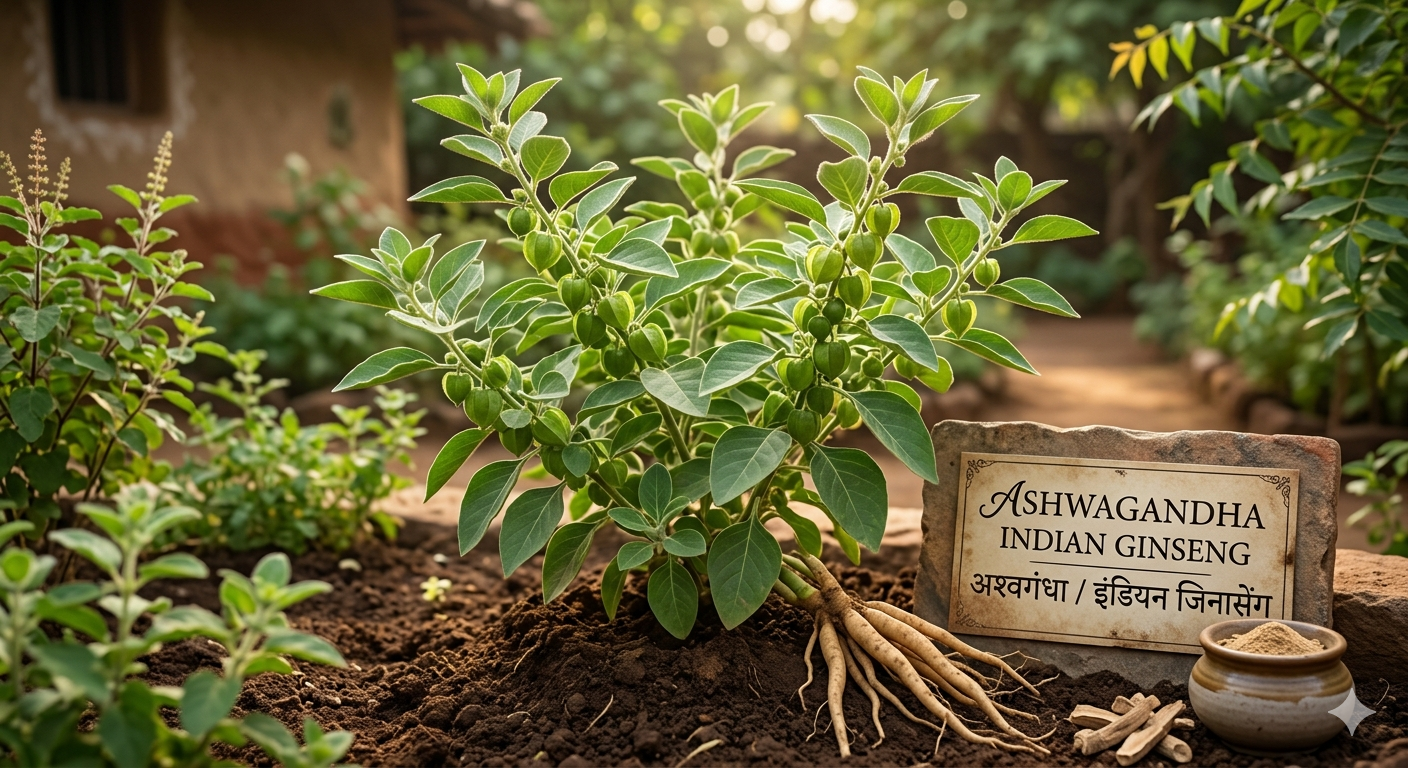
Ashwagandha — less water + poor soil = MORE withanolides! Cortisol -32%, Testosterone +22% (clinical). Rajasthan conditions ideal. Berries mildly toxic. Thyroid medication — monitor.
Ashwagandha — less water + poor soil = MORE withanolides! Cortisol -32%, Testosterone +22% (clinical)। Rajasthan conditions ideal। Berries mildly toxic। Thyroid medication — monitor।
Ashwagandha (Withania somnifera) — Indian Ginseng / Winter Cherry — is Ayurveda's most important adaptogenic herb and one of the most extensively researched medicinal plants in modern pharmacology. Its name in Sanskrit means "smell of horse" (ashwa = horse, gandha = smell) — referring both to the root's distinctive earthy aroma and the traditional belief that consuming it gives the strength and vitality of a horse. Used in Ayurvedic medicine for 3,000+ years, ashwagandha is one of India's most commercially cultivated medicinal herbs today — primarily in Rajasthan, Madhya Pradesh, Uttar Pradesh and Gujarat. For home gardeners, ashwagandha is extraordinary: it grows as a robust 1-2m shrub in dry poor soils that most plants avoid, requires almost no care, and allows harvest of medicinal roots in just 6-8 months from seeds. Growing your own means free, fresh, unadulterated ashwagandha root — dramatically superior to the processed supplements flooding the global market.
Ashwagandha (Withania somnifera) — Indian Ginseng — Ayurveda का most important adaptogenic herb। "Ashwa + Gandha" = horse smell — horse की strength देता है। 3,000+ years Ayurvedic medicine में। India's most commercially cultivated medicinal herb — Rajasthan, MP, UP, Gujarat। Home garden में: dry poor soil में grows, minimal care, 6-8 months में medicinal root harvest।
🌿 Overview, History & Varieties
| 🔬 Scientific Name | Withania somnifera |
| 🌍 Origin | Indian subcontinent, Mediterranean, Africa — India primary cultivation center |
| 💊 Classification | Adaptogen — helps body adapt to physical and mental stress (unique pharmacological category) |
| 🌡️ Temperature | 25-40°C — arid/semi-arid specialist. Frost-tolerant when established. |
| ⏱️ Harvest | 6-8 months from seed — annual or biennial crop |
| 🌱 Edible Parts | Root (primary medicine) + leaves (topical, some internal use) + berries (minor use) |
| Variety / Type | Specialty | Best For |
|---|---|---|
| 🌿 Poshita (CIMAP) | CSIR-CIMAP improved variety — high withanolide content, good yield | Commercial, home garden, highest potency |
| 🌿 Nagori (Rajasthan) | Traditional Rajasthan variety — large roots, mild flavor, most cultivated | Rajasthan commercial, widely available seeds |
| 🌿 Chetak | NMPB variety — high yield, drought tolerant | MP, Rajasthan commercial |
| 🌿 Wild type (Desi) | Smaller roots, more bitter, highest withanolide — traditional forest collection | Maximum potency, Ayurvedic traditional |
💊 Nutrition & Health — Ashwagandha ke Kamal ke Fayde
| Compound | Amount | Health Benefit |
|---|---|---|
| 🛡️ Withanolides | 2-5% in quality root | Primary active: anti-stress, anti-inflammatory, anti-tumor, neuroprotective |
| 🧠 Withaferin A | Key withanolide | Anti-cancer research, NF-κB inhibition (master inflammation switch) |
| 💪 Alkaloids (somniferin) | Significant | Sedative, anti-anxiety — "somnifera" = sleep-inducing in Latin |
| 🌿 Iron | 3.3 mg per 100g | Anemia support — traditional use for iron deficiency |
| 🏋️ Anabolic properties | Testosterone support | Muscle strength, testosterone levels, male fertility research |
| 🧬 Adaptogenic compounds | Full complex | Cortisol reduction, HPA axis modulation — stress resilience |
- Cortisol reduction — the clinically proven benefit: Multiple double-blind, placebo-controlled trials show ashwagandha root extract (300-600mg daily) significantly reduces serum cortisol (the primary stress hormone) by 14-32% over 60-90 days. Cortisol reduction has cascading benefits: improved sleep quality, reduced anxiety, better blood sugar control (cortisol raises blood sugar), reduced belly fat accumulation, and improved immune function. This cortisol-lowering effect is ashwagandha's most robustly proven benefit — unique among herbs in having this level of clinical evidence for stress reduction.
- Testosterone and male fertility: Three clinical trials show ashwagandha root powder (5g daily) increases testosterone by 10-22% and improves sperm count, motility and morphology significantly over 90 days. Traditional Ayurvedic use as vajikarana (sexual vitality enhancer) for men has modern clinical support. Mechanism: reduces stress-induced testosterone suppression (cortisol directly suppresses testosterone production), potentially stimulates LH production.
- Muscle strength and exercise performance: A 2015 Journal of International Society of Sports Nutrition study showed ashwagandha supplementation with resistance training increased muscle mass by 1.5-2x more than placebo, and improved recovery time. This is why ashwagandha has become the most popular Indian adaptogen in global sports nutrition.
🌱 Growing Guide — Arid India ka Medicinal Gem
💧 Growing & Care
- Stress = more withanolides: Counterintuitively, ashwagandha plants grown in slightly stressful conditions (sandy poor soil, less water, heat stress) produce MORE withanolides than plants grown in rich, well-watered conditions. The plant synthesizes withanolides as a defensive response to stress. This is why traditional Rajasthan wild-growing ashwagandha is considered more potent than garden-grown — the harsh desert conditions maximize active compound production. For home gardeners: don't pamper this plant.
- Fungal root rot — main risk: Waterlogged soil causes Phytophthora root rot — kills plants rapidly. Prevention: excellent drainage is everything. Never water when soil is still moist. In monsoon: ensure drainage is free. Raised beds or mounds in high-rainfall areas.
🌿 Harvest, Processing & Medicinal Uses
- Harvest at 6-8 months: Dig entire plant carefully — long taproot goes 30-40 cm deep. Wash roots thoroughly. Fresh root: peel, slice — use in milk decoction (recommended form). Dry: slice thin, sun-dry 7-10 days until brittle. Grind dried root to fine powder. Store in airtight glass jar — 12+ months. Standard dose: 1-2 tsp (3-6g) powder daily in warm milk with honey. Fresh root milk: boil 2-3 slices in 300ml milk 10 minutes — traditional ashwagandha ksheerapaka.
| Preparation | Method | Best For |
|---|---|---|
| 🥛 Ashwagandha Milk | 1 tsp powder in warm milk + honey + cardamom — bedtime | Sleep, stress, testosterone, recovery |
| 🌿 Churna (Powder) | Dried root powder — mix in water, milk, ghee or honey | Daily adaptogen dose — most common use |
| 🍫 Ashwagandha Ladoo | Root powder + ghee + jaggery + nuts — traditional energy sweet | Winter health sweet — traditional India |
| 💊 KSM-66 / Sensoril | Commercial standardized extract — 5% withanolides minimum | When growing own not possible |
| 🌿 Leaf Paste | Fresh leaf paste applied topically — traditional anti-inflammatory | Joint pain, skin infections (external only) |