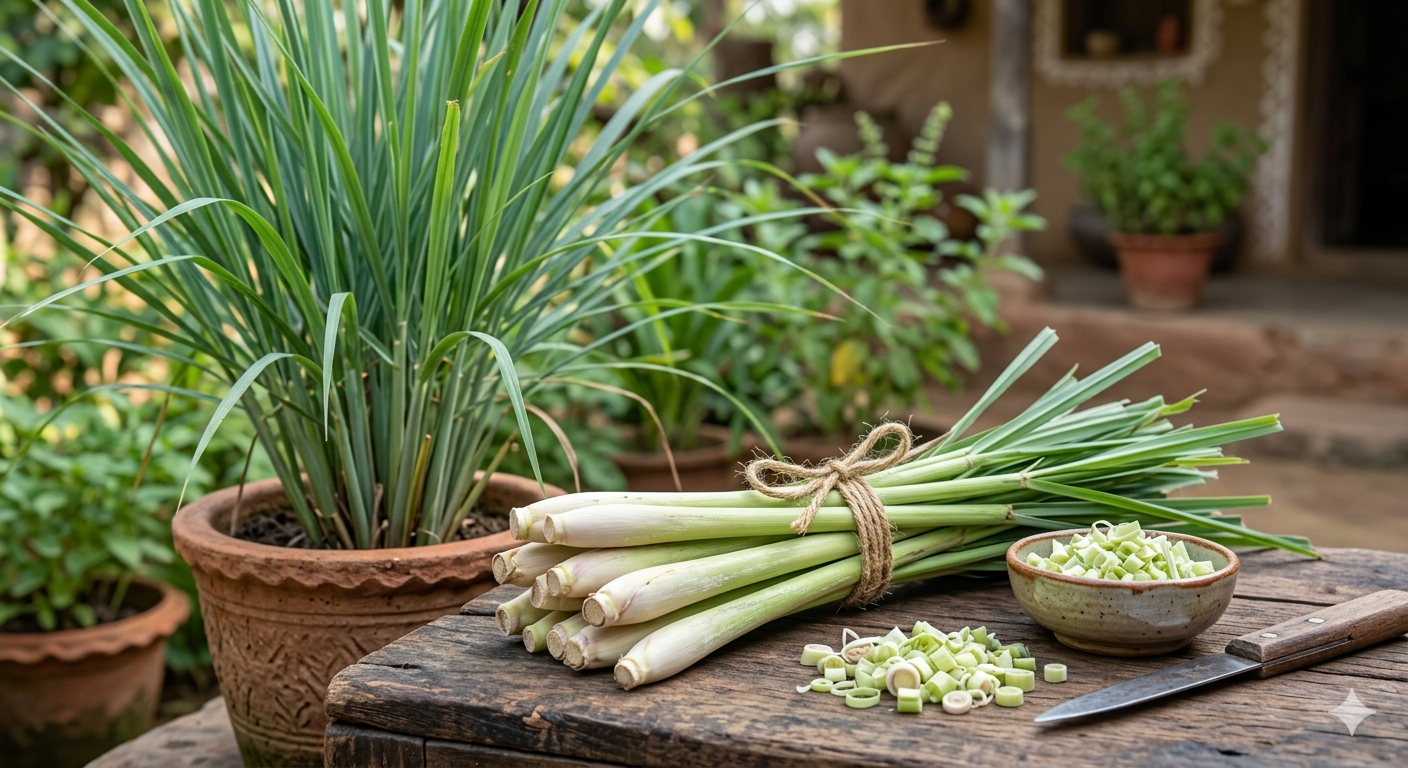
Lemongrass — grow FREE from market stalk in water (roots in 10 days!). Annual rejuvenation cut essential. Sharp leaf edges — wear gloves. India = world's largest oil producer. Chai essential.
Lemongrass — market stalk से FREE grow (10 days में roots!)। Annual rejuvenation cut essential। Sharp leaf edges — gloves पहनो। India = world का largest oil producer। Chai essential।
Lemongrass (Cymbopogon citratus / C. flexuosus) — Lemon Chai Ghas / Gavati Chaha — is India's most commercially important aromatic grass and the dominant flavor in India's beloved masala chai. India is the world's largest producer of lemongrass oil — Kerala, Tamil Nadu and Karnataka grow Cymbopogon flexuosus (East Indian lemongrass) that accounts for a major share of global lemongrass essential oil exports. The two main species: C. citratus (West Indian lemongrass — used in cooking, Thai cuisine, culinary) and C. flexuosus (East Indian / Malabar lemongrass — mainly for essential oil extraction). For home gardeners, lemongrass is among the most rewarding herbs possible: it grows in clumps reaching 1-2 meters, is virtually indestructible once established, requires minimal care, repels mosquitoes (citronella is derived from related species), and provides unlimited fresh grass for daily chai, herbal tea, cooking and aromatherapy year-round.
Lemongrass (Cymbopogon citratus) — Lemon Chai Ghas / Gavati Chaha — India का most commercially important aromatic grass। India = world का largest lemongrass oil producer। Masala chai में dominant flavor। Home garden में most rewarding: 1-2 meter clumps, virtually indestructible, minimal care, mosquitoes repel, unlimited fresh grass year-round।
🌾 Overview, History & Varieties
| 🔬 Scientific Name | Cymbopogon citratus (culinary) | C. flexuosus (East Indian, oil) | C. nardus (citronella) |
| 🌍 Origin | South and Southeast Asia — India and Sri Lanka. Ancient cultivation. |
| 🏭 India | World's largest lemongrass oil producer. Kerala, TN, Karnataka dominant. |
| 🌡️ Temperature | 20-40°C — tropical grass. Frost-sensitive but recovers from mild frost. |
| ⚡ Growth | Fast — clump doubles size every 3-4 months. Self-regenerating perennial. |
| 🦟 Bonus | Natural mosquito repellent — citronella oil from related species |
| Species / Type | Primary Use | Best For |
|---|---|---|
| 🌾 C. citratus (West Indian) | Culinary — thick pale stalks, strong lemon flavor | Thai cooking, chai, cooking base |
| 🌾 C. flexuosus (East Indian) | Essential oil — thinner stalks, high citral content | Oil extraction, Kerala commercial |
| 🌾 C. nardus (Citronella) | Insect repellent oil — different from culinary lemongrass | Natural mosquito repellent |
| 🌾 Gavati Chaha (Maharashtra) | Local name for lemongrass chai — Maharashtra tradition | Daily tea, Maharashtra home garden |
💊 Nutrition & Health — Lemongrass ke Fayde
| Compound | Amount | Health Benefit |
|---|---|---|
| 🌿 Citral (Geranial + Neral) | 70-85% of essential oil | Antimicrobial, antifungal, anti-inflammatory, antioxidant — primary active compound |
| 🧘 Myrcene | Significant in oil | Sedative, analgesic — sleep quality improvement, pain relief |
| 🦟 Citronellal | In related species | Natural insect repellent — mosquito deterrent mechanism |
| 🫀 Potassium | 723 mg per 100g dry | Blood pressure, heart health — significant source |
| 🌿 Chlorogenic acid | Present | Antioxidant, blood sugar management |
| 🍊 Vitamin C | 2.6 mg per 100g fresh | Immunity — modest but consistent contribution from daily tea |
- Anxiety and sleep: Multiple clinical studies show lemongrass tea significantly reduces anxiety markers — citral acts on GABA receptors similarly to mild anxiolytics. A Brazilian clinical trial (2014) showed lemongrass tea as effective as a standard anxiety questionnaire score reduction as low-dose anxiolytics. Traditional Indian and Southeast Asian use of lemongrass tea for stress and insomnia has clinical validation. Two cups of fresh lemongrass tea daily (morning and evening) is a well-supported natural anxiety management strategy.
- Cholesterol reduction: A 2011 study published in the Journal of Advanced Pharmaceutical Technology and Research showed daily lemongrass oil consumption significantly reduced total cholesterol and LDL over 30 days in high-cholesterol patients. The mechanism: citral inhibits cholesterol synthesis enzymes. Daily lemongrass chai — the traditional Indian practice — may genuinely contribute to cardiovascular protection over long-term consumption.
- Mosquito repellent from home garden: Crushing lemongrass leaves and rubbing on skin releases citronellal — effective short-term mosquito deterrent (30-60 min). Planting lemongrass around sitting areas creates mild ambient repellent effect. More effective: steep crushed lemongrass in coconut oil for 48 hours — natural body oil mosquito repellent. Less effective than DEET but natural and pleasant-smelling.
🌱 Growing Guide — Ek Baar Lagao, Saalon Kato
💧 Growing & Care
- Annual rejuvenation cut: Once a year (January-February in North India, anytime in South), cut entire lemongrass clump to 20-25 cm above ground. Looks drastic — recovers completely in 4-6 weeks with vigorous fresh growth. This rejuvenation removes old woody stalks, encourages fresh tender growth with higher essential oil content, and manages clump size. Without annual cutting: clump becomes too woody and dense, quality drops.
- Sharp leaf edges — wear gloves: Lemongrass leaf edges are microscopically sharp (silica-hardened edges) — can cause paper-cut-like cuts on hands and arms during harvesting. Wear gardening gloves when harvesting or doing the annual rejuvenation cut. Particularly careful with children around large established clumps.
🌾 Harvest, Storage & Culinary Uses
- Harvest outer stalks at base: Grasp outer stalk firmly, twist and pull downward — it separates cleanly at base with pale bulbous root end. Or cut at base with sharp knife. Harvest outer mature stalks; inner young growth continues producing. Fresh stalks: refrigerate 2-3 weeks. Dried (sun-dry 5-7 days): 6-12 months. Freeze: cut into pieces, freeze — 6 months. Lemongrass powder: dry completely, grind — versatile spice for chai masala.
| Use | Method | Note |
|---|---|---|
| ☕ Lemongrass Chai | Bruise 1-2 stalks, boil with tea + ginger + milk | Daily India chai — antioxidant, digestive |
| 🌿 Herbal Tea | Fresh/dried leaves steep 10 min — clean, bright lemon flavor | Evening relaxation, anxiety, sleep |
| 🍛 Thai/Asian Cooking | Tender inner stalk sliced fine — lemongrass paste, curry paste | Thai green curry, soups, stir-fry base |
| 🦟 Mosquito Repellent | Crush leaves, rub on skin — citronellal deters mosquitoes | Natural repellent 30-60 min effective |
| 🫙 Lemongrass Oil | Steep crushed stalks in coconut oil 48 hrs — fragrant body oil | Natural mosquito repellent + skincare |