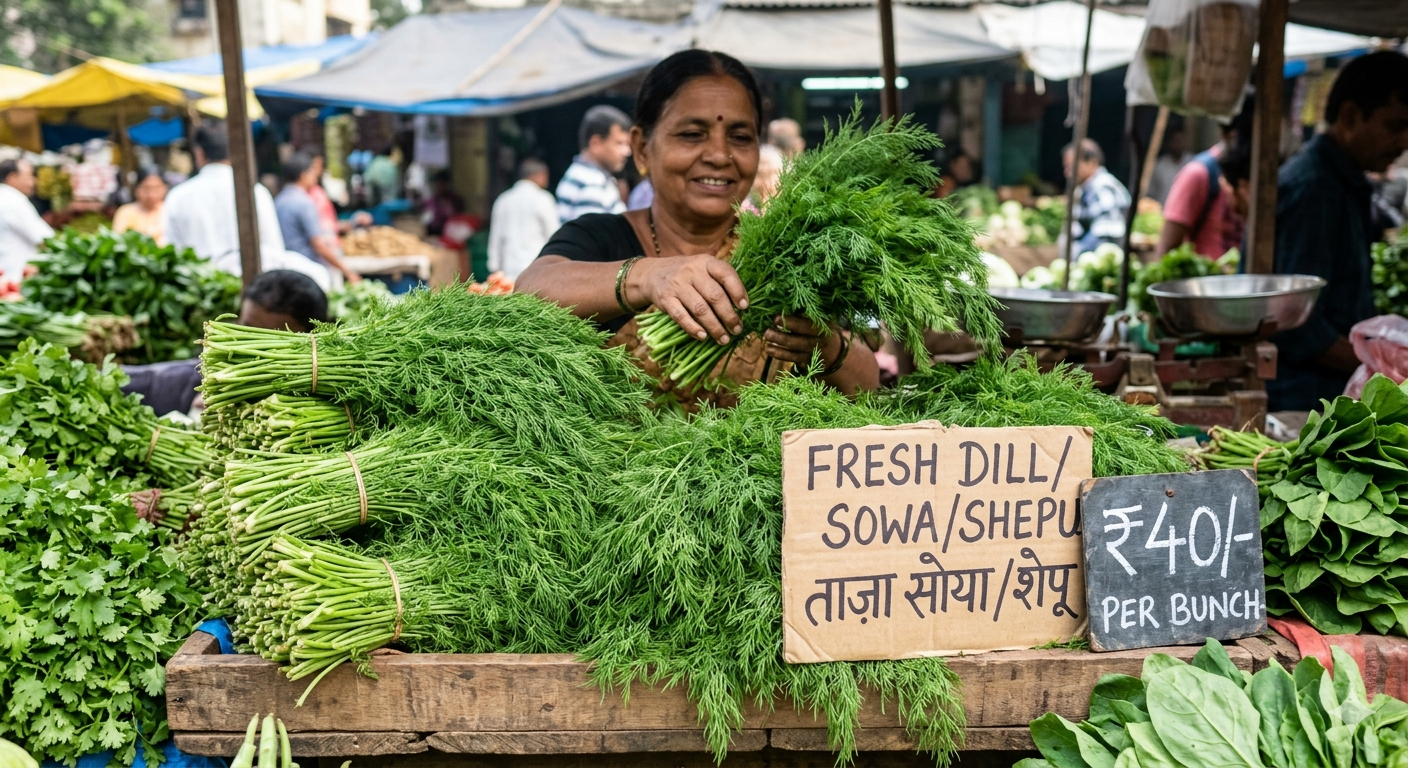
DillSowaIndia Native HerbShatapushpaMarket Seeds FreeGripe Water OriginAway From Fennel
Dill / Sowa — India's OWN ancient herb (Shatapushpa)! Market sowa = free planting seeds. Gripe water origin. KEEP AWAY from fennel (cross-pollinate). Direct sow only (taproot). Self-seeds forever.
Dill / Sowa — India का OWN ancient herb (Shatapushpa)! Market sowa = free planting seeds। Gripe water origin। Fennel से DOOR रखो (cross-pollinate)। Direct sow only (taproot)। Self-seeds forever।
⚡ Quick Reference / एक नज़र में
🌱 Sowing Season
October-November DIRECT SOW (hates transplanting — taproot!) | Self-seeds!
Feathery leaves (fresh) + seeds (same as market sowa) — both same plant!
☀️ Light
Full sun to partial — 5-6 hours
💧 Water
Every 3-4 days — consistent
🌡️ Temperature
15-25°C — cool season (Oct-Feb India)
💊
Key Nutrition / पोषण
Carvone (infant colic — gripe water origin!), Calcium 208mg, Iron 6.6mg, Vit C 85mg
🍳
Indian Kitchen Uses / भारतीय रसोई
Sowa dal (Bengal), shepu bhaji (Maharashtra), dill pickle, infant colic water, fish dishes
Dill (Anethum graveolens) — Sowa / Shepu / Suwa — is one of India's own ancient herbs, far more deeply rooted in Indian culinary and medicinal tradition than most people realize. While the Western world associates dill with Scandinavian cuisine and pickles, India has been using dill for over 2,000 years — it appears in ancient Ayurvedic texts as "Shatapushpa" and is an integral part of Bengali cooking (sowa), Maharashtra cuisine (shepu), North Indian achaar (dill pickles), and baby care traditions across India (dill water/gripe water for infant colic). India is actually a major dill seed exporter — primarily from Rajasthan, Gujarat and UP. For home gardeners, dill is uniquely satisfying: it grows extremely fast (harvestable in 4-6 weeks from seed), provides both fresh herb leaves and seeds from the same plant, is annual but self-seeds prolifically, and is one of India's best cool-weather kitchen garden herbs — directly comparable to coriander in ease and usefulness.
Dill (Anethum graveolens) — Sowa / Shepu / Suwa — India का own ancient herb! Western dill नहीं — Ayurvedic texts में "Shatapushpa"। Bengali cooking (sowa), Maharashtra (shepu), North Indian achaar में essential। India = major dill seed exporter। Home garden में: 4-6 weeks में harvestable, leaves और seeds दोनों, self-seeds prolifically, cool-weather essential kitchen herb।
🌿 Overview, History & Varieties
🔬 Scientific Name
Anethum graveolens
🌍 Origin
South and Southwest Asia including India — 2,000+ years Ayurvedic texts. "Shatapushpa."
🌡️ Temperature
15-25°C — cool season. October-February India ideal.
⚡ Speed
Seed to harvest: 4-6 weeks — one of India's fastest culinary herbs
🌿 Both
Same plant provides fresh leaves (herb) AND dried seeds (spice)
🌱 Direct Sow Only
Dislikes transplanting — sow directly where it will grow
Bone density — significant in generous culinary use
⚙️ Iron
6.6 mg per 100g
Anemia prevention — one of higher-iron herbs
🌿 Quercetin + Kaempferol
Flavonoids in leaves
Antioxidant, anti-inflammatory, cardiovascular
🍊 Vitamin C
85 mg per 100g
Immunity — significant contribution from fresh leaves
Infant colic and gripe water — the traditional connection: Dill has been used for infant colic across India and the world for centuries — "gripe water" (the original formulation, before commercialization) was dill seed water. The mechanism: carvone relaxes smooth muscle in the infant's digestive tract, reducing spasm-related colic pain. Traditional Indian preparation: boil 1/2 tsp dill seeds in 100ml water, cool, strain — give 1-2 tsp to colicky infant. This is the same preparation grandmother used and modern understanding confirms. Dill's antispasmodic action explains why India's oldest Ayurvedic infant remedies feature "shatapushpa" (dill) prominently.
Lactation support: Dill is one of Ayurveda's primary galactagogues (milk production enhancers) for breastfeeding mothers — used as dill seed tea or dill-rich cooking. The mechanism involves prolactin-supporting phytoestrogens and reduction of digestive stress that can inhibit milk letdown. Traditional Indian postpartum diet in many regions includes dill-rich preparations for new mothers — a practice with both traditional validation and increasing modern interest.
Blood sugar management: Multiple animal studies and some human trials show dill seed extract significantly reduces fasting blood glucose and improves lipid profiles in diabetics. Quercetin and kaempferol in leaves improve insulin sensitivity. The traditional inclusion of dill in Ayurvedic diabetes formulations has emerging scientific support.
🌱 Growing Guide — Direct Sow, October-February
🌱
Direct Sow — Mandatory
Dill MUST be direct sown — it has a taproot that breaks with transplanting. Scatter seeds directly in final container or garden bed. Thin to 20-25 cm spacing. Germination: 7-10 days at 15-20°C. October-November sowing ideal. Do not start in seedling tray and transplant. Sow where it will grow. Seeds available cheaply from any spice/seed shop (sowa dana) — same seeds used in cooking work for planting (fresh, not old stock).
🔄
Succession Sowing
Dill bolts (goes to flower/seed) quickly — 6-8 weeks after harvest begins. Sow new batch every 3-4 weeks for continuous supply October-February. 3-4 succession sowings = continuous harvest through entire cool season. Self-seeding: allow some plants to set seed — seeds drop and germinate themselves next October. One season's planting effectively self-perpetuates. Never buy seeds again after first planting.
🏠
Container Growing
12-15 inch deep container (dill grows tall — 60-90 cm). Rich moist mix: 60% cocopeat + 30% compost + 10% garden soil. Full sun to partial sun — 5-6 hours. Water every 3-4 days — moist consistent. Multiple plants per pot: scatter seeds, thin to 3-4 plants per 15-inch container. Dill grows fast and lushly — very satisfying container herb. Kitchen terrace or balcony ideal.
🌾
Seeds Harvest
When plant flowers (yellow umbrella-shaped flower clusters): allow to set seeds. Seeds form in flat disc-like seed heads. When seeds turn brown: cut entire seed head, place in paper bag, allow to dry 1-2 weeks. Shake to release seeds. Store: cooking or planting. Dill seeds (store-bought sowa) = same thing grown at home. Growing own dill = free spice AND free planting seeds forever. One plant: 500-2000 seeds — far more than needed, share freely.
💧 Growing & Care
⚡ Quick Care Reference
☀️ Light
Full sun to partial — 5-6 hrs
Cool season sun is fine
💧 Water
Every 3-4 days — moist
Consistent — drying causes bolting
🌡️ Temperature
15-25°C — cool season
October-February India window
🪴 Soil
Rich moist well-draining
Similar to coriander requirements
🧪 Fertilizer
Monthly dilute liquid
Fast-growing — moderate feeding
⚠️ Companion
Keep away from fennel
Dill + fennel cross-pollinate — flavor changes
Dill and fennel cannot grow together: Dill (Anethum graveolens) and fennel (Foeniculum vulgare) cross-pollinate freely — growing them near each other results in hybridized seeds with intermediate, inferior flavor from both. Keep them in separate locations with at least 2-3 meters distance or in completely separate containers away from each other.
Aphid management: Dill's feathery foliage attracts aphids — soft green clusters on new growth. Neem oil spray weekly prevents. Strong water spray dislodges. Encourage ladybugs — natural aphid predators. Dill also attracts beneficial insects (parasitic wasps, hoverflies) that control aphids on other plants — dual benefit companion plant.
🌿 Harvest, Storage & Culinary Uses
Harvest feathery leaves from outer stems: Snip feathery fronds from outer stems — inner growth continues. Fresh dill: refrigerate in damp paper or stand in water — 1-2 weeks. DO NOT dry — loses most flavor. Freeze: chop, mix with small water in ice trays — 3-4 months (best preservation method). Dill seeds: harvest dry seed heads, sun-dry further, store airtight — 12+ months. Both leaves and seeds from same plant.
Use
Method
Region
🌿 Sowa Dal / Shepu Dal
Fresh dill leaves added to dal — distinctive Bengal/Maharashtra flavor
West Bengal, Maharashtra — daily cooking
🌿 Dill Raita
Fresh chopped dill + curd + jeera + salt — cooling side dish
North India — underutilized but excellent
🥒 Dill Pickle (Achaar)
Dill seeds + cucumber/vegetables in brine — North India achaar
Pan-India — dill seeds primary achaar spice
👶 Dill Water (Infant)
1/2 tsp seeds boiled in 100ml water — strained, cooled, for colic
Dill (Sowa) vs Fennel (Saunf) — most common Indian confusion: Appearance: very similar feathery green leaves, similar yellow flowers. This similarity is why they shouldn't grow together (cross-pollinate). Taste difference: Dill: lighter, more delicate, slightly citrusy-grassy with anise note. Fennel: stronger, sweeter, more intensely anise/licorice. Seeds: Dill seeds (sowa dana) = flatter, lighter tan. Fennel seeds (saunf) = slightly larger, more oblong, greener, more intensely sweet. Use: Dill leaves: fresh herb in cooking, salads. Fennel leaves: eaten raw, salad, raw vegetable. Dill seeds: spice in achaar, tempering, digestive. Fennel seeds: mouth freshener (mukhwas), digestive after meals, used in panch phoron (Bengali 5-spice). Medicinal: both digestive but dill specifically for infant colic; fennel for adult digestive and lactation. Growing: dill is annual cool-season. Fennel is perennial and heat-tolerant. Bottom line: they look similar but taste and use differently — both valuable in Indian kitchen, just for different applications.
Easiest cool-season herb guide: (1) October-November: buy sowa seeds from any spice shop, vegetable market (same seeds you add to achaar). Fresh seeds, not old stock — germination better. Rs.20-50 for 50g. (2) Direct sow in 12-15 inch deep container — NO transplanting. Scatter seeds thinly, press into moist cocopeat mix (60% cocopeat + 30% compost). Cover lightly. (3) Keep moist — mist daily until germination. (4) Germination: 7-10 days at 15-20°C. (5) Thin to 20-25 cm spacing (remove weaker seedlings). (6) Full sun or partial sun. (7) Water every 3-4 days. (8) First harvest: 4-6 weeks — pinch feathery leaves. (9) Continue harvesting outer growth for 4-6 weeks. (10) Allow some plants to flower and set seeds (January-February) — save seeds. (11) March: summer arrives, dill bolts completely — collect seeds, compost plant. (12) Saved seeds: store until October for free replanting. One October packet of sowa dana: produces 3-4 months of fresh dill AND enough seeds for multiple next-season plantings. Growing dill is easier than growing coriander — faster and more forgiving.
Traditional dill water for infant colic — preparation: (1) Measure: 1/4 to 1/2 tsp dill seeds (sowa dana). (2) Boil in 100ml clean water for 5-10 minutes — gentle rolling boil. (3) Cool completely to room temperature. (4) Strain through fine cloth — ensure no seed pieces pass through. (5) Give: 1-2 tsp to infant, 3-4 times daily during colic episodes. For breastfeeding mother alternative: mother drinks dill seed tea (1 tsp in 250ml water) — carvone transfers through breast milk, provides benefit to infant. Important caveats: (1) Dill water for infants: generally considered safe in traditional use. However, for infants under 4-6 months: discuss with pediatrician before use. (2) Modern "gripe water" products: often contain different ingredients now — read labels. (3) Persistent colic: medical evaluation important — rule out underlying causes. (4) Concentration: this traditional dilute preparation is different from dill essential oil — never give essential oil to infants. This traditional preparation has centuries of safe use across Indian and global traditions — the pharmacological mechanism (carvone antispasmodic) is well-established.
Yes — excellent companion planting: Dill and coriander: (1) Same seasonal window: both October-February cool season herbs. (2) Same growing requirements: similar moisture, light, soil preferences. (3) Can share container: in large pot (20+ inch), plant one side dill, other coriander. (4) No cross-pollination concern: different plant families — dill (Apiaceae/Anethum) and coriander (Apiaceae/Coriandrum). They don't hybridize despite being in same family. (5) Harvest timing stagger: coriander faster (3-4 weeks), dill slightly slower (4-6 weeks) — gives staggered ready-to-use window. (6) Flavor combination: fresh dill + fresh coriander chutney = excellent fusion. (7) DO NOT combine with: fennel (cross-pollination concern) or basil (different growing requirements and temperature preference). Practical winter kitchen garden container: dill + coriander + parsley in large pot — complete cool-season fresh herb supply. All three grow beautifully together through India's October-February window, providing complete herb garden from one large container.
Dill seeds (sowa dana) — Indian and continental uses: (1) Achaar/pickle: dill seeds are the primary spice in North Indian vegetable pickles — cucumber achaar, carrot achaar, mixed vegetable. Whole seeds or lightly crushed in the brine. (2) Tadka/tempering: in some regional Indian cuisines (Bengal, Odisha) — dill seeds added to hot oil at start of dal, sabzi preparation. (3) Bread: crush lightly and add to roti/paratha dough — slightly different flavor from ajwain but similarly digestive. (4) Raita: crush few seeds, add to curd — dill raita. (5) Fish curry: in coastal Bengal fish preparations — pairs naturally. (6) Digestive aid: 1/2 tsp seeds chewed after meals — carminative, prevents gas. Same as ajwain but milder. (7) Tea: 1 tsp seeds in 250ml hot water, steep 10 min — excellent digestive and carminative tea. (8) Rice: add whole seeds to rice during cooking — subtle flavoring. Toasting before use: lightly dry-roast seeds 2-3 minutes to enhance aroma before using in cooking. Same principle as ajwain enhancement by dry-roasting.