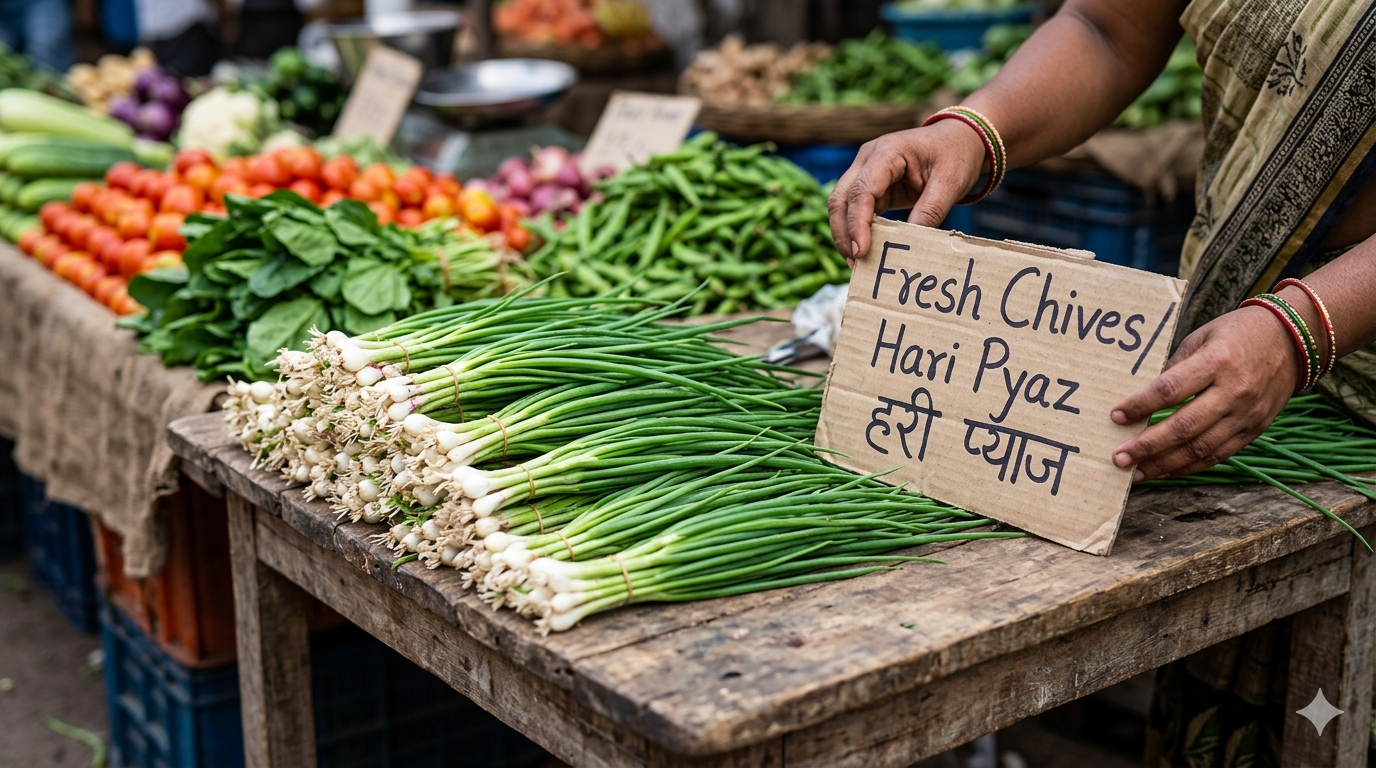
🌱 Oct-Nov or Feb-March | Seed or division | Garlic chives: better India year-round⏱️ Cut to 3-5 cm above soil — regrows 2-3 weeks. Indefinitely from same clump.🌿 Easy Grow✅ Edible Safe
Photo: PlantCare
ChivesGarnish 177% Vitamin KEat the GarnishPurple Flowers EdibleGarlic Chives Better IndiaCut Never PullForever Regrow
Chives — garnish provides 177% Vitamin K per 100g (eat it don't push aside!). Purple flowers edible. Garlic chives: better India heat. Same clump regrows forever. Cut, never pull.
Chives — garnish 177% Vitamin K (खाओ side नहीं करो!)। Purple flowers edible। Garlic chives: better India heat। Same clump forever regrow। Cut, never pull।
⚡ Quick Reference / एक नज़र में
🌱 Sowing Season
Oct-Nov or Feb-March | Seed or division | Garlic chives: better India year-round
⏱️ Harvest Time
Cut to 3-5 cm above soil — regrows 2-3 weeks. Indefinitely from same clump.
🍽️ Edible Parts
Leaves + flowers (both edible!) — cut don't pull. Add at end of cooking.
☀️ Light
Full sun to partial shade — flexible kitchen windowsill herb
💧 Water
Every 3-4 days — consistent
🌡️ Temperature
10-28°C — garlic chives better India heat tolerance
💊
Key Nutrition / पोषण
Vitamin K 177% RDA, Vitamin C 64%, Folate 26% — significant even as garnish!
Chives (Allium schoenoprasum) — Chives / Hari Pyaz — are the most delicate and versatile member of the onion family and the only Allium species native to both the New and Old Worlds. India has its own native chive-like herbs — garlic chives (Allium tuberosum, called "Jangli Lahsun" or Chinese chives) and wild onion grass found in the Himalayas — but the culinary chive from European tradition is increasingly prized in Indian kitchens for its mild, elegant onion-garlic flavor that enhances without overwhelming. For home gardeners, chives are among the most practical and productive kitchen herbs possible: they grow from seeds or divisions, regenerate continuously from the same clump for years, tolerate significant neglect, look ornamental with their purple flower pom-poms, and provide fresh onion-flavored garnishing and cooking ingredient year-round in most Indian climates. Garlic chives (Allium tuberosum) — flat-leaved with garlic note — are particularly well-adapted to Indian conditions and widely used in Chinese and Korean cuisines increasingly available in Indian homes.
Chives (Allium schoenoprasum) — most delicate और versatile Allium family member। India में Allium tuberosum (garlic chives / Jangli Lahsun) native। Home garden में most practical herb: same clump से years तक regenerate, significant neglect tolerant, purple flower ornamental, year-round fresh onion-garlic flavor।
🌿 Overview, History & Varieties
🔬 Scientific Name
Allium schoenoprasum (chives) | A. tuberosum (garlic chives / Chinese chives)
🌍 Origin
Both Old and New World — only Allium native to both. Asia and Europe.
🌡️ Temperature
10-28°C — wide range. Better in cooler conditions. Semi-dormant in extreme heat.
⚡ Regeneration
Cut to ground, regrows in 2-3 weeks — indefinitely from same clump
🌸 Flowers
Purple pom-pom flowers (chives) or white star flowers (garlic chives) — both edible!
💡 India Note
Garlic chives (A. tuberosum) better adapted to India — heat tolerant, available in markets
Species
Flavor
India Adaptation
🌿 Common Chives (A. schoenoprasum)
Mild onion — hollow round leaves
Good Oct-April. Summer semi-dormant. Hills: year-round.
🌿 Garlic Chives (A. tuberosum)
Mild garlic-onion — flat leaves
Better India adaptation — more heat tolerant. Year-round South India.
🌿 Giant Siberian Chives
Stronger onion, larger plant
Good for North India cooler conditions
💊 Nutrition & Health — Chives ke Fayde
Nutrient
Per 100g
Health Benefit
🦴 Vitamin K
212 mcg — 177% RDA
Blood clotting, bone density — significant per serving
🍊 Vitamin C
58 mg — 64% RDA
Immunity, collagen, iron absorption
👁️ Vitamin A
218 mcg — 24% RDA
Eye health, immunity — significant
🌿 Allicin precursors
As in all Alliums
Antimicrobial, cardiovascular, cancer-protective (same as garlic, milder)
🌿 Quercetin + Kaempferol
Flavonoids
Antioxidant, anti-inflammatory, cardiovascular
🫀 Folate
105 mcg — 26% RDA
DNA synthesis, pregnancy health
Allium family health benefits — concentrated in small garnish: Chives share the Allium family's cardiovascular and antimicrobial benefits from organosulfur compounds (allicin precursors) — albeit in milder concentration than garlic or onion. Regular use of chives as garnish provides ongoing low-level cardiovascular protection, cholesterol support and antimicrobial activity. The advantage over eating raw garlic: chives provide these benefits palatably on any dish without the strong odor aftermath.
Vitamin K garnish: Two tablespoons of fresh chopped chives on a dish provides 25-30% of daily Vitamin K needs — from what is essentially a garnish. Regularly eating the chive garnish (rather than moving it to the side of the plate) provides meaningful bone health and cardiovascular protection benefit from a minimal caloric source.
🌱 Growing Guide — Continuous Harvest Herb
🌱
Seed or Division
From seed: germination 10-14 days at 15-22°C. Scatter seeds on cocopeat, thin to 10-15 cm clumps. Buy established clump from nursery (Rs.50-100) for instant harvest. Division: dig mature clump every 2-3 years, split into smaller sections, replant — free new plants. Best planting: October-November or February-March. Garlic chives: slightly slower germination but more heat tolerant — better for South India and summer.
🏠
Container Growing
8-10 inch pot — chives have shallow roots. Multiple clumps per wide pot. Well-draining mix with good nutrition (compost-rich). Full sun to partial shade. Water every 3-4 days. Monthly liquid fertilizer — chives are heavy feeders for their size. One wide pot (15-inch): 3-4 clumps, continuous harvest. Kitchen windowsill or balcony: excellent location. Companion plant: grow alongside tomatoes or carrots — chives deter aphids naturally.
✂️
Harvest Method
Cut entire clump to 3-5 cm above soil level — regrowth in 2-3 weeks. OR snip individual leaves from outer edge as needed. Never pull — always cut. After flowering: cut flower stems and any yellowing leaves — redirects energy to new growth. One healthy chive pot: weekly harvest of fresh chives for 10+ months per year. Clump divided every 2-3 years for multiplication and rejuvenation.
🌸
Edible Flowers
Both chive and garlic chive flowers are edible and beautiful. Chive: purple pompom flowers — mild onion flavor, excellent garnish. Garlic chive: white star flowers — mild garlic note. Use flowers: scatter on salads, float in soups as garnish, use in compound butter, pickle in vinegar. After flowering: plant redirects energy to clump division — divides naturally for multiplication. Allow some flowering for seeds and visual beauty.
💧 Growing & Care
⚡ Quick Care Reference
☀️ Light
Full sun to partial shade
Flexible — kitchen windowsill fine
💧 Water
Every 3-4 days
Consistent — drought causes yellowing
🌡️ Temperature
10-28°C — wide range
Semi-dormant in peak India summer
🪴 Soil
Rich well-draining — compost
Heavy feeder — needs nutrition
🧪 Fertilizer
Monthly liquid NPK
Regular feeding = lush continuous harvest
✂️ Cut
To 3-5 cm every 3-4 weeks
Regular cutting = continuous production
Summer management: In India's peak summer, chives may yellow and look stressed — cut the entire clump to 3 cm above soil, reduce watering slightly, apply compost top-dress. The clump remains alive underground through heat stress and regenerates vigorously when temperatures moderate. Garlic chives handle summer better — prioritize for summer growing in hot regions.
Division every 2-3 years: Chive clumps become crowded over time — reduced productivity. Dig entire clump, separate into 4-6 smaller sections of 8-10 bulbs each. Replant sections in fresh soil-compost mix. Each section becomes a full productive clump in 4-6 weeks. Free plant multiplication and rejuvenation simultaneously.
🌿 Harvest, Storage & Culinary Uses
Snip fresh, use immediately: Fresh chives: refrigerate in damp paper, 1-2 weeks. DO NOT cook heavily — loses delicate onion flavor. Add at end of cooking or as garnish. Freeze: chop finely, freeze in ice cube trays with water — 3-4 months. Dry: loses most flavor — not recommended. Fresh always best. Chive butter: chop + softened butter + lemon — roll and freeze for months.
Use
Method
Note
🌿 Garnish
Snipped fresh over eggs, soup, dal, potato, paneer
Most versatile garnish — mild onion without overpowering
🥚 Egg dishes
Chopped in omelette, scrambled — classic pairing
Chive + egg = global classic combination
🧀 Chive Paneer / Cheese
Mix chopped chives into paneer + salt + lemon — herb paneer spread
Excellent on roti, bread, as dip
🌸 Flower Garnish
Scatter purple flowers on salads, soups — edible and beautiful
Most elegant herb garnish available
🫙 Chive Vinegar
Pack chive flowers in white vinegar — turns beautiful pink-purple
Flavored vinegar for dressings, salads
❓ FAQ
Common confusion: Chives (Allium schoenoprasum): thin hollow grass-like leaves. No bulb base. Always used as herb — snipped leaves only. Very mild onion flavor. Perennial clump. Primarily garnish. Green Onion / Scallion / Spring Onion (Allium cepa group): thicker hollow leaves with visible white/light green base. Small swollen bulb at base. Both green tops AND white base eaten. Moderate onion flavor. Annual or biennial. Primary vegetable. Garlic Chives (A. tuberosum): flat (not hollow) broad leaves. Strong garlic-onion flavor. Eaten as vegetable in Asian cuisines. White flowers. Perennial. Indian "hari pyaz" from market: usually scallion/spring onion. Indian "jangli lahsun" from hills: garlic chives or wild garlic. All three are valuable, all three grow in India: chives for delicate garnish, spring onion for cooking, garlic chives for Asian-influenced dishes. Growing all three in separate pots gives complete Allium herb garden coverage.
Garlic chives India guide — more heat tolerant than regular chives: (1) Seeds: available from Chinese vegetable seed suppliers online or in cities with Chinese restaurants/communities. Rs.30-80 per packet. (2) OR: market "jangli lahsun" bundles from vegetable markets in mountain cities (Shimla, Mussoorie, Darjeeling) — plant base sections. (3) Sowing: February-April or September-November. Scatter seeds on cocopeat, 5mm deep, keep moist. (4) Germination: 10-21 days — slower than chives. (5) Transplant at 8-10 cm to final pot. (6) Full sun. Water every 3-4 days. (7) First harvest: 2 months. Cut entire clump to 3 cm above soil. (8) Regrowth: 2-3 weeks. Repeat indefinitely. India advantage: garlic chives handle more heat than regular chives — productive through more of India's year. Flower: beautiful white star clusters — edible, ornamental. Use: same as regular chives + suits Chinese/Asian dishes better. Nutrition similar to chives. Distinct garlic note makes it excellent substitute for both green onion AND light garlic flavoring in cooking.
Chive storage — from best to acceptable quality: (1) Fresh same day: best flavor and nutrition. Cut and use immediately. (2) Refrigerator (1-2 weeks): wrap in barely damp paper towel, place in open plastic bag. Or stand snipped chives upright in glass with 1 cm water — keep in fridge. (3) Freezer (3-4 months): chop finely into small pieces. Fill ice cube tray with chopped chives, pour small amount water over, freeze. Pop frozen cubes into zip bag. Drop 1-2 cubes directly into cooking — no thawing. Excellent for soups, dals, scrambled eggs. (4) Chive butter (3-6 months frozen): mash 2 tbsp softened butter per 1 tbsp chopped chives. Roll in cling wrap into log, freeze. Slice discs as needed — melts on hot food releasing fresh chive flavor. (5) Chive vinegar (3-6 months room temp): pack fresh chive flowers or leaves in white vinegar. Pink-purple beautiful vinegar. Use in dressings. (6) Drying: not recommended — loses 70%+ of flavor. Only for emergency long-term storage. Growing your own chives is the definitive solution to fresh availability — always accessible in the pot, pick as needed. Eliminates all storage concerns.
Different roles in Indian and continental cooking: Garlic: assertive, pungent — foundation flavor in Indian cooking (tadka, base masala). Cooked to develop depth. Strong lingering flavor. 5-6 cloves in a dish. Chives: delicate, fresh — finishing flavor and garnish. Never cooked (loses flavor). Fresh last-minute addition. 2-3 tbsp in a dish. When to choose chives over garlic: (1) Dishes where raw garlic would be too pungent — egg preparations, creamy dishes, cold preparations. (2) When you want onion-garlic note without strong raw garlic smell. (3) As visual garnish with flavor. (4) In fusion dishes where garlic flavor is wanted but not traditional garlic preparation. Substitution: chives cannot replace garlic in Indian masala or tadka — too delicate, wrong cooking method. Garlic cannot replace chives as fresh garnish — too strong. They solve different culinary problems. Having both in garden = complete onion-garlic flavor spectrum covered. Growing chives: the only way to have quality fresh chives in India — rarely available fresh in markets, quickly wilted when found.
Chives in pregnancy — safe and beneficial: (1) Folate: 105 mcg per 100g — significant for pregnancy, especially first trimester neural tube development. (2) Vitamin K: important for fetal bone development and maternal clotting. (3) Vitamin C: immunity and collagen support during pregnancy. (4) Allium compounds: mild antimicrobial — helps maintain healthy gut flora. (5) Iron absorption: Vitamin C in chives enhances iron absorption from plant-based iron sources in meals. Safety: chives are completely safe during pregnancy in culinary amounts. Regular use of chives as garnish on food throughout pregnancy provides meaningful micronutrient contribution without any risk. Compared to supplements: the folate in chives is in natural food form — better absorbed than synthetic folic acid supplements for many women. The traditional recommendation to eat a varied diet of herbs and vegetables during pregnancy is nutritionally validated — chives contribute meaningfully to this. Daily fresh chive garnish on morning eggs, dal, or soup is one of the easiest micronutrient delivery methods possible in pregnancy.