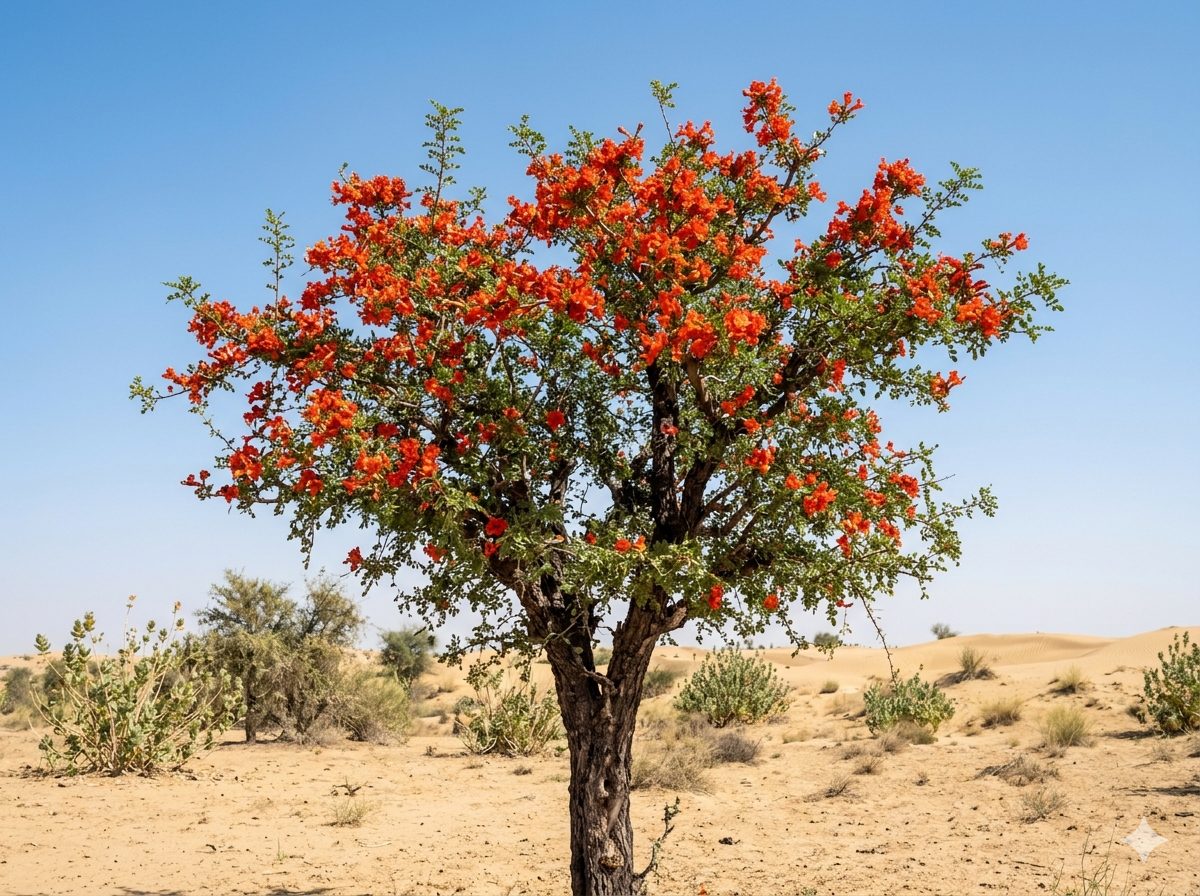
Rohida Roheda Marwar Teak Desert Tree Rajasthan Orange Flowers — PlantCare
📷 PlantCare
🕉️ Sacred & Medicinal Trees

Rohida / Roheda / Marwar Teak रोहेड़ा / रोहितक / Desert Teak

Tecomella undulata Family: Bignoniaceae

Rohida — Rajasthan's State Tree (Marwar Teak). Survives 48°C, 100mm rainfall, pure sand! Rohitaka: 3,000-yr liver/jaundice Ayurveda. Timber: Rs.1,500-3,000/cubic ft. Mehrangarh Fort woodwork. Bishnoi sacred.

📏 8–12 metres ⏳ 100–200+ years 📈 Slow to moderate — desert adaptation 📍 Rajasthan (primary), Gujarat, UP Bundelkhand, Haryana — 100-500mm rainfall ✅ State Tree Rajasthan — Rajasthan FD permission mandatory to cut. Threatened species. 💰 Rs.1,500–3,000/cubic foot — one of India's most expensive
📤 WhatsApp
Rohida Roheda Marwar Teak State Tree RJ 48C Desert Survival Rohitaka Liver 3000yr Hepatoprotective Confirmed Rs1500-3000 Premium Timber Bishnoi Sacred Rajasthan

रोहेड़ा — Rajasthan का State Tree (Marwar Teak)। 48°C, 100mm rainfall, pure sand में survive! Rohitaka: 3,000-yr liver/jaundice Ayurveda। Timber: Rs.1,500-3,000/cubic ft। Mehrangarh Fort woodwork। Bishnoi sacred।

Rohida (Tecomella undulata) — Roheda / Marwar Teak / Desert Teak / Rohitaka — is Rajasthan's State Tree and one of India's most drought-resistant and ecologically important trees of the Thar Desert and semi-arid regions. Called "Marwar Teak" because its wood quality rivals teak in hardness and durability, Rohida is remarkable for thriving in conditions where even hardy desert trees struggle — it tolerates temperatures up to 48°C, survives on rainfall as low as 100-150mm per year, and grows in pure sand dunes and rocky desert soils. The tree produces extraordinary orange-yellow trumpet-shaped flowers (February-April) that transform the bleak Rajasthan desert into spectacular color — the timing before leaves appear makes the display even more dramatic. In Ayurveda, Rohida is known as Rohitaka — one of the most important liver medicines. The bark of Rohida has been used for 3,000+ years for liver diseases, jaundice, and spleen disorders. Modern research has confirmed significant hepatoprotective (liver-protecting) activity. The wood is also one of Rajasthan's most prized commercial timbers — hard, durable, termite-resistant, beautifully grained — used in the finest Rajasthani furniture, doors, and carved woodwork that are internationally renowned.

Rohida (Tecomella undulata) — रोहेड़ा / Marwar Teak — Rajasthan का State Tree। Thar Desert और semi-arid regions का most drought-resistant tree। "Marwar Teak" क्योंकि wood quality teak से rival। 48°C temperature tolerate, 100-150mm rainfall पर survive, pure sand dunes में grows। February-April — extraordinary orange-yellow trumpet flowers — leaves आने से पहले। Ayurveda में Rohitaka — most important liver medicines में। 3,000+ years से liver diseases, jaundice, spleen में। Modern research: significant hepatoprotective activity confirmed। Wood: Rajasthan का most prized commercial timber।

🌸 Overview & Quick Facts / परिचय और मुख्य तथ्य

🔬 Scientific NameTecomella undulata — Family: Bignoniaceae
📏 Height / ऊंचाई8–12 metres | Small-medium tree | Spreading canopy / छोटा-मध्यम, spreading canopy
Lifespan / आयु100–200+ years / 100-200+ वर्ष
🌸 Flowers / फूलFebruary–April — brilliant orange-yellow trumpet clusters, leafless tree. Spectacular! / फरवरी-अप्रैल — पत्तेरहित, orange-yellow trumpet
🌡️ Climate / जलवायुArid to semi-arid. Rajasthan primary. 100-500mm rainfall. Up to 48°C temperature tolerance!
🌍 Native Range / मूल क्षेत्रRajasthan (primary), Gujarat, UP Bundelkhand, Haryana, Pakistan (Sindh)
⚖️ Legal Status / कानूनीState Tree Rajasthan — cultural protection. Not federally protected but Rajasthan Forest Dept permission mandatory for cutting. Threatened due to overexploitation.
💰 Value / मूल्यTimber: Rs.1,500–3,000/cubic foot | Bark: Rs.40–80/kg | Flowers: Rs.5-15/kg (camel fodder)

🌿 Parts & Their Uses — हर अंग का उपयोग

🟫
Bark / छाल (Liver Medicine)
THE primary medicinal part — Rohitaka in classical Ayurveda. Used for 3,000+ years for liver diseases, jaundice (kamala), spleen disorders (pliha), and abdominal tumours. Contains rohitukine (a flavone alkaloid) — hepatoprotective confirmed. Market: Rs.40-80/kg dried. AYUSH formulary listed.

Primary medicinal — Rohitaka classical Ayurveda में। 3,000+ years liver diseases, jaundice (kamala), spleen disorders (pliha)। Rohitukine (flavone alkaloid) — hepatoprotective confirmed। Market: Rs.40-80/kg। AYUSH formulary listed।
🌸
Flowers / फूल
Brilliant orange-yellow trumpet flowers — spectacular. Flowers: camel fodder (camels eat fallen flowers eagerly — important desert nutrition). Flower extract: mild anti-oxidant research. Flowers used in local desert festivals and offerings. Not commercially traded for food/medicine. Flowers important desert bee nectar source in Feb-April lean season.

Brilliant orange-yellow trumpet फूल। Flowers: camel fodder (camels eagerly खाते — important desert nutrition)। Flower extract: mild anti-oxidant। Desert festivals में। Commercially traded नहीं। Feb-April lean season में desert bees के लिए nectar source।
🍃
Leaves / पत्ते
Leaves: browsed by camels, goats — important desert fodder. Leaf extract: anti-bacterial research. Leaves used as food wrapping material in desert communities. Leaf infusion: traditional use for fever and general debility. Undulate (wavy) leaf margins — distinctive identification feature.

Leaves: camels, goats browse — important desert fodder। Leaf extract: anti-bacterial। Food wrapping material desert communities में। Leaf infusion: fever और general debility। Undulate (wavy) leaf margins — distinctive identification।
🌱
Seeds / बीज
Seeds in long, narrow capsules (15-30cm). Seed extract: anti-inflammatory, anti-microbial research. Seeds not widely commercially traded. Used in traditional medicine for skin conditions. Seeds: ground and applied as paste for skin infections in desert tribal medicine.

Long, narrow capsules (15-30cm) में बीज। Seed extract: anti-inflammatory, anti-microbial। Commercially widely नहीं traded। Skin conditions में traditional। Desert tribal medicine में skin infections के लिए paste।
🌱
Roots / जड़ें
Deep taproot system — critical desert adaptation that accesses deep groundwater. Root bark: used medicinally in tribal desert medicine for liver and spleen. Root system critical for sand dune stabilization — ecological service. Never collect roots from living trees — destroys the tree's survival mechanism in desert conditions.

Deep taproot system — desert में deep groundwater access critical adaptation। Root bark: tribal desert medicine में liver और spleen। Sand dune stabilization — ecological service। Living trees से roots collect मत करें — desert survival mechanism destroy।
🪵
Wood / लकड़ी (Most Valuable)
Rohida timber = "Marwar Teak." Heartwood: dark brown, hard, heavy, durable (Class I — similar to teak). Termite resistant — critical in desert termite pressure areas. Beautiful grain — highly prized for Rajasthani furniture, doors, carved woodwork, forts. Market: Rs.1,500-3,000/cubic foot — one of Rajasthan's most expensive timbers. State permission mandatory to cut.

Rohida timber = "Marwar Teak।" Heartwood: dark brown, hard, heavy, Class I durability (teak जैसी)। Termite resistant। Beautiful grain — Rajasthani furniture, doors, carved woodwork, forts। Market: Rs.1,500-3,000/cubic foot — Rajasthan के most expensive timbers में। State permission mandatory।

🌍 Desert Ecology & Conservation / रेगिस्तान पारिस्थितिकी और संरक्षण

⚡ Key Facts / मुख्य तथ्य
🌡️ Extreme Tolerant
48°C temperature, 100-150mm rainfall, pure sand — most drought-resistant tree in India.
48°C temperature, 100-150mm rainfall, pure sand — India का most drought-resistant tree।
🏛️ State Tree RJ
Rajasthan's State Tree. Found in Rajasthan's historic forts and monuments woodwork.
Rajasthan का State Tree। Rajasthan के historic forts और monuments woodwork में।
🫁 Liver Medicine
Rohitaka — 3,000+ year Ayurvedic liver medicine. Hepatoprotective confirmed research.
Rohitaka — 3,000+ वर्ष Ayurvedic liver medicine। Hepatoprotective confirmed।
🐪 Camel Fodder
Flowers, leaves — important camel food in Thar Desert. Critical desert livelihood support.
Flowers, leaves — Thar Desert में important camel food। Critical desert livelihood।
⚠️ Threatened
Over-exploited for premium timber. Population declining in wild. Conservation urgently needed.
Premium timber के लिए over-exploited। Wild population declining। Conservation urgent।
🪵 Premium Timber
Rs.1,500-3,000/cubic foot — one of India's most expensive indigenous timbers.
Rs.1,500-3,000/cubic foot — India के most expensive indigenous timbers में।

🌱 Growing Guide / रोहेड़ा कैसे उगाएं

ParameterEnglishHindi / हिंदी
🌱 PropagationSeeds from dry capsules (June-July). Light seeds — germination 7-15 days. Also stem cuttings. Seeds viable 6 months if stored dry.Dry capsules से बीज (June-July)। Light seeds — 7-15 दिन germination। Stem cuttings से भी। 6 months dry storage viable।
🪴 SoilSandy to rocky desert soil. pH 7.0–9.5 (alkaline tolerant). Excellent drainage essential. Avoid waterlogged — dies rapidly.Sandy से rocky desert soil। pH 7.0-9.5 (alkaline tolerant)। Excellent drainage। Waterlogged — rapidly dies।
📅 Best TimeMonsoon July-August — even minimal monsoon rain is enough for establishment.Monsoon July-August — minimal monsoon rain enough establish करने के लिए।
💧 WaterExtremely drought tolerant — rainfall 100-500mm is enough. NO irrigation needed after 2 years. Deep taproot accesses groundwater.बेहद drought tolerant — 100-500mm rainfall enough। 2 years के बाद irrigation नहीं। Deep taproot groundwater access।
📏 Spacing6–8 metres for timber plantation. 4-5 metres for bark + flowers. Roots not invasive.Timber plantation: 6-8 मीटर। Bark + flowers: 4-5 मीटर। Roots invasive नहीं।
⚠️ Conservation notePlant Rohida — it is declining in wild. Every planted tree contributes to conservation of Rajasthan's State Tree.Rohida लगाएं — wild में decline हो रहा है। हर planted tree Rajasthan के State Tree के conservation में योगदान।

💰 Market Value & Legal Status / बाज़ार मूल्य और कानूनी स्थिति

Product / उत्पादValue / मूल्यLegal / कानूनी
🪵 Timber / लकड़ीRs.1,500–3,000/cubic foot — premium / premiumRajasthan Forest Dept permission mandatory. State Tree — special protection. Illegal cutting heavy penalty.
🟫 Bark / छालRs.40–80/kg dried AyurvedicFallen bark: OK. Tree cutting for bark: permission needed. Sustainable harvest max 25% girth.
🌸 FlowersRs.5–15/kg camel fodder / camel fodderCollection from ground: OK. / ठीक
🌱 SeedlingsRs.30–80/plant nurseryFreely traded. Rajasthan Forest Dept distributes free seedlings for conservation planting.
❓ Frequently Asked Questions / अक्सर पूछे जाने वाले सवाल
Rohida bark for liver conditions — Ayurvedic evidence: Rohitaka (Rohida bark) is specifically mentioned in Charaka Samhita, Sushruta Samhita and Ashtanga Hridayam as the primary treatment for kamala (jaundice), pliha (spleen disorders), and yakrit roga (liver diseases) — the same liver conditions named 3,000 years ago correspond to what we now understand as hepatitis, fatty liver, jaundice from various causes, and splenomegaly. Active compound: Rohitukine — a flavone alkaloid unique to Tecomella undulata. Research: confirmed hepatoprotective activity in liver cell culture and animal studies. Rohitukine has also shown potential anti-cancer activity (particularly for blood cancers — CDK inhibition) in more recent research. Traditional preparation for jaundice: (1) Bark decoction: 10g dried Rohida bark + 500ml water. Boil to 200ml. Strain. Drink 100ml twice daily for 3-4 weeks. (2) Rohida powder: 3-5g bark powder + warm water + honey. Twice daily. (3) Combined with Bhumiamalaki (Phyllanthus niruri): Rohida bark + Bhumiamalaki — the classical Ayurvedic jaundice combination. Bhumiamalaki adds viral hepatitis inhibition (research confirmed). (4) Rohidarak Rishta: classical fermented formulation — available at Ayurvedic pharmacies. Caution: severe acute hepatitis — consult hepatologist first. Rohida is complementary — not a replacement for medical evaluation. For jaundice in infants: NEVER self-medicate — always medical evaluation. Alcohol-related liver disease: stop alcohol completely, then Rohida as adjunct with doctor guidance. Rohitukine research: Several pharmaceutical companies are researching rohitukine for CDK2/CDK9 inhibition as anti-cancer drug lead — if this research succeeds, Rohida may become one of India's most valuable medicinal trees.

Rohida bark liver — Ayurvedic: Rohitaka: Charaka, Sushruta, Ashtanga Hridayam में kamala (jaundice), pliha (spleen), yakrit roga (liver) के लिए primary treatment। Rohitukine — unique flavone alkaloid। Confirmed hepatoprotective। Rohitukine: anti-cancer research (CDK inhibition — blood cancers)। Preparation: (1) Bark decoction: 10g + 500ml → 200ml। 100ml twice daily 3-4 weeks। (2) Powder: 3-5g + honey। (3) + Bhumiamalaki: classical jaundice combination। (4) Rohidarak Rishta: classical formulation। Caution: severe acute hepatitis — hepatologist first। Infants: NEVER self-medicate। Alcohol-related: stop alcohol completely, then adjunct। Pharmaceutical research: rohitukine as anti-cancer drug lead — CDK2/CDK9।
Rohida as Rajasthan State Tree — the significance: Rohida was declared Rajasthan's State Tree in 1983. The selection reflects multiple dimensions of significance to Rajasthan's identity, ecology, and history. Ecological significance: Rohida is uniquely adapted to Rajasthan's extreme conditions — extreme heat (up to 48°C), minimal rainfall (100-500mm), sandy/rocky desert soils. No other commercially valuable timber tree can survive in these conditions. Rohida thus represents ecological resilience — surviving where others cannot. It is the only tree that provides premium-quality timber in India's most extreme desert environment. Historical significance: Rohida wood was used in the construction of Rajasthan's greatest heritage sites — Mehrangarh Fort (Jodhpur), Junagarh Fort (Bikaner), Umaid Bhawan Palace interiors, and countless havelis. The characteristic carved wooden doors and lattice windows (jharokas) of Rajasthani architecture are traditionally made from Rohida — it can be carved intricately due to its fine grain while being hard enough to last centuries. Cultural significance: The tree is part of Bishnoi community's sacred ecology — the Bishnoi of Rajasthan have protected trees including Rohida for centuries as part of their religious practice. The 1730 Khejarli Massacre (363 Bishnois gave their lives protecting trees) is one of history's greatest acts of environmental conservation — Rohida trees were among those protected. Commercial significance: Rohida timber's extreme value (Rs.1,500-3,000/cubic foot) has unfortunately made it a target for illegal felling — the tree's conservation status is increasingly threatened despite State Tree protection.

Rohida State Tree — significance: 1983 में declared। Ecological: extreme conditions adapt — 48°C, 100-500mm, sandy/rocky। Other commercial timber trees इन conditions में survive नहीं। Desert में premium timber — unique। Historical: Mehrangarh Fort, Junagarh Fort, Umaid Bhawan Palace — Rohida wood। Rajasthani carved doors, jharokas — Rohida। Cultural: Bishnoi community की sacred ecology — centuries से protect। 1730 Khejarli Massacre — 363 Bishnois trees (including Rohida) protect करते हुए lives दिए। History का greatest environmental conservation act। Commercial: Rs.1,500-3,000/cubic foot → illegal felling target। Conservation threatened despite State Tree protection।
Rohida desert survival mechanisms — remarkable adaptations: Water access: deep taproot system (6-10 metres) accesses deep groundwater table even when surface is completely dry. Rohida can be seen growing on sand dunes where there is no visible moisture — the taproot has found water far below. This is the primary survival mechanism. Water conservation: small waxy leaves reduce transpiration. Deciduous — loses leaves in hottest months (May-June) to eliminate transpiration when water stress is maximum. Flowers before leaves (February-April) — reproduction completed before maximum heat. Bark adaptations: grey-brown bark reflects heat better than dark bark. Bark also slightly corky — insulates inner tissues from extreme heat. Fire tolerance: Rohida bark has some fire resistance — important in desert areas where grass fires occur. Growth strategy: slow growth conserves energy in harsh conditions. The rings of Rohida are very tight (high density wood) — slow growth = dense timber = termite resistance. Deep root anchoring: on sand dunes, conventional trees are uprooted in desert storms (aandhi). Rohida's deep anchoring taproot survives. Temperature tolerance: cellular mechanisms that prevent protein denaturation at 48°C — among the highest heat tolerance of any Indian tree. Comparison: Most fruit trees die above 40°C. Neem tolerates up to 44-45°C. Rohida: 48°C. This extraordinary heat tolerance makes Rohida critical for climate change adaptation — as temperatures rise, Rohida's range and importance will only grow.

Rohida desert survival: Water access: deep taproot (6-10 metres) — deep groundwater। Sand dunes पर visible moisture नहीं — taproot far below water found। Water conservation: small waxy leaves — transpiration reduce। Deciduous — hottest months (May-June) में leaves shed। Flowers before leaves — reproduction before maximum heat। Bark: grey-brown — heat reflect। Slightly corky — inner tissues insulate। Fire tolerance। Growth strategy: slow growth = dense timber = termite resistance। Deep root anchoring: desert storms (aandhi) में survive। Temperature tolerance: 48°C protein denaturation prevent। Comparison: fruit trees >40°C die। Neem: 44-45°C। Rohida: 48°C। Climate change adaptation: temperature बढ़ने पर Rohida की importance बढ़ेगी।
Rohida timber in Rajasthani craftsmanship: Rohida (Marwar Teak) has been the foundation of Rajasthan's wood carving and furniture tradition for at least 500 years. Properties that make it ideal for carving: Fine grain — allows intricate detail work without splintering. Hardness — Class I durability means carved pieces survive centuries. Natural oils — prevent drying, cracking and termite attack without chemical treatment. Color — deep brown to reddish-brown heartwood that polishes to rich luster. Traditional applications: (1) Jharokas (carved lattice windows): the famous Rajasthani haveli jharokas — intricate geometric and floral patterns carved from Rohida. UNESCO heritage significance. (2) Doors (darwaze): massive carved wooden doors of Rajasthani forts and havelis. Some surviving doors are 400-500 years old — testament to Rohida's durability. (3) Furniture: traditional Rajasthani charpoy (bed frame), chairs, tables — Rohida was the preferred wood before synthetic alternatives. (4) Temple paraphernalia: deities' wooden thrones, palanquins, temple furniture. (5) Musical instruments: some traditional Rajasthani instruments use Rohida wood for resonator bodies. Market for antique Rohida woodwork: exceptional. Antique Rohida carved panels: Rs.5,000-50,000 per panel depending on intricacy and age. Antique Rohida jharokas: Rs.20,000-2,00,000+ in Rajasthan antique markets and internationally. The combination of historical significance + extreme rarity (tree now protected) + carving quality makes Rohida woodwork among India's most valuable traditional crafts. New Rohida timber: extremely scarce and expensive. Modern Rajasthani artisans increasingly working with alternative woods or reclaimed old Rohida timber.

Rohida timber Rajasthani craftsmanship: 500+ years Rajasthan की wood carving foundation। Properties: Fine grain (intricate carving), Class I hardness (centuries survive), natural oils (termite prevent), rich polish। Applications: (1) Jharokas: famous Rajasthani haveli jharokas — intricate patterns। UNESCO heritage significance। (2) Doors: Rajasthani forts और havelis के carved doors। 400-500 साल पुराने surviving। (3) Traditional furniture। (4) Temple paraphernalia। (5) Musical instruments। Antique market: exceptional। Antique Rohida carved panels: Rs.5,000-50,000। Antique jharokas: Rs.20,000-2,00,000+। Historical significance + extreme rarity + carving quality = India's most valuable traditional crafts में। New timber: extremely scarce। Modern artisans: alternative woods या reclaimed old Rohida।
Rohida cultivation in Rajasthan — conservation and income opportunity: Context: Rohida populations are declining rapidly in Rajasthan due to illegal timber felling. The State Forest Department actively promotes Rohida plantation as both conservation and livelihood program. Seed collection: May-June when pods turn brown and seeds shed. Collect seeds from under tree. Clean and store dry. Seeds: 7-15 day germination at 30-35°C. Nursery: polybag with sandy soil + 10% compost. Partial shade first month, then full sun. Ready to plant at 4-6 months (30-40cm height). Plantation: July-August with monsoon rains — minimal irrigation needed. Pit: 45×45×45cm. Fill with sandy soil + 500g rock phosphate + small FYM. Plant at collar level. First watering. After establishment (2 years): completely rain-fed — NO further irrigation needed in normal Rajasthan monsoon years. This is a key advantage — once established, Rohida costs almost nothing to maintain. Income timeline: Year 1-7: bark harvest possible from pruned branches. Year 15-20: timber harvest (state permission required). Year 8-15: significant bark income Rs.40-80/kg. Government programs: Rajasthan Van Mahotsav — free Rohida seedlings. MGNREGS plantation — Rohida included. Rajasthan Forest Dept plantation subsidies for private farmers planting State Tree. NMPB: medicinal plant cultivation scheme includes Rohida bark production. Important legal reminder: Even on private land in Rajasthan, cutting Rohida requires Forest Department permission — it is a protected species as State Tree. Plan accordingly — the timber harvest requires advance permission application.

Rohida cultivation Rajasthan: Context: populations rapidly declining। State Forest Dept Rohida plantation actively promote। Seed: May-June pods brown। 7-15 day germination। Nursery: sandy soil + 10% compost। 4-6 months ready (30-40cm)। Plantation: July-August monsoon। Pit: 45×45×45cm, sandy soil + rock phosphate + FYM। After establishment (2 years): completely rain-fed — NO irrigation। Key advantage: maintenance cost almost zero। Income: Year 1-7 bark pruned branches से। Year 8-15: significant bark Rs.40-80/kg। Year 15-20: timber (state permission required)। Govt: Rajasthan Van Mahotsav — free seedlings। MGNREGS — Rohida included। Forest Dept subsidies। NMPB medicinal plant scheme। Legal reminder: Private land पर भी Rohida cutting Forest Dept permission required — State Tree protected। Advance permission application plan करें।
⚠️
AI-Assisted Content — Please Read
AI-सहायता से बनाई गई सामग्री — कृपया पढ़ें

All tools, plant encyclopedias, edible growing guides and blog content on PlantCare are created with the assistance of AI (Artificial Intelligence) and are intended for general informational and educational purposes only. While we strive for accuracy, the information provided may not be complete, current or suitable for every situation, region or individual plant variety.

For health, medical or serious agricultural decisions — always consult a qualified horticulturist, agronomist, Ayurvedic practitioner, medical professional or relevant expert. PlantCare does not take responsibility for outcomes arising from use of this information. Identification results from AI tools (plant identifier, pest identifier etc.) should be verified before taking any action.

इस वेबसाइट पर सभी tools, plant encyclopedias, edible guides और blog content AI (Artificial Intelligence) की सहायता से बनाए गए हैं और केवल सामान्य जानकारी और शिक्षा के उद्देश्य से हैं। स्वास्थ्य, चिकित्सा या गंभीर कृषि निर्णयों के लिए कृपया किसी योग्य विशेषज्ञ से संपर्क करें। PlantCare इस जानकारी के उपयोग से होने वाले परिणामों के लिए जिम्मेदार नहीं है।