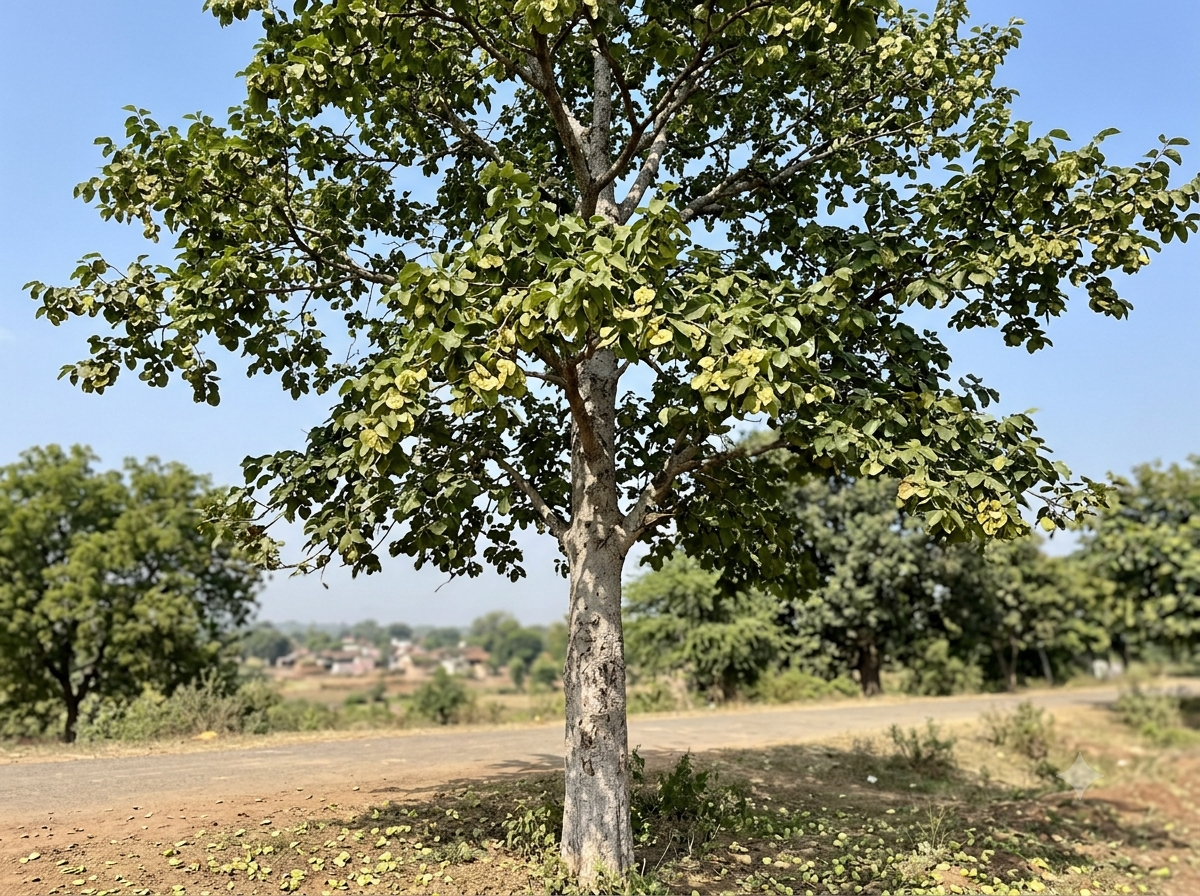
Indian Elm Dhaurangi Holoptelea Samara Fruit Tree India — PlantCare
📷 PlantCare
🕉️ Sacred & Medicinal Trees

Indian Elm / Dhaurangi / Chilauni धौरंगी / कांजू / पापड़ी

Holoptelea integrifolia Family: Ulmaceae (Elm family)

Indian Elm / Dhaurangi — skin specialist tree. Bark: eczema, ringworm, vitiligo, psoriasis (anti-fungal confirmed). ID tip: HUGE round flat winged samara (2-4cm) in Jan-April — unmistakable. Anti-diabetic leaf confirmed. Grows pH 9 alkaline soils!

📏 15–25 metres spreading crown ⏳ 100–200+ years 📈 Moderate — 1.5–2 ft/year 📍 Pan-India — dry to moist deciduous, alkaline tolerant up to pH 9 ⚠️ Not protected. Freely cultivatable. Timber: FD transit permit. 💰 Rs.500–900/cubic foot moderate timber
📤 WhatsApp
Indian Elm Dhaurangi Skin Specialist Eczema Ringworm Vitiligo Anti-Fungal Confirmed Distinctive Samara 2-4cm Anti-Diabetic Leaf Confirmed Alkaline pH9 Pioneer Chilauni Edible Tribal

धौरंगी — skin specialist tree। Bark: eczema, ringworm, vitiligo, psoriasis (anti-fungal confirmed)। ID: HUGE round flat winged samara (2-4cm) Jan-April — unmistakable। Anti-diabetic leaf confirmed। pH 9 alkaline soils में grows!

Indian Elm (Holoptelea integrifolia) — Dhaurangi / Kanju / Papri / Chilauni / Indian Elm — is one of India's most underappreciated medium-large trees, found across the subcontinent from the Himalayan foothills to peninsular India in dry to moist deciduous forests. The tree has a fascinating botanical identity — despite being called "Indian Elm," it belongs to the Ulmaceae family (true elm family) and bears striking resemblance to European elm trees in both leaf form and the distinctive large winged fruit (samara) that makes identification very easy. In Ayurveda, Indian Elm bark and leaves have documented applications for skin diseases, rheumatism, diabetes management and wound healing — the bark contains a unique resinous substance with significant anti-inflammatory and anti-fungal properties. The tree is particularly valued in traditional medicine for its role in treating chronic skin disorders including eczema, ringworm and vitiligo. The wood, while not a premium commercial timber, is hard enough for agricultural implements and construction, and the tree's ability to grow on degraded and alkaline soils makes it valuable for land reclamation. The large round samara fruits (winged seeds) are one of the most distinctive features — they appear before the leaves in January-February and make the tree recognizable even from a distance.

Indian Elm (Holoptelea integrifolia) — धौरंगी / कांजू / Papri — India के most underappreciated medium-large trees में। Himalayan foothills से peninsular India तक। European elm से striking resemblance — Ulmaceae family। Distinctive large winged fruit (samara) — identification easy। Ayurveda में: bark और leaves — skin diseases, rheumatism, diabetes, wound healing। Unique resinous substance — significant anti-inflammatory + anti-fungal। Chronic skin disorders में specially valued — eczema, ringworm, vitiligo। Wood: agricultural implements, construction। Degraded और alkaline soils पर grows — land reclamation। Large round samara fruits January-February — leaves आने से पहले। Very distinctive identification।

🌳 Overview & Quick Facts / परिचय और मुख्य तथ्य

🔬 Scientific NameHoloptelea integrifolia — Family: Ulmaceae (Elm family)
📏 Height / ऊंचाई15–25 metres | Spreading crown | Buttressed base in old trees
Lifespan / आयु100–200+ years
📈 Growth Rate / वृद्धि दरModerate — 1.5–2 ft/year
🌸 Flowers / फूलJanuary–March — small greenish, before leaves. Inconspicuous but fragrant. / January-March — leaves से पहले
🍃 Fruits / फलFebruary–April — DISTINCTIVE large round winged samara (2-4cm). Key identification! / फरवरी-अप्रैल — DISTINCTIVE large round winged samara
⚖️ Legal Status / कानूनीNot specially protected. Cultivation freely allowed. Timber: Forest Dept transit permit.
💰 Value / मूल्यBark: Rs.15–30/kg Ayurvedic | Timber: Rs.500–900/cubic foot | Seeds: Rs.20-40/kg

🌿 Parts & Their Uses — हर अंग का उपयोग

🟫
Bark / छाल (Primary Medicinal)
THE most important medicinal part. Bark contains unique resin — anti-inflammatory, anti-fungal, anti-rheumatic. Traditional: bark paste applied to eczema, ringworm, vitiligo, psoriasis skin patches. Bark decoction: rheumatism (joint inflammation), diabetes support. Anti-microbial for skin infections. Market: Rs.15-30/kg dried. AYUSH formulary referenced.

Most important medicinal। Unique resin — anti-inflammatory, anti-fungal, anti-rheumatic। Traditional: bark paste — eczema, ringworm, vitiligo, psoriasis। Bark decoction: rheumatism, diabetes। Anti-microbial। Market: Rs.15-30/kg। AYUSH formulary referenced।
🍃
Leaves / पत्ते
Young leaves: edible — mild, slightly mucilaginous. Used as vegetable in tribal areas (West Bengal, Chhattisgarh). Leaf paste: applied to skin diseases, boils, wounds. Leaf extract: anti-diabetic research (confirmed glucose-lowering activity). Cattle fodder (moderate palatability). Leaf litter: good mulch.

Young leaves: edible — mild, slightly mucilaginous। Tribal areas में vegetable (WB, CG)। Leaf paste: skin diseases, boils, wounds। Leaf extract: anti-diabetic research (glucose-lowering confirmed)। Cattle fodder। Leaf litter: good mulch।
🌸
Flowers / फूल
Small greenish-white flowers appearing January-March before leaves. Mildly fragrant — some honey source but less than many trees. Flower extract: mild anti-oxidant. Not commercially traded. The pre-leaf flowering is distinctive — white samara fruits appear with or shortly after flowers, making the bare tree look flowering from a distance.

Small greenish-white, January-March leaves से पहले। Mildly fragrant — some honey source। Flower extract: mild anti-oxidant। Not traded। Pre-leaf flowering distinctive — bare tree पर white samaras से दूर से flowering जैसा लगता।
🌬️
Winged Fruits / पंखदार फल (Samara)
THE most distinctive feature — large (2-4cm) round flat winged samara. Paper-thin, wind-dispersed. Edible when very young/tender. Seeds inside: contain fatty oil — research on anti-inflammatory activity. Ground samara: traditional application for skin diseases in tribal medicine. Large numbers of samaras carpet ground — collected by birds and small mammals.

Most distinctive feature — large (2-4cm) round flat winged samara। Paper-thin, wind-dispersed। Very young होने पर edible। Seeds: fatty oil — anti-inflammatory research। Ground samara: tribal medicine में skin diseases। Large numbers ground carpet — birds और small mammals collect।
🌱
Roots / जड़ें
Root bark: anti-inflammatory, anti-rheumatic (similar to main bark). Traditional tribal use for joint disorders. Roots tolerate alkaline and degraded soils — good pioneer tree for land reclamation. Root system not highly invasive — can plant moderately close to structures. Roots improve soil aeration in compacted soils.

Root bark: anti-inflammatory, anti-rheumatic (main bark जैसा)। Joint disorders tribal। Alkaline और degraded soils tolerate — land reclamation pioneer। Roots highly invasive नहीं — structures के moderately close। Compacted soils में aeration improve।
🪵
Wood / लकड़ी
Wood: hard, light grey-brown, good grain. Traditional uses: agricultural implements, cart wheels, furniture, construction timber. NOT premium commercial timber — moderate hardness. Market: Rs.500-900/cubic foot. Forest Dept transit permit required. Historical use: traditional school slates in some regions were made from Holoptelea thin slabs.

लकड़ी: hard, light grey-brown, good grain। Agricultural implements, cart wheels, furniture, निर्माण। NOT premium commercial। Market: Rs.500-900/cubic foot। Transit permit required। Historical: कुछ regions में traditional school slates Holoptelea thin slabs से।

🌍 Skin Medicine & Ecology / त्वचा चिकित्सा और पारिस्थितिकी

⚡ Key Facts / मुख्य तथ्य
🧴 Skin Medicine
Bark paste for eczema, ringworm, vitiligo, psoriasis — anti-fungal + anti-inflammatory confirmed.
Bark paste: eczema, ringworm, vitiligo, psoriasis — anti-fungal + anti-inflammatory confirmed।
🌬️ Samara ID
Large (2-4cm) round flat winged samara fruit — most distinctive identification feature. Appears January-April before leaves.
Large (2-4cm) round flat winged samara — most distinctive ID। January-April leaves से पहले।
🌱 Degraded Land
Tolerates alkaline, degraded, compacted soils — pioneer species for land reclamation.
Alkaline, degraded, compacted soils tolerant — land reclamation pioneer।
🍃 Anti-Diabetic
Leaf extract glucose-lowering activity confirmed in research — anti-diabetic support.
Leaf extract glucose-lowering confirmed — anti-diabetic support।
🌳 Elm Family
True elm family (Ulmaceae) — India's only significant wild elm. European elm relative.
True elm family (Ulmaceae) — India का only significant wild elm। European elm relative।
⚠️ Dhaura Confusion
Often confused with Axlewood (Anogeissus latifolia) locally — different species, different uses.
Axlewood (Anogeissus) से locally confuse — different species, different uses।

🌱 Growing Guide / धौरंगी कैसे उगाएं

ParameterEnglishHindi / हिंदी
🌱 PropagationSeeds from fresh samaras (March-April) — collect immediately when turning brown. Germination 10-20 days. Seeds lose viability within 2-3 weeks — plant fresh!Fresh samaras से बीज (March-April) — brown होने पर तुरंत collect। 10-20 दिन germination। 2-3 weeks में viability lose — fresh plant करें!
🪴 SoilAdaptable — loamy to alkaline soils. pH 6.0–9.0. Tolerates poor soil well. Good pioneer for degraded land.Adaptable — loamy to alkaline। pH 6.0-9.0। Poor soil tolerate। Degraded land pioneer।
📅 Best TimeMonsoon June-July for transplanting nursery-raised plants. Seeds: directly sow in April (fresh collected).Transplanting: Monsoon June-July। Seeds: April में directly fresh collected बोएं।
📏 Spacing6–8 metres for timber. Not highly invasive roots — 5-6m from structures OK. Good avenue tree.Timber: 6-8 मीटर। Highly invasive roots नहीं — structures से 5-6m OK। Good avenue tree।
🟫 Bark harvestYear 8-10 onward. Sustainable — collect from pruned branches only. Never more than 25% girth on standing tree.Year 8-10+। Pruned branches से। Standing tree पर max 25% girth।
💡 Best useUrban avenue tree, degraded land plantation, farm boundary shade tree, skin medicine bark production. Low-maintenance multipurpose.Urban avenue tree, degraded land plantation, farm boundary shade, skin medicine bark। Low-maintenance multipurpose।

💰 Market Value & Legal Status / बाज़ार मूल्य और कानूनी स्थिति

Product / उत्पादValue / मूल्यLegal / कानूनी
🟫 Bark / छालRs.15–30/kg dried Ayurvedic / AyurvedicOwn trees sustainably. Forest: FRA 2006 tribal rights.
🍃 Young LeavesRs.10–20/kg fresh (tribal vegetable market)Freely collected from own trees / freely
🪵 Timber / लकड़ीRs.500–900/cubic footTransit permit Forest Dept / FD permit
🌬️ Seeds (samara)Rs.20–40/kg nursery + researchFreely collected when fallen / freely
❓ Frequently Asked Questions / अक्सर पूछे जाने वाले सवाल
Indian Elm bark for skin — traditional and research: Active compounds: Holoptelea bark contains a unique resin with anti-fungal and anti-inflammatory activity — confirmed in laboratory studies against dermatophytes (skin fungi). Also contains tannins and flavonoids with anti-oxidant properties. Primary skin conditions treated: (1) Eczema (Vicharchika in Ayurveda): bark paste application reduces inflammation and itching. Anti-inflammatory reduces mast cell response. (2) Ringworm (Dadru): anti-fungal activity against Trichophyton and Microsporum — confirmed in research. (3) Vitiligo (Shvitra): bark paste traditionally applied to depigmented patches — mechanism unclear but long traditional use across India. (4) Psoriasis: reduces skin inflammation and scaling — anti-oxidant activity reduces oxidative skin damage. Preparation: (1) Fresh bark paste: scrape inner bark (not outer woody bark). Grind to smooth paste with small amount of water. Apply to affected area, leave 30-60 minutes. Rinse with cool water. Do twice daily for 3-4 weeks. (2) Bark in sesame oil: soak bark pieces in sesame oil for 2 weeks in sun. Strain. Apply oil to skin twice daily. Better for dry skin conditions (eczema, psoriasis). (3) Bark powder + turmeric: mix equal parts Dhaurangi bark powder + turmeric powder with coconut oil. Apply to fungal patches — combined anti-fungal action. Caution: patch test first (inner arm). Some people may have sensitivity. Do not apply on open wounds or mucous membranes. For severe chronic conditions — consult dermatologist or Ayurvedic practitioner.

Indian Elm bark skin — traditional + research: Active: unique resin — anti-fungal (dermatophytes confirmed), anti-inflammatory। Tannins + flavonoids — anti-oxidant। Skin conditions: (1) Eczema (Vicharchika): bark paste — inflammation + itching reduce। (2) Ringworm (Dadru): Trichophyton, Microsporum anti-fungal confirmed। (3) Vitiligo: bark paste depigmented patches — long traditional use। (4) Psoriasis: inflammation + scaling reduce। Preparation: (1) Fresh bark paste: inner bark grind + water। 30-60 min apply। 2x daily, 3-4 weeks। (2) Bark in sesame oil: 2 weeks sun-soak। Dry conditions (eczema, psoriasis)। (3) Bark powder + turmeric + coconut oil: fungal patches combined। Caution: patch test first। Open wounds पर नहीं। Severe chronic: dermatologist।
Indian Elm identification — the samara is the key: Holoptelea integrifolia is one of the easiest Indian trees to identify when fruiting (January-April) — the samara fruit is unmistakable. Samara description: round to broadly oval, flat, papery-thin, 2-4cm diameter. Has a central seed surrounded by a broad papery wing on all sides (like a round disc). Color: green when young, turning yellowish-brown to straw-colored when dry. Appear in large clusters on bare or early-leafing branches. Wind-dispersed — in windy weather, thousands of these disc-shaped samaras float through the air making the area look like it's snowing paper discs. When to see samaras: January-April (before or with early leaves). Most distinctive from February-March. Leaves (when present): alternate, ovate-elliptic, 7-15cm, with serrated margins. Base slightly asymmetric (like elm leaves). Rough upper surface, softer below. Bark: grey to dark grey, corky texture in mature trees. Develops irregular plates. Does not flake like Axlewood (important distinction). Overall tree: medium-large (15-25m). Spreading crown. Often has buttressed base in very old specimens. Habitat: dry to moist deciduous forests, often near seasonal water bodies. Common near village boundaries and old homesteads in Central and North India. Confused with: (1) Axlewood (Dhaura) — see axlewood entry for distinction. Key: Dhaurangi samara = large (2-4cm) round disc. Dhaura fruits = very small, clustered. (2) Large-leaf Cordia species — similar leaf texture but very different fruit and bark.

Indian Elm identification — samara is key: Samara: round to broadly oval, flat, papery-thin, 2-4cm diameter। Central seed + broad papery wing all sides (round disc)। Green → straw-colored। Large clusters bare branches पर। Wind-dispersed — windy weather में paper disc snow जैसा। January-April (Feb-March most distinctive)। Leaves: alternate, ovate-elliptic, 7-15cm, serrated margins। Base asymmetric (elm leaves जैसा)। Bark: grey corky, irregular plates। Flake नहीं करता (Axlewood distinction)। Confused with: (1) Axlewood — Dhaurangi samara = large (2-4cm) round disc। Dhaura fruits = small clustered। (2) Large-leaf Cordia — different fruit और bark।
Indian Elm for diabetes support — research and method: Research basis: Holoptelea integrifolia leaf extract has been tested in multiple in-vitro and animal studies for anti-diabetic activity. Key findings: (1) Alpha-glucosidase inhibition: leaf extract slows starch breakdown → reduces post-meal glucose spike. Same mechanism as the drug acarbose. (2) Glucose uptake: leaf compounds appear to improve cellular glucose uptake (similar to metformin mechanism but much milder). (3) Anti-oxidant: reduces oxidative stress associated with diabetes complications. (4) Insulin secretion: some evidence of beta-cell stimulation in animal models. Research status: All studies so far are in-vitro or animal — no large human RCTs. Evidence is promising but not at the level of definitive clinical recommendation. Traditional use: In Ayurveda, Dhaurangi bark and leaves are used for Prameha (diabetes-spectrum conditions). Long traditional use in UP, MP, Maharashtra tribal communities. Preparation: (1) Leaf juice: 10-15ml fresh Dhaurangi leaf juice + warm water. Morning empty stomach. (2) Leaf powder: dry leaves in shade, powder finely. 3-5g + warm water, twice daily before meals. (3) Bark decoction: 10g dried bark + 400ml water, boil to 200ml, strain, drink 100ml twice daily. Best combined with lifestyle changes (diet + exercise) rather than as sole treatment. Important caution: Never replace diabetes medication with Indian Elm. Monitor blood glucose regularly if adding as complement. Inform doctor. Potential drug interaction with anti-diabetic medications — hypoglycemia risk if combined without monitoring.

Indian Elm diabetes — research: Research: leaf extract in-vitro और animal studies। (1) Alpha-glucosidase inhibition — post-meal glucose spike reduce। (2) Glucose uptake improve। (3) Anti-oxidant। (4) Beta-cell stimulation some evidence। Status: in-vitro/animal only — no large human RCTs। Promising but not definitive। Traditional: Prameha (diabetes-spectrum) में Ayurveda। UP, MP, Maharashtra tribal communities। Preparation: (1) Leaf juice: 10-15ml + warm water, morning। (2) Leaf powder: 3-5g before meals। (3) Bark decoction: 10g + 400ml → 200ml, 100ml twice। Lifestyle changes के साथ। Caution: diabetes medication replace नहीं। Blood glucose monitor। Doctor inform। Hypoglycemia risk — monitor।
Indian Elm for degraded land reclamation: Holoptelea integrifolia is a true pioneer species — it establishes itself on disturbed, degraded, compacted, and alkaline soils where more sensitive trees fail. Specific tolerances: (1) Alkaline soils: pH up to 9.0 — tolerates highly calcareous soils of Rajasthan, UP and peninsular India where most trees struggle. (2) Compacted soils: root system penetrates compacted layers — gradually breaks up subsoil. (3) Rocky soils: found naturally on rocky outcrops — roots penetrate rock crevices. (4) Seasonal waterlogging: tolerates some seasonal flooding — useful for flood-prone degraded land. (5) Low fertility soils: survives on low organic matter soils — begins building organic matter through leaf litter. Reclamation process: Plant on degraded land (monsoon). Year 1-2: slow establishment. Year 3-5: canopy begins forming, leaf litter accumulation starts. Year 5-10: soil measurably improved under canopy. Subsequent planting of more sensitive species becomes possible under Dhaurangi shade/protection. Year 10-15: timber income begins. Government programs: MNREGS plantation includes Dhaurangi for degraded land in UP, MP, Bihar. Social forestry departments plant as avenue and boundary tree on degraded government land. Low input requirement: once established (3+ years), Indian Elm requires virtually no inputs — water, fertilizer or maintenance. This makes it economically viable for degraded land where investment capacity is low. Income despite degraded land: bark (Rs.15-30/kg from Year 10), leaves (tribal vegetable market), seeds (nursery trade), eventual timber — all from otherwise unproductive land.

Indian Elm degraded land: True pioneer — disturbed, degraded, compacted, alkaline soils पर। Specific tolerances: (1) Alkaline (pH 9.0) — Rajasthan, UP calcareous soils। (2) Compacted soils: root penetrate। (3) Rocky outcrops। (4) Seasonal waterlogging। (5) Low fertility। Reclamation: Monsoon plant। Year 1-2: slow establish। Year 3-5: canopy + leaf litter। Year 5-10: soil measurably improved। Year 10-15: timber। Govt: MNREGS Dhaurangi UP, MP, Bihar। Social forestry: avenue + boundary। Low input: 3+ years established — virtually no maintenance। Income degraded land: bark (Rs.15-30/kg) + leaves + seeds + timber।
Indian Elm young leaves as vegetable — tribal cuisine: Holoptelea young leaves are consumed as a seasonal vegetable primarily in West Bengal (Bangla: "Chilauni pata"), Chhattisgarh, Maharashtra (Gondi communities) and some parts of UP. Seasonality: young tender leaves appear after leaf fall (February-April). Best collected when still pale-pink to light green — fully dark green leaves become tougher and more bitter. Taste: mild, slightly mucilaginous (like okra), very slight bitterness. Neutral flavor base — takes on flavors of spices and cooking medium. Preparation methods: (1) Simple sauté: heat mustard oil, add hing, onion, garlic. Add washed young Dhaurangi leaves. Sauté 5-7 minutes. Add salt, red chili, turmeric. Cook until wilted. Serve with rice or roti. Tribal staple in lean seasons. (2) With lentils: add leaves to masoor or moong dal while cooking. Nutritional addition. (3) Pakoras: dip young leaves in spiced besan batter, deep fry. Seasonal snack. (4) In soup: add leaves to vegetable soup. Mucilaginous quality thickens soup naturally. Nutritional significance: young Dhaurangi leaves provide seasonal nutrition in tribal communities when other vegetables are scarce (February-April pre-harvest season). The leaves provide iron, calcium, and vitamins during the nutritional gap before summer vegetables are available. The mucilaginous quality also has mild prebiotic effect — feeds beneficial gut bacteria. Cultural note: in some West Bengal communities, Chilauni leaves are considered a "poor person's vegetable" — eaten during food scarcity. But traditional knowledge recognizes their nutritional and medicinal value. Eating seasonal forest vegetables like Dhaurangi leaves is an important tradition of nutritional resilience in tribal communities.

Indian Elm leaves vegetable — tribal cuisine: Primary: West Bengal (Chilauni pata), Chhattisgarh, Maharashtra (Gondi), UP। Seasonality: February-April। Pale-pink से light green — fully dark green = tougher, bitter। Taste: mild, slightly mucilaginous (okra जैसा), slight bitterness। Methods: (1) Simple sauté: mustard oil + hing + onion + garlic + leaves + salt + chili + turmeric। 5-7 min। Rice या roti के साथ। Tribal staple। (2) Dal में add। (3) Pakoras: besan batter में। (4) Soup: mucilaginous naturally thickens। Nutritional significance: February-April pre-harvest nutritional gap में tribal communities के लिए। Iron, calcium, vitamins। Mucilaginous: prebiotic effect। Cultural: Bengal में "poor person's vegetable" — but nutritional + medicinal value recognized। Seasonal forest vegetable = nutritional resilience tradition।
⚠️
AI-Assisted Content — Please Read
AI-सहायता से बनाई गई सामग्री — कृपया पढ़ें

All tools, plant encyclopedias, edible growing guides and blog content on PlantCare are created with the assistance of AI (Artificial Intelligence) and are intended for general informational and educational purposes only. While we strive for accuracy, the information provided may not be complete, current or suitable for every situation, region or individual plant variety.

For health, medical or serious agricultural decisions — always consult a qualified horticulturist, agronomist, Ayurvedic practitioner, medical professional or relevant expert. PlantCare does not take responsibility for outcomes arising from use of this information. Identification results from AI tools (plant identifier, pest identifier etc.) should be verified before taking any action.

इस वेबसाइट पर सभी tools, plant encyclopedias, edible guides और blog content AI (Artificial Intelligence) की सहायता से बनाए गए हैं और केवल सामान्य जानकारी और शिक्षा के उद्देश्य से हैं। स्वास्थ्य, चिकित्सा या गंभीर कृषि निर्णयों के लिए कृपया किसी योग्य विशेषज्ञ से संपर्क करें। PlantCare इस जानकारी के उपयोग से होने वाले परिणामों के लिए जिम्मेदार नहीं है।