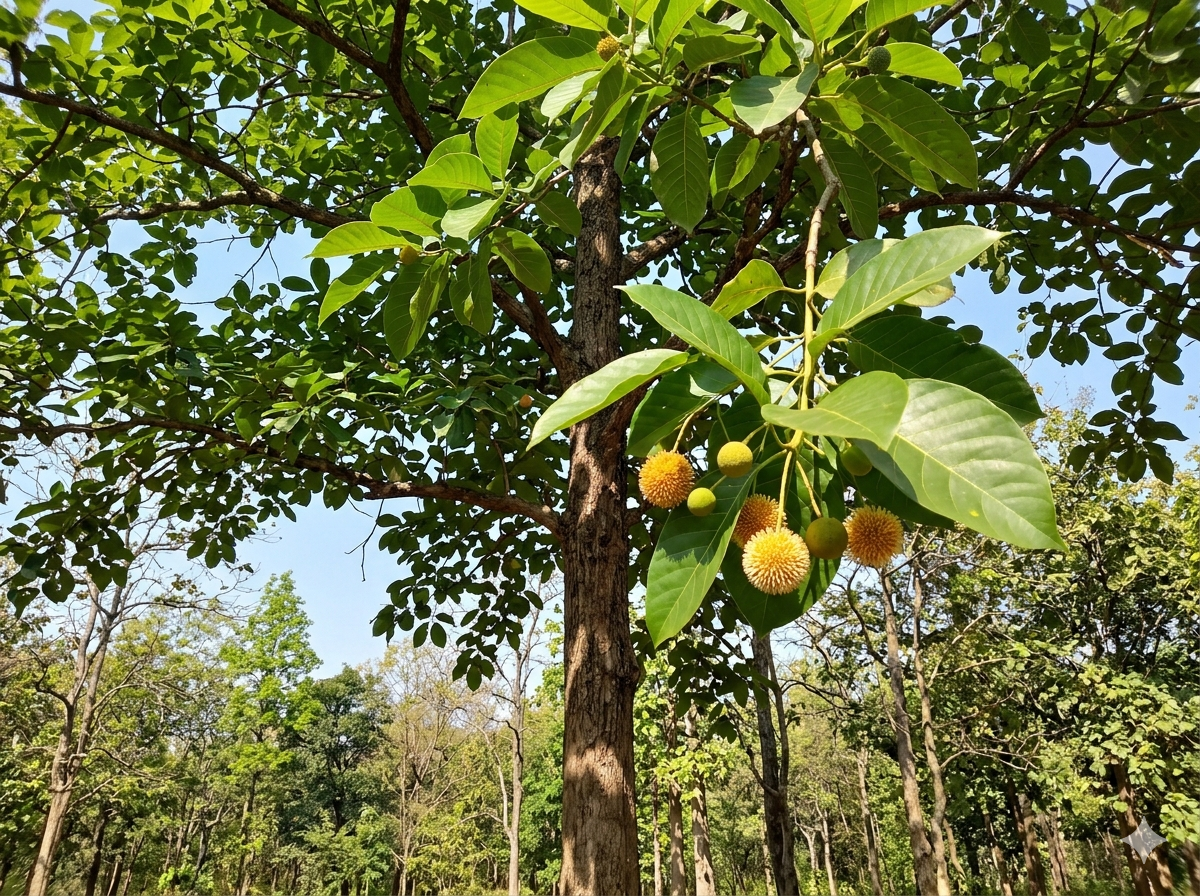
हल्दू — true Kadamba नहीं (common confusion)! India की plywood industry primary species। 3-5 फुट/वर्ष नदी किनारे। Year 12 पर Rs.35-38 lakh/hectare riverside plantation income। English willow से पहले traditional cricket bat wood।
Haldu (Haldina cordifolia) — Haldu / Kadamba-Haldu / Common Kadamba / Yellow Kadamba — is one of India's most important and underappreciated riverine timber trees, found along the banks of rivers and streams across the Himalayan foothills, Central India and Western Ghats. Despite sharing the common name "Kadamba" in many regions (leading to confusion with the true Kadamba Neolamarckia cadamba), Haldu is botanically distinct — in Rubiaceae family but different genus. Haldu is particularly significant because it is one of the fastest-growing quality timber trees in India — producing wood that is suitable for plywood, paper pulp, sports equipment and packaging within 10-12 years. India's plywood and paper industry has historically relied heavily on Haldu as a raw material, and with increasing plantation programs, Haldu is positioned as one of the most commercially important agroforestry trees for river-adjacent land in the Himalayan belt. The bark and leaves also have documented Ayurvedic applications — the bark is used for fever, the leaves as cattle fodder, and the yellow-green flower clusters attract important pollinators in the monsoon season when many other forest trees are not flowering.
Haldu (Haldina cordifolia) — हल्दू / Common Kadamba — India के most important riverine timber trees में। Himalayan foothills, Central India और Western Ghats में rivers और streams के किनारे। "Kadamba" नाम से confusion (true Kadamba = Neolamarckia cadamba — अलग)। India के fastest-growing quality timber trees में — 10-12 साल में plywood, paper pulp, sports equipment के लिए suitable wood। India की plywood और paper industry Haldu पर historically dependent। Himalayan belt में river-adjacent land के लिए most commercially important agroforestry trees में। Bark: fever। Leaves: cattle fodder। Flowers: monsoon pollinators।
🌳 Overview & Quick Facts / परिचय और मुख्य तथ्य
| 🔬 Scientific Name | Haldina cordifolia (syn. Adina cordifolia) — Family: Rubiaceae |
| ⚠️ Name Confusion | Called "Kadamba" in many regions — NOT the true Kadamba (Neolamarckia cadamba). Different species, different uses. |
| 📏 Height / ऊंचाई | 20–30 metres | Large deciduous riverine tree / बड़ा deciduous riverine tree |
| ⏳ Lifespan / आयु | 100–200+ years | Commercial harvest in 10-15 years for plywood |
| 📈 Growth Rate / वृद्धि दर | Fast — 3–5 ft/year near rivers / तेज़ — नदी किनारे 3-5 फुट/वर्ष |
| 🌸 Flowers / फूल | July–September — yellow-green spherical clusters. Fragrant. / July-September — yellow-green spherical, fragrant |
| ⚖️ Legal Status / कानूनी | Not specially protected. Commercial cultivation freely allowed. Timber: Forest Dept transit permit. Important industrial timber. |
| 💰 Timber Value / लकड़ी मूल्य | Rs.600–1,200/cubic foot | Plywood industry key species | Paper pulp important source |
🌿 Parts & Their Uses — हर अंग का उपयोग
Most important product। Light yellow-brown, fine-grained। Plywood: Indian plywood industry की primary species। Paper pulp: important fiber। Sports: cricket bats, hockey sticks (traditional)। Furniture: light furniture, packing cases। Market: Rs.600-1,200/cubic foot। Plantation: 10-15 year harvest।
Bark decoction: anti-pyretic (fever), anti-inflammatory। Fever और body pain में। Tannins, alkaloids, flavonoids। MFP: Rs.8-15/kg। Leather tanning — high tannin। Anti-bacterial research।
Large heart-shaped leaves (hence "cordifolia")। Excellent cattle/buffalo fodder — high palatability और protein। Leaf litter: excellent green manure। Food plates tribal areas में। Leaf extract: mild anti-bacterial। Muga silkworm के लिए minor secondary food tree।
Yellow-green spherical clusters (July-September) — fragrant। Honey source — monsoon में many trees bare होने पर। Pollinator support। Flower extract: mild anti-oxidant। Bees: distinctive Haldu honey — premium forest honey।
Root system: excellent riverbank stabilizer — Himalayan foothills riverbed erosion prevent। Root extract: mild anti-inflammatory। Medicinally collect नहीं — critical riparian role। Fish: important shade tree — fallen leaves decompose nutrients। Riverine forests ecological keystone।
Historical: English willow dominant होने से पहले traditional Indian cricket bats Haldu से। Hockey sticks, hockey balls (old design)। Traditional sporting goods। Haldu: light weight + fine grain + good impact resistance = sports equipment ideal।
🌍 Plywood Industry & Riparian Ecology / Plywood Industry और नदी पारिस्थितिकी
🌱 Growing Guide / हल्दू कैसे उगाएं
| Parameter | English | Hindi / हिंदी |
|---|---|---|
| 🌱 Propagation | Seeds from ripe fruits (Sept-Nov). Very fine seeds — mix with sand for sowing. Germination 15-25 days. Also root suckers from established trees. | Ripe fruits से बीज (Sept-Nov)। बहुत fine seeds — sand के साथ sow। 15-25 दिन germination। Established trees से root suckers। |
| 🪴 Soil | Deep alluvial or sandy-loam riverine soil. Moist conditions essential. pH 6.0–8.0. Grows best near rivers and streams. | Deep alluvial या sandy-loam riverine मिट्टी। Moist conditions essential। pH 6.0-8.0। Rivers और streams के पास best। |
| 💧 Water | High moisture requirement. Riverbank planting ideal — natural moisture. Regular irrigation first 3 years if not near river. | High moisture। Riverbank planting ideal। River के पास नहीं: पहले 3 साल regular irrigation। |
| 📅 Best Time | Monsoon June-July — most important timing. Very fast establishment with monsoon moisture. | Monsoon June-July — most important। Monsoon moisture के साथ बहुत fast establish। |
| 📏 Spacing | Plywood plantation: 3×3m (high density). Timber: 5×5m. Agroforestry on riverside: 8-10m rows. | Plywood plantation: 3×3m (high density)। Timber: 5×5m। Riverside agroforestry: 8-10m rows। |
| 💰 Income | Year 12-15: plywood/pulp timber. 200 trees × 0.3 cubic metre × Rs.800/cubic ft × 35.3 = Rs.1.7 lakh/hectare. Plus annual fodder + honey. | Year 12-15: plywood/pulp timber। 200 trees × 0.3 cubic metre × Rs.800 × 35.3 = Rs.1.7 lakh/hectare। Plus fodder + honey। |
💰 Market Value & Legal Status / बाज़ार मूल्य और कानूनी स्थिति
| Product / उत्पाद | Value / मूल्य | Legal / कानूनी |
|---|---|---|
| 🪵 Timber / लकड़ी | Rs.600–1,200/cubic foot | Plywood industry buyer direct | Transit permit Forest Dept. Private plantation: own timber freely with permit. |
| 🏭 Pulpwood | Rs.2,000–4,000/tonne paper industry | Transit permit. Paper mills direct buyer for plantation wood. |
| 🟫 Bark / छाल | Rs.8–15/kg dried tanning + Ayurvedic | Own trees: sustainably. Forest: FRA 2006 tribal rights. |
| 🍯 Honey / शहद | Rs.300–500/kg Haldu forest honey premium | Freely tradeable / freely |
Haldu vs True Kadamba: Same family (Rubiaceae), completely different species। True Kadamba (Neolamarckia): Medium-large। Leaves: simple, large। Flowers: ORANGE-GOLD spherical heads (3-5cm) — very distinctive। Krishna tree, attar, timber। Haldu (Haldina cordifolia): Large riverine। Leaves: distinctly heart-shaped। Flowers: YELLOW-GREEN spherical — similar structure, different color। Primarily timber/plywood। Less sacred। Tell apart: Flower color definitive — ORANGE-GOLD = true Kadamba; YELLOW-GREEN = Haldu। Leaf: Haldu distinctly heart-shaped base। Practically: Kadamba attar = must be Neolamarckia। Plywood/timber = Haldina। मत confuse करें।
Haldu Indian plywood industry: India plywood: Rs.30,000 crore+ annually। Key species: Gurjan, Rubber wood, Haldu, Eucalyptus। Haldu ideal: (1) Fine, uniform grain: smooth veneer। (2) Light weight: 560-670 kg/cubic metre। (3) Easy working: low silica, good gluability। (4) Class III durability: interior furniture, commercial plywood। (5) Large diameter available। (6) Fast growth: 10-15 year rotation। Geographic advantage: Himalayan foothills — UP, Uttarakhand, HP, Bihar। Yamuna Nagar (Haryana) = Asia's largest plywood hub। Proximity = transport cost reduce। Future: natural forest restricted → planted sources। Haldu riverine plantation = sustainable supply। NABARD: Haldu plantation covered — UP, Uttarakhand riverside land वाले access कर सकते।
Haldu riverside plantation — practical guide: Best land: river flood plains, moist alluvial — Himalayan rivers (Ganga/Yamuna/Brahmaputra tributaries)। UP, Uttarakhand, Bihar, Assam। Underutilized land (annual crops flood out) — Haldu handles seasonal flooding। Establishment: June-July। 40×40×40cm pit + rock phosphate + compost। After establish: seasonal flood + monsoon sufficient। Spacing plywood: 3×3m = 1,111 trees/hectare। First harvest regrowth: root suckers। Income (1 hectare, 12 year): 167 cubic metres × 35.3 × Rs.700 = Rs.41 lakh। Net: ~Rs.35-38 lakh flood-prone land से। Plus: fodder Rs.10,000-20,000 + honey Rs.10,000-15,000। Govt: UP Horticulture + Forest Dept promote। NABARD loans available। Uttarakhand FDC: subsidized seedlings।
Haldu bark fever — traditional और research: Himalayan belt में fever management में traditional। "Haldu" — yellow wood, but primary medicinal = bark fever use। Active: Tannins, Flavonoids, Indole alkaloids (Rubiaceae family quinine-type related)। Mechanism: prostaglandin inhibition (aspirin जैसा) anti-pyretic। Research: limited, in-vitro anti-pyretic और anti-inflammatory confirm। Traditional preparation: (1) Bark decoction: 10g + 500ml → 250ml। 100ml twice daily। (2) + ginger juice + honey: enhanced effect। (3) External: bark paste forehead। Caution: high fever (>104°F), prolonged fever (>3 days), severe chills, rash, jaundice — medical evaluation। Mild-moderate fever support के रूप में appropriate। Major Ayurvedic fever trees (Neem, Giloy, Chirayata) से less studied।
Haldu cricket bats — history: English willow (Salix alba var. caerulea) dominant होने से पहले Indian cricket bats में Haldu और Kashmir willow। Haldu properties as bat: Light weight, good impact resistance, fine grain, locally available। English willow dominant क्यों: (1) Superior elasticity: unique cellular structure — "spring" in quality bat। Ball better rebounds। Haldu में cellular elasticity नहीं। (2) MCC regulations: English willow characteristics around developed। (3) Player preference: established performance advantage। (4) India cricket professionalized। Kashmir willow compromise: J&K में — lower-price training bats (Rs.500-3,000)। English willow: Rs.3,000-50,000+ professional। Haldu today: Himalayan communities में traditional sports equipment — lathi, hockey stick handles, wooden toys। Revival: sustainable sports equipment interest — artisanal "traditional Indian wood" cricket bat niche possible।