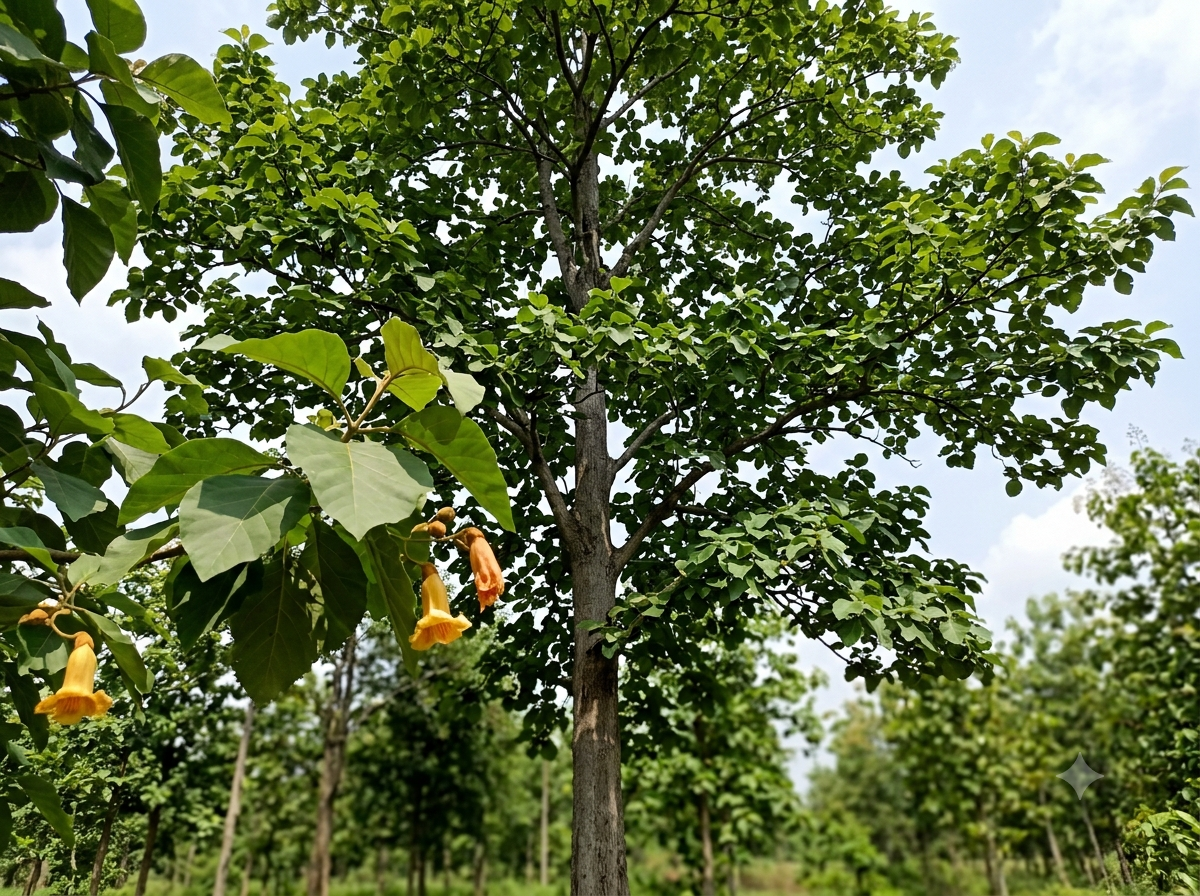
Gambhar Gmelina White Teak Fast Timber Musical Instruments India — PlantCare
📷 PlantCare
🕉️ Sacred & Medicinal Trees

Gambhar / White Teak / Gmelina गम्भार / गंभारी / शिवान

Gmelina arborea Family: Lamiaceae (Mint family)

Gambhar / Gmelina — fastest quality timber India (4-6 ft/yr!). Rs.1.1 crore/ha at 15 yr. Sitar, tabla, harmonium preferred wood (acoustic resonance). Dashamoola Ayurveda root. Flowers + fruits both edible. Better than Eucalyptus!

📏 20–30 metres straight trunk ⏳ 50–100+ years commercial 10-15 yr 📈 Very fast — 4–6 ft/year. One of India's fastest quality timber trees. 📍 Pan-India below 1,500m — 750-2500mm rainfall preferred ⚠️ Not protected. Commercial plantation actively encouraged. Timber: FD transit permit. 💰 Rs.800–1,500/cubic foot + musical instruments premium
📤 WhatsApp
Gambhar Gmelina 4-6ft/yr Fastest Quality Rs1.1Cr/ha 15yr Sitar Tabla Harmonium Wood Dashamoola Ten Roots Flowers Fruits Edible Better Than Eucalyptus

गम्भार — India का fastest quality timber (4-6 फुट/वर्ष!)। Rs.1.1 crore/ha 15 साल में। Sitar, tabla, harmonium preferred wood (acoustic resonance)। Dashamoola Ayurveda root। Flowers + fruits दोनों edible। Eucalyptus से better!

Gambhar (Gmelina arborea) — Gambhari / White Teak / Shivan / Kashmiri Shisham / Beechwood — is one of India's most commercially important fast-growing timber trees, widely planted across tropical and subtropical India for its exceptional combination of fast growth and good timber quality. Gambhar is unique in the Indian timber landscape: it grows almost as fast as Eucalyptus but produces timber of considerably higher quality — hard, durable, beautifully grained wood suitable for furniture, musical instruments, sports equipment, and construction. This combination makes Gambhar one of the most economically attractive plantation trees available to Indian farmers. In Ayurveda, Gambhar is one of the Dashamoola (ten roots) — one of India's most important classical formulations used for fever, respiratory conditions, nervous system disorders, and general rejuvenation. The bark, roots, leaves and fruits all have documented therapeutic applications. The tree also produces beautiful large yellow-orange flowers and edible fruits — giving it ornamental, food and medicinal value simultaneously. Gambhar is also extensively used in agroforestry systems because it is a strong nitrogen fixer, improves soil, provides excellent shade, and its leaf litter rapidly improves soil organic matter. It is one of India's most versatile and underutilized commercial trees.

Gambhar (Gmelina arborea) — गम्भार / White Teak / Shivan — India के most commercially important fast-growing timber trees में। Eucalyptus जितना fast grow लेकिन considerably higher quality timber। Furniture, musical instruments, sports equipment, construction। India के most economically attractive plantation trees में। Ayurveda में Gambhar = Dashamoola के दस roots में — fever, respiratory, nervous system, rejuvenation। Bark, roots, leaves, fruits: all documented medicinal। Beautiful yellow-orange flowers, edible fruits। Strong N-fixer — soil improve, excellent shade, leaf litter soil organic matter।

🌳 Overview & Quick Facts / परिचय और मुख्य तथ्य

🔬 Scientific NameGmelina arborea — Family: Lamiaceae (Mint family)
📏 Height / ऊंचाई20–30 metres | Straight trunk — excellent timber form
Lifespan / आयु50–100+ years | Commercial harvest 10-15 years
📈 Growth Rate / वृद्धि दरVery fast — 4–6 ft/year when young. One of India's fastest quality timber trees.
🌸 Flowers / फूलMarch–April — large yellow-orange funnel shaped. Beautiful! Edible. / मार्च-अप्रैल — large yellow-orange funnel। Beautiful! Edible।
🌡️ Climate / जलवायुTropical to subtropical. 750-2500mm rainfall. 20–40°C. Pan-India below 1,500m.
⚖️ Legal Status / कानूनीNot protected. Commercial plantation actively encouraged. Timber: Forest Dept transit permit.
💰 Timber Value / लकड़ी मूल्यRs.800–1,500/cubic foot | Plywood industry + furniture + musical instruments

🌿 Parts & Their Uses — हर अंग का उपयोग

🪵
Wood / लकड़ी (Primary Commercial Value)
Light yellowish-brown, moderate hardness, beautiful grain, easy to work. Uses: furniture, plywood, musical instruments (sitars, tablas — resonance quality), sports goods, packing cases, railway carriages, construction. Market: Rs.800-1,500/cubic foot. 10-15 year plantation harvest. Paper pulp also important use.

Light yellowish-brown, moderate hardness, beautiful grain। Uses: furniture, plywood, musical instruments (sitars, tablas — resonance quality), sports goods, packing cases, railway carriages। Market: Rs.800-1,500/cubic foot। 10-15 year harvest। Paper pulp।
🌱
Roots / जड़ें (Dashamoola)
Gambhar root = one of the Dashamoola (ten roots). Root bark decoction: anti-pyretic (fever), anti-inflammatory, nervine tonic. Dashamoola preparations: fever, respiratory conditions, rheumatism, post-partum recovery. Root MFP: Rs.15-30/kg. AYUSH formulary listed. Collect only from pruned roots — never uproot the tree.

Gambhar root = Dashamoola में। Root bark decoction: anti-pyretic, anti-inflammatory, nervine। Dashamoola: fever, respiratory, rheumatism, post-partum। Root MFP: Rs.15-30/kg। AYUSH formulary। Pruned roots से collect — पेड़ uproot नहीं।
🟫
Bark / छाल
Bark decoction: anti-pyretic, anti-inflammatory, anti-snake-venom (traditional). Bark used in leprosy treatment in traditional medicine. Anti-diarrheal. Contains iridoid glycosides, lignans with confirmed anti-microbial activity. MFP rate: Rs.10-18/kg dried. Bark juice: applied to skin diseases and wounds.

Bark decoction: anti-pyretic, anti-inflammatory, anti-snake-venom (traditional)। Leprosy treatment। Anti-diarrheal। Iridoid glycosides, lignans — confirmed anti-microbial। MFP: Rs.10-18/kg। Bark juice: skin diseases, wounds।
🍎
Fruits / फल (Edible)
Oval, yellow, pulpy fruits (3-4cm) — edible when ripe. Slightly sweet, mucilaginous. Eaten fresh in tribal areas. Fruit pulp: used in Ayurvedic formulations for digestive conditions. Wildlife: monkeys, birds, jackals eat fruits — important forest food. Fruit extract: mild anti-oxidant research.

Oval, yellow, pulpy fruits (3-4cm) — ripe होने पर edible। Slightly sweet, mucilaginous। Tribal areas में fresh खाते। Fruit pulp: digestive conditions Ayurvedic। Wildlife: monkeys, birds, jackals। Anti-oxidant research।
🌸
Flowers / फूल
Large yellow-orange funnel-shaped flowers (March-April) — beautiful, edible, excellent honey source. Flowers eaten as vegetable in some tribal communities. Excellent nectar source — bees produce distinctive Gambhar honey. Flower extract: anti-inflammatory research. Ornamental value — one of India's most spectacular flowering timber trees.

Large yellow-orange funnel flowers (March-April) — beautiful, edible, honey source। Tribal communities में vegetable के रूप में। Distinctive Gambhar honey। Flower extract: anti-inflammatory। India के most spectacular flowering timber trees में।
🍃
Leaves / पत्ते
Large leaves (20-30cm) — excellent cattle fodder (high protein, good palatability). Leaf litter: rapid decomposition, excellent green manure. Leaf extract: anti-fungal, anti-bacterial research. Young leaves: occasionally used in tribal cooking. N-fixing root bacteria: soil nitrogen improvement significant. Important silkworm food in some regions.

Large leaves (20-30cm) — excellent cattle fodder। Leaf litter: rapid decomposition, excellent green manure। Leaf extract: anti-fungal, anti-bacterial। Young leaves: tribal cooking। N-fixing root bacteria: significant soil N। Silkworm food some regions।

🌍 Timber Industry & Dashamoola / Timber Industry और Dashamoola

⚡ Key Facts / मुख्य तथ्य
⚡ Fast + Quality
4-6 ft/year growth + Rs.800-1,500/cubic ft timber. Best fast-quality combination in India.
4-6 फुट/वर्ष + Rs.800-1,500/cubic ft। India में best fast-quality combination।
🎸 Musical Instruments
Sitar, tabla, harmonium — resonance quality makes Gambhar preferred for Indian instruments.
Sitar, tabla, harmonium — resonance quality से Gambhar Indian instruments के लिए preferred।
💊 Dashamoola
One of 10 roots — classical Ayurvedic formulation for fever, respiratory, nervous system.
10 roots में एक — fever, respiratory, nervous system classical formulation।
🌿 Agroforestry
N-fixing, excellent shade, fast leaf litter mulch. Ideal agroforestry companion tree.
N-fixing, excellent shade, fast leaf litter mulch। Ideal agroforestry companion।
🍎 Edible
Flowers + fruits both edible. Ornamental + food + timber + medicine = four values.
Flowers + fruits दोनों edible। Ornamental + food + timber + medicine = four values।
📄 Pulpwood
Important paper pulp species — paper mills active buyers. Alternative to eucalyptus pulp.
Important paper pulp species। Paper mills active buyers। Eucalyptus pulp का alternative।

🌱 Growing Guide / गम्भार कैसे उगाएं

ParameterEnglishHindi / हिंदी
🌱 PropagationSeeds from ripe fruits (May-July). Germination 15-30 days. Also stem cuttings (hardwood, August-September). Seeds: remove pulp before sowing.Ripe fruits से बीज (May-July)। 15-30 दिन germination। Stem cuttings (hardwood, Aug-Sept)। Seeds: sowing से पहले pulp remove।
🪴 SoilDeep moist loamy soil. pH 6.0–8.0. High rainfall (750-2500mm) preferred. Cannot tolerate prolonged drought or waterlogging.Deep moist loamy। pH 6.0-8.0। High rainfall preferred। Prolonged drought या waterlogging: नहीं।
📅 Best TimeMonsoon June-July — most important. Excellent establishment with monsoon moisture.Monsoon June-July — most important। Monsoon moisture excellent establishment।
📏 SpacingTimber: 4×4m (625 trees/ha). Pulpwood: 2×2m (2,500 trees/ha). Agroforestry: 10m rows, crops between.Timber: 4×4m (625 trees/ha)। Pulpwood: 2×2m। Agroforestry: 10m rows, crops बीच।
🌿 PruningPrune lower branches annually (years 1-5) for straight timber form — clear bole development essential for timber quality.Lower branches annually prune (years 1-5) — straight timber form। Clear bole development timber quality के लिए essential।
💰 Income625 trees × 0.5 cubic metre (15 yr) × Rs.1,000/cubic ft × 35.3 = Rs.1.1 crore/ha timber. Plus annual fodder + honey.625 trees × 0.5 cubic metre × Rs.1,000 × 35.3 = Rs.1.1 crore/ha timber। Plus fodder + honey।

💰 Market Value & Legal Status / बाज़ार मूल्य और कानूनी स्थिति

Product / उत्पादValue / मूल्यLegal / कानूनी
🪵 Timber / लकड़ीRs.800–1,500/cubic foot | Musical instruments premiumTransit permit Forest Dept. Own plantation: freely with permit.
📄 PulpwoodRs.2,500–4,500/tonne paper millsPaper mills direct buyer. Transit permit.
🌱 Roots (Dashamoola)Rs.15–30/kg MFP Ayurvedic marketOwn trees pruned roots: freely. Forest: FRA 2006.
🍯 HoneyRs.300–500/kg Gambhar honeyFreely traded / freely
❓ Frequently Asked Questions / अक्सर पूछे जाने वाले सवाल
Dashamoola (Ten Roots) — Gambhar's role: Dashamoola is one of Ayurveda's most important classical formulations — literally "ten roots." The ten roots are: Bael (Aegle marmelos), Syonaka (Oroxylum indicum), Gambhari (Gmelina arborea), Patala (Stereospermum suaveolens), Agnimantha (Premna serratifolia), Shalaparni (Desmodium gangeticum), Prishniparni (Uraria picta), Brihati (Solanum indicum), Kantakari (Solanum xanthocarpum), Gokshura (Tribulus terrestris). Gambhari (Gambhar) specifically contributes: anti-pyretic action, nervine tonic properties, anti-inflammatory for respiratory conditions. Prepared as Dashamoolarishtam (fermented liquid) — one of India's most widely consumed Ayurvedic formulations. Used for: fever (all types in classical texts), post-partum recovery (standard prescription), respiratory conditions, neurological weakness, rheumatism. Available commercially: Dabur Dashmool Ras, Baidyanath Dashmularishta, Kerala Ayurveda, IMPCOPS. Rs.100-200/450ml. Gambhar root specifically: root bark decoction alone for fever and inflammation is a valid classical usage — doesn't require the full Dashamoola combination for simpler conditions.

Dashamoola (Ten Roots): Bael, Syonaka, Gambhari (Gambhar), Patala, Agnimantha, Shalaparni, Prishniparni, Brihati, Kantakari, Gokshura। Gambhari specifically: anti-pyretic, nervine tonic, respiratory anti-inflammatory। Dashamoolarishtam = India's most consumed Ayurvedic formulations में। Uses: fever, post-partum, respiratory, neurological, rheumatism। Commercially: Dabur, Baidyanath, Kerala Ayurveda — Rs.100-200/450ml।
Gambhar for musical instruments — acoustic science: Indian classical music instrument makers (especially in Miraj, Maharashtra and Kolkata, West Bengal) have used Gambhar (Gmelina) for centuries. Why Gambhar is acoustically excellent: (1) Resonance: Gambhar wood has excellent acoustic resonance — vibrates at frequencies important for musical tones. The wood grain and density create specific frequency response characteristics. (2) Workability: soft enough for fine carving and shaping, hard enough for structural integrity. Ideal for sitars (complex curved shapes) and harmoniums (rectangular cabinetry). (3) Light weight with strength: allows large instrument bodies without excessive weight — important for portability and playability. (4) Stability: Gambhar is dimensionally stable — does not expand/contract significantly with humidity changes. Critical for instruments that must maintain tuning. Instruments using Gambhar: Sitar: body (tumba traditionally gourd, neck and resonator from Gambhar). Harmonium: entire cabinet. Tanpura: body. Tabla: some components. Sarangi: body. Veena: soundboard. Modern situation: Gambhar for instruments is increasingly from plantation wood. Traditional luthiers note plantation Gambhar (faster grown) has slightly different acoustic properties than old-growth forest Gambhar — open grain vs tighter grain — affects tonal quality. Instrument makers prefer slow-grown timber. Alternative: Tun (Toona ciliata) also used, but Gambhar preferred for resonance. Import substitute: Gambhar replaces imported European tonewoods for budget Indian instruments.

Gambhar musical instruments — acoustic science: India's classical instrument makers Miraj (MH) और Kolkata (WB) centuries से। Why excellent: (1) Resonance: excellent acoustic — musical tones के लिए important frequency response। (2) Workability: fine carving + structural integrity। Sitars (complex curves) + harmoniums (rectangular) ideal। (3) Light weight + strength: large instrument bodies, portable। (4) Stability: dimensional — humidity changes पर expand/contract नहीं। Instruments: Sitar, Harmonium, Tanpura, Tabla, Sarangi, Veena। Modern: plantation Gambhar (faster grown) — slightly different acoustic। Instrument makers slow-grown timber prefer। Alternative: Tun (Toona ciliata) also used। Import substitute: European tonewoods replace।
Gambhar plantation income — detailed 15-year projection: Setup (1 hectare, 625 trees, 4×4m): Seedlings: 625 × Rs.20 = Rs.12,500. Land preparation: Rs.15,000. Planting labor: Rs.8,000. Fertilizer + maintenance (15 years): Rs.40,000. Transit permit (timber sale): Rs.5,000. Total investment: ~Rs.80,000. Annual income during growth (Years 1-14): Leaf fodder: Rs.5,000-10,000/year. Flowers/fruits (tribal sale or own use): Rs.2,000-5,000. Honey (if beekeeping alongside): Rs.8,000-15,000. Total annual: Rs.15,000-30,000/year. Timber harvest (Year 15): 625 trees. Realistic yield: trees with proper pruning → 4-6m clear bole, 30-40cm diameter at base. Volume: 625 × 0.3-0.5 cubic metre = 187-312 cubic metres. Market: Rs.1,000/cubic foot × 35.3 cubic feet/cubic metre × 250 cubic metres = Rs.88 lakh. Conservative estimate: Rs.60-80 lakh timber income at Year 15. Adding 15 years of annual income: Rs.15,000 × 15 = Rs.2.25 lakh. Total 15-year project income: Rs.62-82 lakh from Rs.80,000 investment. ROI: 775-1,025x on invested capital over 15 years. Government support: NABARD agroforestry scheme loans at 7-9% for Gambhar plantation. State Forest Departments in Karnataka, AP, TN, Maharashtra promote Gambhar plantation with subsidized seedlings. Caution: timber prices vary — get local market quotes before planning. Timber must be sold with transit permit — cannot be transported without FD permission.

Gambhar plantation income — 15-year projection: Setup (625 trees, 4×4m): ~Rs.80,000 total। Annual income Years 1-14: fodder + flowers/fruits + honey = Rs.15,000-30,000/year। Timber harvest Year 15: 250 cubic metres × Rs.1,000/cubic ft × 35.3 = Rs.88 lakh। Conservative: Rs.60-80 lakh timber। 15-year annual total: Rs.2.25 lakh। Total project: Rs.62-82 lakh from Rs.80,000 investment। ROI: 775-1,025x। Govt support: NABARD loans 7-9%। Karnataka, AP, TN, Maharashtra subsidized seedlings। Caution: timber prices vary — local market quotes। Transit permit mandatory।
Gambhar vs Eucalyptus — honest comparison for Indian farmers: Growth rate: Eucalyptus: 8-12 ft/year (fastest). Gambhar: 4-6 ft/year (very fast, but slower). Eucalyptus wins on pure speed. Timber quality: Eucalyptus: hard, good for construction and pulp, but grain is often interlocked making furniture difficult. Gambhar: moderate hardness, beautiful straight grain, excellent for furniture, musical instruments, plywood. Gambhar wins clearly on timber quality. Market price: Eucalyptus: Rs.400-700/cubic foot (mostly pulp market). Gambhar: Rs.800-1,500/cubic foot (furniture + multiple markets). Gambhar: 2-3x higher price. Soil impact: Eucalyptus: allelopathic — releases chemicals that inhibit understorey plants. Depletes soil moisture and nitrogen significantly. Monoculture problems documented. Gambhar: N-fixing legume. Improves soil. Leaf litter decomposes beneficially. Intercropping possible. Water requirement: Eucalyptus: higher water demand despite drought tolerance — draws down groundwater significantly. Major criticism in water-stressed India. Gambhar: moderate water — more environmentally responsible in water-stressed areas. Agroforestry suitability: Eucalyptus: poor for intercropping (allelopathy + shade + water competition). Gambhar: excellent for intercropping (N-fixing, beneficial leaf litter, moderate shade). Multiple income streams. Verdict: For pulpwood only, short rotation (5-7 years) — Eucalyptus has speed advantage. For timber income, soil health, water conservation, multiple products, and agroforestry — Gambhar is superior on almost every dimension. For most Indian farmer scenarios: Gambhar recommended.

Gambhar vs Eucalyptus comparison: Growth: Eucalyptus 8-12 ft/yr (fastest)। Gambhar 4-6 ft/yr। Eucalyptus faster। Timber: Eucalyptus hard but interlocked grain, furniture difficult। Gambhar beautiful straight grain, furniture + instruments + plywood। Gambhar clearly wins। Price: Eucalyptus Rs.400-700 (mostly pulp)। Gambhar Rs.800-1,500 (multiple markets)। Gambhar 2-3x। Soil: Eucalyptus allelopathic, soil deplete। Gambhar N-fixing, soil improve। Water: Eucalyptus groundwater drawdown — water-stressed India में criticism। Gambhar moderate। Agroforestry: Eucalyptus poor (allelopathy)। Gambhar excellent। Verdict: Pulpwood only, short rotation → Eucalyptus speed। Timber income + soil + water + multiple products → Gambhar superior। Most Indian farmer scenarios: Gambhar recommended।
Gambhar flowers and fruits — edible uses: Flowers: Large (3-5cm) yellow-orange funnel-shaped flowers appear in March-April on leafless or newly leafing branches. Taste: slightly sweet, mucilaginous, mild pleasant flavor. Edible raw or cooked. Uses: (1) Raw in salads — fresh flowers add color and mild sweetness. (2) Cooked as vegetable — sauté with onion, garlic, mild spices. Tribal communities in Maharashtra, Karnataka, MP cook as seasonal vegetable. (3) In fritters (pakoras) — flower dipped in besan batter, fried. Popular seasonal snack in forest villages. (4) In soups and dal — add flowers at end of cooking for visual appeal and mild nutrition. Nutritional note: flowers contain significant calcium and vitamin content. Fruits: Oval yellow drupes (3-4cm) ripen May-July. Taste: sweet, slightly astringent, mucilaginous (gummy) texture inside. Not everyone's favorite texture but nutritious. Uses: (1) Eaten fresh by children in tribal areas. (2) Fruit extract in Ayurvedic digestive preparations. (3) Soaked overnight, eaten next morning — softens texture. Wildlife food: monkeys, birds, jackals eat fruits enthusiastically — you can often find Gambhar trees by watching for animal activity. Cultural note: in Maharashtra and Karnataka, Gambhar flowers are collected for puja and medicinal use by traditional healers during the brief March-April flowering season — considered a seasonal forest gift.

Gambhar flowers और fruits: Flowers: large (3-5cm) yellow-orange, March-April। Slightly sweet, mucilaginous। Uses: (1) Raw salads। (2) Cooked vegetable — sauté with onion, spices। Tribal Maharashtra, Karnataka, MP में। (3) Pakoras — besan batter में। (4) Soups और dal में। Nutritional: significant calcium + vitamins। Fruits: oval yellow drupes (3-4cm), May-July ripe। Sweet, slightly astringent, mucilaginous। Uses: (1) Fresh tribal children खाते। (2) Ayurvedic digestive preparations। (3) Overnight soak — texture soften। Wildlife: monkeys, birds, jackals enthusiastically। Cultural: Maharashtra, Karnataka में March-April पूजा और medicinal — seasonal forest gift माना जाता।
⚠️
AI-Assisted Content — Please Read
AI-सहायता से बनाई गई सामग्री — कृपया पढ़ें

All tools, plant encyclopedias, edible growing guides and blog content on PlantCare are created with the assistance of AI (Artificial Intelligence) and are intended for general informational and educational purposes only. While we strive for accuracy, the information provided may not be complete, current or suitable for every situation, region or individual plant variety.

For health, medical or serious agricultural decisions — always consult a qualified horticulturist, agronomist, Ayurvedic practitioner, medical professional or relevant expert. PlantCare does not take responsibility for outcomes arising from use of this information. Identification results from AI tools (plant identifier, pest identifier etc.) should be verified before taking any action.

इस वेबसाइट पर सभी tools, plant encyclopedias, edible guides और blog content AI (Artificial Intelligence) की सहायता से बनाए गए हैं और केवल सामान्य जानकारी और शिक्षा के उद्देश्य से हैं। स्वास्थ्य, चिकित्सा या गंभीर कृषि निर्णयों के लिए कृपया किसी योग्य विशेषज्ञ से संपर्क करें। PlantCare इस जानकारी के उपयोग से होने वाले परिणामों के लिए जिम्मेदार नहीं है।