Urad Black Gram Farming India — Idli Dosa Dal Makhani Pulse Encyclopedia
🌾 Crops & Grains

Urad / Black Gram उड़द / काली दाल

Vigna mungo
🌱 Kharif June-July | 2-3 pickings = 20-25% more yield | YMV resistant variety critical ⏱️ 70-90 days | 2-3 pickings | MSP Rs.7,400/qt | Papad industry premium buyer 🌿 Easy Grow ✅ Edible Safe
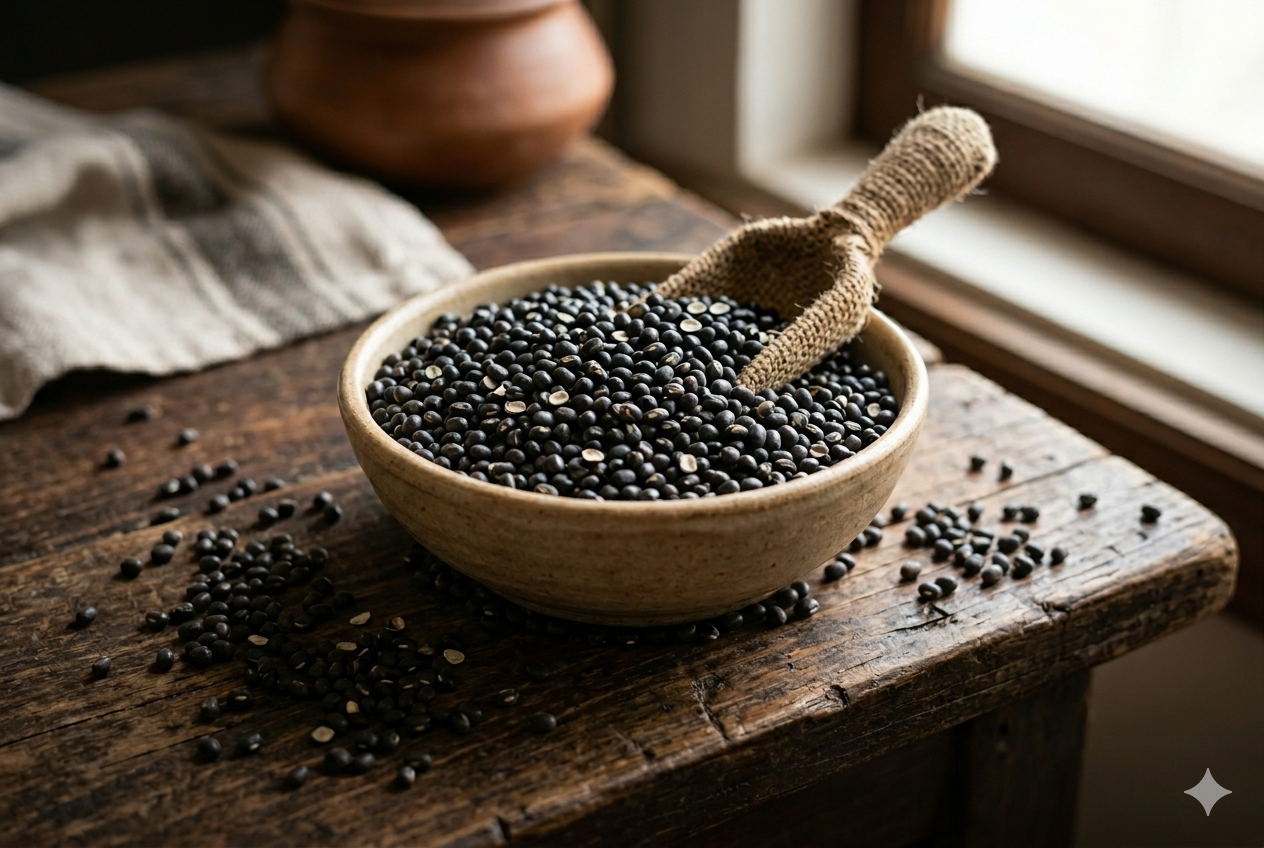
Photo: PlantCare
Urad Black Gram Highest Protein Pulse Idli Dosa Only Urad No Substitute Fermentation Papad Premium Dal Makhani MSP 7400

Urad / Black Gram — HIGHEST protein common pulse (25-26g). Idli + dosa ONLY possible with urad (unique fermentation — no substitute!). Papad industry pays premium. MSP Rs.7,400/qt.

Urad / Black Gram — HIGHEST protein common pulse (25-26g)। Idli + dosa ONLY urad से possible (unique fermentation — no substitute!)। Papad industry premium pay करती। MSP Rs.7,400/qt।

⚡ Quick Reference / एक नज़र में
🌱 Sowing Season
Kharif June-July | 2-3 pickings = 20-25% more yield | YMV resistant variety critical
⏱️ Harvest Time
70-90 days | 2-3 pickings | MSP Rs.7,400/qt | Papad industry premium buyer
🍽️ Edible Parts
Grain — urad dal, dhuli urad, idli/dosa batter (UNIQUE fermentation!), papad, dal makhani
☀️ Light
Full sun — 6+ hours
💧 Water
600-700mm | 3-4 irrigations | More moisture than moong | 70-90 days
🌡️ Temperature
25-35°C — warm humid. More humidity tolerant than moong.
💊
Key Nutrition / पोषण
Protein 25-26g (HIGHEST common pulse!), Iron 7.6mg, Calcium 154mg, Unique starch fermentation
🍳
Indian Kitchen Uses / भारतीय रसोई
Idli, dosa, vada, papad, dal makhani, urad dal — South Indian cuisine foundation

Urad (Vigna mungo) — Black Gram / Urad Dal / Kali Dal — is India's most culturally significant pulse and the foundation of South Indian cuisine's most iconic dishes. Without urad, there would be no idli, no dosa, no vada, no papad — the fermentation-dependent culinary tradition that defines South Indian food globally relies entirely on urad's unique property: its high starch content that ferments rapidly, creates the characteristic sour flavor, and provides the airy texture impossible to replicate with any other pulse. In North India, urad is equally essential — urad dal makhani (slow-cooked black urad) is arguably India's most globally celebrated dal, the foundation of Dal Makhani that put Punjab on the world food map. India produces approximately 3-3.5 million tonnes annually, with Madhya Pradesh, Uttar Pradesh, Andhra Pradesh, Maharashtra and Rajasthan being primary producers. As a Kharif crop, urad is grown during the monsoon season alongside moong, often as an intercrop, and shares similar agronomic requirements — but has distinct nutritional properties including the highest protein content among common Indian pulses.

Urad (Vigna mungo) — Black Gram — idli, dosa, vada, papad — South Indian cuisine इसके बिना impossible! Urad का fermentation property unique है — कोई दूसरी dal replicate नहीं कर सकती। North India: Dal Makhani का base। India 3-3.5 million tonnes annually। Highest protein among common Indian pulses।

🌱 Overview, Classification & Varieties

🔬 Scientific NameVigna mungo
📅 SeasonKharif (main) — June-July | Rabi (South India irrigated) | Short Zaid possible
🌡️ Temperature25-35°C — warm humid. More humidity tolerant than moong.
💧 Water600-700mm | 3-4 irrigations | More moisture need than moong
⏱️ Duration70-90 days — slightly longer than moong
🌾 YieldImproved: 1.0-1.5 t/ha | Traditional: 0.5-0.8 t/ha
VarietySpecialtyRegion
🌱 Pant U-19GBPUAT — wilt + YMV resistant, high yield, 75-80 days. UP standard.UP, Uttarakhand
🌱 KU-300Kanpur — YMV tolerant, short duration. Good for both seasons.UP, Bihar
🌱 LBG-17ANGRAU — Andhra/Telangana standard, drought tolerantAP, Telangana, Karnataka
🌱 TAU-1TNAU — Tamil Nadu variety, short duration, multiple pickingsTamil Nadu
🌱 PDU-1 (Uttara)UAS Dharwad — Karnataka standard, YMV resistantKarnataka, Maharashtra

🪴 Soil, Sowing & Nutrient Management

🪴
Soil Requirements
Well-draining loamy to clay loam — pH 6.0-7.5. Urad tolerates slightly heavier soils than moong. Black cotton soil: possible in Kharif if drainage assured. Sandy loam: good with adequate moisture. Waterlogging: kills within 24-48 hours — same as moong. Deep plowing: exposes pod borer pupae. Raised beds in heavy soils prevent waterlogging during heavy monsoon rains. Avoid very acidic soils (below pH 5.5).
📅
Sowing
June 15 — July 15 Kharif sowing. Seed rate: 15-20 kg/ha. Spacing: 30 × 10 cm. Depth: 3-4 cm. Seed treatment: Rhizobium (Vigna-specific — same as moong) + Thiram + Imidacloprid (YMV whitefly control). Often intercropped with sorghum (jowar) or maize — 2:1 row ratio. Intercropping: urad benefits from taller crop shade in peak heat, main crop benefits from urad's N-fixation. In South India Rabi: October-November sowing, irrigated, 80-90 days to harvest.
🧪
Fertilizer
N: 15-20 kg/ha starter only — Rhizobium fixes 40-80 kg N/ha. P: 40 kg P₂O₅ — critical. K: 20 kg K₂O. Sulphur: 20 kg/ha for protein quality improvement. Rhizobium (Vigna mungo specific strain): essential — use correct strain, not chickpea Rhizobium. Boron: 1 kg/ha borax — improves pod set and reduces flower drop. FYM: 5 tonnes/ha pre-sowing improves soil structure. Total input: Rs.6,000-10,000/ha — very economical for a high-value crop.
🫙
Papad & Food Industry Demand
Urad is the primary raw material for India's massive papad industry (Lijjat Papad, regional producers). Papad-grade urad: must be clean, uniform, free of damaged grains. Premium: papad mills pay Rs.500-1,000/qt above market price for quality urad. Idli-dosa batter industry: large-scale batter manufacturers in South India use significant quantities of urad dal. Food processing demand provides price floor above MSP in most years — market linkage more consistent than for other pulses.

🌿 Crop Protection & Management

⚡ Key Pests & Diseases
🦠 Yellow Mosaic
MYMV — whitefly vector
Resistant variety + Imidacloprid seed treatment
🍂 Leaf Spot
Cercospora canescens
Mancozeb or Carbendazim spray
🌿 Powdery Mildew
Erysiphe polygoni
Sulphur dust or Karathane
🐛 Pod Borer
Maruca vitrata
Emamectin benzoate at pod stage
🐛 Whitefly
Bemisia tabaci — YMV vector
Imidacloprid 17.8SL foliar spray
🌾 Root Rot
Macrophomina phaseolina
Trichoderma seed treatment + drainage
Tool / ResourceUse for Urad
📅 Crop Sowing CalendarKharif urad sowing dates — UP, MP, AP, Karnataka region-wise
🧪 Fertilizer CalculatorMinimal N + P dosage — Vigna pulse calculation
🔍 Pest IdentifierYMV symptoms vs leaf spot — visual identification
🌱 Companion Planting GuideUrad + jowar / urad + maize intercrop systems
💧 Watering CalculatorKharif supplemental irrigation — critical at flowering

🌱 Harvest, Nutrition, Uses & Economics

  • 2-3 pickings for maximum yield: Like moong, urad pods mature unevenly — 2-3 pickings give 20-25% more yield. First picking: 70-75 days when 60-70% pods turn black. Second: 80-85 days. Final: 90 days. Mechanical single harvest: at 70-75% pod maturity. Dry 3-4 days, thresh, clean. Moisture: 10-12% for storage. MSP 2024-25: Rs.7,400/quintal. Market often above MSP due to consistent demand from South Indian food industry and dal mills.
Nutrition (per 100g dry)ValueNote
💪 Protein25-26g — highest common pulseMore protein than moong, chana, lentil
🌾 Fiber18gExcellent gut health, prebiotic
⚙️ Iron7.6mg — 42% RDASecond only to lentil among common dals
🦴 Calcium154mgGood for vegetarian bone health
🌿 Potassium983mg — 21% RDABlood pressure support
🧬 FermentationUnique starchOnly dal that ferments properly for idli/dosa — unique property
❓ FAQ
Urad's unique fermentation science: Urad dal contains specific starches and proteins that: (1) Provide substrate for Leuconostoc mesenteroides bacteria (natural in rice and urad). (2) The bacteria produce lactic acid (sour flavor) and CO2 (airy porous texture). (3) Urad's high viscosity when ground creates batter that traps CO2 bubbles — giving idli's characteristic spongy texture. Why no substitute works: Moong: ferments but lower viscosity — flat, dense idli. Chana dal: different starch structure — doesn't foam properly. Any other dal: doesn't support the same fermentation profile. Traditional ratio: 1 part urad dal: 3 parts rice (parboiled or idli rice). Modern quick version: 1:2 with fenugreek (methi seeds — 1/4 tsp) added which accelerates fermentation. Fermentation time: 8-12 hours at 25-30°C. Winter: longer fermentation (12-16 hours) or warm oven. Summer: 6-8 hours. The urad-rice fermentation is one of the world's most sophisticated traditional food biotechnology systems — creating a completely new food with different nutritional and flavor profile from its ingredients. There is NO substitute for urad in authentic idli-dosa batter — any deviation produces visually similar but texturally and nutritionally inferior results.
Authentic Dal Makhani — the secret is time: Ingredients: Whole urad (sabut kali dal): 250g. Rajma (kidney beans): 50g. Butter: 50-75g. Fresh cream: 100ml. Onion, tomato, ginger-garlic paste, spices. The TIME secret: (1) Soak urad + rajma overnight (8-10 hours). (2) Pressure cook with salt 8-10 whistles — fully soft, no resistance. (3) In heavy bottom pan (or earthen pot): melt butter, add cumin, then onions (cook until deep golden — 15-20 minutes properly). (4) Add ginger-garlic paste — cook 5 minutes. (5) Add tomato puree + red chilli + coriander powder — cook until oil separates (10-15 minutes). (6) Add boiled dal + rajma. (7) KEY: slow cook on lowest flame for minimum 2-3 hours, stirring occasionally. Restaurant secret: they keep it on slow fire for 6-8 hours — the "dum" cooking. This long cooking: breaks down dal completely, develops deep flavor, creates creamy texture WITHOUT heavy cream addition. (8) Add fresh cream only at end. Butter: do not reduce — this is not a low-fat dish. (9) Rest overnight in fridge: next-day dal makhani is dramatically better. The Moti Mahal Restaurant, Old Delhi origin story: they cooked leftover dal overnight in tandoor residual heat — accidental discovery of the dum slow-cook method. Authentic Dal Makhani takes minimum 3-4 hours active work — any "30-minute Dal Makhani" recipe produces something different.
MP Kharif urad farming: (1) Variety: PDU-1 or Pant U-19 (both YMV resistant — critical). Buy certified seed from MPSC or KVK Jabalpur/Rewa. (2) June 15 — July 10 sowing with monsoon onset. (3) Seed treatment: Vigna Rhizobium (specific strain) + Thiram 2g/kg + Imidacloprid 5g/kg (YMV vector control). (4) Spacing: 30 × 10 cm. Seed rate: 15-20 kg/ha. (5) Fertilizer: DAP 1 bag/bigha (P) + zero urea (Rhizobium provides N). (6) Irrigation: if August dry spell occurs — one irrigation at flowering (40-45 days). Usually monsoon sufficient. (7) YMV: monitor weekly from 30 days. If whitefly seen: Imidacloprid foliar spray. (8) Harvest: 2 pickings — first at 70 days, second at 80-85 days. (9) Dry, thresh, clean. (10) Sell: APMC mandi at MSP Rs.7,400/qt or local dal mill. Economics per hectare: Input Rs.8,000-12,000. Revenue at 1.2t × Rs.7400: Rs.88,800. Net: Rs.76,000-80,000 — strong return for Kharif 80-day crop. MP advantage: black cotton soil areas after sorghum/maize — urad as intercrop provides bonus income per unit area.
Papad-grade urad specifications and achieving them: Industry requirements: Moisture: ≤10% (lower than MSP 12% — extra drying needed). Purity: ≥98% — virtually no foreign matter, broken grains, discolored seeds. Protein: ≥22% — starch quality for papad texture. Uniform size: papad mills prefer uniform medium-large grain. Varieties: LBG-17, TAU-1 — medium-large grain preferred. How to achieve: (1) Timely 2-3 pickings — reduces over-mature black discolored pods. (2) Careful threshing — avoids breaking grain. (3) Thorough cleaning — remove dirt, chaff, broken. (4) Additional sun-drying to <10% moisture — 1-2 days extra. (5) Storage: dry clean gunny bags on wooden platforms — no direct floor contact. Premium: Lijjat Papad, regional papad manufacturers — pay Rs.500-1,000/qt premium for specification-meeting lots. FPO advantage: collective sorting + cleaning + bulk supply to papad manufacturer. Individual farmer has poor bargaining power; FPO of 50-100 farmers supplying 200-500 tonnes collectively can negotiate directly with papad industry for premium contract. Value chain note: 1 kg urad dal → 1.2-1.5 kg papad (after adding spices + baking). Papad retail: Rs.300-500/kg vs urad Rs.90-100/kg. The value multiplication is significant — processing opportunity for FPOs.
Comprehensive comparison: Protein: Urad 25-26g vs Moong 24g — Urad slightly wins. Iron: Urad 7.6mg vs Moong 6.7mg — Urad wins. Fiber: Urad 18g vs Moong 16g — Urad slightly more. Calcium: Urad 154mg vs Moong 132mg — Urad wins. Digestibility: Moong clearly wins — urad is heavier, more gas-producing. Ayurveda classifies urad as "guru" (heavy) vs moong as "laghu" (light). GI: Similar for both — both very low (25-35). Fermentation property: Urad unique — moong cannot replace in idli/dosa. Special property of moong: sprouting generates Vitamin C from zero. Verdict: Urad wins on raw nutrition numbers but moong wins on digestibility and ease. For general daily dal: moong (easier digestion, less gas). For maximum protein and iron: urad. For recovering patients, children, elderly: moong (lighter). For young healthy adults needing maximum protein: urad. Traditional wisdom: eat urad at lunch (heaviest meal, maximum digestion power), moong at dinner (lighter digestion at night). This Ayurvedic prescription is physiologically sound — gastric acid secretion is higher at noon than evening.
⚠️
AI-Assisted Content — Please Read
AI-सहायता से बनाई गई सामग्री — कृपया पढ़ें

All tools, plant encyclopedias, edible growing guides and blog content on PlantCare are created with the assistance of AI (Artificial Intelligence) and are intended for general informational and educational purposes only. While we strive for accuracy, the information provided may not be complete, current or suitable for every situation, region or individual plant variety.

For health, medical or serious agricultural decisions — always consult a qualified horticulturist, agronomist, Ayurvedic practitioner, medical professional or relevant expert. PlantCare does not take responsibility for outcomes arising from use of this information. Identification results from AI tools (plant identifier, pest identifier etc.) should be verified before taking any action.

इस वेबसाइट पर सभी tools, plant encyclopedias, edible guides और blog content AI (Artificial Intelligence) की सहायता से बनाए गए हैं और केवल सामान्य जानकारी और शिक्षा के उद्देश्य से हैं। स्वास्थ्य, चिकित्सा या गंभीर कृषि निर्णयों के लिए कृपया किसी योग्य विशेषज्ञ से संपर्क करें। PlantCare इस जानकारी के उपयोग से होने वाले परिणामों के लिए जिम्मेदार नहीं है।