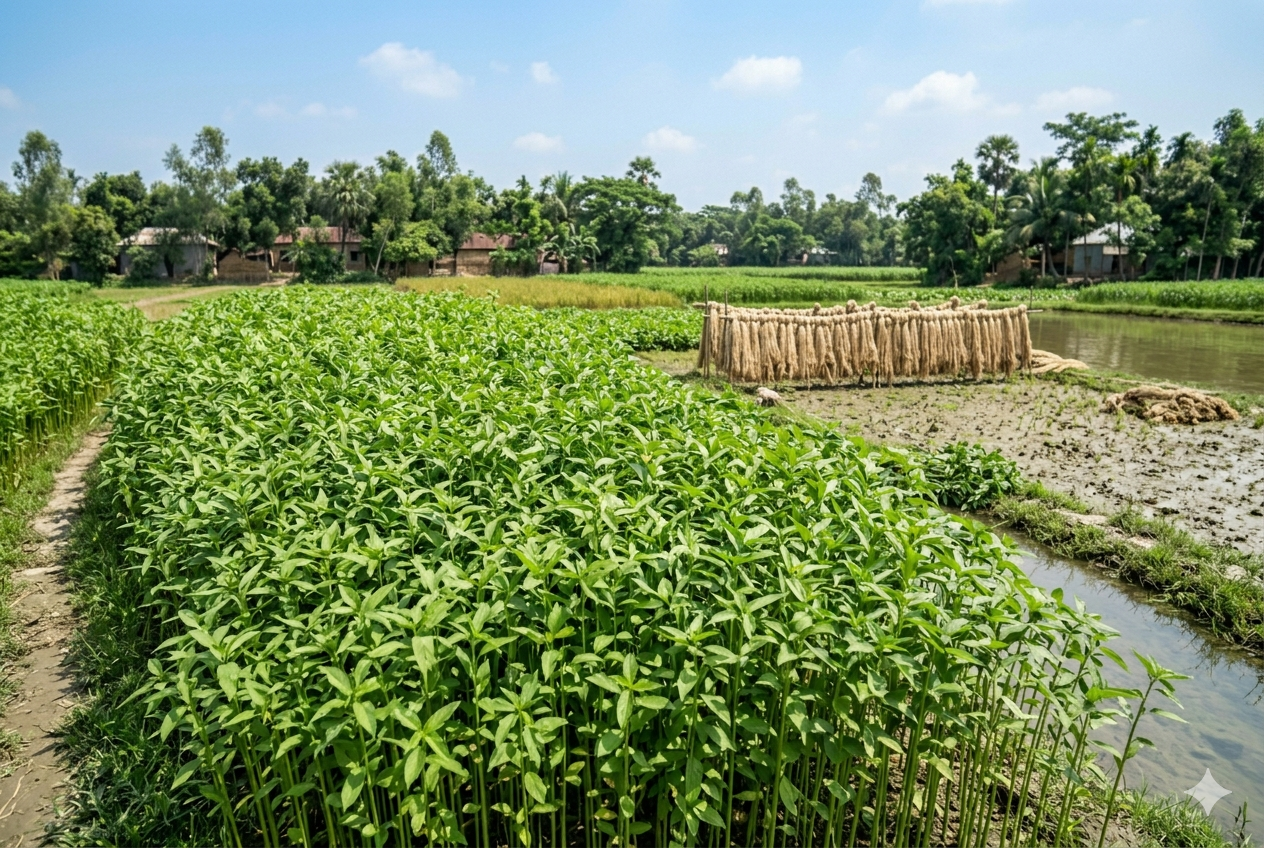
Jute Paat Golden Fiber Farming India — Pat Shaak Edible Leaves Geotextile Encyclopedia
🌾 Crops & Grains

Jute / Paat / Golden Fiber जूट / पाट / सोना रेशा

Corchorus olitorius (Tossa — finer fiber) | C. capsularis (White — flood tolerant)
🌱 Kharif March-May | Tiny seeds — pre-soak 12-24 hrs | Thinning essential | Harvest before flowering ⏱️ 100-120 days | Cut at bud/flower stage | Retting 10-20 days in water | MSP Rs.5,335/qt 🌿 Medium Grow ✅ Edible Safe
Photo: PlantCare
Jute Paat Leaves Edible Pat Shaak Mulukhiyah Egypt Plastic Ban Demand Geotextile Future Indigo Revolt History Ribbon Retting Pollution

Jute / Paat — young leaves are EDIBLE (Pat shaak Bengal + Mulukhiyah = Egypt's national dish!). Most people don't know this. Plastic ban + geotextile = growing demand. Indigo Revolt 1859 historical crop.

Jute / Paat — young leaves EDIBLE हैं (Pat shaak Bengal + Mulukhiyah = Egypt का national dish!)। Most people नहीं जानते। Plastic ban + geotextile = growing demand। Indigo Revolt 1859 historical crop।

⚡ Quick Reference / एक नज़र में
🌱 Sowing Season
Kharif March-May | Tiny seeds — pre-soak 12-24 hrs | Thinning essential | Harvest before flowering
⏱️ Harvest Time
100-120 days | Cut at bud/flower stage | Retting 10-20 days in water | MSP Rs.5,335/qt
🍽️ Edible Parts
Young leaves (Pat shaak Bengal / Mulukhiyah Egypt-Africa) — most nutritious leafy vegetable few know!
☀️ Light
Full sun — 6+ hours
💧 Water
1000-1500mm — high rainfall | C. capsularis flood tolerant | Retting water pollution concern
🌡️ Temperature
25-35°C — hot humid | Monsoon essential
💊
Key Nutrition / पोषण
Leaves: Calcium 266mg, Iron 3.1mg, Vit C 48mg, Mucilage (prebiotic unique) | Fiber = bags, geotextile
🍳
Indian Kitchen Uses / भारतीय रसोई
Pat shaak (Bengal leafy vegetable — mustard oil tadka), mulukhiyah soup (Egypt national dish), herbal tea

Jute (Corchorus olitorius / C. capsularis) — Paat / Sona / Golden Fiber — is India's most important natural fiber crop after cotton and one of the world's most sustainable and versatile agricultural products. India is the world's largest jute producer and the second largest exporter, with West Bengal, Bihar, Assam, Odisha and Tripura being the primary growing states. The Ganges delta's unique combination of humid heat, abundant rainfall and alluvial soil makes it the world's most productive jute-growing geography — explaining why Bengal has been the global center of jute cultivation for centuries. Jute's designation as "Golden Fiber" reflects its extraordinary versatility: jute bags (replacing plastic bags), jute ropes, carpet backing, geotextiles, jute composites, and the emerging biocomposite materials market. The edible connection often surprises people: young jute leaves (pat shaak in Bengal, mulukhiyah in Egypt and Middle East) are one of the world's most nutritious and widely consumed leafy vegetables in Africa and South Asia — a food tradition largely unknown outside these regions. Jute cultivation also supports over 4 million farmers and 0.4 million mill workers in eastern India.

Jute (Corchorus olitorius) — Paat / Sona / Golden Fiber — India का most important natural fiber after cotton। India = world का largest producer। West Bengal, Bihar, Assam primary producers। Ganges delta = world का most productive geography। Young jute leaves = edible vegetable! (Pat shaak Bengal, Mulukhiyah Africa/Egypt) — most nutritious leafy।

🌿 Overview, Classification & Varieties

🔬 Scientific NameCorchorus olitorius (Tossa jute — finer fiber) | C. capsularis (White jute — flood tolerant)
📅 SeasonKharif — sown March-May, retted and harvested July-September
🌡️ Temperature25-35°C — hot humid. Monsoon moisture essential.
💧 Water1000-1500mm — high rainfall needed | Flooding tolerant (C. capsularis)
⏱️ Duration100-120 days | Harvest before flowering for best fiber quality
🌾 YieldFiber: 2.5-3.5 t/ha (dry retted) | Leaves: 8-12 t/ha fresh
VarietySpeciesSpecialtyRegion
🌿 JRO-524 (Suren)C. olitoriusCRIJAF — Tossa standard. High fiber yield, disease resistant.WB, Bihar, Assam
🌿 JBO-1 (Basudev)C. capsularisFlood tolerant White jute — for WB delta areasWB flood-prone
🌿 JRC-321C. capsularisEarly — for areas with shorter growing seasonBihar, UP
🌿 CRIJAF SonaC. olitoriusGolden fiber variety — finest quality, high finenessWB premium
🌿 Olitorius for leavesC. olitoriusLeafy vegetable use — young leaves harvested before floweringBengal, Bihar household

🪴 Soil, Sowing & Nutrient Management

🪴
Soil — Alluvial Ideal
Sandy loam to loam — alluvial soil of Gangetic delta ideal. pH 6.0-7.5. Well-draining or flood-tolerant species (C. capsularis for flood areas). Jute's unique requirement: good drainage during germination but needs water through growing season. High organic matter improves fiber quality. WB alluvial soil: perfect naturally — explains Bengal's global jute dominance. Black cotton and laterite soils: possible with irrigation. Do NOT grow in soils with high salt content — fiber quality deteriorates.
📅
Sowing — March-May Window
March 15 — May 15 optimal. Earlier sowing in South (Bihar, Assam). Tiny seeds — mix with sand for uniform broadcasting. Seed rate: 7-8 kg/ha. Shallow sowing: 1-2 cm only. Line sowing: 25-30 cm rows. Germination: 4-7 days. Thinning: essential at 15 days — 5-7 cm between plants for fiber crop, wider for leaf crop. Seed treatment: Thiram 3g/kg + Trichoderma 5g/kg. Pre-soaking seeds 12-24 hours improves germination rate significantly.
🧪
Fertilizer
N: 60-80 kg/ha (split — half at sowing, half at 30 days). P: 20-30 kg P₂O₅. K: 20-30 kg K₂O. FYM: 5-8 tonnes/ha pre-sowing — critical for alluvial soils after repeated jute cultivation. Compost mulch: reduces weed competition. Jute is a relatively low-fertilizer crop — the alluvial soil's natural fertility supports much of the requirement. Annual FYM application maintains soil organic matter better than inorganic fertilizers alone. Sulphur: 10-15 kg/ha — improves fiber fineness. Green manuring between jute seasons: dhaincha (Sesbania bispinosa) — traditional WB practice for N addition.
💧
Retting — Critical Processing
Retting: separation of jute fiber from woody stem by controlled bacterial decomposition in water. After harvesting: bundle stalks, immerse in slow-moving water (ponds, rivers) for 10-20 days. Bacteria (Clostridium sp.) decompose the pectin binding fiber to stem. Pull fiber bundles when fiber separates cleanly from woody stem. Wash, dry. Traditional retting: ponds or ditches — water pollution concern. Improved retting: microbial retting using Bacillus culture added to retting water — 30% faster, better fiber quality, less water pollution. Ribbon retting: mechanical ribboning machine extracts fiber without water retting — cleaner, faster, less land needed. Ribbon retting adoption is increasing — less environmental impact.

🌿 Crop Protection & Management

⚡ Key Pests & Diseases
🌿 Stem Rot
Macrophomina phaseolina
Trichoderma seed treatment + drainage
🍂 Anthracnose
Colletotrichum corchori
Mancozeb spray at early stage
🐛 Shoot Weevil
Apion corchori — shoot tip
Malathion spray
🐛 Bihar Hairy Caterpillar
Spilosoma obliqua
Quinalphos or Chlorpyrifos spray
🌿 Soft Rot
Bacterial — Erwinia carotovora
Avoid waterlogging — copper spray
🐛 Yellow Mite
Polyphagotarsonemus latus
Acaricide spray at early mite sign
Tool / ResourceUse for Jute
📅 Crop Sowing CalendarKharif jute sowing dates — WB, Bihar, Assam, Odisha
🧪 Fertilizer CalculatorN-P-K + FYM dosage for alluvial soil jute
🔍 Pest IdentifierStem rot vs anthracnose — jute disease identification
💧 Watering CalculatorRain-fed jute supplemental irrigation schedule
🌱 Companion Planting GuideJute + dhaincha green manure rotation system

🌿 Harvest, Retting, Nutrition (Leaves) & Economics

  • Harvest at flowering stage for best fiber: 100-120 days. Harvest when plant just starts to flower — after flowering fiber quality deteriorates rapidly. Cut at base. Bundle (30-40 stalks per bundle). Immerse in slow water for retting (10-20 days). Pull fiber when separates cleanly. Wash thoroughly. Dry in sun. Grade by color and fineness. MSP 2024-25: Rs.5,335/quintal (TD-3 grade). Tossa jute fetches 10-15% more than white jute for fine grades. Market: mainly through HAB (Jute Commissioner of India) mandis and private traders.
Jute Leaves — Nutrition (per 100g)ValueNote
💪 Protein4.5g (fresh leaves)Good protein for leafy vegetable
⚙️ Iron3.1mg — 17% RDASignificant — Africa uses jute leaves for iron nutrition
🦴 Calcium266mg — 27% RDAExcellent — one of highest calcium leafy vegetables
🍊 Vitamin C48mg — 53% RDAGood immunity contribution
🌿 Beta-caroteneHighVision, immunity, skin
🌾 MucilageHighCreates characteristic viscous texture — prebiotic, gut health
❓ FAQ
Jute leaves as food — Bengal tradition: Young tender jute leaves (C. olitorius — Tossa jute specifically): edible, nutritious, widely consumed in West Bengal as "pat shaak," Bihar as "pat saag," and across East Africa and Egypt (mulukhiyah — Egypt's national vegetable!). When to harvest: young leaves from plants 30-50 days old — before the plant flowers. Young leaves: tender, mild flavor. Older leaves: tougher, stronger flavor. How to cook (Bengali style): (1) Wash thoroughly. (2) Finely chop leaves and tender stems. (3) Tadka: mustard seeds + dried red chilli in mustard oil. (4) Add chopped leaves, stir-fry 5-7 minutes. (5) Add panch phoron spice mix, salt, small amount sugar. (6) Cover and cook 3-5 more minutes until soft. (7) Optional: small amount shrimp paste (prawn) in Bengali tradition. Mulukhiyah (Egyptian): Dried or fresh jute leaves + chicken or rabbit stock + garlic + coriander — classic Egyptian comfort dish. Nutritional note: the characteristic mucilaginous (sticky) texture from jute leaves — similar to okra — is soluble fiber (prebiotic). Provides gut health benefit. Iron and calcium content: significant for vegetarian Eastern India diet. Urban India awareness: essentially zero — this traditional Bengal food is virtually unknown in other Indian states despite its outstanding nutrition and easy availability in jute-growing regions.
Plastic ban and jute opportunity: India's plastic bag ban (single-use plastic ban, 2022) and various state-level bans: theoretically massive opportunity for jute bags. Reality check so far: (1) Enforcement: plastic bans in India have historically been poorly enforced — plastic availability continued despite bans. (2) Cost: jute bags significantly more expensive than plastic (Rs.15-40/bag vs Rs.1-3 plastic) — creates economic resistance. (3) Quality: jute bags not always suitable for wet or oily goods — limited application. Actual demand increase: Packaging sector: FCI, Jute Corporations, government mandating jute bags for grain storage — mandatory jute packaging policy. This is the most effective driver of jute demand. Retail: eco-conscious consumers and premium brands actively preferring jute. Export: EU, US sustainable packaging demand. Fashion: jute bags as fashion accessory — growing market. Government support: JPC (Jute Corporation of India) — minimum price support, procurement. Jute iCAD scheme: cluster development for value-added jute products. Annual jute demand: 9-10 million bales. Current production: 8.5-9 million bales — roughly balanced. Plastic ban full enforcement: would increase demand 20-30%. Future of jute: not dramatic overnight transformation but steady growing demand supported by government policy and sustainability trends. Jute farming remains economically viable in WB delta — not threatened but also not experiencing dramatic boom.
Retting water pollution — the jute industry's environmental challenge: Traditional retting: bundles immersed in ponds, ditches, slow rivers for 10-20 days. Bacterial decomposition of pectin produces: methane, hydrogen sulfide, organic acids. The water turns dark, smells strongly, oxygen depletes. Fish die in retting ponds. Downstream water users affected. This is the jute industry's biggest environmental problem. Solutions being implemented: (1) Improved water retting: use designated retting ponds, not drinking water sources. CRIJAF bacterial culture added — faster retting (10 days vs 15-20), better fiber, less pollution because shorter exposure. (2) Ribbon retting: mechanical ribbon extraction machine (Rs.15,000-25,000) extracts fiber from fresh stalk without water retting. 80-90% pollution reduction. Better fiber quality. Becoming available for farmer collectives. (3) Chemical retting: CRIJAF-developed chemical retting agent reduces time and pollution. (4) Effluent treatment: larger retting installations treating wastewater. (5) Biogas from retting waste: organic matter from retting converted to biogas. Government program: JMDC (Jute Manufacturers Development Council) subsidizing ribbon retting machines for FPOs. Most practical path: ribbon retting adoption — mechanical, cleaner, faster. Adoption is slow due to capital cost and need for group ownership model — individual farmer can't afford the machine alone. FPO-owned ribbon retting units are the recommended model for environmental improvement while maintaining farmer economics.
Bihar jute farming: Bihar is second largest jute state after WB. Champaran, Sitamarhi, Muzaffarpur, Kishanganj districts primary. (1) March 15-April 30 sowing. (2) Variety: JRO-524 (Tossa — better fiber price) or JRC-321 (short duration). (3) Field: alluvial Gangetic plain soil. Light cultivation, well-draining. (4) Seed: 7-8 kg/ha. Mix with 3x dry sand for broadcast. Depth: 1.5 cm. (5) Thin at 15-20 days to 5-7 cm. (6) Fertilizer: N 60 kg split + P 20 kg + K 20 kg. FYM 5 tonnes pre-sowing. (7) Irrigation: 2-3 times in dry April-May. Monsoon usually sufficient after June. (8) Harvest: July-August when just starting to flower. Cut at base. (9) Retting: local ponds or river — immerse bundled stalks 12-15 days. (10) Fiber extraction, washing, drying. (11) Grade and sell: JCI mandis in Samastipur, Muzaffarpur, Purnea. MSP Rs.5,335/qt. FPO collective grading gets better price. Value addition: jute craft items (bags, mats) — cottage industry income for women's SHGs. Bihar SHG jute handicraft program: active government support through Jeevika. Rs.300-800/bag vs Rs.100-150/kg raw fiber — significant value addition multiplier.
Jute geotextiles — the most promising modern application: What are geotextiles: fabric used for soil erosion control, slope stabilization, road construction. Jute geotextile (JGT): woven jute fabric used for: (1) Hillside erosion control — National Highway Authority mandate for hill road projects. (2) River bank protection — NDMA specifications. (3) Rajasthan desert stabilization — afforestation programs. (4) Mine spoil stabilization. Why jute is ideal for geotextile: Biodegradable — breaks down in soil after 1-3 years, leaving behind stabilized soil with improved organic matter. Plant roots grow through jute fabric. No microplastic pollution (vs synthetic geotextiles). Comparable technical performance for temporary stabilization needs. Government mandate: Bureau of Indian Standards (BIS) specifications for jute geotextile. NITI Aayog recommendation: increase jute geotextile use in government infrastructure projects. Market size: Current: Rs.150-200 crore. Projected by 2030: Rs.800-1,000 crore. Demand driver: India's massive road and infrastructure building program — if 20% of slope stabilization uses JGT, demand increases 5-8x current production. Impact on farming: each 10% JGT demand increase requires ~50,000 additional tonnes jute fiber. 15,000-20,000 additional hectares cultivation needed. Jute geotextile is the single largest new demand driver for jute farming — its scaling depends on government specification enforcement and price competitiveness with synthetic alternatives.
⚠️
AI-Assisted Content — Please Read
AI-सहायता से बनाई गई सामग्री — कृपया पढ़ें

All tools, plant encyclopedias, edible growing guides and blog content on PlantCare are created with the assistance of AI (Artificial Intelligence) and are intended for general informational and educational purposes only. While we strive for accuracy, the information provided may not be complete, current or suitable for every situation, region or individual plant variety.

For health, medical or serious agricultural decisions — always consult a qualified horticulturist, agronomist, Ayurvedic practitioner, medical professional or relevant expert. PlantCare does not take responsibility for outcomes arising from use of this information. Identification results from AI tools (plant identifier, pest identifier etc.) should be verified before taking any action.

इस वेबसाइट पर सभी tools, plant encyclopedias, edible guides और blog content AI (Artificial Intelligence) की सहायता से बनाए गए हैं और केवल सामान्य जानकारी और शिक्षा के उद्देश्य से हैं। स्वास्थ्य, चिकित्सा या गंभीर कृषि निर्णयों के लिए कृपया किसी योग्य विशेषज्ञ से संपर्क करें। PlantCare इस जानकारी के उपयोग से होने वाले परिणामों के लिए जिम्मेदार नहीं है।