Indigo Neel Blue Gold Farming India — Natural Dye Sustainable Fashion Revolt Encyclopedia
🌾 Crops & Grains

Indigo / Neel / Blue Gold नील / इंडिगो / नीला सोना

Indigofera tinctoria (true indigo) | I. arrecta (African)
🌱 Kharif June-July | Perennial: 3-4 cuts/year | Harvest at bud stage (before flowering) = peak indigotin ⏱️ 3-4 cuts/year | 150-250 kg dried indigo cake/ha/year | Rs.1,500-4,000/kg dried | Sustainable fashion revival! 🌿 Medium Grow ✅ Edible Safe
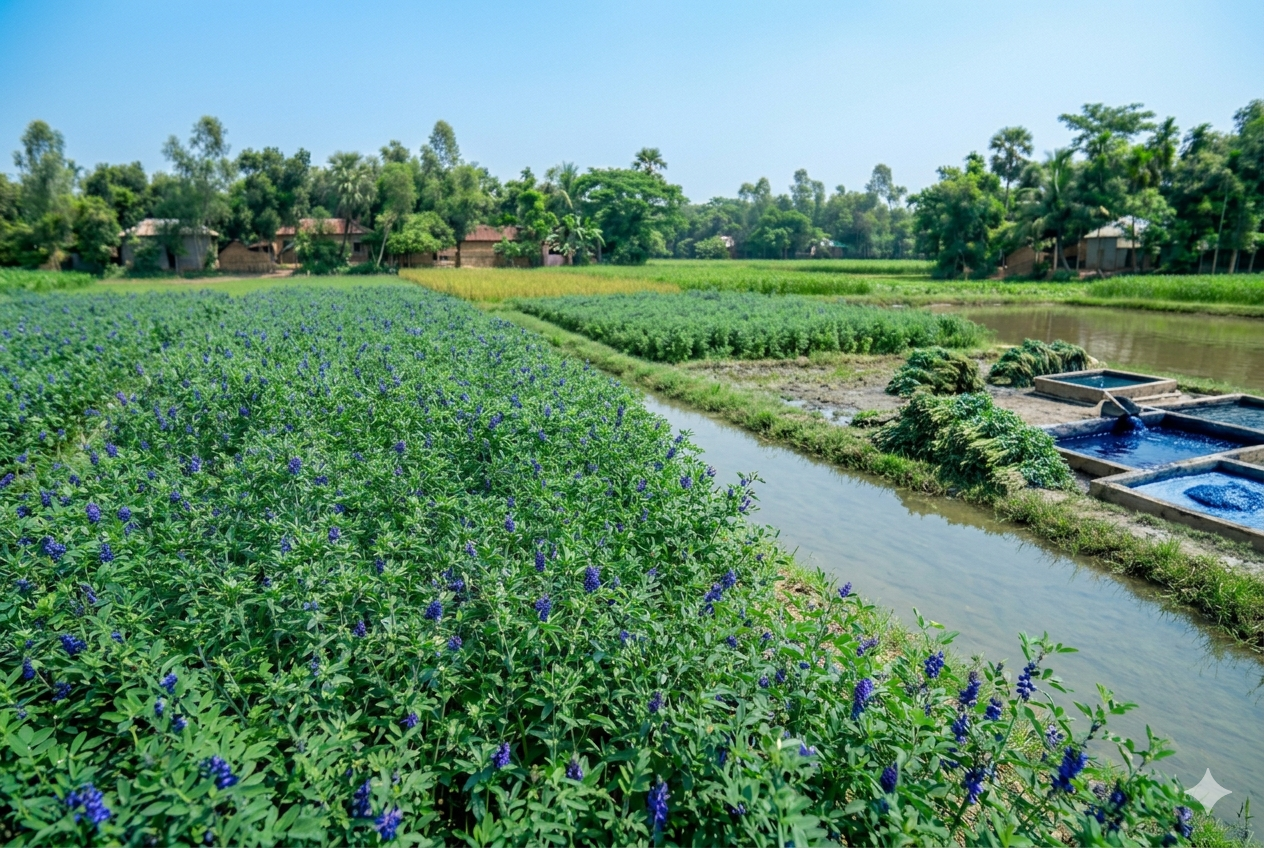
Photo: PlantCare
Indigo Neel Blue Gold Revolt 1859 Gandhi Satyagraha Sustainable Denim Revival GOTS Premium Rs.4000/kg Dried Jeans Blue Science

Indigo / Neel — "Blue Gold" that inspired Indigo Revolt 1859 (Gandhi's first satyagraha!). NOW making comeback: sustainable denim + GOTS demand. Rs.1,500-4,000/kg dried. Jeans blue science explained.

Indigo / Neel — "Blue Gold" जिसने Indigo Revolt 1859 inspire किया (Gandhi का first satyagraha!)। NOW comeback: sustainable denim + GOTS demand। Rs.1,500-4,000/kg dried। Jeans blue science explained।

⚡ Quick Reference / एक नज़र में
🌱 Sowing Season
Kharif June-July | Perennial: 3-4 cuts/year | Harvest at bud stage (before flowering) = peak indigotin
⏱️ Harvest Time
3-4 cuts/year | 150-250 kg dried indigo cake/ha/year | Rs.1,500-4,000/kg dried | Sustainable fashion revival!
🍽️ Edible Parts
NOT edible — natural dye crop | Indigotin = blue dye | 800x more sustainable than synthetic aniline-based indigo
☀️ Light
Full sun — 6+ hours
💧 Water
600-900mm — moderate. Drought tolerant once established.
🌡️ Temperature
25-35°C — tropical. Frost kills.
💊
Key Nutrition / पोषण
Dye: indigotin compound. N-fixes soil. Sustainable fashion: GOTS certified, denim industry natural alternative.
🍳
Indian Kitchen Uses / भारतीय रसोई
NOT food — textile dye. Natural fabric dyeing (home + artisan). Historical: Buddhist robes, denim predecessor.

Indigo (Indigofera tinctoria) — Neel / Nil — is India's most historically significant dye crop and one of the most consequential agricultural commodities in world history. Indian indigo — called "Blue Gold" — dominated global trade for centuries, dyeing fabrics from ancient Egypt to Renaissance Europe. The indigo trade's dark chapter is inseparable from India's colonial history: the forced indigo cultivation under the British Neel Cultivation System in Bengal and Bihar (1830s-1860s) sparked the Indigo Revolt of 1859 — one of India's first organized peasant uprisings against colonial exploitation, inspiring a generation of Indian activists and directly influencing Gandhi's later methods. The synthetic indigo invention by Adolf von Baeyer (1880s) collapsed India's natural indigo industry overnight — from India exporting 90% of world indigo to near-zero by 1900. Today, natural indigo is making a spectacular comeback: the global sustainable fashion movement, GOTS-certified organic textile demand, artisanal natural dye revival, and the world's largest denim manufacturers seeking natural alternatives to synthetic indigo (which requires carcinogenic aniline) have created a genuine market renaissance for natural Indian indigo — potentially the most interesting agricultural revival story in contemporary India.

Indigo (Indigofera tinctoria) — Neel / Nil — India का "Blue Gold" — centuries तक global trade dominated। Indigo Revolt 1859 = India का first organized peasant uprising, Gandhi को inspire किया। Synthetic indigo 1880s से natural indigo collapse। Ab comeback: sustainable fashion + GOTS + denim industry natural alternatives चाहती। Most interesting agricultural revival story।

🌿 Overview, Classification & Varieties

🔬 Scientific NameIndigofera tinctoria (true indigo) | I. arrecta (African) | I. suffruticosa (Guatemala)
📅 SeasonKharif — sown June-July | Two-three cuts per season | Perennial in tropical areas
🌡️ Temperature25-35°C — tropical, warm. Frost kills.
💧 Water600-900mm — moderate. Drought tolerant once established. Waterlogging: kills.
⏱️ DurationFirst cut: 90-100 days | Subsequent ratoon cuts every 60-70 days | Perennial 3-4 years
🌾 YieldFresh biomass: 20-30 t/ha/year | Dry indigo dye cake: 150-300 kg/ha/year
Variety/TypeSpecialtyRegion
🌿 Indigofera tinctoriaTraditional India variety — highest indigotin content. Standard natural dye industry.Tamil Nadu, Andhra, Bihar historic
🌿 Local Bihar ecotypesHistoric Champaran varieties — some preserved by farmers. Historical significance.Bihar (revival efforts)
🌿 I. suffruticosaGuatemala indigo — higher yield but slightly different dye qualityExperimental India
🌿 Improved selectionsCRIJAF and private breeders working on higher indigotin yield linesResearch stations

🪴 Soil, Cultivation & Dye Extraction

🪴
Soil & Cultivation
Well-draining loamy to sandy loam — pH 6.0-7.5. Moderate fertility — too rich soil reduces indigotin (dye compound) content. Nitrogen fixation: indigo is a legume — fixes 40-80 kg N/ha. Minimal fertilizer needed. Waterlogging: kills rapidly. Good drainage essential. First year: sow from seed (5-7 kg/ha), June-July. Spacing: 30-45 cm × 15 cm. Subsequent years: ratoon from established root system. Cut at ground level when biomass is maximum (just before flowering). 3-4 cuts per year in warm climates.
🔵
Dye Extraction Process
Traditional extraction: (1) Harvest fresh green biomass just before/at flowering. (2) Immerse in large vats of water — fermentation 10-14 hours. (3) Bacteria release indican (precursor) from leaves. (4) Beat/oxygenate water vigorously — indican oxidizes to indigotin (blue pigment). (5) Add lime (calcium hydroxide) — precipitates blue indigotin. (6) Drain, press sediment. (7) Cut into cakes, dry — indigo cake = trade form. Indigotin content: 40-60% of dry cake. Modern extraction: mechanical aerator + faster process. Yield: 100-200 kg dried indigo cake per tonne of fresh leaves. Quality measure: indigotin percentage — natural indigo 40-60%, synthetic 98%+.
👗
Natural vs Synthetic Indigo
Synthetic indigo dominates: 80,000 tonnes/year synthetic indigo produced globally. Used for 5 billion pairs of jeans annually. Made from aniline (petroleum derivative — carcinogenic in production). Natural indigo: only 2,000-3,000 tonnes/year. Premium 20-30x price over synthetic. Genuinely different properties: (1) Softer color — "living fade" that improves with washing. (2) Complex molecular mixture — not pure indigotin, has other compounds giving unique character. (3) Sustainable production. (4) No aniline carcinogen. Denim brands seeking natural: Levi's (Natural Fiber Welding partnership), Japan denim (deep tradition of natural indigo). Premium natural indigo denim: Rs.5,000-20,000/pair vs Rs.500-2,000 synthetic. Market exists — supply is the constraint.
📜
Indigo Revolt 1859 — History
Historical context every Indian should know: British colonial system forced Bengal and Bihar farmers to grow indigo on 3/20 (teen-kathi) of their land — whether profitable or not. Mills owned by British planters. Farmers paid advance (dadon) — kept in perpetual debt. Profits went entirely to British. 1859: Bengal farmers refused en masse — Indigo Revolt. Harish Chandra Mukherjee wrote "Nil Darpan" (1858-59) — play exposing indigo farmer exploitation — became major political document. Michael Madhusudan Dutt translated to English. James Long distributed it — arrested for sedition. The revolt succeeded: Bengal Government Indigo Commission acknowledged farmer grievances. Indigo cultivation became voluntary. Gandhi visited Champaran in 1917 — studied same indigo planter exploitation continuing in Bihar. First satyagraha in India. Led to Champaran Agrarian Act 1918. The indigo crop's revival today carries this history — natural indigo cultivation being positioned as farmer-owned enterprise, not colonial extraction. A genuine historical redemption arc.

🌿 Crop Care & Market Access

⚡ Key Pests & Diseases
🐛 Pod Borer
Maruca vitrata — Vigna type
Emamectin spray — cut before flowering avoids
🐛 Whitefly
Bemisia tabaci
Neem oil spray — organic preferred
🌿 Root Rot
Phytophthora sp.
Drainage + Trichoderma treatment
🍂 Leaf Spot
Cercospora indigoferae
Mancozeb spray
🐛 Aphid
Multiple species
Neem oil or Imidacloprid
🌾 Weed
First 30-40 days critical
Hand weeding — herbicide residue affects dye quality
Tool / ResourceUse for Indigo
📅 Crop Sowing CalendarKharif indigo sowing + ratoon cut schedule — Tamil Nadu, AP
🧪 Fertilizer CalculatorMinimal N (legume) + P dosage for dye quality optimization
🔍 Pest IdentifierOrganic-compatible pest identification for GOTS certification
🌱 Companion Planting GuideIndigo N-fixation benefit in crop rotation systems
💧 Watering CalculatorIrrigation schedule — establish first year, ratoon management

🌿 Harvest, Processing, Market & Economics

  • Cut at bud stage before flowering — 3-4 times per year: Maximum indigotin in leaves at late vegetative/early bud stage. Cut at 10-15 cm from ground (allows ratoon). Process immediately — indigotin degrades rapidly in cut leaves. Full vat extraction within 4-6 hours of harvest. Dry indigo cake: store in cool dry conditions. Market: natural indigo buyers include natural dye merchants (Rajasthan, Gujarat, Tamil Nadu), export buyers (Japan, Europe), artisanal dyers. Price: Rs.1,500-4,000/kg dried natural indigo cake (40% indigotin). Certified organic: premium of 30-50% above regular.
EconomicsDetail
🌿 Biomass yield3-4 cuts × 6-8 t/ha each = 20-30 t/ha fresh biomass annually
🔵 Dye yield150-250 kg dried indigo cake per hectare per year (40% indigotin)
💰 Revenue200 kg cake × Rs.2,500/kg = Rs.5,00,000/ha potential
📊 Input costRs.40,000-60,000/ha/year (establishment Rs.80,000 yr 1)
🌍 Market accessDirect export buyers + India artisanal market + FPO collective extraction
⚠️ ChallengeExtraction processing requires infrastructure — collective investment needed
❓ FAQ
Natural indigo profitability — realistic assessment 2025: Market demand: genuine and growing. H&M, Inditex (Zara), Levi's have stated natural indigo sourcing targets. Japan premium denim market (3-5 billion yen/year) actively seeks Indian natural indigo. French artisanal textile houses. Premium pricing: natural indigo Rs.2,000-5,000/kg vs synthetic Rs.200-400/kg — 10-15x premium. Current supply: India produces only 200-500 tonnes natural indigo annually (estimate — no official data). Market potential: 2,000-5,000 tonnes for premium natural textile market. Revenue potential: at 200 kg/ha yield × Rs.3,000/kg = Rs.6 lakh/ha gross. After extraction cost, net: Rs.3-4 lakh/ha. Better than most Kharif crops. Constraints: (1) Extraction infrastructure: requires vat extraction facility — single farmer cannot afford alone. FPO collective extraction units needed. (2) Market linkage: cannot sell through regular APMC — need direct buyer contact or export agent. (3) Certification: GOTS organic certification required for premium market — Rs.50,000-80,000 initial investment. (4) Technical knowledge: extraction process skills — NIFT (National Institute of Fashion Technology) and some NGOs provide training. Who is doing it successfully: Tamil Nadu farmers near Coimbatore and Tirupur (textile hub). Rajasthan dabu printing artisan communities sourcing from contracted farmers. Government support: Textile Ministry schemes for natural dye promotion. Verdict: profitable with right market linkage + collective extraction. Difficult individually. Best model: 20-50 farmer FPO + shared extraction facility + direct export buyer or artisanal textile brand partnership.
Home natural indigo dyeing — vat dyeing basics: Indigo is unique: it's insoluble in water — must be chemically reduced to soluble "leuco" form to dye, then re-oxidizes on fiber to create blue color. This is why indigo dyeing is more complex than most natural dyes. Simple vat (for beginners): Equipment: large non-metal container (plastic/ceramic), thermometer. Chemicals: natural indigo powder (available from dye suppliers Rs.800-2,000/100g), sodium hydrosulfite (reducing agent) or traditional: wheat bran fermentation vat. Simple chemical vat recipe (for 100g fabric): (1) Dissolve 10g indigo powder in 50ml warm water + few drops alcohol. (2) Add 10g sodium hydrosulfite + 10g soda ash to 5 litres warm water (50°C). (3) Add dissolved indigo to vat. (4) Wait 20-30 minutes — vat surface turns bronze-green (sign of reduction working). (5) Pre-wet fabric in warm water, squeeze, gently immerse in vat WITHOUT agitating surface. (6) Leave 5-10 minutes, slowly remove — fabric looks yellow-green initially. (7) Oxidize in air: unfold fabric, spread in air. Blue color develops as indigotin re-oxidizes. 5-15 minutes. (8) Return to vat for deeper blue. More dips = darker blue. (9) Rinse in cold water, air dry. Tips: (1) Don't agitate vat — introduces oxygen, reduces effectiveness. (2) Temperature 45-50°C optimal. (3) Traditional Japanese vat (sukumo fermentation) — more complex, superior results, 2-week setup. (4) Dye before cutting fabric — easier handling. Natural indigo on cotton: mordanting less critical than other natural dyes — indigo bonds directly to cotton. On silk/wool: bonds even better.
Champaran Indigo — complete history: Geographic context: Champaran district, Bihar — part of Bengal Presidency under British. Flat Gangetic plain, fertile alluvial soil — ideal for indigo. The system (tinkathia): British planters (mostly European) forced every tenant farmer to cultivate indigo on minimum 3 kathas (teen-kathi, or 3/20) of their land — regardless of their wishes or the crop's profitability to them. Farmers received advance (dadon) which kept them perpetually indebted. Planter controlled local police, courts — legal recourse essentially unavailable. The exploitation: planters paid below-market prices for indigo (they set the price). Farmers could not refuse cultivation or switch to more profitable crops. Physical coercion — beating, destruction of other crops — documented extensively. Conditions: described as servitude without technical slavery. Transition of plantation to indigo: when better crops possible, farmers forbidden from shifting without planter permission. 1859 revolt: sparked in Nadia district, Bengal. Farmers collectively refused indigo cultivation. "Indigo is being manufactured from our blood." Organized through village-to-village communication. Planters responded with violence. Farmers persisted. Bengal Indigo Commission 1860: appointed to investigate. Report acknowledged farmer grievances — voluntary cultivation officially recognized. Practical end of Bengal indigo cultivation. Bihar continuation: the system continued longer in Bihar. Gandhi 1917: Rajkumar Shukla, a Champaran indigo farmer, personally convinced Gandhi to visit. Gandhi conducted detailed survey — documented farmer conditions. Champaran Agrarian Act 1918 — abolished tinkathia system. This was Gandhi's first civil disobedience in India. Synthetic indigo's role: Adolf von Baeyer synthesized indigo in 1880, BASF commercialized by 1900. India's natural indigo export collapsed from Rs.1.5 crore to near-zero within a decade. The planters' exploitation ended not from justice but from industrial competition.
Indigo and jeans blue — the chemistry: Why indigo on jeans specifically: (1) Denim (warp-faced twill fabric) woven with indigo-dyed warp threads and white weft. Only the warp surface appears blue — white weft shows in lighter areas. (2) Indigo's unique surface dyeing: unlike most dyes that penetrate fiber completely, indigo stays on the surface (ring dyeing). This creates the characteristic fading — surface indigo wears off with use, revealing white inner fiber. This "living fade" is the defining characteristic of denim. Chemistry of indigo on cotton: Indigo (C16H10N2O2) = blue crystalline solid, insoluble in water. Reduction: indigo + reducing agent → leuco-indigo (yellow-green, water soluble). Leuco-indigo penetrates cotton fibers. Oxidation: leuco-indigo + oxygen → indigo (blue, insoluble, locked in fiber surface). The ring-dyeing effect: indigo in leuco form only penetrates outer layers of cotton fiber (hydrophilic cotton absorbs it, but indigo's large molecule can't penetrate deeply). When re-oxidized, blue indigo locked in outer ring — white core remains. This creates the gradient that fades with washing/wearing. Natural vs synthetic indigo fading: natural indigo has additional compounds (isatin, indirubin) beyond pure indigotin — creates more complex molecular interactions with cotton. The fading is less uniform, more "organic" and "interesting" to premium denim connoisseurs — the "wabi-sabi" quality that Japanese denim culture prizes. Vintage jeans collectors: natural indigo jeans from 1950s-1960s (when some manufacturers still used natural) — extremely valuable precisely because of their unique aging character impossible to replicate with synthetic.
India natural indigo revival — current landscape 2025: Active revival zones: (1) Tamil Nadu: farmers near Tirupur textile hub, NGO support, direct brand linkages. Some 500-1000 hectares estimated. (2) Rajasthan: Bagru, Sanganer block printing communities — dabu and resist printing using natural indigo. Artisan-farmer direct linkage. (3) Andhra Pradesh: Srikalahasthi kalamkari artists — natural indigo specific traditional use. (4) Bihar Champaran: symbolic revival — small scale, historical significance. Government programs: Ministry of Textiles "Scheme for Integrated Textile Parks" includes natural dye clusters. NITI Aayog has recommended natural dye promotion. State government programs in TN, Rajasthan supporting natural dye farmers. NGO-led programs: Dastakar, Craft Documentation and Research Centre, FDDI (Footwear Design and Development Institute) — training natural dye artisans and farmers. Corporate participation: Fabindia sources natural indigo textiles. Good Earth (premium home goods). International: specific Japanese buyers (Sakamoto Indigo Sewing — specializes in natural indigo products) visiting India sourcing annually. Challenges remaining: Extraction infrastructure scattered — no organized cooperative extraction network. No price discovery mechanism — buyer-seller power imbalance. Certification cost high for small farmers. Technical knowledge transfer incomplete. Most optimistic scenario: if 5,000-10,000 hectares natural indigo established with collective processing and guaranteed buyer linkages — a viable natural indigo industry. Current trajectory: slow but real growth. Natural indigo revival is happening — not yet at scale to transform agricultural economics but momentum is building.
⚠️
AI-Assisted Content — Please Read
AI-सहायता से बनाई गई सामग्री — कृपया पढ़ें

All tools, plant encyclopedias, edible growing guides and blog content on PlantCare are created with the assistance of AI (Artificial Intelligence) and are intended for general informational and educational purposes only. While we strive for accuracy, the information provided may not be complete, current or suitable for every situation, region or individual plant variety.

For health, medical or serious agricultural decisions — always consult a qualified horticulturist, agronomist, Ayurvedic practitioner, medical professional or relevant expert. PlantCare does not take responsibility for outcomes arising from use of this information. Identification results from AI tools (plant identifier, pest identifier etc.) should be verified before taking any action.

इस वेबसाइट पर सभी tools, plant encyclopedias, edible guides और blog content AI (Artificial Intelligence) की सहायता से बनाए गए हैं और केवल सामान्य जानकारी और शिक्षा के उद्देश्य से हैं। स्वास्थ्य, चिकित्सा या गंभीर कृषि निर्णयों के लिए कृपया किसी योग्य विशेषज्ञ से संपर्क करें। PlantCare इस जानकारी के उपयोग से होने वाले परिणामों के लिए जिम्मेदार नहीं है।