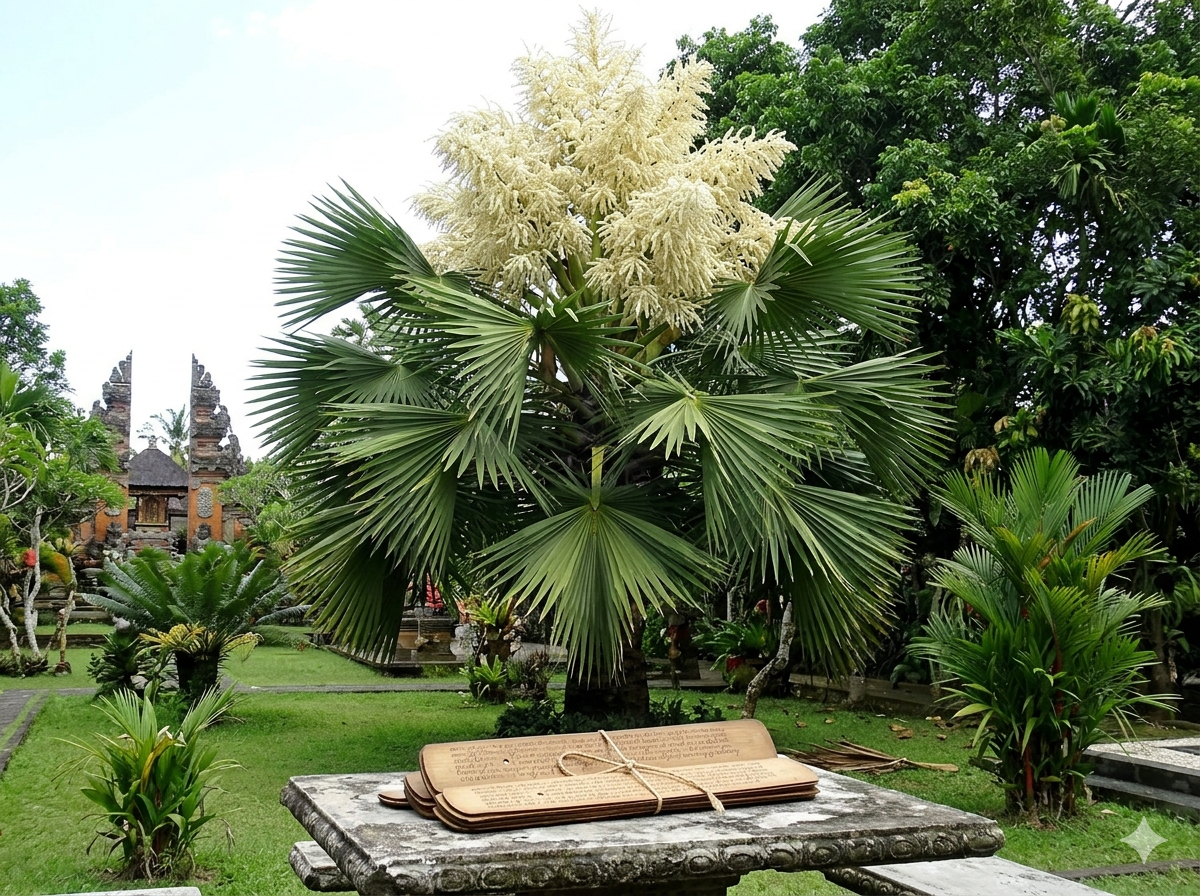
Talipot Palm Corypha umbraculifera Kerala Manuscript Ancient — PlantCare
📷 PlantCare
🌴 Palms & Himalayan Trees

Talipot Palm / Ancient Manuscript Palm तालिपोत पाम / ताड़पत्र / Codda Pana

Corypha umbraculifera Family: Arecaceae (Palm family) | NATIVE Kerala + Sri Lanka

Talipot Palm — DOUBLE WORLD RECORD: largest undivided leaf (5m — complete umbrella for 25 people) + largest inflorescence of any plant (6-8m tall). Ancient Kerala + South India "paper" — Vedic texts + Ayurvedic Ashtangahridayam written on Talipot leaves. 40-80 years vegetative → ONE spectacular flowering → dies completely.

📏 15–25 metres | WORLD'S LARGEST undivided leaf (5m diameter)! | World record inflorescence ⏳ 40–80 years vegetative → ONE spectacular flowering → DIES completely 📈 Slow | WORLD RECORDS: largest leaf + largest inflorescence any plant | 40-80yr wait WORTH IT 📍 Kerala (Thiruvananthapuram, Kollam). Sri Lanka. Coastal Karnataka. Temple + botanical gardens. ⚠️ Native Kerala. Not protected. Temple + botanical gardens common. Leaf collection traditional rights. 💰 Not commercial — priceless as landscape specimen. Cultural + heritage value immeasurable.
📤 WhatsApp
Talipot Palm 5m World Largest Undivided Leaf Umbrella 25 People 6-8m World Largest Inflorescence Any Plant Ancient Manuscripts Kerala Vedic Ayurveda Ashtangahridayam 40-80yr Monocarpic Once Lifetime Tala Olai Iron Stylus Ezhuthani Kerala Sri Lanka Native Temple Livistona Drooping vs Talipot Stiff

Talipot Palm — DOUBLE WORLD RECORD: largest undivided leaf (5m — 25 लोगों का complete umbrella) + largest inflorescence any plant (6-8m)। Ancient Kerala "paper" — Vedic texts + Ayurvedic Ashtangahridayam Talipot पर। 40-80 years vegetative → ONE spectacular flowering → completely dies।

Talipot Palm (Corypha umbraculifera) — Talipot Palm / Tala / Codda Pana / Kudapal — is one of the most extraordinary palms in the world, holding multiple botanical superlatives: it produces the world's largest undivided leaf (up to 5m diameter, used as a complete umbrella), the world's largest inflorescence of any plant (the flowering spike reaches 6-8m tall with millions of flowers), and is one of the most famously monocarpic of all plants — living 40-80 years as a purely vegetative palm before producing its single, spectacular, death-defining flowering event. The Talipot Palm is native to South India and Sri Lanka, growing naturally in Kerala (particularly Thiruvananthapuram and Kollam districts), Karnataka coastal, and Sri Lanka. In Kerala, the Talipot Palm is culturally and artistically extraordinary — the large fan-shaped leaves (olai) have been used since ancient times as the primary writing material for palm leaf manuscripts (tala olai poottu), making them the "paper" of ancient South India. Kerala's ancient literature, Vedic texts, royal records, and Ayurvedic manuscripts were written on Talipot Palm leaves — making this tree the most important information storage medium of classical South Indian civilization. The palm is also planted as a statement ornamental tree in botanical gardens and temple compounds across Kerala and Tamil Nadu, where its enormous fan leaves create an unmistakable tropical grandeur. The flowering event — when it finally arrives after 40-80 years — is one of India's most spectacular natural phenomena: the entire crown of enormous fan leaves is replaced by a 6-8m tall branching inflorescence covered with millions of white flowers.

Talipot Palm (Corypha umbraculifera) — तालिपोत पाम / तला / Codda Pana — world's most extraordinary palms में। Multiple botanical superlatives: world's largest undivided leaf (5m diameter, complete umbrella!), world's largest inflorescence of any plant (6-8m tall, millions of flowers), most famously monocarpic — 40-80 years vegetative फिर single spectacular death-defining flowering। South India + Sri Lanka native। Kerala (Thiruvananthapuram, Kollam), Karnataka coastal, Sri Lanka। Kerala में culturally + artistically extraordinary — large fan-shaped leaves (olai) = ancient times से primary writing material। Palm leaf manuscripts (tala olai poottu) = ancient South India का "paper।" Kerala ancient literature, Vedic texts, royal records, Ayurvedic manuscripts — Talipot Palm leaves पर। Classical South Indian civilization का most important information storage medium। Botanical gardens + temple compounds में statement ornamental। Flowering: 40-80 years के बाद — India's most spectacular natural phenomena।

🌴 Overview & Quick Facts / परिचय और मुख्य तथ्य

🔬 Scientific NameCorypha umbraculifera — Family: Arecaceae | NATIVE Kerala + Sri Lanka
🏆 World RecordsLARGEST undivided leaf (5m diameter) | LARGEST inflorescence of any plant (6-8m) | Most spectacular monocarpic flowering!
📏 Height / ऊंचाई15–25 metres | Massive fan-leaf crown | Enormous girth trunk
Lifespan + Flowering40–80 years vegetative growth → ONE spectacular flowering → DIES. Once in a lifetime event!
📃 ManuscriptsAncient Kerala + South India's writing medium — Vedic texts, Ayurvedic manuscripts on Talipot leaves! / Ancient South India writing medium!
🌡️ Climate / जलवायुTropical humid — Kerala (primary), Sri Lanka, coastal Karnataka, coastal TN. High rainfall 1,500-3,000mm.
⚖️ Legal Status / कानूनीNative Kerala. Not protected. Temple + botanical gardens common. Leaf collection: traditional rights. Freely planted.
💰 Value / मूल्यOrnamental: very high (temple/botanical) | Leaves: Rs.20-60/leaf manuscript grade | Toddy: Rs.30-60/litre | Cultural: immeasurable

🌿 Parts & Their Uses — हर अंग का उपयोग

🌿
Fan Leaves / पंखे के पत्ते (World's Largest)
WORLD'S LARGEST undivided leaf — up to 5m diameter. Used as complete umbrella (the tree's scientific name "umbraculifera" = umbrella-bearer). Traditional uses: (1) Palm leaf manuscripts (olai) — writing medium for classical Kerala/South India literature. (2) Umbrella/shade: single leaf provides shade for 20-25 people. (3) Thatching material. (4) Fans (traditional ventilation). (5) Traditional food platters. Market: manuscript-grade dried leaves Rs.20-60/leaf. Craft/decoration Rs.10-30/leaf.

WORLD'S LARGEST undivided leaf — 5m diameter। Complete umbrella। Scientific name "umbraculifera" = umbrella-bearer। Traditional: (1) Palm leaf manuscripts (olai) — classical Kerala/South India literature writing medium। (2) Umbrella/shade: 1 leaf = 20-25 people shade। (3) Thatching। (4) Fans (traditional ventilation)। (5) Food platters। Market: manuscript-grade dried Rs.20-60/leaf। Craft/decoration Rs.10-30।
📃
Palm Leaf Manuscripts / ताड़पत्र (Ancient Information)
THE most important historical use. Dried Talipot leaves processed for writing: cleaned, dried, smoked, cut into strips (olai poottu). Written with iron stylus (ezhuthani) — not ink, but incised writing. Letters filled with charcoal or lamp black for visibility. Kerala's entire classical literature (Manipravalam, Ramacharitam, Ayurvedic Ashtangahridayam, Kerala Mahatmyam) preserved on Talipot manuscripts. Thousands of manuscripts in Kerala archives. International scholars study Kerala palm manuscripts.

THE most important historical use। Dried leaves process: clean + dry + smoke + cut strips (olai poottu)। Iron stylus (ezhuthani) — ink नहीं, incised writing। Charcoal/lamp black fill visibility। Kerala's entire classical literature (Manipravalam, Ramacharitam, Ayurvedic Ashtangahridayam) = Talipot manuscripts। Thousands Kerala archives में। International scholars study।
🌸
The Great Flowering / महान फूल (Once in Lifetime)
THE most spectacular event. After 40-80 years of vegetative growth: the palm produces a 6-8m TALL flowering spike (world's largest inflorescence of any plant) with millions of tiny white flowers covering the enormous branched structure. This lasts 6-8 months. Then: seeds ripen (millions of seeds), the tree dies completely. The flowering draws insects, birds, and wildlife from kilometers. A flowering Talipot Palm is a once-in-decades botanical spectacle — people travel to see it.

THE most spectacular। 40-80 years vegetative: 6-8m TALL flowering spike (world's largest inflorescence any plant) + millions tiny white flowers। 6-8 months। Then: millions seeds ripen → tree completely die। Insects, birds, wildlife kilometers से। Flowering Talipot = once-in-decades botanical spectacle। People travel to see।
🍶
Sap / रस
Sap tapped from inflorescence stalk during flowering phase — very sweet. Ferments to toddy (kallu). Concentrated to jaggery. In Kerala: Talipot Palm toddy is tapped during the rare flowering event. Not commercially significant (short supply, once per 40-80 years per tree). Traditional communities tap any Talipot that flowers in their area. Sap: Rs.30-60/litre. Jaggery: Rs.100-200/kg rare.

Sap: flowering phase inflorescence stalk से tap — very sweet। Toddy (kallu) ferment। Jaggery concentrate। Kerala: Talipot Palm toddy = rare flowering event पर tap। Not commercially significant (short supply, 40-80 years per tree)। Traditional: area में flower करने वाला Talipot = tap। Sap Rs.30-60/litre। Jaggery Rs.100-200/kg rare।
🌾
Seeds / बीज
Millions of seeds after flowering. Each seed: large (3-4cm) round, hard. Seeds germinate freely under parent tree. Young shoots edible — traditional tribal food in Kerala. Seeds: edible core when processed (remove hard shell, boil). Seed starch: traditional famine food. Not commercially significant. Seeds naturally abundant after flowering — forest communities collect for consumption and propagation.

Millions of seeds post-flowering। Each: large (3-4cm) round, hard। Parent tree के नीचे freely germinate। Young shoots: edible — traditional tribal Kerala। Seeds: edible core processed (hard shell remove, boil)। Seed starch: traditional famine food। Commercially significant नहीं। Post-flowering naturally abundant — forest communities collect।
🏛️
Temple + Ornamental / मंदिर
MOST COMMON modern use. Planted in: Kerala + TN temple compounds (sacred association with Hindu + Buddhist texts written on Talipot leaves), botanical gardens across India (Thiruvananthapuram, Bengaluru, Kolkata have spectacular specimens), luxury resort landscaping. The enormous fan leaves create unmatched tropical grandeur. A 30-40 year old Talipot in full leaf is one of India's most impressive living landscape features.

MOST COMMON modern use। Kerala + TN temple compounds (Hindu + Buddhist texts Talipot पर written — sacred association), botanical gardens India-wide (Thiruvananthapuram, Bengaluru, Kolkata spectacular specimens), luxury resort landscaping। Enormous fan leaves = unmatched tropical grandeur। 30-40 year old Talipot full leaf = India's most impressive living landscape features में।

🌍 World Records + Ancient Manuscripts / World Records और Ancient Manuscripts

⚡ Key Facts / मुख्य तथ्य
🍃 Largest Leaf
5m diameter — world's largest undivided leaf. "Umbraculifera" = umbrella-bearer. Complete shade for 25 people.
5m diameter — world's largest undivided leaf। "Umbraculifera" = umbrella-bearer। 25 लोगों को complete shade।
🌸 Largest Flowering
6-8m flowering spike — world's largest inflorescence of any plant. Millions of flowers once in 40-80 years.
6-8m flowering spike — any plant का world's largest inflorescence। 40-80 years में once millions of flowers।
📃 Ancient Manuscripts
Kerala's entire classical literature written on Talipot leaves. Ancient South India's "paper." Irreplaceable heritage.
Kerala का entire classical literature Talipot पर। Ancient South India का "paper।" Irreplaceable heritage।
⏳ 40-80 Years
40-80 years of patient vegetative growth before ONE spectacular flowering. Then dies completely.
40-80 years patient vegetative growth → ONE spectacular flowering → completely die।
🌴 Kerala Native
Thiruvananthapuram, Kollam districts primary habitat. Sri Lanka + coastal Karnataka also.
Thiruvananthapuram, Kollam primary habitat। Sri Lanka + coastal Karnataka भी।
🏛️ Temple Tree
Kerala + TN temple compounds sacred tree. Botanical gardens India's most spectacular palm specimens.
Kerala + TN temple compounds sacred। Botanical gardens India's most spectacular palm specimens।

🌱 Growing Guide / Talipot Palm कैसे उगाएं

Temple compounds (Kerala tradition), botanical gardens, large estate gardens with long-term vision, university campuses, heritage properties. A Talipot Palm planted in a public garden is a gift to future generations who will witness the flowering event.A mature 20-year Talipot is almost priceless as a landscape specimen — few exist commercially. Botanical gardens pay Rs.50,000-2,00,000 for well-grown specimens. The cultural + heritage value of mature Talipot trees in Kerala exceeds any commercial calculation.
ParameterEnglishHindi / हिंदी
🌱 PropagationSeeds only (no offsets, no cuttings). Abundant seeds from flowering trees. Germination 2-4 months. Sow fresh seeds in well-draining medium, partial shade. Success rate 60-80%. Seedlings grow slowly initially.Seeds only (offsets नहीं, cuttings नहीं)। Flowering trees से abundant seeds। 2-4 months germination। Well-draining medium, partial shade fresh sow। 60-80% success। Seedlings initially slowly grow।
🌡️ ClimateTropical humid — Kerala, Sri Lanka, coastal Karnataka, coastal TN. High rainfall essential. NOT for dry areas, cold, frost. Will not flower in unsuitable climate — just grows leaves for decades without reward.Tropical humid — Kerala, Sri Lanka, coastal Karnataka, coastal TN। High rainfall essential। Dry areas, cold, frost: NOT। Unsuitable climate = decades leaves only, no flowering।
PatienceTHE longest commitment in this encyclopedia. 40-80 years before flowering. Plant for grandchildren. Most people who plant a Talipot will not live to see it flower. This is the ultimate long-term gift to future generations and to the botanical heritage of Kerala.THIS encyclopedia में THE longest commitment। 40-80 years before flowering। Grandchildren के लिए plant। Most people जो plant करते हैं = flowering देखने से पहले नहीं। Future generations + Kerala botanical heritage को ultimate long-term gift।
🏛️ Best forTemple compounds (Kerala tradition), botanical gardens, large estate gardens long-term vision, university campuses, heritage properties। Public garden Talipot = future generations को gift जो flowering देखेंगे।
📏 SpacePlant minimum 8-10m from any structure — the enormous fan leaves (5m diameter) need clearance in all directions. Roots non-invasive (palm root system). Can be planted in large pots for first 10-15 years then transplanted.Any structure से minimum 8-10m — enormous fan leaves (5m diameter) all directions clearance। Roots non-invasive (palm)। Large pots में first 10-15 years then transplant।
💰 Value20-year mature Talipot = landscape specimen के रूप में almost priceless। Commercial में few exist। Botanical gardens Rs.50,000-2,00,000। Kerala में mature Talipot cultural + heritage value = any commercial calculation exceeds।

💰 Value & Legal Status / मूल्य और कानूनी स्थिति

🌿 Fan leaves (fresh/dried)Rs.20–60/leaf manuscript grade | Craft/decor Rs.10-30Freely collected own trees. Traditional community rights.
🏛️ Ornamental specimenRs.50,000–2,00,000 mature (rare) | Botanical garden premiumFreely traded. Very limited supply — few mature specimens available.
🍶 Sap/Toddy (during flowering)Rs.30–60/litre | Very rare — once per 40-80 years per treeState excise license toddy. Own use freely. Rare availability.
🌱 SeedlingsRs.200–800/plant | Limited availabilityFreely traded. Kerala botanical gardens sometimes sell seedlings.
❓ Frequently Asked Questions / अक्सर पूछे जाने वाले सवाल
Kerala palm leaf manuscript making — the ancient craft: Talipot Palm leaves (called "tala olai" or "codda pana" in Malayalam) were the primary writing material of Kerala for over 2,000 years — from ancient Vedic times through the 19th century (when paper gradually replaced palm leaves). The manuscript making process: (1) Leaf preparation: mature Talipot leaves were harvested before full maturity (when the leaf segments were still somewhat flexible). The large fan-shaped leaves were first cut into strips of appropriate width (typically 2-4cm wide, 40-60cm long). (2) Curing: strips were buried in damp earth or soaked in water for 2-4 weeks. This removes some moisture and begins toughening the fiber. (3) Drying: strips were sun-dried completely then gently smoked over turmeric/herbal smoke (protects against insects). This turning process is done multiple times. (4) Oiling: dried strips were coated with turmeric + oil mixture (traditional: sesame oil + turmeric) — this protects against insects and keeps the leaf supple for writing. (5) Writing: iron stylus (ezhuthani) used to incise letters into the leaf surface (not ink — the stylus scratches the surface, revealing the inner lighter fiber). Letters filled with charcoal dust or lamp black (soot) mixed with oil — rubbed into the incisions for visibility, then wiped clean from the surface. (6) Binding: multiple leaves (olai) were stacked in order, bound together with cord through holes at one or both ends. Wooden boards (often carved) protect top and bottom. This bound stack is the "manuscript." Durability: properly made and stored Talipot manuscripts last 500-1,000+ years. Manuscripts from 10th-15th century CE still exist in Kerala archives and are readable. Today: palm leaf manuscript tradition is maintained by: Kerala Kaumudi archives, KSSP (Kerala Shastra Sahitya Parishad), and individual traditional families who still practice olai writing for ritual and cultural purposes. National Mission for Manuscripts (NMM) under Ministry of Culture preserves and digitizes Kerala palm manuscripts.

Kerala palm leaf manuscripts: Talipot leaves ("tala olai/codda pana") = Kerala 2,000+ years primary writing material। Ancient Vedic times through 19th century। Process: (1) Leaf preparation: mature harvest before full maturity। Fan-shaped → strips cut (2-4cm wide, 40-60cm long)। (2) Curing: damp earth bury या water soak 2-4 weeks। Moisture remove + fiber toughen। (3) Drying: sun-dry completely → turmeric/herbal smoke (insect protection)। Multiple times। (4) Oiling: turmeric + sesame oil coat — insect protect, supple keep। (5) Writing: iron stylus (ezhuthani) = leaf surface incise (ink नहीं — scratch lighter inner fiber reveal)। Charcoal dust/lamp black + oil → incisions fill → surface wipe clean। (6) Binding: multiple leaves (olai) stack → cord through holes → wooden boards protect। Bound stack = "manuscript।" Durability: properly made = 500-1,000+ years। 10th-15th century CE manuscripts Kerala archives में readable exist। Today: Kerala Kaumudi, KSSP, traditional families olai writing maintain। National Mission for Manuscripts (NMM) preserve + digitize।
Witnessing a Talipot Palm flowering — the once-in-decades event: Because Talipot Palms flower only once in 40-80 years, any individual flowering event is extremely rare — most people will never witness one in their lifetime without specifically seeking it out. How to find out if one is flowering: (1) Kerala Forest Department: maintains a database of Talipot Palm trees in protected areas and botanical gardens. Contact them for current flowering information. (2) Thiruvananthapuram Botanical Garden (Government Botanical Garden, Palode): one of the best places to see mature Talipot Palms in Kerala. Has had flowering events in recent years. Social media: when a Talipot flowers anywhere in Kerala, it becomes regional news — search "Talipot Palm flowering 2024" or recent year on social media. (3) Sri Lanka: Sri Lanka has significant Talipot Palm populations and botanical gardens (Peradeniya Botanical Garden near Kandy) with documented flowering events. Temple compounds in Thiruvananthapuram, Kollam, Kollam district temples: many Kerala temples have 30-60 year old Talipot Palms. Temple priests often know the flowering schedule as it's considered auspicious. What the flowering looks like: the 6-8m tall branching inflorescence emerging from the center of the leaf crown is breathtaking. The entire crown of enormous fan leaves is overshadowed by the flowering spike. White flowers cover the entire structure. The fragrance during flowering attracts enormous numbers of insects — the humming sound from thousands of bees and insects is audible from 50-100m. Duration: full flowering over 6-8 months. Seeds ripen and the tree dies 8-12 months after first flowers appear. Photography tips: the scale is hard to convey — include a human figure for scale reference. Best shots: early morning when flowers fresh. The dying phase (when seeds are ripening and the inflorescence structure turns brown) has its own dramatic beauty. The entire lifecycle of a Talipot is considered one of botanical photography's great subjects.

Talipot Palm flowering: 40-80 years में once — most people lifetime में without specifically seeking = never witness। How find: (1) Kerala Forest Department: protected areas + botanical gardens Talipot database। Current flowering info। (2) Thiruvananthapuram Botanical Garden (Govt Botanical Garden, Palode): best Kerala Talipot mature palms। Recent years flowering events। Social media: Talipot flowers = regional news। "Talipot Palm flowering 2024" search। (3) Sri Lanka: significant populations। Peradeniya Botanical Garden (Kandy near) documented events। (4) Temple compounds Thiruvananthapuram, Kollam districts: many 30-60 year old। Temple priests often flowering schedule know (auspicious considered)। Flowering appearance: 6-8m branching inflorescence = breathtaking। Fan leaves overshadowed। White flowers entire structure cover। Fragrance = enormous insects attract। Thousands bees humming = 50-100m से audible। Duration: 6-8 months full flowering। 8-12 months बाद seeds ripen + tree die। Photography: human figure for scale। Early morning fresh flowers best। Dying phase: brown structure = own dramatic beauty। Talipot entire lifecycle = botanical photography के great subjects में।
Talipot as nature's largest umbrella: The scientific name "umbraculifera" (umbrella-bearer) perfectly captures the Talipot Palm's most immediately useful property — a single mature Talipot leaf is large enough to shelter 20-25 people from rain or sun. Traditional umbrella use: (1) Royal/ceremonial: in ancient Kerala and Sri Lanka royal courts, Talipot fan leaves were used as ceremonial umbrellas (called "kudai" or "chatri") carried over royalty and religious figures in processions. The large fan leaf on a bamboo pole is depicted in ancient Kerala murals and temple carvings. (2) Field workers: in coastal Kerala and Sri Lanka, farmers and field workers traditionally cut and carried a single Talipot leaf to the fields for shade during the hot season. A single leaf provides complete head-to-shoulder shelter for several people. (3) Religious processions: some Kerala temple festivals still use traditional Talipot leaf umbrellas in processions — a living connection to ancient Kerala ceremonial tradition. (4) Emergency shelter: in traditional Kerala forest communities, a Talipot leaf was the immediate first shelter material — large, waterproof when fresh, easily propped up. How to use as umbrella: cut a mature but not fully aged leaf at the petiole (the stem connecting leaf to trunk). Insert a strong bamboo pole or stick into the petiole as a handle (the petiole is hollow at the base and accepts a stick). Hold the stick with the leaf overhead — the fan shape naturally spreads. The natural wax coating on fresh Talipot leaves makes them effectively waterproof for 4-6 hours. Modern revival: several Kerala artisan and eco-craft enterprises are using Talipot leaves for: eco-friendly disposable food plates (premium alternative to plastic/paper plates for traditional Kerala meals), traditional craft products for the tourism market, and ceremonial umbrellas for Kerala wedding processions (traditional aesthetic). These products command Rs.50-200/piece in the premium traditional craft market.

Talipot umbrella: "Umbraculifera" = umbrella-bearer। Single mature leaf = 20-25 people shelter। Traditional: (1) Royal/ceremonial: ancient Kerala + Sri Lanka royal courts में ceremonial umbrella (kudai/chatri)। Bamboo pole पर fan leaf। Ancient Kerala murals + temple carvings में depicted। (2) Field workers: coastal Kerala + Sri Lanka farmers = hot season shade। Single leaf = complete head-to-shoulder shelter several people। (3) Religious processions: some Kerala temple festivals traditional Talipot leaf umbrellas still use। (4) Emergency shelter: forest communities में immediate first shelter material — large, fresh waterproof, easily propped। How to use: mature leaf petiole से cut। Strong bamboo pole into petiole insert (hollow base accepts)। Pole hold leaf overhead — fan shape naturally spread। Fresh Talipot natural wax = effectively waterproof 4-6 hours। Modern revival: Kerala artisan enterprises: eco-friendly food plates (traditional Kerala meals premium alternative), traditional craft products tourism market, ceremonial umbrellas Kerala wedding processions। Premium traditional craft market Rs.50-200/piece।
Talipot (Corypha umbraculifera) vs Livistona (Chinese Fan Palm/Livistona chinensis) — distinguishing India's large fan palms: Both are large fan-leafed palms commonly found in India, and both can be confused because both have circular fan-shaped leaves rather than the feathery pinnate leaves of most palms. Key differences: Size: Talipot leaf = 5m diameter (world's largest). Livistona leaf = 1-2m diameter (large, but not Talipot scale). This is the most obvious difference — a mature Talipot's leaves are 3-5x larger. Leaf tips: Talipot: the leaf segments are stiff, erect, and don't droop. Very formal, rigid fan shape. Livistona: the outer part of each leaf segment DROOPS downward — creating a distinctive drooping fringe effect. The weeping leaf tips are Livistona's most distinctive visual feature. Monocarpy: Talipot = strictly monocarpic (flowers once, dies). Livistona = NOT monocarpic — flowers every year like a normal tree, produces small fruits annually, lives for 80-200 years without dying after flowering. Trunk: Talipot: very large girth trunk (40-80cm diameter), often with old leaf base scar rings. Livistona: smaller girth trunk (20-40cm), similar ring scars. Height: Talipot: 15-25m. Livistona: 10-20m. Geographic: Talipot: Kerala, Sri Lanka, coastal Karnataka primary. Livistona chinensis: widespread ornamental across all of India (Chinese origin). Climate: Talipot: strictly tropical humid. Livistona chinensis: tolerates broader range including slightly drier/cooler conditions. Simple identification test: DROOPING leaf segment tips = Livistona. STIFF UPRIGHT leaf segments + MASSIVE SIZE = Talipot. If the fan leaf is less than 2m diameter = almost certainly NOT Talipot (it's either Livistona or a young Talipot still developing).

Talipot vs Livistona: Both large fan-leafed India। Both circular fan leaves (not pinnate)। Key differences: Size: Talipot = 5m diameter (world's largest)। Livistona = 1-2m (large, not Talipot scale)। Most obvious — mature Talipot 3-5x larger। Leaf tips: Talipot: stiff, ERECT segments (don't droop)। Very formal rigid fan। Livistona: outer segments DROOP downward — distinctive drooping fringe। Weeping leaf tips = Livistona most distinctive। Monocarpy: Talipot = strictly monocarpic (once flower, die)। Livistona = NOT monocarpic — every year flower, annual small fruits, 80-200 years without dying। Trunk: Talipot: very large girth (40-80cm)। Livistona: smaller (20-40cm)। Height: Talipot 15-25m। Livistona 10-20m। Geographic: Talipot: Kerala, Sri Lanka, coastal Karnataka primary। Livistona chinensis: all India ornamental widespread (Chinese origin)। Climate: Talipot: strictly tropical humid। Livistona: broader range (slightly drier/cooler also)। Simple test: DROOPING leaf tips = Livistona। STIFF UPRIGHT segments + MASSIVE SIZE = Talipot। Fan leaf <2m diameter = almost certainly NOT Talipot (Livistona या young Talipot)।
⚠️
AI-Assisted Content — Please Read
AI-सहायता से बनाई गई सामग्री — कृपया पढ़ें

All tools, plant encyclopedias, edible growing guides and blog content on PlantCare are created with the assistance of AI (Artificial Intelligence) and are intended for general informational and educational purposes only. While we strive for accuracy, the information provided may not be complete, current or suitable for every situation, region or individual plant variety.

For health, medical or serious agricultural decisions — always consult a qualified horticulturist, agronomist, Ayurvedic practitioner, medical professional or relevant expert. PlantCare does not take responsibility for outcomes arising from use of this information. Identification results from AI tools (plant identifier, pest identifier etc.) should be verified before taking any action.

इस वेबसाइट पर सभी tools, plant encyclopedias, edible guides और blog content AI (Artificial Intelligence) की सहायता से बनाए गए हैं और केवल सामान्य जानकारी और शिक्षा के उद्देश्य से हैं। स्वास्थ्य, चिकित्सा या गंभीर कृषि निर्णयों के लिए कृपया किसी योग्य विशेषज्ञ से संपर्क करें। PlantCare इस जानकारी के उपयोग से होने वाले परिणामों के लिए जिम्मेदार नहीं है।