Sugar Palm Arenga pinnata NE India Ijuk Fiber Gula Aren — PlantCare
📷 PlantCare
🌴 Palms & Himalayan Trees

Sugar Palm / Aren Palm / Ijuk Palm शुगर पाम / एरेन पाम / इजुक पाम

Arenga pinnata Family: Arecaceae (Palm family) | NATIVE NE India + Andaman

Sugar Palm — WORLD RECORD sap yield (15-25 litres/day from ONE palm!). BLACK SHAGGY TRUNK + silvery-white leaf undersides = instant ID. IJUK FIBER = world's most durable natural fiber (50+ year thatching, saltwater rope). Bottom-to-TOP monocarpic over 10-15 years. NE India + Andaman native. Gula aren palm sugar lower GI.

📏 12–20 metres | BLACK SHAGGY FIBROUS TRUNK (ijuk) | Silvery-white leaf undersides ⏳ 25–50 years before flowering + death | MONOCARPIC BOTTOM-TO-TOP 10-15 years! 📈 Moderate — 2–3 ft/year | Monocarpic BOTTOM→TOP (10-15 years!) opposite Fishtail 📍 Tropical humid — Assam, Meghalaya, Manipur, Mizoram, Tripura, Andaman. 1,500-4,000mm. ⚠️ Native NE India + Andaman. Not specially protected. FRA 2006 tribal rights. FSSAI palm sugar. State excise wine. 💰 Not timber — sap primary. 15-25 litres/day world record! Rs.50,000-1,00,000/tree/year potential.
📤 WhatsApp
Sugar Palm World Record 15-25L Day Sap One Palm Black Shaggy Fibrous Trunk Ijuk Instant ID Ijuk Worlds Most Durable Natural Fiber 50yr Thatching Bottom-To-Top Monocarpic 10-15yr Decade Tap Gula Aren Palm Sugar Lower GI NE India Andaman Native Silvery-White Leaf Undersides

Sugar Palm — WORLD RECORD sap (ONE palm से 15-25 litres/day!)। BLACK SHAGGY TRUNK + silvery-white leaf = instant ID। IJUK FIBER = world's most durable natural (50+ year thatching)। Bottom-to-TOP monocarpic 10-15 years। NE India + Andaman native। Gula aren lower GI।

Sugar Palm (Arenga pinnata) — Sugar Palm / Aren Palm / Gomuti Palm / Black Sugar Palm / Ijuk Palm — is one of Southeast Asia's most economically important and versatile native palms, and an increasingly significant agricultural tree in India's northeastern states (Assam, Meghalaya, Manipur, Mizoram, Tripura) and the Andaman Islands where it grows naturally. The Sugar Palm earns its name from the extraordinarily productive sap it produces — a single mature Sugar Palm can yield 15-25 litres of sweet sap per day, significantly more than any other tapping palm, making it the world's most productive palm for sugar and alcohol production. This sap is processed into palm sugar (gula aren — Indonesia's most prized cooking sugar), palm wine (tuak), vinegar, and palm alcohol. Like the Fishtail Palm (Caryota urens), the Sugar Palm is monocarpic — it flowers once and dies, but the flowering process takes 10-15 years and begins from the BOTTOM fronds and progresses UPWARD (opposite of Fishtail Palm) — with tapping beginning from the lowest inflorescences and continuing upward for years, providing continuous sap yield as the tree approaches its final flowering. The tree's black fiber (ijuk) from the leaf sheath is one of the strongest natural fibers in the world — used for traditional rope, thatching, and brooms. The palm heart (palmito) is eaten, the young leaves are woven, and the starchy pith provides sago. Arenga pinnata is the cornerstone of traditional livelihoods in rural Northeast India and Andaman tribal communities.

Sugar Palm (Arenga pinnata) — शुगर पाम / Aren Palm / Black Sugar Palm / Ijuk Palm — SE Asia का most economically important + versatile native palm। India: NE states (Assam, Meghalaya, Manipur, Mizoram, Tripura) + Andaman Islands में growing। Name: extraordinarily productive sap — single mature tree 15-25 litres sweet sap/day (any other tapping palm से significantly more)। World's most productive palm sugar + alcohol। Sap: palm sugar (gula aren), palm wine (tuak), vinegar, palm alcohol। Fishtail Palm जैसा MONOCARPIC — once flower then die। Flowering: 10-15 years, BOTTOM से UP (Fishtail opposite)। Lowest inflorescences से tapping start → years continue। Black fiber (ijuk) leaf sheath = world's strongest natural fibers। Traditional rope, thatching, brooms। Palm heart edible। Young leaves woven। Starchy pith: sago। NE India + Andaman tribal livelihoods cornerstone।

🌴 Overview & Quick Facts / परिचय और मुख्य तथ्य

🔬 Scientific NameArenga pinnata — Family: Arecaceae | NATIVE SE Asia + NE India + Andaman
⚠️ MONOCARPICDies after flowering — but flowering takes 10-15 YEARS from bottom UP. Tap lower inflorescences for years before tree dies!
📏 Height / ऊंचाई12–20 metres | Shaggy black fiber skirt distinctive | Massive crown
Lifespan / आयु25–50 years before flowering + death | Very productive last 10-15 years
💧 Sap Yield15–25 litres/day! World's most productive tapping palm! / 15-25 litres/day — world record!
🌡️ Climate / जलवायुTropical humid — Assam, Meghalaya, Manipur, Mizoram, Tripura, Andaman. High rainfall 1,500-4,000mm.
⚖️ Legal Status / कानूनीNative NE India + Andaman. Not specially protected. Freely planted. FRA 2006 tribal rights. Palm sugar: FSSAI. Palm wine: state excise.
💰 Value / मूल्यPalm sugar: Rs.150–400/kg | Sap: Rs.30-60/litre | Ijuk fiber: Rs.30-60/kg | Palm vinegar: Rs.80-150/litre

🌿 Parts & Their Uses — हर अंग का उपयोग

💧
Sap / रस (World's Most Productive)
PRIMARY value. 15-25 litres/day — record-breaking yield. Sap from inflorescence stalk cuts. Sweet, white, slightly foamy. Products: (1) Palm sugar (gula aren/aren sugar) — boiled concentrated. (2) Palm wine (tuak) — fermented 6-12 hours. (3) Palm vinegar — further fermented. (4) Palm alcohol (arrack) — distilled. (5) Fresh neera — sweet drink. Market: palm sugar Rs.150-400/kg. One tree at peak tapping: Rs.50,000-1,00,000/year income potential.

PRIMARY value। 15-25 litres/day — record-breaking। Inflorescence stalk cuts से sap। Sweet, white, slightly foamy। Products: (1) Palm sugar (gula aren) — boiled concentrated। (2) Palm wine (tuak) — 6-12 hours fermented। (3) Vinegar — further। (4) Palm alcohol (arrack) — distilled। (5) Fresh neera — sweet drink। Market: palm sugar Rs.150-400/kg। Peak tapping tree: Rs.50,000-1,00,000/year potential।
🧵
Ijuk Fiber / इजुक रेशा (World's Strongest Natural)
Black fiber from leaf base sheaths — "ijuk" in Indonesian/Malay. Extremely strong, water-resistant, rot-resistant, insect-resistant. Among world's most durable natural fibers. Traditional uses: rope making (marine rope — survives saltwater), thatching (lasts 50+ years), brooms, brushes, erosion-control mats. In Indonesia: ijuk from Sugar Palm is a major traditional industry. India: NE tribal communities use traditionally. Market: Rs.30-60/kg raw fiber. Specialty rope Rs.200-400/kg.

Black fiber leaf base sheaths = "ijuk।" Extremely strong, water-resistant, rot-resistant, insect-resistant। World के most durable natural fibers में। Rope (marine — saltwater survives), thatching (50+ years), brooms, brushes, erosion mats। Indonesia: ijuk = major traditional industry। India: NE tribal traditional। Market: Rs.30-60/kg raw। Specialty rope Rs.200-400/kg।
🌾
Sago / साबूदाना
Pith of trunk: abundant starch (sago). Harvested from trunk of trees that have begun their terminal flowering. Processing: trunk cut open, starchy pith extracted, washed repeatedly, dried. Edible sago — same as Sago Palm (Metroxylon sagu). Traditional NE India tribal food source during tree's final phase. Nutritious starch. More productive than Fishtail Palm sago. Limited commercial production in India currently.

Trunk pith: abundant starch (sago)। Terminal flowering begin trees से harvest। Trunk cut, pith extract, repeatedly wash, dry। Edible sago — Sago Palm (Metroxylon) जैसा। Traditional NE India tribal food tree's final phase। Nutritious starch। Fishtail Palm से more productive। India में commercial production currently limited।
🌿
Leaves / पत्ते
Very large pinnate fronds (6-9m!) — among India's largest palm leaves. Young leaflets: woven into mats, baskets, hats. Midrib: structural material for construction. Traditional thatching: large fronds for roof coverings. Young sheathing leaves (before opening): edible as vegetable in NE India and SE Asia. Leaf petiole fiber: additional fiber source alongside ijuk.

Very large pinnate fronds (6-9m!) — India के largest palm leaves में। Young leaflets: mats, baskets, hats weave। Midrib: construction structural। Traditional thatching: large fronds roof। Young sheathing leaves (opening से पहले): edible vegetable NE India + SE Asia। Leaf petiole fiber: ijuk के alongside additional।
🍽️
Palm Heart + Shoots / पाम हृदय
Apical bud (palm heart/palmito) — edible, delicate creamy flavor. Harvesting kills tree — only from old unproductive trees. Young shoot vegetables: several parts edible as traditional vegetables in NE India. Flower buds (before opening): traditional vegetable in some Assam tribal communities. Seeds of unripe fruits: edible (boiled) but causes skin irritation when raw (calcium oxalate similar to Fishtail Palm).

Apical bud (palm heart) — edible, delicate creamy। Harvesting = tree kill — old unproductive only। Young shoot vegetables: NE India traditional। Flower buds (before opening): Assam tribal traditional vegetable। Unripe fruits seeds: edible (boiled) but raw = skin irritation (calcium oxalate Fishtail Palm similar)।
⬆️
Monocarpic Bottom-Up / नीचे से ऊपर
UNIQUE bottom-to-top monocarpic flowering. Inflorescences appear from LOWEST fronds first, progressing upward over 10-15 years. Tapping system: start tapping the lowest inflorescences (most productive) and continue upward as lower ones exhaust. This gives 10-15 years of tapping from a single tree's terminal flowering event. Contrast with Fishtail Palm (top-to-bottom, 2-4 years). Sugar Palm tapping = multi-year income from death phase.

UNIQUE bottom-to-top monocarpic। Inflorescences: LOWEST fronds first, 10-15 years upward। Tapping: lowest (most productive) से start, upward continue। Single tree terminal flowering से 10-15 years tapping। Fishtail Palm contrast (top-to-bottom, 2-4 years)। Sugar Palm = death phase से multi-year income।

🌍 World's Most Productive Sap Palm / World's Most Productive Sap Palm

⚡ Key Facts / मुख्य तथ्य
💧 15-25L/Day
World record sap yield — 15-25 litres/day from ONE palm. Most productive tapping palm globally.
World record — ONE palm से 15-25 litres/day। Most productive tapping palm globally।
🧵 Strongest Fiber
Black ijuk fiber — world's most durable natural fiber. 50+ year thatching. Saltwater-resistant rope.
Black ijuk — world's most durable natural fiber। 50+ year thatching। Saltwater-resistant rope।
⬆️ Bottom-Up
Monocarpic bottom-to-top flowering over 10-15 years. Tap for decade+ from ONE tree's final phase.
Monocarpic bottom-to-top 10-15 years। ONE tree final phase से decade+ tap।
🍬 Palm Sugar
Gula aren — SE Asia's most prized cooking sugar. Indonesia's premium Rs.150-400/kg. Lower GI than cane sugar.
Gula aren — SE Asia का most prized cooking sugar। Rs.150-400/kg। Cane sugar से lower GI।
🌿 NE India Native
Assam, Meghalaya, Manipur, Mizoram, Tripura, Andaman native. Tribal livelihood cornerstone.
Assam, Meghalaya, Manipur, Mizoram, Tripura, Andaman native। Tribal livelihood cornerstone।
🌾 Triple Product
Sap + fiber + sago from same tree. One Sugar Palm = complete livelihood system.
Sap + fiber + sago same tree से। One Sugar Palm = complete livelihood system।

🌱 Growing Guide / Sugar Palm कैसे उगाएं

1 peak tapping tree: 20 litres/day × 150 days × Rs.40 = Rs.1.2 lakh/year fresh sap. OR palm sugar: 20 litres → 2 kg sugar × 150 days = 300 kg × Rs.250 = Rs.75,000/year. Fresh sap sale = higher income. One productive Sugar Palm = 1-1.5 year school fees from single tree.Ijuk fiber: remove from old leaf base sheaths as they die and detach from trunk. Clean, dry, grade by length. Short: stuffing/padding. Long: rope/thatching. Market: Rs.30-60/kg raw. Traditional rope makers in Assam + Manipur buy.
ParameterEnglishHindi / हिंदी
🌱 PropagationSeeds from ripe fruits (wear gloves — outer fruit flesh has raphide crystals, skin irritant). Remove flesh, wash seeds, sow immediately. Germination 3-6 months (slow). Basal suckers from established trees (rare — some individuals produce). Keep seeds moist during germination.Ripe fruits से seeds (gloves wear — outer flesh raphide crystals, skin irritant)। Flesh remove, wash, immediately sow। 3-6 months germination (slow)। Established trees से basal suckers (rare — some individuals produce)। Germination during moist keep।
🌡️ ClimateTropical humid — Assam, Meghalaya, Manipur, Mizoram, Tripura, Andaman. 1,500-4,000mm rainfall. NOT for dry Rajasthan, cold Himalayan, or frost. Partial shade tolerant (understory in nature).Tropical humid — Assam, Meghalaya, Manipur, Mizoram, Tripura, Andaman। 1,500-4,000mm। Dry Rajasthan, cold Himalayan, frost: NOT। Partial shade tolerant (nature में understory)।
💧 Tapping systemTapping begins when lowest inflorescences appear (Year 15-20). Hammer/bruise inflorescence stalk for 1 week before cutting. Make fresh cut daily. Collect twice daily. One inflorescence: 15-25 litres/day for 3-6 months. Move to next inflorescence progressively upward. 10-15 years total tapping from terminal flowering.Tapping: lowest inflorescences (Year 15-20)। 1 week पहले inflorescence stalk hammer/bruise। Daily fresh cut। Twice daily collect। One inflorescence: 15-25 litres/day, 3-6 months। Progressively upward next। Terminal flowering से 10-15 years total tapping।
Succession plantingPlant new seedlings every 5-7 years to ensure continuous supply as old trees complete flowering and die. Stagger tree ages: never all same age. Identify suckers from productive trees for succession.Every 5-7 years new seedlings plant continuous supply। Tree ages stagger: never all same age। Productive trees से suckers identify succession।
💰 Income1 peak tapping tree: 20 × 150 × Rs.40 = Rs.1.2 lakh/year fresh। OR palm sugar: 300 kg × Rs.250 = Rs.75,000। Fresh sap = higher income। One tree = 1-1.5 year school fees।
🧵 Fiber harvestIjuk fiber: old leaf base sheaths die + detach trunk से remove। Clean, dry, grade by length। Short: stuffing/padding। Long: rope/thatching। Market: Rs.30-60/kg। Assam + Manipur traditional rope makers buy।

💰 Market Value & Legal Status / बाज़ार मूल्य और कानूनी स्थिति

🍬 Palm sugar (gula aren)Rs.150–400/kg | Premium health food market Rs.400+FSSAI food license commercial. Own use freely.
💧 Fresh sap (neera)Rs.30–60/litre | 15-25 litres/day prime treeFSSAI license. Own use freely.
🧵 Ijuk fiberRs.30–60/kg raw | Specialty rope Rs.200-400/kgFRA 2006 tribal rights. Own trees freely.
🍷 Palm wine (tuak)Rs.30–80/litre | Traditional NE IndiaState excise license. NE India state rules vary.
❓ Frequently Asked Questions / अक्सर पूछे जाने वाले सवाल
Gula aren (palm sugar from Arenga pinnata) — health properties: Palm sugar from Arenga pinnata (gula aren, gula jawa, aren sugar) has gained significant attention as a "healthier" alternative to refined sugar — and there is genuine scientific basis for some of these claims, though the extent is often overstated in marketing. Composition vs refined sugar: Refined white sugar = 99.9% sucrose, zero minerals, zero vitamins. Palm sugar: 70-80% sucrose (similar to refined sugar — primary note: still high sugar). However: also contains significant potassium, magnesium, zinc, iron, B vitamins, inulin (prebiotic fiber). Glycemic index: palm sugar GI = approximately 35-42 vs refined white sugar GI = 65-70. Significantly lower GI — relevant for blood sugar management. Why lower GI: the presence of inulin (a prebiotic dietary fiber) in palm sugar slows glucose absorption, reducing the glycemic response. Anti-oxidants: palm sugar contains flavonoids and phenolic compounds (not present in refined sugar). Relevant for anti-oxidant dietary contribution. Minerals: the iron, zinc, and potassium content in palm sugar is meaningfully higher than refined sugar and comparable to some natural sweeteners. Practical assessment: palm sugar IS meaningfully different from refined sugar nutritionally — but it is NOT a "sugar-free" food. It still contains significant sugars and calories. It is best used as a replacement for refined sugar for people wanting: lower GI option, trace minerals, natural processing. People with diabetes should still monitor intake — palm sugar is "better" than refined sugar but not "free." Caution: "organic palm sugar" and "coconut sugar" (different source) are marketed aggressively with health claims. Arenga pinnata palm sugar is generally considered nutritionally superior to coconut palm sugar (Cocos nucifera) due to higher inulin content. Buy authentic gula aren (not relabeled coconut sugar) for maximum benefit.

Gula aren health: Arenga pinnata palm sugar। Refined sugar vs palm sugar: Refined = 99.9% sucrose, zero minerals, zero vitamins। Palm sugar: 70-80% sucrose (still high — primary note)। But: potassium, magnesium, zinc, iron, B vitamins, inulin (prebiotic fiber)। Glycemic index: palm sugar ~35-42 vs refined ~65-70। Significantly lower GI। Why: inulin = glucose absorption slow करता है। Anti-oxidants: flavonoids + phenolic compounds (refined sugar में absent)। Minerals: iron, zinc, potassium meaningfully higher। Practical: palm sugar IS different nutritionally from refined — NOT "sugar-free।" Still significant sugars + calories। Best as refined sugar replacement for: lower GI, trace minerals, natural processing। Diabetics: monitor करें — "better" than refined but not "free।" Caution: "organic palm sugar" + "coconut sugar" aggressive marketing। Arenga pinnata > coconut palm sugar (Cocos nucifera) nutritionally generally — higher inulin। Authentic gula aren buy (relabeled coconut sugar नहीं) for maximum benefit।
Ijuk fiber — why it's exceptional: The black fiber (called "ijuk" in Indonesian/Malay, derived from the leaf base sheaths of Arenga pinnata) is one of the world's most extraordinary natural fibers — valued for properties that are genuinely unusual even among natural materials. Chemical resistance: ijuk fiber contains very high levels of silica and complex ligno-cellulosic compounds that make it highly resistant to: water (doesn't absorb and weaken like most plant fibers), saltwater (specifically used for marine rope because it doesn't corrode or weaken in seawater — unique among plant fibers), acids, alkalis, and most chemicals. Biological resistance: ijuk has natural anti-fungal, anti-bacterial, and anti-insect compounds. It resists the decay organisms that destroy most plant fibers — which is why ijuk thatching can last 50+ years. Mechanical properties: strong tensile strength for a natural fiber, good flexibility, doesn't become brittle over time. Why these properties: the silica content is the key. Ijuk fiber accumulates silica from the sap and the soil — the silicification process effectively turns parts of the fiber into silica-reinforced material. This is similar to the silicification that makes bamboo and rice straw wear-resistant. Traditional applications that demonstrate these properties: marine rope: ijuk rope was traditionally used for ship rigging and anchor ropes across the Indonesian archipelago and in coastal NE India because it resisted seawater degradation that destroyed hemp and cotton ropes. Thatching: ijuk palm thatching in traditional Indonesian and NE Indian houses lasts 50-80 years vs 15-20 years for coconut palm thatching. Water well linings: ijuk mats were traditionally used to line the inside of water wells — resists both the constant water exposure and the soil chemicals. Erosion control: ijuk mats are used for slope erosion control and riverbank stabilization. Modern applications: erosion control engineering, specialized marine applications, artisanal crafts. India opportunity: NE India Sugar Palm ijuk fiber could be developed as a premium natural materials product — the fiber's unique properties have real market value in specialty applications.

Ijuk fiber exceptional: Black fiber leaf base sheaths Arenga pinnata। World's most extraordinary natural fibers में। Chemical resistance: very high silica + complex ligno-cellulosic compounds। Water resistant (absorb नहीं + weaken नहीं)। Saltwater resistant (marine rope — plant fibers में unique। Seawater में corrode/weaken नहीं)। Acids, alkalis, most chemicals resistant। Biological resistance: natural anti-fungal, anti-bacterial, anti-insect। Decay organisms resist — इसीलिए ijuk thatching 50+ years। Mechanical: strong tensile strength, good flexibility, brittle नहीं। Why: silica content = key। Sap + soil से silica accumulate। Silicification = silica-reinforced material (bamboo + rice straw जैसा)। Traditional applications: Marine rope: Indonesian archipelago + coastal NE India ship rigging + anchor ropes। Seawater degradation resist। Thatching: 50-80 years (coconut palm 15-20 vs)। Water well linings: constant water + soil chemicals resist। Erosion control: slope erosion + riverbank stabilization। Modern: erosion engineering, marine applications, artisanal crafts। India opportunity: NE India ijuk fiber = premium natural materials product। Specialty applications real market value।
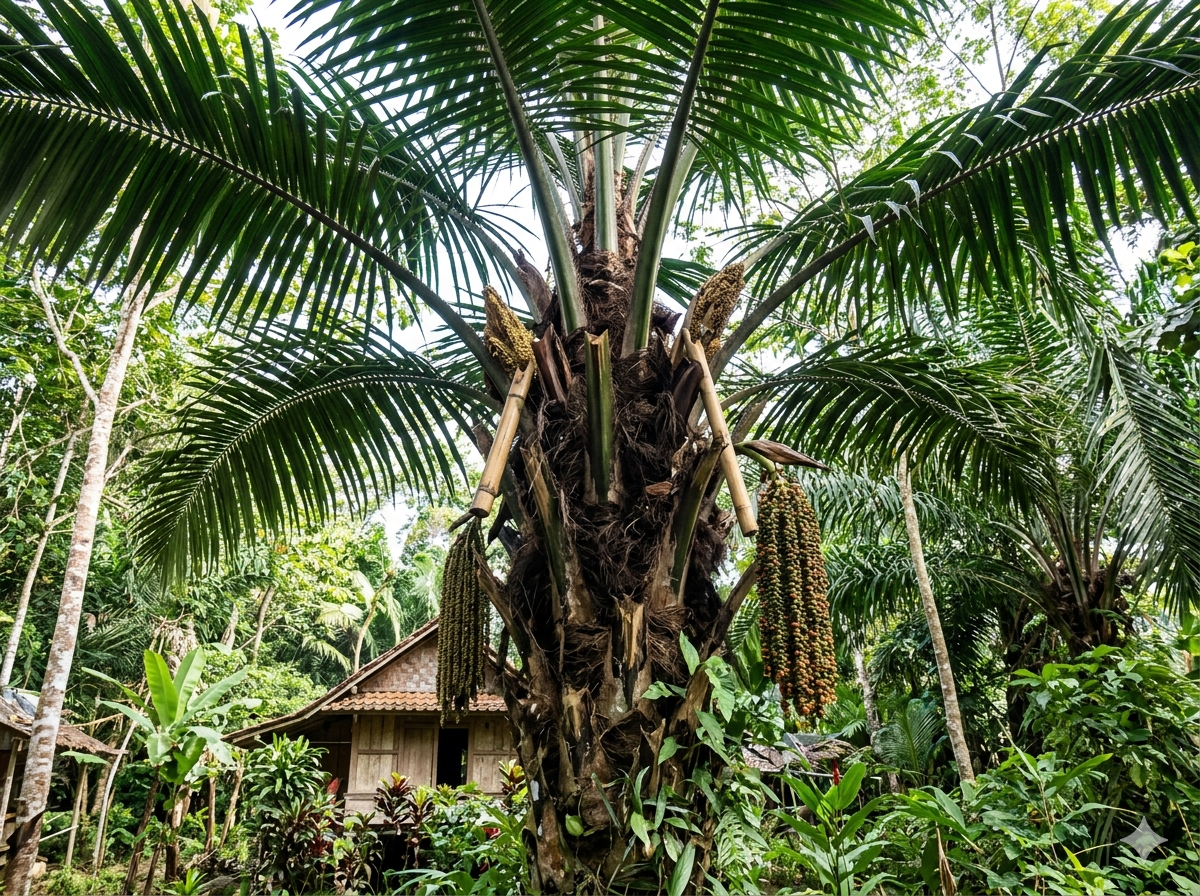
Arenga pinnata identification: Sugar Palm has several very distinctive features that make it unmistakable once you know them. Trunk: The most distinctive feature is the "shaggy skirt" — the trunk of mature Arenga pinnata is covered with dark brown to black fibers (ijuk) from old leaf base sheaths that haven't fallen away completely. These black fibrous sheaths cling to the trunk creating a distinctive shaggy, unkempt appearance. No other common Indian palm has this black fibrous shaggy trunk. Leaves: Very large (6-9m!) pinnate fronds — among India's largest. The leaflets are distinctive: dark green above, SILVERY-WHITE (glaucous) below. When the wind moves the fronds: the silver-white undersides flash — creating a distinctive two-tone green-silver appearance. Leaf midrib: strong, covered with black spiny fibers. Inflorescences: emerge from the LOWEST fronds first (bottom-up — opposite of most palms and opposite of Fishtail Palm). Large (2-4m) hanging inflorescences with cream-yellow flowers. Fruits: large oval (5-10cm) dark green to black fruits in heavy pendulous bunches. The fruits contain crystalline raphides — handle with gloves (skin and mouth irritant). Fruits not edible raw. Habitat: tropical humid forest understory and margins in Assam, Meghalaya, Manipur, Mizoram, Tripura, Andaman Islands. Often in slightly shaded positions under taller trees. Height: 12-20m at maturity, spreading crown with massive fronds. Simple identification test: tropical humid NE India/Andaman + palm with black shaggy fibrous trunk + very large fronds with silver-white undersides + bottom inflorescences first = Arenga pinnata with high confidence.

Arenga pinnata identification: Trunk: MOST DISTINCTIVE = "shaggy skirt" — dark brown to black ijuk fibers old leaf base sheaths से। Shaggy, unkempt appearance। No other common Indian palm — black fibrous shaggy trunk। Leaves: Very large (6-9m!) pinnate fronds। Distinctive leaflets: dark green above, SILVERY-WHITE (glaucous) below। Wind में: silver-white undersides flash — green-silver two-tone। Leaf midrib: black spiny fibers। Inflorescences: LOWEST fronds FIRST (bottom-up — most palms + Fishtail Palm opposite)। Large (2-4m) hanging cream-yellow flowers। Fruits: large oval (5-10cm) dark green to black heavy pendulous bunches। Raphide crystals — gloves handle। Raw NOT edible। Habitat: tropical humid forest understory + margins Assam, Meghalaya, Manipur, Mizoram, Tripura, Andaman। Slightly shaded positions। Height: 12-20m, massive fronds। Simple test: tropical humid NE India/Andaman + black shaggy fibrous trunk + very large fronds silvery-white undersides + bottom inflorescences first = Arenga pinnata high confidence।
Arenga pinnata (Sugar Palm) vs Caryota urens (Fishtail Palm) — related but different: Both are tall monocarpic palms with N-rich sap from NE India and South India respectively. Both have somewhat shaggy trunks, both are monocarpic (flower once and die), and both have sap that can cause skin irritation. But they are different genera and have very different leaves, sap yields, and geographic distribution. Leaf comparison — THE key difference: Fishtail Palm (Caryota urens): BIPINNATE (twice-compound) leaves with distinctive jagged fish-tail shaped leaflets. The only palm in India with bipinnate leaves — instantly distinctive. Sugar Palm (Arenga pinnata): PINNATE (once-compound) leaves with large, entire leaflets that are dark green above and SILVERY-WHITE below. Not fish-tail shaped. Trunk: Fishtail Palm: smooth trunk covered with fibrous sheaths but not the heavy black ijuk fiber. Sugar Palm: SHAGGY BLACK FIBROUS TRUNK (ijuk) — very distinctive. Monocarpic flowering direction: Fishtail Palm: TOP to BOTTOM (2-4 years). Sugar Palm: BOTTOM to TOP (10-15 years). This is a critical management difference: Sugar Palm gives you 10-15 years of tapping from its terminal flowering while Fishtail Palm gives only 2-4 years. Sap yield: Sugar Palm: 15-25 litres/day (world record). Fishtail Palm: 3-5 litres/day. Sugar Palm yields 5-8x more sap per tree per day. Geographic distribution: Fishtail Palm (Caryota urens): Western Ghats, Eastern Ghats, South India, NE India (moist areas). Sugar Palm (Arenga pinnata): NE India (Assam, Meghalaya, Manipur, Mizoram, Tripura) and Andaman Islands primarily. At altitude 500-1,500m they can overlap in NE India — use leaf shape and trunk character to distinguish. Memory aid: FISH-TAIL LEAFLETS + SMOOTH TRUNK = Fishtail Palm (Caryota). SILVERY-WHITE LEAF UNDERSIDES + BLACK SHAGGY TRUNK + BOTTOM-UP FLOWERING = Sugar Palm (Arenga).

Sugar Palm vs Fishtail Palm: Both tall monocarpic, NE/South India, shaggy trunks, skin-irritant sap। But different genera, different leaves, sap yields, geographic distribution। KEY DIFFERENCE — leaves: Fishtail Palm (Caryota urens): BIPINNATE — jagged fish-tail leaflets। Only Indian palm bipinnate — instantly distinctive। Sugar Palm (Arenga pinnata): PINNATE — large entire leaflets, dark green above, SILVERY-WHITE below। Not fish-tail shaped। Trunk: Fishtail: smooth + fibrous sheaths (ijuk नहीं heavy)। Sugar Palm: SHAGGY BLACK FIBROUS TRUNK (ijuk) — very distinctive। Monocarpic direction: Fishtail: TOP to BOTTOM (2-4 years)। Sugar Palm: BOTTOM to TOP (10-15 years)। Management critical: Sugar Palm = 10-15 years tapping terminal। Fishtail = only 2-4 years। Sap yield: Sugar Palm: 15-25 litres/day (world record)। Fishtail: 3-5 litres/day। Sugar Palm = 5-8x more। Geographic: Fishtail: Western + Eastern Ghats, South India, NE India moist। Sugar Palm: NE India primarily + Andaman। Memory: FISH-TAIL LEAFLETS + SMOOTH TRUNK = Fishtail (Caryota)। SILVERY-WHITE LEAF UNDERSIDES + BLACK SHAGGY TRUNK + BOTTOM-UP = Sugar Palm (Arenga)।
⚠️
AI-Assisted Content — Please Read
AI-सहायता से बनाई गई सामग्री — कृपया पढ़ें

All tools, plant encyclopedias, edible growing guides and blog content on PlantCare are created with the assistance of AI (Artificial Intelligence) and are intended for general informational and educational purposes only. While we strive for accuracy, the information provided may not be complete, current or suitable for every situation, region or individual plant variety.

For health, medical or serious agricultural decisions — always consult a qualified horticulturist, agronomist, Ayurvedic practitioner, medical professional or relevant expert. PlantCare does not take responsibility for outcomes arising from use of this information. Identification results from AI tools (plant identifier, pest identifier etc.) should be verified before taking any action.

इस वेबसाइट पर सभी tools, plant encyclopedias, edible guides और blog content AI (Artificial Intelligence) की सहायता से बनाए गए हैं और केवल सामान्य जानकारी और शिक्षा के उद्देश्य से हैं। स्वास्थ्य, चिकित्सा या गंभीर कृषि निर्णयों के लिए कृपया किसी योग्य विशेषज्ञ से संपर्क करें। PlantCare इस जानकारी के उपयोग से होने वाले परिणामों के लिए जिम्मेदार नहीं है।