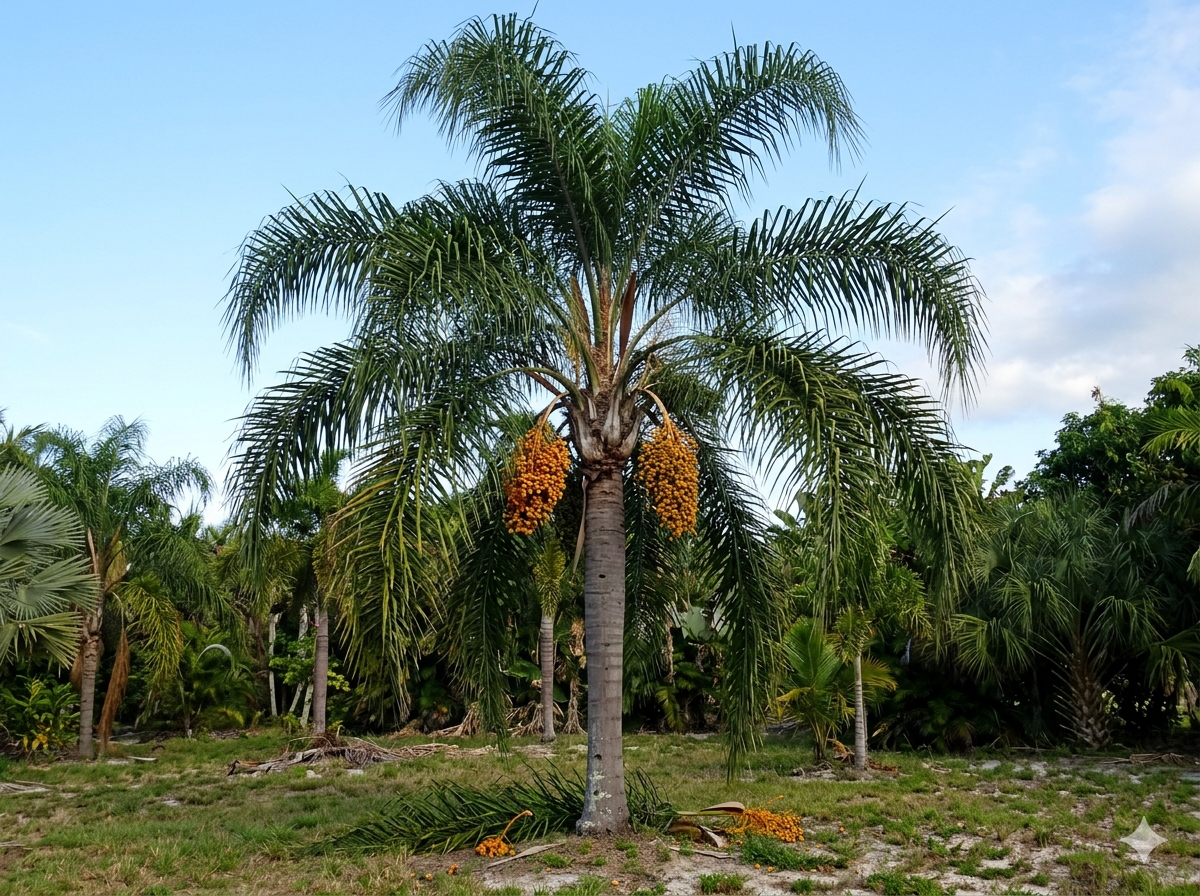
Queen Palm Syagrus romanzoffiana Orange Fruits India Landscape — PlantCare
📷 PlantCare
🌴 Palms & Himalayan Trees

Queen Palm / Cocos Palm / South American Palm क्वीन पाम / Cocos Palm

Syagrus romanzoffiana Family: Arecaceae (Palm family)

Queen Palm — YEAR-ROUND spectacular BRIGHT ORANGE fruit clusters (most photogenic landscape palm!). NO crownshaft = key ID vs Royal Palm. 4-6 ft/year fast + more adaptable (Gujarat, Rajasthan plains where Royal Palm won't grow). Wildlife magnet: fruit bats, parakeets, hornbills. Romantic arching fronds vs Royal's formal erect.

📏 10–15 metres | Smooth ring-scarred grey trunk | NO crownshaft | ORANGE FRUIT CLUSTERS! ⏳ 80–120 years | Fast-growing landscape statement 📈 FAST — 4–6 ft/year | More adaptable than Royal Palm | India's rising premium palm 📍 Tropical to subtropical India below 600m. Kerala, MH, TN, Gujarat, AP, Rajasthan plains (irrigation). ⚠️ Not native. Not protected. Freely planted + traded. Premium landscape India. 💰 Not timber. Landscape value Rs.30,000-2,50,000 established specimen.
📤 WhatsApp
Queen Palm Year-Round Orange Fruit Clusters Most Photogenic NO Crownshaft vs Royal Palm Green Crownshaft Key ID 4-6ft Year Fast More Adaptable Gujarat Rajasthan Wildlife Hub Bats Parakeets Hornbills Romantic Arching vs Royal Formal Erect Rs30k-2.5L Landscape Value South America Native India Rising

Queen Palm — YEAR-ROUND spectacular BRIGHT ORANGE fruit clusters (most photogenic!)। NO crownshaft = Royal Palm vs key ID। 4-6 ft/year fast + more adaptable (Gujarat, Rajasthan पर Royal Palm won't grow)। Wildlife magnet: bats, parakeets, hornbills। Romantic arching vs Royal's formal erect।

Queen Palm (Syagrus romanzoffiana) — Queen Palm / Cocos Palm / Jerivá Palm / Pindo Palm (incorrect) — is one of South America's most elegant native palms and one of India's most rapidly growing premium landscape palms over the past decade. Native to South America (Brazil, Argentina, Uruguay, Paraguay), Queen Palm has been widely planted in tropical and subtropical landscaping globally for its graceful appearance, fast growth, and adaptability. The tree is characterized by its smooth grey trunk with evenly spaced ring scars, elegant arching bright-green pinnate fronds that arch gracefully outward (giving a softer, more romantic silhouette compared to the formal Royal Palm), and its year-round production of large clusters of orange fruits that attract birds and wildlife. In India, Queen Palm has found a particular niche in luxury residential landscaping, avenue planting, and resort design where its combination of fast growth (4-6 ft/year), elegant form, and abundant orange fruit clusters creates dramatic landscape effects quickly. The tree is somewhat confused with Royal Palm (both have smooth ring-scarred trunks) but differs in having: no crownshaft (versus Royal Palm's distinctive bright green crownshaft), more feathery arching fronds (versus Royal Palm's more erect fronds), and copious orange fruit production. A mature Queen Palm laden with bright orange fruit clusters against deep green fronds is one of the most photogenic landscape trees available in tropical India.

Queen Palm (Syagrus romanzoffiana) — क्वीन पाम / Cocos Palm — South America (Brazil, Argentina, Uruguay, Paraguay) native। India: past decade में most rapidly growing premium landscape palms में। Smooth grey trunk + evenly spaced ring scars + elegant arching bright-green pinnate fronds (softer, more romantic silhouette than Royal Palm) + year-round large orange fruit clusters। India: luxury residential landscaping, avenue, resort। Fast growth (4-6 ft/year) + elegant form + abundant orange fruits = dramatic landscape quickly। Royal Palm से confused (both smooth ring-scarred trunks) but different: no crownshaft (Royal Palm bright green crownshaft), more feathery arching fronds, copious orange fruits। Mature Queen Palm orange fruits against deep green fronds = most photogenic landscape trees tropical India।

🌴 Overview & Quick Facts / परिचय और मुख्य तथ्य

🔬 Scientific NameSyagrus romanzoffiana — Family: Arecaceae (Palm family)
📏 Height / ऊंचाई10–15 metres | Smooth ring-scarred grey trunk | NO crownshaft | Arching feathery fronds
Lifespan / आयु80–120 years | Landscape specimen for decades
📈 Growth Rate / वृद्धि दरFAST — 4–6 ft/year | Among India's fastest ornamental palms | Impressive in 8-10 years
🍊 Fruits / फलYEAR-ROUND large clusters of BRIGHT ORANGE fruits! Spectacular ornamental + wildlife food. / Year-round orange clusters spectacular!
🌡️ Climate / जलवायुTropical to subtropical. Pan-India below 600m. Kerala, Maharashtra, TN, Gujarat, AP, Rajasthan (with irrigation). More adaptable than Royal Palm.
⚖️ Legal Status / कानूनीNot native. Not protected. Freely planted + traded. Premium landscape palm India.
💰 Value / मूल्यNursery (1yr): Rs.300–1,000 | 3yr specimen: Rs.3,000-8,000 | Established (5-7m): Rs.30,000-80,000 | Mature: Rs.1,00,000+

🌿 Features & Uses — विशेषताएं और उपयोग

🍊
Orange Fruit Clusters (Signature Feature)
THE most photogenic feature. Year-round large pendant clusters (0.5-1m long) of bright orange oval fruits (2-3cm each). Entire clusters contain 100-500+ fruits. Color: starts green, ripens to bright orange-yellow. The fruiting clusters hang dramatically below the green fronds — creating a stunning orange + green color combination. Seeds inside fruits: used for propagation. Fruit pulp: sweetish, sticky, edible but not commonly eaten. Birds and wildlife very attracted.

THE most photogenic। Year-round large pendant clusters (0.5-1m long) bright orange oval fruits (2-3cm each)। 100-500+ fruits per cluster। Green से starts, bright orange-yellow ripens। Clusters green fronds से below hang — stunning orange + green combination। Seeds: propagation। Fruit pulp: sweetish, sticky, edible (not commonly eaten)। Birds + wildlife very attracted।
🌴
Elegant Arching Form
Unlike Royal Palm's formal military-straight erect fronds, Queen Palm fronds arch outward and slightly downward in a graceful, romantic sweep — giving a softer tropical forest feel. 10-15 live fronds at crown. Fronds 2-4m long, slightly twisted. The overall silhouette: more romantic and organic than formal Royal Palm. Pairs beautifully with: tropical gardens, resort aesthetics, waterside planting. Falls cleanly when old — low maintenance.

Royal Palm के formal military-straight erect fronds unlike, Queen Palm fronds graceful romantic sweep में outward + slightly downward arch। Softer tropical forest feel। 10-15 live fronds। 2-4m long, slightly twisted। Silhouette: formal Royal Palm से more romantic + organic। Tropical gardens, resort aesthetics, waterside planting। Cleanly fall when old — low maintenance।
🌍
Broader Climate Tolerance
More adaptable than Royal Palm. Works in: tropical Kerala/Goa/coastal Karnataka, subtropical Maharashtra (Pune, Nashik), Gujarat (Ahmedabad, Surat with irrigation), AP, Rajasthan plains (with irrigation in hot dry summer). Moderate drought tolerance once established. Brief cold tolerance (3-4°C). More versatile than Royal Palm for non-coastal + drier locations. NOT for Himalayan hill stations or sustained frost.

Royal Palm से more adaptable। Works: tropical Kerala/Goa/coastal Karnataka, subtropical MH (Pune, Nashik), Gujarat (Ahmedabad, Surat irrigation), AP, Rajasthan plains (irrigation summer)। Moderate drought tolerance established। Brief cold tolerance (3-4°C)। Non-coastal + drier locations: Royal Palm से more versatile। Himalayan hill stations या sustained frost: NOT।
🏛️
Landscape Uses
Premium landscape uses: (1) Avenue: rows of Queen Palms at 5-7m spacing — romantic tropical boulevard effect. (2) Resort + hotel: poolside, garden feature, entrance approach. (3) Luxury residential: private garden focal specimen, driveway lining. (4) Waterside planting: near water bodies — the arching fronds + orange fruits over water = spectacular. (5) Mixed palm grouping: complement to Royal Palm (formal) + Foxtail (fluffy). Queen adds organic romance.

Premium uses: (1) Avenue: 5-7m spacing rows — romantic tropical boulevard। (2) Resort + hotel: poolside, garden, entrance। (3) Luxury residential: focal specimen, driveway। (4) Waterside: water bodies near — arching fronds + orange fruits over water spectacular। (5) Mixed palm grouping: Royal Palm (formal) + Foxtail (fluffy) complement। Queen = organic romance add।
🦜
Wildlife Attraction
Year-round orange fruits = consistent wildlife food source. Attracts: fruit bats (at night), mynahs, parakeets, koels, hornbills (where present), squirrels, monkeys. A mature Queen Palm in a garden becomes a wildlife hub — contributing to urban biodiversity. The abundant fruit production means wildlife can rely on it as a consistent food source. Excellent for bird-watching gardens and eco-conscious landscaping.

Year-round orange fruits = consistent wildlife food। Attracts: fruit bats (night), mynahs, parakeets, koels, hornbills (where present), squirrels, monkeys। Mature Queen Palm = garden में wildlife hub। Urban biodiversity contribute। Abundant fruit = wildlife consistent reliance। Bird-watching gardens + eco-conscious landscaping excellent।
🌸
Flowers / फूल
Large branching creamy-white inflorescences emerging from among the fronds (at crown, within frond area — unlike Royal Palm's below-crown emergence). Year-round in tropics. Excellent honey source — long-lasting nectar flow. The inflorescences develop into fruit clusters over 6-8 months. One mature tree: 3-6 inflorescences simultaneously at different fruit development stages — always something orange happening in crown.

Large branching creamy-white inflorescences fronds के among (crown within frond area — Royal Palm's below-crown unlike)। Year-round tropics। Excellent honey — long-lasting nectar। 6-8 months fruit clusters develop। One mature tree: 3-6 inflorescences simultaneously different stages — always something orange in crown।

🌍 Orange Fruit Spectacular + Faster Than Royal / Orange Fruit और Faster Than Royal

⚡ Key Facts / मुख्य तथ्य
🍊 Year-Round Orange
Massive pendant orange fruit clusters year-round. Most photogenic landscape palm in tropical India.
Massive pendant orange fruit clusters year-round। Tropical India का most photogenic landscape palm।
⚡ Fast + Elegant
4-6 ft/year + graceful arching romantic fronds. Faster and more adaptable than Royal Palm.
4-6 ft/year + graceful arching romantic। Faster + more adaptable than Royal Palm।
🌍 No Crownshaft
Key ID vs Royal Palm: NO bright green crownshaft. Fronds directly from trunk. More organic silhouette.
Royal Palm vs key ID: NO bright green crownshaft। Fronds directly from trunk। More organic silhouette।
🗺️ More Adaptable
Works in Rajasthan plains, Gujarat, interior Maharashtra — drier areas Royal Palm won't survive.
Rajasthan plains, Gujarat, interior MH में works — Royal Palm won't survive drier areas।
🦜 Wildlife Hub
Bats, parakeets, mynahs, hornbills, squirrels year-round. Urban biodiversity contribution.
Bats, parakeets, mynahs, hornbills, squirrels year-round। Urban biodiversity contribution।
🌴 Nursery Fast
Fast growth = good nursery business. Rs.300 seedling → Rs.30,000-80,000 in 5-7 years.
Fast growth = good nursery। Rs.300 seedling → Rs.30,000-80,000 in 5-7 years।

🌱 Growing Guide / Queen Palm कैसे उगाएं

Regular watering first 2 years. Once established: moderate drought tolerance. Deep watering once weekly dry season. Good drainage essential — standing water causes root rot. Sandy loam to loamy soil best.Palm-specific slow-release (8:2:12 + micronutrients) quarterly. Potassium critical. Magnesium: Epsom salt monthly if yellowing fronds. Iron+manganese: foliar if new fronds yellow (alkaline soil deficiency).Falling orange fruits can be slippery on paths — plant away from walkways if this is concern. Fruit attracts wildlife (positive for gardens, may be concern near entrances). Birds and bats also attract insects — normal ecological chain.Fast growth makes excellent nursery investment. Rs.300 seedling → Rs.3,000-8,000 at 3 years. → Rs.30,000-80,000 at 6-7 years. Demand from luxury residential + resort developers consistently high. South India nursery operators increasingly grow Queen Palm.
ParameterEnglishHindi / हिंदी
🌱 PropagationSeeds from ripe orange-yellow fruits (remove flesh, wash, sow immediately). Germination 2-4 months. Success rate 60-75%. No offsets — seed only. Tissue culture starting to become available in India for faster establishment.Ripe orange-yellow fruits से seeds (flesh remove, wash, immediately sow)। 2-4 months germination। 60-75% success। Offsets नहीं — seed only। Tissue culture India में starting available।
🌡️ ClimateTropical to subtropical — more adaptable than Royal Palm. Kerala, Goa, Karnataka, TN, MH, Gujarat, AP, Rajasthan plains (with irrigation). Brief cold tolerance (3-4°C). NOT for Himalayan hill stations or sustained frost.Tropical to subtropical — Royal Palm से more adaptable। Kerala, Goa, Karnataka, TN, MH, Gujarat, AP, Rajasthan plains (irrigation)। Brief cold (3-4°C)। Himalayan hill stations या sustained frost: NOT।
💧 WaterFirst 2 years regular। Established: moderate drought tolerance। Dry season: weekly deep। Good drainage essential — standing water = root rot। Sandy loam to loamy best।
🌿 FertilizerPalm-specific slow-release (8:2:12 + micronutrients) quarterly। Potassium critical। Magnesium: Epsom salt monthly yellowing fronds। Iron+manganese foliar: new fronds yellow (alkaline soil)।
🍊 Fruit managementFalling orange fruits = paths पर slippery। Walkways से away plant if concern। Wildlife attract (garden positive, entrance near concern)। Birds + bats = insects attract — normal ecological chain।
💰 NurseryFast growth excellent nursery। Rs.300 seedling → Rs.3,000-8,000 (3 years) → Rs.30,000-80,000 (6-7 years)। Luxury residential + resort developers consistently high demand। South India nursery operators increasingly grow।

💰 Market Value / बाज़ार मूल्य

🌴 Seedling (1 year)Rs.300–1,000Freely traded. Kerala, Karnataka nurseries. Online.
🌴 Young plant (3 years, 1.5-2m)Rs.3,000–8,000Freely traded. Specialty palm nurseries.
🌴 Specimen (5-7 years, 4-5m)Rs.30,000–80,000Landscape nurseries. Professional transport.
🌴 Mature (10+ years, 8-10m)Rs.1,00,000–2,50,000Specialist transplanting required. Limited availability.
❓ Frequently Asked Questions / अक्सर पूछे जाने वाले सवाल
Queen Palm vs Royal Palm — choosing for your Indian landscape: Both are tall, smooth-trunked, fast-growing pinnate palms widely used in Indian luxury landscaping. They are frequently confused and compared. Key identification difference: CROWNSHAFT. Royal Palm (Roystonea regia): HAS a bright EMERALD-GREEN cylindrical crownshaft just below the crown. This is the most distinctive Royal Palm feature — a vivid green section of smooth trunk immediately below the leaf crown. Queen Palm (Syagrus romanzoffiana): NO crownshaft — the fronds emerge directly from the top of the trunk without any distinctive green sheath section. This single feature allows instant identification. Silhouette difference: Royal Palm: fronds more upright and formal, creating a more military/architectural appearance. Trunk: pure grey-white, larger diameter. Queen Palm: fronds arch outward and droop more gracefully, creating a softer romantic silhouette. Trunk: grey, slightly smaller diameter. Fruit: Royal Palm: small purple-black fruits in large clusters below crownshaft. Very rarely noticeable. Queen Palm: DRAMATIC large pendant clusters of bright ORANGE fruits. Very noticeable and photogenic. This is a key ornamental advantage for Queen Palm. Climate adaptability: Royal Palm: strictly humid tropical. Will not thrive in Gujarat, Rajasthan plains, or drier inland areas. Queen Palm: moderately drought tolerant, adapts to drier subtropical conditions. More versatile for wider India range. Growth rate: both fast (3-6 ft/year in good conditions). Royal Palm ultimately slightly taller (15-30m vs Queen's 10-15m). Best for formal/institutional/grand scale: Royal Palm. Best for romantic/resort/residential/wider climate range: Queen Palm. Summary: GREEN CROWNSHAFT = Royal Palm (formal, strictly humid tropical). NO CROWNSHAFT + ORANGE FRUIT CLUSTERS = Queen Palm (romantic, more adaptable). Plant them together in a large landscape for maximum effect — the formal Royal Palm avenue + romantic Queen Palm feature = stunning combination.

Queen Palm vs Royal Palm: Key ID difference: CROWNSHAFT। Royal Palm: HAS bright EMERALD-GREEN cylindrical crownshaft just below crown। Queen Palm: NO crownshaft — fronds directly trunk top से emerge। Single feature = instant identification। Silhouette: Royal = upright formal military/architectural। Grey-white pure, larger diameter। Queen = outward arch drooping graceful romantic। Grey slightly smaller। Fruits: Royal = small purple-black clusters below crownshaft (barely noticeable)। Queen = DRAMATIC large pendant BRIGHT ORANGE clusters। Very noticeable + photogenic। Queen Palm ornamental advantage। Climate: Royal = strictly humid tropical। Gujarat, Rajasthan plains, drier inland: NOT। Queen = moderate drought tolerant, drier subtropical adapts। Wider India range। Growth: both fast (3-6 ft/year)। Royal ultimately slightly taller। Formal/institutional/grand: Royal Palm। Romantic/resort/residential/wider climate: Queen Palm। Summary: GREEN CROWNSHAFT = Royal (formal, strictly humid)। NO CROWNSHAFT + ORANGE FRUITS = Queen (romantic, more adaptable)। Together large landscape: formal Royal avenue + romantic Queen feature = stunning combination।
Queen Palm fruits — uses and notes: The bright orange fruits of Syagrus romanzoffiana are one of the tree's most distinctive ornamental features — the cascading clusters of orange oval fruits against the deep green fronds create one of tropical landscaping's most photogenic effects. About the fruits: each fruit (2-3cm oval) contains: outer fleshy orange-yellow pulp (epicarp + mesocarp) + a hard fibrous seed coat (endocarp) + large (1.5-2cm) hard seed inside. The fruit pulp: sweetish, slightly oily, edible but not commonly consumed by humans in India. In South America (Brazil), the fruit pulp was traditionally eaten by indigenous communities and is still occasionally used in local food preparation. The seed inside: hard, white, containing an oily "vegetable ivory" like material — related to the coconut endosperm. The seed oil: Syagrus oil (extracted from the seed) is edible and has good fatty acid profile (lauric acid + oleic acid). Some Brazilian communities extract oil for cooking. Seeds: for propagation — viability 60-75% when fresh. Germination 2-4 months. Wildlife use: the primary practical value of Queen Palm fruits. The sweet oily pulp attracts fruit bats (at night), multiple bird species, squirrels, and monkeys. In urban India, a fruiting Queen Palm becomes a consistent wildlife feeding station. Fruit management: falling ripe fruits can create slippery walkways — plant away from pedestrian paths if this is a concern. The fallen orange fruits are aesthetically striking on the ground — many landscape designers actually let them accumulate under the tree as a natural ground carpet effect. The orange + green ground cover = very photogenic in resort landscapes. Practical: fallen fruits can be composted — the fibrous pulp decomposes well and adds organic matter to soil.

Queen Palm fruits: Each (2-3cm oval): outer fleshy orange-yellow pulp + hard fibrous seed coat + large (1.5-2cm) hard seed। Fruit pulp: sweetish, slightly oily, edible (not commonly consumed India)। South America: traditionally eaten + occasional local food। Seed: hard white oily "vegetable ivory" — coconut endosperm related। Syagrus oil: edible, good fatty acids (lauric + oleic)। Brazilian communities cooking। Seeds: propagation 60-75% fresh। 2-4 months germination। Wildlife use: PRIMARY practical value। Sweet oily pulp: fruit bats (night), multiple bird species, squirrels, monkeys। Urban India: consistent wildlife feeding station। Fruit management: ripe fallen = walkways slippery। Pedestrian paths से away plant। Fallen orange fruits: aesthetically striking। Landscape designers: natural ground carpet effect। Orange + green = very photogenic resort। Practical: composted well। Fibrous pulp decomposes + organic matter adds।
Queen Palm ideal growing locations in India: Syagrus romanzoffiana is notably more adaptable than most premium ornamental palms — it tolerates a wider range of climates than the strictly tropical Royal Palm, which gives it broader applicability across India. Best performance regions: (1) Kerala: excellent conditions. High rainfall, warm temperatures, humidity — Queen Palm thrives and grows vigorously. Some of India's finest Queen Palm specimens are in Kerala gardens and resorts. Thiruvananthapuram, Kochi, Thrissur areas especially good. (2) Coastal Karnataka + Goa: very good conditions. Mangalore, Panaji, Belagavi. (3) Maharashtra coastal (Konkan): Mumbai, Alibaug, Ratnagiri. Good growth with the coastal humidity. (4) Tamil Nadu coastal + interior: Chennai, Coimbatore, Salem. Slightly drier interior — needs more irrigation but grows well. (5) Andhra Pradesh + Telangana: coastal AP (Visakhapatnam, Vijayawada area) excellent. Interior AP/Telangana (Hyderabad): with irrigation, performs well. (6) Gujarat: Ahmedabad, Surat, Vadodara — more challenging (hot dry summer) but with regular deep irrigation and some protection from extreme heat: manageable. Not as vigorous as in humid tropics. (7) Rajasthan + UP plains: possible in major cities (Jaipur, Lucknow) with consistent irrigation and mulching. Not natural habitat — requires more care. Struggles in extreme summer (48°C+). Challenging but possible for enthusiasts. Where NOT: Himalayan hill stations (cold), north Indian areas with hard frost below 0°C (Punjab, Haryana in cold winters — problematic), very arid desert zones without irrigation. Assessment: Queen Palm vs Royal Palm in India — Queen Palm's greater climate tolerance makes it the more practical choice for most Indian locations outside the strictly humid coastal tropical belt. Royal Palm is the grander choice where conditions allow; Queen Palm is the smarter choice where conditions are less than perfect.

Queen Palm India ideal locations: Royal Palm से notably more adaptable। Best: (1) Kerala: excellent। High rainfall, warm, humid। India's finest specimens। Thiruvananthapuram, Kochi, Thrissur especially। (2) Coastal Karnataka + Goa: very good। Mangalore, Panaji, Belagavi। (3) MH coastal (Konkan): Mumbai, Alibaug, Ratnagiri। Coastal humidity + good growth। (4) TN coastal + interior: Chennai, Coimbatore, Salem। Interior drier = more irrigation, but well。 (5) AP + Telangana: coastal AP excellent। Interior (Hyderabad): irrigation + well। (6) Gujarat: Ahmedabad, Surat, Vadodara। Hot dry summer challenging — regular deep irrigation + heat protection = manageable। Humid tropics से less vigorous। (7) Rajasthan + UP plains: Jaipur, Lucknow possible। Consistent irrigation + mulching। Not natural habitat। Extreme summer (48°C+) struggles। Enthusiasts के लिए possible। NOT: Himalayan hill stations, hard frost below 0°C (Punjab, Haryana cold winters), very arid without irrigation। Assessment: Queen Palm vs Royal Palm — Queen Palm greater climate tolerance = most Indian locations के लिए more practical। Strictly humid coastal tropical: Royal Palm grander। Less than perfect conditions: Queen Palm smarter।
⚠️
AI-Assisted Content — Please Read
AI-सहायता से बनाई गई सामग्री — कृपया पढ़ें

All tools, plant encyclopedias, edible growing guides and blog content on PlantCare are created with the assistance of AI (Artificial Intelligence) and are intended for general informational and educational purposes only. While we strive for accuracy, the information provided may not be complete, current or suitable for every situation, region or individual plant variety.

For health, medical or serious agricultural decisions — always consult a qualified horticulturist, agronomist, Ayurvedic practitioner, medical professional or relevant expert. PlantCare does not take responsibility for outcomes arising from use of this information. Identification results from AI tools (plant identifier, pest identifier etc.) should be verified before taking any action.

इस वेबसाइट पर सभी tools, plant encyclopedias, edible guides और blog content AI (Artificial Intelligence) की सहायता से बनाए गए हैं और केवल सामान्य जानकारी और शिक्षा के उद्देश्य से हैं। स्वास्थ्य, चिकित्सा या गंभीर कृषि निर्णयों के लिए कृपया किसी योग्य विशेषज्ञ से संपर्क करें। PlantCare इस जानकारी के उपयोग से होने वाले परिणामों के लिए जिम्मेदार नहीं है।