Portia Tree Paras Pipal Indian Tulip Yellow Purple Flowers India — PlantCare
📷 PlantCare
🌸 Flowering & Ornamental Trees

Portia Tree / Paras Pipal / Indian Tulip पारस पीपल / भेंडी / पारस पत्थर

Thespesia populnea Family: Malvaceae (Hibiscus family)

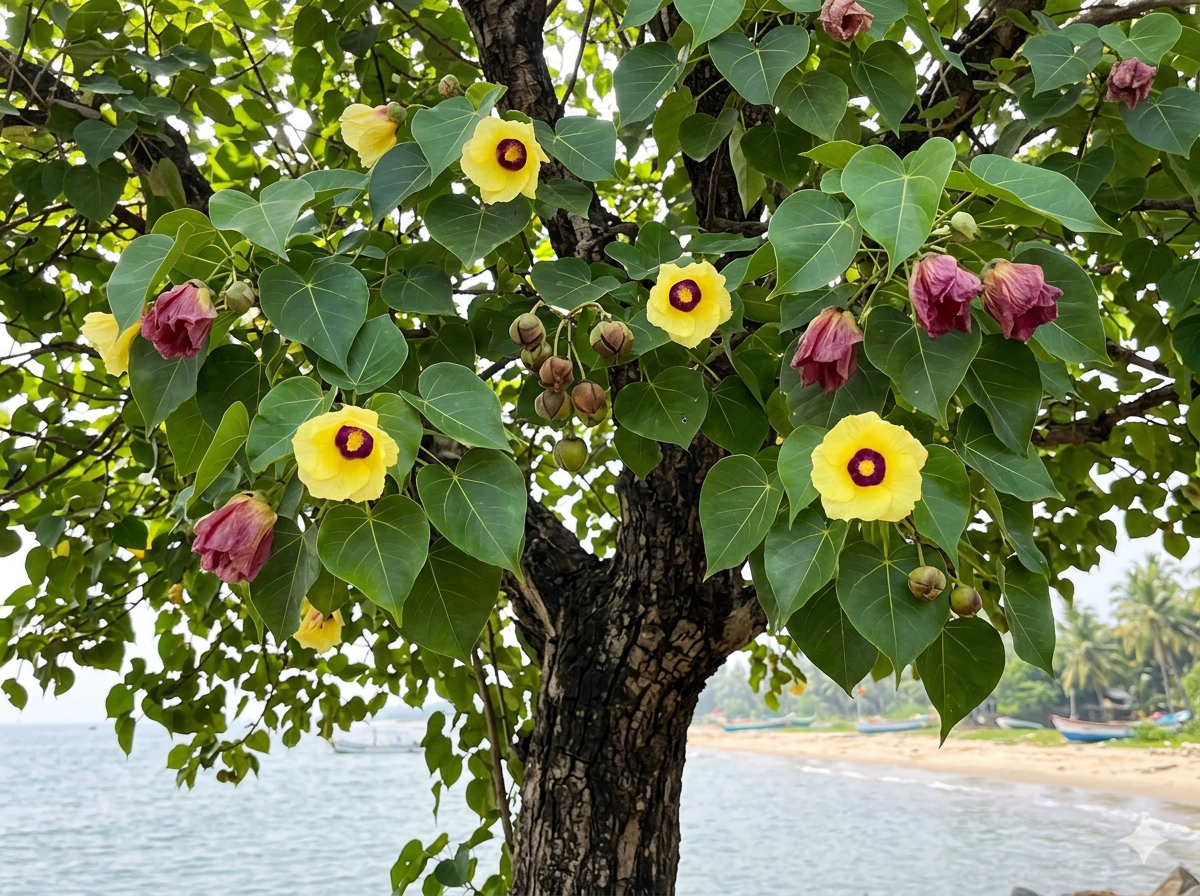
Portia Tree / Paras Pipal — flowers CHANGE COLOR same day (yellow morning → pink-purple afternoon)! Lord Murugan Thaipusam sacred. Fruit dye for fishing nets (natural anti-fouling!). Chettinad premier carving wood. Bark: eczema, ringworm, vitiligo confirmed.

📏 6–15 metres | Rounded spreading | Multi-stemmed often ⏳ 100–200+ years coastal 📈 Moderate-fast — 2–3 ft/year 📍 Tropical coastal — Kerala, Karnataka, Tamil Nadu, Goa, Andaman. More inland tolerant than Calophyllum. ⚠️ Native coastal. Not protected. Coastal zone rules near beach. Timber: FD permit. 💰 Rs.800–1,800/cubic foot — Chettinad furniture + South Indian temple carving premier wood
📤 WhatsApp
Portia Tree Paras Pipal Flower Color Change Yellow→Purple Same Day Lord Murugan Thaipusam Sacred Fishing Net Anti-Fouling Dye Chettinad Carving Premier Eczema Ringworm Vitiligo Bark Blue Mormon Butterfly

पारस पीपल — flowers SAME DAY रंग change (yellow morning → pink-purple afternoon)! Lord Murugan Thaipusam sacred। Fishing nets के लिए fruit dye (natural anti-fouling!)। Chettinad premier carving wood। Bark: eczema, ringworm, vitiligo confirmed।

Portia Tree (Thespesia populnea) — Paras Pipal / Portia Tree / Indian Tulip / Umbrella Tree / Bhendi Tree — is one of India's most versatile and beautiful coastal flowering trees, combining ornamental flowers, ecological importance, and medicinal value in a single package. The tree produces beautiful yellow flowers with a distinctive dark purple center (resembling a hibiscus — both are in the Malvaceae family) that transition to pink-purple as they age during the day — giving a single tree multiple flower colors simultaneously. These flowers resemble the Sacred Tulip of ancient Indian mythology. The tree is found naturally across coastal India and is one of the most important trees in Indian coastal communities — its wood is one of the finest for wood carving and traditional crafts, its leaves and bark have significant Ayurvedic applications particularly for skin diseases, and its coastal tolerance (salt spray, waterlogging, cyclone winds) makes it ecologically irreplaceable in coastal protection. In Tamil Nadu, it is associated with Lord Murugan and planted near temples. The tree is also one of the most important species in traditional Thaipusam festivals in South India and Malaysia. The unripe fruits are used as a source of yellow-green dye, and the bark has been used traditionally for paper-making and fiber extraction.

Portia Tree (Thespesia populnea) — पारस पीपल / Indian Tulip — India के most versatile और beautiful coastal flowering trees में। Yellow flowers + distinctive dark purple center (hibiscus जैसी — both Malvaceae) → aging पर pink-purple — एक tree पर multiple colors simultaneously। Ancient Indian mythology का Sacred Tulip। Coastal India naturally। Finest wood carving और traditional crafts। Bark + leaves: significant Ayurvedic skin diseases। Coastal tolerance: salt spray, waterlogging, cyclone winds। Tamil Nadu: Lord Murugan associated — temples के पास। Thaipusam festivals South India + Malaysia। Unripe fruits: yellow-green dye। Bark: paper-making + fiber।

🌸 Overview & Quick Facts / परिचय और मुख्य तथ्य

🔬 Scientific NameThespesia populnea — Family: Malvaceae (Hibiscus family)
📏 Height / ऊंचाई6–15 metres | Rounded spreading canopy | Often multi-stemmed
Lifespan / आयु100–200+ years coastal specimens / 100-200+ वर्ष
📈 Growth Rate / वृद्धि दरModerate-fast — 2–3 ft/year / मध्यम-तेज़
🌸 Flowers / फूलYear-round in tropics — yellow with purple center → aging pink-purple. Multiple colors same tree! / Year-round। Yellow→purple→pink। Multiple colors!
🌡️ Climate / जलवायुTropical coastal — Kerala, Karnataka, Tamil Nadu, Andaman, Goa. Salt tolerant, cyclone resistant.
⚖️ Legal Status / कानूनीNative coastal India. Not specially protected. Coastal zone rules apply near beach. Timber: FD permit.
💰 Value / मूल्यTimber (carving): Rs.800–1,800/cubic ft | Bark: Rs.10-20/kg | Dye: Rs.10-25/kg fruits | Ornamental high

🌿 Parts & Their Uses — हर अंग का उपयोग

🌸
Flowers / फूल (Multi-Color Display)
Yellow-cream when fresh (morning) with dark purple center. Ages to pink-purple by afternoon — same tree shows multiple color stages simultaneously. Hibiscus-like large (5-8cm). Year-round flowering in coastal tropics. Edible — mild. Traditional: flower offering to Lord Murugan (Thaipusam). Honey source. Flower extract: anti-oxidant. Not commercially traded.

Morning: yellow-cream + dark purple center। Afternoon: pink-purple → same tree multiple colors। Hibiscus-like large (5-8cm)। Year-round coastal। Edible — mild। Lord Murugan offering (Thaipusam)। Honey source। Anti-oxidant। Commercially traded नहीं।
🟫
Bark / छाल (Skin Medicine)
Bark: anti-inflammatory, anti-microbial, anti-fungal. Traditional South India: bark paste for chronic skin diseases — eczema, psoriasis, ringworm, vitiligo. Bark decoction: fever, liver conditions, dysentery. Contains thespesone and thespone (unique ketones). MFP: Rs.10-20/kg. Bark fiber: traditional rope and paper-making.

Anti-inflammatory, anti-microbial, anti-fungal। South India traditional: eczema, psoriasis, ringworm, vitiligo — chronic skin। Bark decoction: fever, liver, dysentery। Thespesone + thespone (unique ketones)। MFP: Rs.10-20/kg। Bark fiber: rope + paper-making।
🍃
Leaves / पत्ते
Heart-shaped leaves (similar to Peepal). Leaf extract: anti-inflammatory, anti-oxidant, anti-diabetic research. Traditional: leaf paste for skin conditions, wound healing. Young leaves: edible in some coastal communities. Cattle fodder (moderate). Leaf litter: good coastal mulch. Important food plant for specific butterfly larvae (Blue Mormon in South India).

Heart-shaped leaves (Peepal जैसी)। Leaf extract: anti-inflammatory, anti-oxidant, anti-diabetic research। Leaf paste: skin conditions, wound healing। Young leaves: coastal communities में edible। Cattle fodder। Coastal mulch। Blue Mormon butterfly larvae food plant।
🎨
Fruits & Dye / फल और रंग
Round fruits (3-5cm) — unripe green fruits yield yellow-green dye for fabric. Traditional coastal fabric dyeing — particularly for fishing nets (dye also has anti-fouling properties, extending net life). Ripe fruit: dark purple-black, edible (mild). Seeds inside: contain fixed oil used in traditional cosmetics. Fruit extract: anti-microbial research.

Round fruits (3-5cm) — unripe green fruits: yellow-green dye fabric। Traditional coastal fabric + fishing nets (dye = anti-fouling, net life extend)। Ripe: dark purple-black, edible (mild)। Seeds: fixed oil traditional cosmetics। Fruit extract: anti-microbial।
🌊
Coastal Ecology / तटीय पारिस्थितिकी
Excellent coastal protection tree — salt tolerant, waterlogging tolerant, cyclone wind resistant. Roots prevent beach erosion. Important food plant for coastal wildlife. Mangrove fringe associate — often found at forest-beach transition. Post-tsunami: Portia Tree groves helped buffer wave damage in Tamil Nadu and Andaman.

Salt tolerant, waterlogging tolerant, cyclone resistant। Beach erosion prevent। Coastal wildlife food plant। Mangrove fringe associate। Post-tsunami: Tamil Nadu + Andaman में wave damage buffer किया।
🪵
Wood / लकड़ी (Carving Premier)
Wood: hard, durable, beautiful brownish-yellow, fine grain. PREMIER wood for coastal crafts and traditional carving — Chettinad furniture, South Indian temple carvings, traditional household implements. Market: Rs.800-1,800/cubic foot. FD + coastal rules. One of Tamil Nadu's most prized traditional carving timbers. Moisture-resistant — stays beautiful in humid coastal conditions.

Hard, durable, brownish-yellow, fine grain। PREMIER coastal crafts + carving — Chettinad furniture, South Indian temple carvings। Market: Rs.800-1,800/cubic foot। FD + coastal rules। Tamil Nadu's most prized carving timbers में। Moisture-resistant — coastal humid conditions में beautiful।

🌍 Lord Murugan Sacred & Coastal Craft / Lord Murugan Sacred और Coastal Craft

⚡ Key Facts / मुख्य तथ्य
🌸 Multi-Color Flower
Yellow morning → pink-purple afternoon — same tree multiple flower colors simultaneously. Unique display.
Yellow morning → pink-purple afternoon — same tree multiple colors simultaneously। Unique display।
🕉️ Lord Murugan
Sacred to Lord Murugan — Thaipusam festival South India and Malaysia. Planted near Murugan temples.
Lord Murugan को sacred — Thaipusam festival South India + Malaysia। Murugan temples के पास plant।
🎨 Fishing Net Dye
Fruit dye used for fishing nets — anti-fouling properties extend net life. Unique coastal practical use.
Fruit dye fishing nets — anti-fouling, net life extend। Unique coastal practical use।
🪵 Chettinad Carving
Premier wood for Chettinad furniture and South Indian temple carvings — fine grain, moisture-resistant.
Chettinad furniture + South Indian temple carvings के लिए premier wood — fine grain, moisture-resistant।
🌊 Cyclone Resistant
Salt + waterlogging + cyclone wind tolerant. Post-tsunami buffer confirmed. Coastal protection keystone.
Salt + waterlogging + cyclone tolerant। Post-tsunami buffer confirmed। Coastal protection keystone।
🦋 Butterfly
Blue Mormon butterfly (South India's large blue butterfly) larvae food plant. Important butterfly support tree.
Blue Mormon butterfly (South India's large blue) larvae food plant। Important butterfly support।

🌱 Growing Guide / पारस पीपल कैसे उगाएं

ParameterEnglishHindi / हिंदी
🌱 PropagationSeeds (easy, 80%+ success). Soak 12 hours. Germination 10-20 days. Also stem cuttings (good success).Seeds (easy, 80%+)। 12 hours soak। 10-20 दिन germination। Stem cuttings भी।
🌡️ ClimateTropical coastal — Kerala, Karnataka, Tamil Nadu, Goa, Andaman. MORE inland tolerant than Calophyllum. Can grow up to 500m altitude.Tropical coastal। Calophyllum से MORE inland tolerant। 500m altitude तक।
🌊 Coastal toleranceSalt spray, saline soil, periodic waterlogging — all tolerated. Plant within 20-50m of sea safely.Salt spray, saline soil, periodic waterlogging — tolerated। Sea से 20-50m के within safely।
📏 Spacing4-6m garden. 5-7m avenue. Less invasive roots than Ficus — can plant 4-5m from structures.Garden: 4-6m। Avenue: 5-7m। Ficus से less invasive roots — structures से 4-5m।
🌸 First flowersYear 3-5 from seed. Year 2-3 from cutting. Year-round flowering once established in coastal conditions.Seed से Year 3-5। Cutting से Year 2-3। Coastal conditions में once established year-round।
🎨 Best coastal useTemple gardens, coastal resort landscaping, beach protection planting, festival tree, Murugan temple approach avenue.Temple gardens, coastal resort, beach protection, festival tree, Murugan temple approach avenue।

💰 Value & Legal Status / मूल्य और कानूनी स्थिति

Product / उत्पादValue / मूल्यLegal / कानूनी
🪵 Timber (carving)Rs.800–1,800/cubic foot | Chettinad furniture premiumFD permit + Coastal Conservation Zone rules near beach
🟫 Bark / छालRs.10–20/kg MFP / MFPOwn trees sustainably / sustainably
🎨 Fruits (dye)Rs.10–25/kg unripe fruits / dye marketFreely collected own trees / freely
🌱 NurseryRs.80–400/plant coastal garden ornamentalFreely traded / freely
❓ Frequently Asked Questions / अक्सर पूछे जाने वाले सवाल
Thespesia flower color change — botanical explanation: The flowers of Portia Tree (and related hibiscus family members) change color during the day because of anthocyanin chemistry responding to pH changes inside the flower petal cells. When the flower first opens in the morning: cells in the petals are at a slightly acidic pH — this causes the anthocyanin pigments to appear yellow to cream-colored (flavonoids in acidic state = yellow). As the flower ages through the day: metabolic processes and pollination activities cause the cell pH to shift toward more alkaline. This causes the exact same anthocyanin molecules to appear pink-purple (flavonoids in alkaline state = pink-purple). Why this matters for the tree: pollinator guidance. The color change signals to pollinators whether a flower has been pollinated or not. Fresh yellow flowers = available for pollination. Pink-purple flowers = already pollinated (no further reward available). Pollinators learn to focus on yellow fresh flowers — maximizing pollination efficiency. The result for observers: since different flowers on the same tree open on different days (continuous blooming), a single tree always has yellow morning flowers and pink-purple older flowers simultaneously — creating the multi-color display. This is an evolutionary strategy — the same tree seems to offer variety, attracting pollinators. The same mechanism occurs in the related cotton flower (Gossypium), hibiscus species, and several other Malvaceae family members. South Indian traditional significance: the color change was noticed by ancient temple builders — the sacred yellow-to-red/purple progression mirrors the sacred fire color spectrum in Agamic temple tradition, contributing to the tree's association with Lord Murugan.

Flower color change: Anthocyanin chemistry + pH changes। Morning fresh flower: petal cells slightly acidic pH → anthocyanins = yellow/cream (flavonoids acidic state)। Aging through day: metabolic + pollination → pH shifts alkaline → same anthocyanin molecules = pink-purple (alkaline state)। Pollinator guidance purpose: fresh yellow = available। Pink-purple = already pollinated। Pollinators learn → fresh flowers focus → pollination efficiency maximize। Observer result: different flowers different days open → simultaneously yellow (fresh) + pink-purple (older) = multi-color display। Same mechanism: cotton flower, hibiscus, Malvaceae family। South Indian tradition: yellow→red/purple progression = sacred fire color spectrum Agamic tradition → Lord Murugan association।
Thespesia bark for skin — traditional and research: Thespesia populnea bark is used extensively in traditional South Indian medicine (Tamil Nadu, Kerala, Andhra) for chronic skin diseases. Active compounds: Thespesone, Thespone, Populneol (unique ketone compounds not found in other plants), Mansonone (sesquiterpenoid), flavonoids, tannins. Research: anti-inflammatory confirmed, anti-fungal against dermatophytes confirmed, anti-bacterial confirmed. Applications: (1) Chronic eczema and psoriasis: bark paste (bark powder + coconut oil or sesame oil) applied twice daily to affected patches. The anti-inflammatory + anti-fungal combination reduces both inflammation and secondary fungal infection common in chronic eczema. (2) Ringworm: bark paste directly on ringworm patches, twice daily for 3-4 weeks. More effective when combined with 10% turmeric paste. (3) Vitiligo: traditional — bark paste applied to depigmented patches. Mechanism unclear — no confirmed research but long traditional use in Tamil Nadu and Kerala. (4) Wounds and ulcers: bark decoction wash for chronic non-healing wounds. The tannins and anti-bacterial compounds promote healing. Preparation: (1) Bark paste: grind fresh or dried bark with coconut milk or sesame oil to smooth paste. Apply to affected area. Cover with clean cloth. Leave 30-60 minutes. Rinse with cool water. Twice daily. (2) Bark decoction: 10g dried bark + 400ml water, boil to 200ml, strain. Use as wash for skin conditions OR drink 100ml twice daily for internal conditions (fever, liver). Caution: patch test first. Not for open bleeding wounds (tannin may sting). Not for internal use in pregnancy.

Thespesia bark skin: Extensive South Indian traditional (TN, Kerala, AP)। Active: Thespesone, Thespone, Populneol (unique ketones), Mansonone, flavonoids, tannins। Research: anti-inflammatory + anti-fungal (dermatophytes) + anti-bacterial confirmed। Applications: (1) Chronic eczema, psoriasis: bark paste + coconut/sesame oil। Twice daily। Anti-inflammatory + anti-fungal combination। (2) Ringworm: bark paste + turmeric paste 10%। 3-4 weeks। (3) Vitiligo: bark paste depigmented patches। Traditional TN + Kerala। (4) Wounds/ulcers: bark decoction wash। Preparation: (1) Bark paste: fresh/dried bark + coconut milk/sesame oil grind। 30-60 min। Twice daily। (2) Bark decoction: 10g + 400ml → 200ml। Wash या 100ml twice daily internal। Caution: patch test। Open bleeding wounds नहीं। Internal: pregnancy avoid।
Thespesia and Thaipusam — the sacred connection: Thaipusam is one of South India's and the Tamil diaspora's most important festivals — celebrated primarily in Tamil Nadu, Malaysia, Singapore, Sri Lanka, and Mauritius — dedicated to Lord Murugan (Kartikeya, Skanda). Portia Tree (Thespesia populnea — called "Poovarasu" in Tamil) has deep sacred significance in this context. Why sacred to Lord Murugan: (1) "Poovarasu" name: "Poo" = flower, "Arasu" = king/royal. The "King of Flowers" — its multi-colored daily blooming and continuous year-round flowering was seen as exceptional among trees. (2) Kavadi connection: the Kavadi (burden) carried by devotees in Thaipusam processions is traditionally decorated with Portia Tree flowers and leaves. The yellow-turning-pink flowers represent the transformation through devotion. (3) Temple planting: Murugan temples traditionally have Portia Tree in their sacred grove. Particularly prominent at Palani (Dandayuthapani Swamy) temple, Tiruchendur, and other major Murugan shrines. (4) Mythological: in Tamil Saiva tradition, Portia Tree is associated with Lord Murugan's valor and transformation. Malaysia significance: Malaysia has the world's largest Thaipusam celebration (Batu Caves, Kuala Lumpur — hundreds of thousands of devotees). Portia Tree brought by Tamil migrants — planted wherever Tamil communities settled in South East Asia. The tree's presence marks Tamil sacred and community spaces in Malaysia, Singapore, Mauritius, South Africa Tamil communities. Ecological note: Portia Tree's association with sacred spaces has inadvertently protected it from cutting in coastal Tamil Nadu and Kerala — temple association provides de facto conservation.

Thespesia + Thaipusam: Thaipusam = Lord Murugan, TN + Malaysian Tamil diaspora। Portia Tree = "Poovarasu" Tamil में। Why sacred: (1) "Poovarasu" = "King of Flowers" — multi-colored, year-round। (2) Kavadi traditionally decorated with Portia flowers + leaves। Yellow→pink = devotion through transformation। (3) Temple planting: Murugan temples। Palani, Tiruchendur, major Murugan shrines। (4) Tamil Saiva mythology: Murugan's valor + transformation। Malaysia: Batu Caves Thaipusam (world's largest) में Tamil migrants Portia Tree brought। Tamil communities South East Asia, Mauritius, South Africa में plant। Ecological: sacred space association → de facto conservation — coastal Tamil Nadu + Kerala में cutting से inadvertently protected।
Thespesia wood in Chettinad furniture — the craft connection: Chettinad (Chettiadu) is a region of Tamil Nadu famous for its grand heritage mansions (Chettinad Naattukotai houses) built by the prosperous Chettiar trading community from the 18th to early 20th century. These mansions are characterized by elaborate woodwork — carved wooden columns, panels, doors, furniture. Thespesia populnea (Poovarasu) wood properties that make it ideal for Chettinad carving: (1) Hardness: hard enough to hold intricate carved detail (Janka ~700-900 lbf) without splintering. (2) Fine grain: allows smooth, detailed carving with minimal tool marks. The wood's texture is ideal for the complex geometric and floral motifs of Chettinad carving tradition. (3) Coastal moisture resistance: Chettinad is a relatively humid coastal region. Thespesia wood resists moisture, fungal attack, and insect damage in humid conditions — unlike some other tropical woods. (4) Color: beautiful warm brownish-yellow heartwood that polishes to a warm luster. Develops richer color with age. (5) Availability: Portia Tree was historically abundant along the coastal Tamil Nadu region — accessible to Chettinad craftsmen. Traditional Chettinad furniture: wooden swing (oonjal), carved columns (thoon), decorative ceiling panels, ornate door frames, intricately carved wooden cots. Antique market: authentic Chettinad Thespesia furniture is highly valuable — carved columns Rs.10,000-1,00,000 depending on size and intricacy. Antique Chettinad wooden doors: Rs.50,000-5,00,000 in antique markets. Modern relevance: Chettinad-style furniture is a growing niche in premium South Indian interior design. Thespesia wood scarcity (due to coastal development) has made existing old pieces more valuable and created demand for plantation Thespesia wood.

Thespesia Chettinad furniture: Chettinad = TN region, grand heritage mansions (18th-20th century Chettiar), elaborate woodwork। Thespesia properties for Chettinad: (1) Hardness: Janka ~700-900 lbf — intricate carved detail hold। (2) Fine grain: smooth detailed carving, minimal tool marks। Complex geometric + floral motifs। (3) Coastal moisture resistance: humid Chettinad = fungal + insect resist। (4) Color: warm brownish-yellow, warm luster, richer with age। (5) Historically abundant coastal TN। Traditional: wooden swing (oonjal), carved columns (thoon), ceiling panels, door frames, carved cots। Antique: carved columns Rs.10,000-1,00,000। Antique doors: Rs.50,000-5,00,000। Modern: premium South Indian interior design niche। Coastal development → Thespesia scarcity → existing pieces more valuable + plantation wood demand।
Thespesia fruit dye for fishing nets — the traditional practice: This is one of the most fascinating and practical traditional knowledge applications of any Indian tree — coastal fishermen across South India and Sri Lanka have traditionally used the unripe fruits of Portia Tree to dye and treat their fishing nets. How it works: Unripe green fruits of Thespesia populnea contain a complex mixture of natural chemicals including tannins, flavonoids, and ketone compounds (thespesone). This mixture has three effects on fishing nets: (1) Yellow-green dye: the fruit juice dyes the net fibers yellow-green — this color reportedly reduces net visibility to fish in South Indian coastal waters (where water has specific green-yellow tint due to phytoplankton). (2) Anti-fouling properties: the tannins and ketone compounds inhibit growth of marine fouling organisms (algae, barnacles, mussels, marine worms) on net fibers. This is exactly what modern anti-fouling paints for boats are designed to do — but natural and biodegradable. (3) Fiber preservation: the natural chemicals partially tan the net fiber (historically natural fiber nets — coir, cotton), extending its life in the marine environment. Process: crush unripe fruits, boil in water. Soak clean nets in the liquid for 24-48 hours. Dry in shade. Repeat 2-3 times for full effect. Treat nets 2-3 times per season. Modern relevance: as synthetic nets replaced natural fiber nets, this practice declined. But with growing interest in sustainable fishing and biodegradable net materials, traditional Thespesia net treatment is being reinvestigated by coastal fishery researchers in Kerala, Tamil Nadu and Sri Lanka as a natural, eco-friendly alternative to chemical anti-fouling treatments.

Thespesia fruit dye fishing nets: South India + Sri Lanka coastal fishermen traditional practice। Unripe green fruits: tannins + flavonoids + ketone compounds (thespesone)। Three effects: (1) Yellow-green dye: net fibers dye। South Indian coastal water में specific tint = fish को net less visible। (2) Anti-fouling: tannins + ketones = marine fouling organisms inhibit (algae, barnacles, marine worms)। Modern anti-fouling paint जैसा but natural + biodegradable। (3) Fiber preservation: natural tanning। Coir, cotton nets life extend। Process: unripe fruits crush + boil। Nets 24-48 hours soak। Shade dry। 2-3 times repeat। 2-3 times/season। Modern: synthetic nets = practice declined। Sustainable fishing interest → traditional Thespesia net treatment reinvestigated। Kerala, TN, Sri Lanka fishery researchers। Eco-friendly alternative chemical anti-fouling।
⚠️
AI-Assisted Content — Please Read
AI-सहायता से बनाई गई सामग्री — कृपया पढ़ें

All tools, plant encyclopedias, edible growing guides and blog content on PlantCare are created with the assistance of AI (Artificial Intelligence) and are intended for general informational and educational purposes only. While we strive for accuracy, the information provided may not be complete, current or suitable for every situation, region or individual plant variety.

For health, medical or serious agricultural decisions — always consult a qualified horticulturist, agronomist, Ayurvedic practitioner, medical professional or relevant expert. PlantCare does not take responsibility for outcomes arising from use of this information. Identification results from AI tools (plant identifier, pest identifier etc.) should be verified before taking any action.

इस वेबसाइट पर सभी tools, plant encyclopedias, edible guides और blog content AI (Artificial Intelligence) की सहायता से बनाए गए हैं और केवल सामान्य जानकारी और शिक्षा के उद्देश्य से हैं। स्वास्थ्य, चिकित्सा या गंभीर कृषि निर्णयों के लिए कृपया किसी योग्य विशेषज्ञ से संपर्क करें। PlantCare इस जानकारी के उपयोग से होने वाले परिणामों के लिए जिम्मेदार नहीं है।