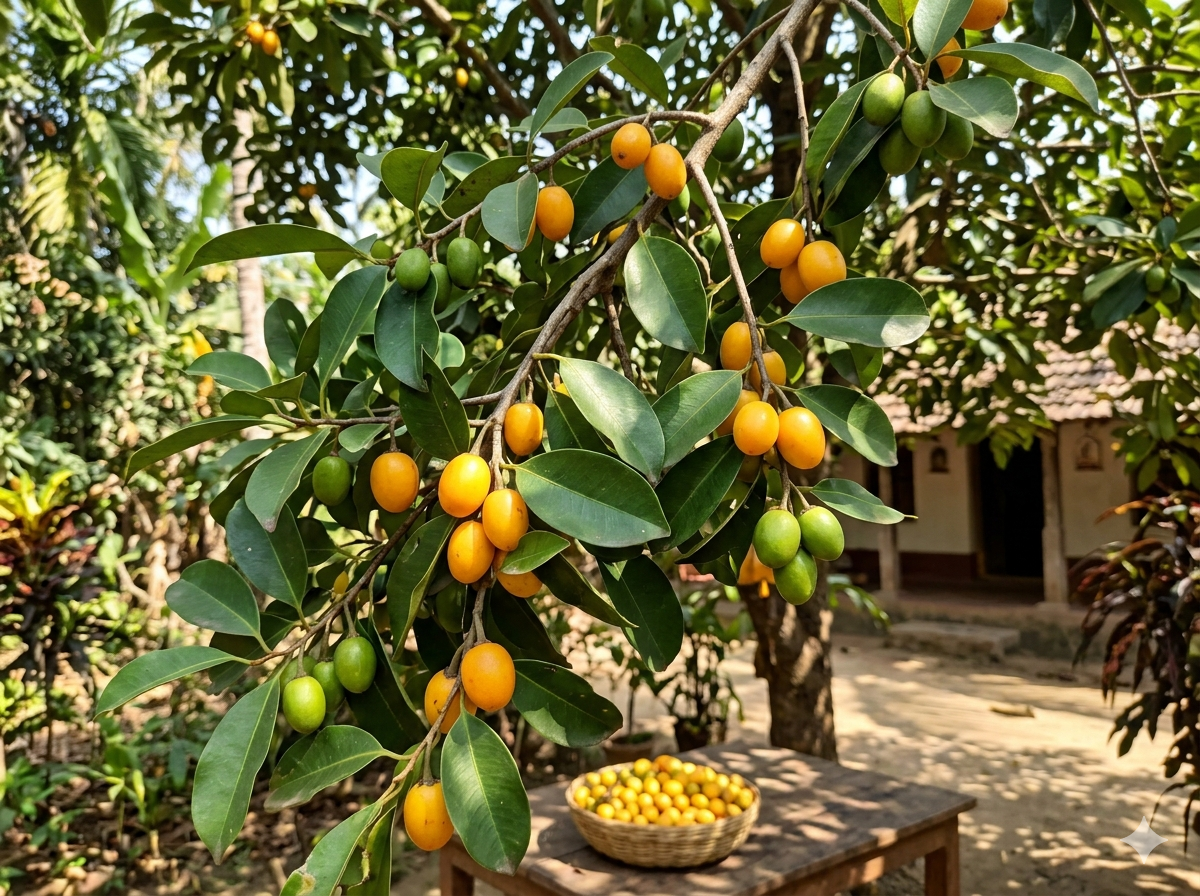
खिरनी — India का SWEETEST WILD FRUIT (caramel-honey flavor ANY cultivated से more intense!)। Chiku जैसा family (Sapotaceae) — milky latex identifier। Anti-diabetic bark confirmed। India के HARDEST woods में। 200-500+ year trees। FORGOTTEN SUPERFRUIT huge urban market potential।
Khirni (Manilkara hexandra) — Khirni / Rayan / Khirna / Rayan / Malkangni (some regions) — is one of India's most beloved and underappreciated native fruit trees, producing small (1-2cm) oval yellow fruits that are extraordinarily sweet — often described as having a concentrated caramel-honey sweetness more intense than any cultivated fruit. The Khirni tree is native to the Indian subcontinent and found naturally across peninsular India from Rajasthan and Gujarat through Maharashtra, Madhya Pradesh, and the Deccan plateau. The tree is in the same family (Sapotaceae) as Chiku (Sapodilla) and shares the milky latex and delicious fruit characteristics of that family. Despite producing one of the sweetest fruits in India, Khirni is almost entirely absent from commercial horticulture and markets — it is a forest tree whose fruits are enjoyed by forest communities, wildlife, and those lucky enough to encounter it. The tree is also commercially significant for its extremely hard, durable wood (one of India's hardest woods, used for agricultural implements and construction), significant bark medicinal properties (anti-diabetic activity confirmed), and the tree forms an important part of dry deciduous forest ecology across Central India. Khirni fruits are a beloved seasonal childhood memory for generations in Rajasthan, MP, and Maharashtra — the small sweet yellow fruits have intense emotional and cultural resonance as a "forgotten fruit" that deserves revival.
Khirni (Manilkara hexandra) — खिरनी / रायण / खिरना — India के most beloved + underappreciated native fruit trees में। Small (1-2cm) oval yellow fruits — extraordinarily sweet (concentrated caramel-honey sweetness)। Peninsular India native — Rajasthan, Gujarat, Maharashtra, MP, Deccan plateau। Sapotaceae family — Chiku (Sapodilla) जैसा family। Milky latex + delicious fruits। Commercial horticulture में almost entirely absent — forest tree। Forest communities, wildlife, lucky visitors enjoy। Extremely hard durable wood (India's hardest में)। Bark: anti-diabetic confirmed। Dry deciduous forest ecology important। Rajasthan, MP, Maharashtra में generations की beloved seasonal childhood memory — "forgotten fruit" revival deserves।
🌳 Overview & Quick Facts / परिचय और मुख्य तथ्य
| 🔬 Scientific Name | Manilkara hexandra — Family: Sapotaceae (same as Chiku/Sapodilla) |
| 📏 Height / ऊंचाई | 10–20 metres | Dense spreading crown | Slow-growing massive old trees |
| ⏳ Lifespan / आयु | 200–500+ years | Ancient trees documented | Deeply rooted native |
| 📈 Growth Rate / वृद्धि दर | Slow — 0.5–1.5 ft/year | Slow but extraordinarily long-lived and productive |
| 🍊 Fruit / फल | April–June — small (1-2cm) oval yellow-orange. INTENSELY SWEET — caramel-honey flavor! / April-June — INTENSELY SWEET caramel-honey! |
| 🌡️ Climate / जलवायु | Tropical dry to semi-arid. Rajasthan, Gujarat, MP, Maharashtra, AP primary. Drought tolerant. |
| ⚖️ Legal Status / कानूनी | Native. Not protected. Freely planted. Freely traded (minimal commercial market). FRA 2006 forest fruit collection rights. |
| 💰 Value / मूल्य | Fruits: Rs.20–60/kg (very limited market) | Wood: Rs.800-1,800/cubic ft | Bark: Rs.15-25/kg | Ornamental: medium |
🌿 Parts & Their Uses — हर अंग का उपयोग
THE defining value। Small (1-2cm), oval, yellow-orange ripe। Flesh: sweet, creamy, concentrated caramel-honey — cultivated fruit से more intensely sweet। Unripe milky latex (Chiku जैसा)। Fresh eat। April-June season। Wildlife: monkeys, bears, birds enthusiastically। Market: very limited (Rs.20-60/kg local forest markets)। Opportunity: "forest honey fruit" premium branded — urban health food potential।
India के hardest woods में — Teak जैसा या harder Janka। Dense, durable, fine-grained। Agricultural implements (handles, plough), construction (beams, pillars), furniture, railway sleepers (historical)। Insects + decay resistant। Market: Rs.800-1,800/cubic foot। FD transit permit। Commercially not widely — forest tree।
Anti-diabetic activity confirmed (blood glucose reduce research)। Anti-inflammatory, astringent। Bark decoction: fever, diarrhea, skin diseases। Tannins, saponins, glycosides। MFP: Rs.15-25/kg। Bark paste: wounds, burns। Pharmaceutical research interest anti-diabetic। Traditional Ayurvedic: diabetes formulations।
Small white fragrant (Feb-April) — excellent honey source। Rajasthan + MP forests में most important pre-monsoon honey trees। Migratory beekeepers premium collection। Khirni honey: mild golden, distinctive subtle caramel notes। Market: Rs.350-600/kg। Not widely known — market development opportunity।
Milky white latex bark cuts से। Chiku latex जैसा same family। Traditional: adhesive। Research: rubber-like compounds (not commercially exploited)। Traditional: skin conditions applied। Sapotaceae family characteristic। Branch cut → milky latex = immediate Sapotaceae identifier (Khirni + Chiku + Mahua relatives)।
Dark green, glossy, oval — ornamental। Most conditions में evergreen। Dense canopy excellent shade। Traditional cattle fodder (limited palatability)। Leaf litter: slowly decomposes — long-lasting mulch। Dense evergreen canopy = best shade trees hot dry conditions। Rajasthan farmers: fields में large Khirni = cattle summer shade prize।
🌍 India's Forgotten Sweet Fruit & Premium Wood / India's Forgotten Fruit और Premium Wood
🌱 Growing Guide / खिरनी कैसे उगाएं
| Parameter | English | Hindi / हिंदी |
|---|---|---|
| 🌱 Propagation | Seeds from ripe fruits (remove flesh, sow fresh). Germination 3-6 weeks. Grafting/budding from productive trees — for true-to-type faster fruiting. Seed-grown: first fruit Year 10-15. Grafted: Year 4-6. | Ripe fruits से seeds (flesh remove, fresh sow)। 3-6 weeks germination। Grafting/budding productive trees से — true-to-type faster fruiting। Seed-grown: Year 10-15। Grafted: Year 4-6। |
| 🌡️ Climate + Soil | Tropical dry. Rajasthan, Gujarat, MP, Maharashtra, AP. Very drought tolerant. Rocky, sandy, poor soils — thrives. pH 6.0-9.0. NOT for waterlogged or very humid coastal. | Tropical dry। Rajasthan, Gujarat, MP, MH, AP। Very drought tolerant। Rocky, sandy, poor soils — thrives। pH 6.0-9.0। Waterlogged या very humid coastal: NOT। |
| ⏳ Patience | Very slow-growing but extraordinarily long-lived. Think of Khirni as a generational investment — trees planted today will feed grandchildren and great-grandchildren for 200+ years. Worth every year of waiting. | Very slow-growing but extraordinarily long-lived। Generational investment के रूप में सोचें — today planted trees = grandchildren + great-grandchildren 200+ years feed। Every year of waiting worth it। |
| 💰 Revival opportunity | Khirni fruits are completely unknown in urban India despite extraordinary flavor. Opportunity: graft improved varieties, establish orchards near cities, market as "Himalayan honey fruit" or "India's sweetest wild fruit." Urban food market + health food market potential is significant. | Urban India में Khirni fruits completely unknown। Extraordinary flavor के बावजूद। Opportunity: improved varieties graft, cities के near orchards establish, "India's sweetest wild fruit" market। Urban food + health food market significant potential। |
| 🌿 Companion planting | Excellent field boundary or agroforestry tree for dry Rajasthan/MP. Shade + fruit + honey + bark medicine simultaneously. Combined with Khejri: the perfect dry zone agroforestry duo — both native, both drought-tolerant, both multiple-use. | Dry Rajasthan/MP के लिए excellent field boundary या agroforestry। Shade + fruit + honey + bark medicine simultaneously। Khejri के साथ combined: perfect dry zone agroforestry duo — both native, drought-tolerant, multiple-use। |
| 💰 Income model | Mature tree (25yr+): 20-40 kg × Rs.40 = Rs.800-1,600/tree/year। Plus honey। Plus livestock shade Rs.500/tree। Plus 200 years production। Net present value: immeasurable। |
💰 Market Value & Legal Status / बाज़ार मूल्य और कानूनी स्थिति
| 🍊 Fresh fruits | Rs.20–60/kg | Very limited local forest market | Freely collected own trees. FRA 2006 forest rights. No commercial restrictions. |
| 🪵 Timber | Rs.800–1,800/cubic foot | Very hard premium wood | FD transit permit. Slow to mature — protect existing trees. |
| 🟫 Bark | Rs.15–25/kg anti-diabetic research demand | Own trees sustainably. FRA 2006 forest areas. |
| 🍯 Honey | Rs.350–600/kg Khirni forest honey | Freely traded / freely |
Khirni sweetness: Sapotaceae family — world's sweetest fruits (Chiku, Mamey Sapote, Canistel)। Highly concentrated fructose-glucose-sucrose evolution। Khirni: very small (1-2cm) = sugar-containing flesh to total weight ratio high। Flavor compounds: primarily fructose (sweetest natural sugar) + aromatic compounds (sesquiterpenes, esters) = distinctive caramel-vanilla-honey notes। Only fully ripe on tree develop — unripe: latex taste। Comparison: Chiku 15-20% total sugars। Khirni 18-25% (some analyses) — often sweeter per gram। "Caramel" note: Maillard-like reactions concentrating sugars, hot pre-monsoon sun (April-June) में ripen। Rajasthan + MP pre-monsoon heat = sugars concentrate + complex flavors develop। Small size = concentrated flavor: small fruit में large fruit का sugar + flavor। 10-15 Khirni = intense experience। Ripening: tree से fallen when perfectly ripe (Mahua जैसा)। Fallen collect = best flavor। Tree-picked early = noticeably less sweet।
Khirni commercial revival: India's greatest undiscovered food treasure। Extraordinary flavor + nutritional value (high sugars, Vitamin C, anti-oxidants) + cultural resonance = modern markets में completely absent। Why not commercial: (1) Slow-growing (10-15 years fruit)। (2) Small fruit — labor-intensive harvest। (3) Short shelf life fully ripe (1-2 days)। (4) No organized supply chain। Revival strategy: (1) Grafted plants: ICAR-CISH Lucknow + similar institutes। High-producing wild trees से grafted varieties। 10-15 years → 4-6 years — CRITICAL first step। (2) Value-added: jam/jelly, squash, dry fruit/candy, wine — shelf life extend + urban distribution। (3) Premium positioning: "India's lost superfruit" या "Forest honey fruit।" Extreme sweetness + wild/indigenous origin। Health-conscious urban Rs.200-400/kg। (4) Social media + food influencer: genuinely extraordinary flavor — food bloggers + chefs taste करके invariably surprised + enthusiastic। Urban foodie + nostalgia = powerful combination। (5) Farmers' market: April-June season। Premium urban Rs.100-200/kg। Forest communities income। Actions: trees हैं → document + photograph + markets seek। Entrepreneur: pilot value-added। ICAR near: grafted variety development approach।
Khirni identification: Leaves: oblong to elliptic (5-15cm), dark green, glossy, leathery। Branch tips पर clustered (fasciculate — Sapotaceae characteristic)। Thick stiff। Latex: SMALL BRANCH/LEAF STEM CUT — milky white latex immediately। Most immediate identifier। Milky white sap = Sapotaceae। No other family: milky latex + fleshy sweet fruit + clustered leaves combination। Bark: dark grey-brown, roughly furrowed old trees। Lenticels visible। Fruits: small (1-2cm) oval। Unripe: green hard latex-filled। Ripe: yellow-orange to red-brown। Leaf clusters में। Taste test: ripe fallen fruit = intensely sweet caramel, no bitterness = Khirni। Any bitterness = unripe या different species। Seeds: large (1cm+) shiny dark brown, 1-3 per fruit। Wood: cut branch = extremely hard, dense, fine-grained, yellowish-brown। Tool blunts quickly। Habitat: dry deciduous forests, rocky hillsides, field boundaries Rajasthan, Gujarat, MP, MH। Rocky outcrops। Confusion: Manilkara zapota (Chiku) — same family, larger fruits (4-8cm), elongated, rough-skinned। Both milky latex। Chiku cultivated, Khirni wild। Simple ID: dry deciduous/field boundary + large leathery clustered leaves + milky white latex from cuts + small oval sweet yellow fruits (April-June) = Khirni high confidence।
Khirni bark anti-diabetic: Traditional use Rajasthan, MP, Gujarat। Modern research validating। Active compounds: triterpenes (lupeol, beta-sitosterol), saponins, tannins, flavonoids। Anti-diabetic: (1) Lupeol: pentacyclic triterpene। Animal studies: blood glucose reduce, insulin sensitivity improve (metformin जैसा mechanism)। Anti-inflammatory confirmed — Type 2 diabetes pathology relevant। (2) Beta-sitosterol: phytosterol। Glucose absorption from intestine reduce + pancreatic beta cells insulin release improve। (3) Saponins: glucose absorption inhibit intestine (acarbose mechanism similar)। Research: multiple Indian pharmaceutical + botanical institutions (CSIR, ICMR-affiliated)। Diabetic animal models में significant blood glucose reduction। Some studies: 30-40% fasting blood glucose reduction। Traditional: 10g dried bark + 400ml → 200ml। 100ml 2x daily empty stomach। Rajasthan rural communities traditional dose। Caution: primarily animal studies। Human clinical trials limited। Doctor guidance। Prescribed medications REPLACE NOT। Blood glucose carefully monitor — additive hypoglycemic possible। Not for: pregnant, children, severe kidney/liver।
Khirni vs Chiku: Same genus (Manilkara) + same family (Sapotaceae) — botanical cousins। Shared: (1) Milky white latex any cut। (2) Fleshy sweet fruits brown/yellow-brown skin। (3) Large shiny brown seeds। (4) Dense hard wood। (5) Leathery clustered leaves। (6) Tropical origin। Differences: Khirni (M. hexandra): native India। Wild, undomesticated। Very small (1-2cm)। Yellow-orange ripe। Intensely sweet concentrated। Very slow growth। Extremely hardy dry। Wood very hard। Chiku/Sapodilla (M. zapota): Mexico/Central America native — India introduced। Cultivated commercial। Larger (4-8cm)। Brown rough skin ripe। Creamy-brown flesh। Sweet but less concentrated। Faster growth cultivation। Irrigation requires। Origin: Chiku = Portuguese colonial era introduced। Khirni = India forests में millions of years — native। Introduced species commercially developed, native species ignored — interesting reversal। Taste: side by side: Chiku = creamy brown texture, caramel-brown moderate sweetness। Khirni = yellow firm, intense caramel-honey, concentrated। Most people: Khirni = sweeter + more intensely flavored। Commercial neglect puzzling। Genetic diversity: wild Khirni = significant natural variation fruit size, sweetness, productivity = raw material improved cultivated varieties। Wild Khirni preserve = genetic diversity preserve।