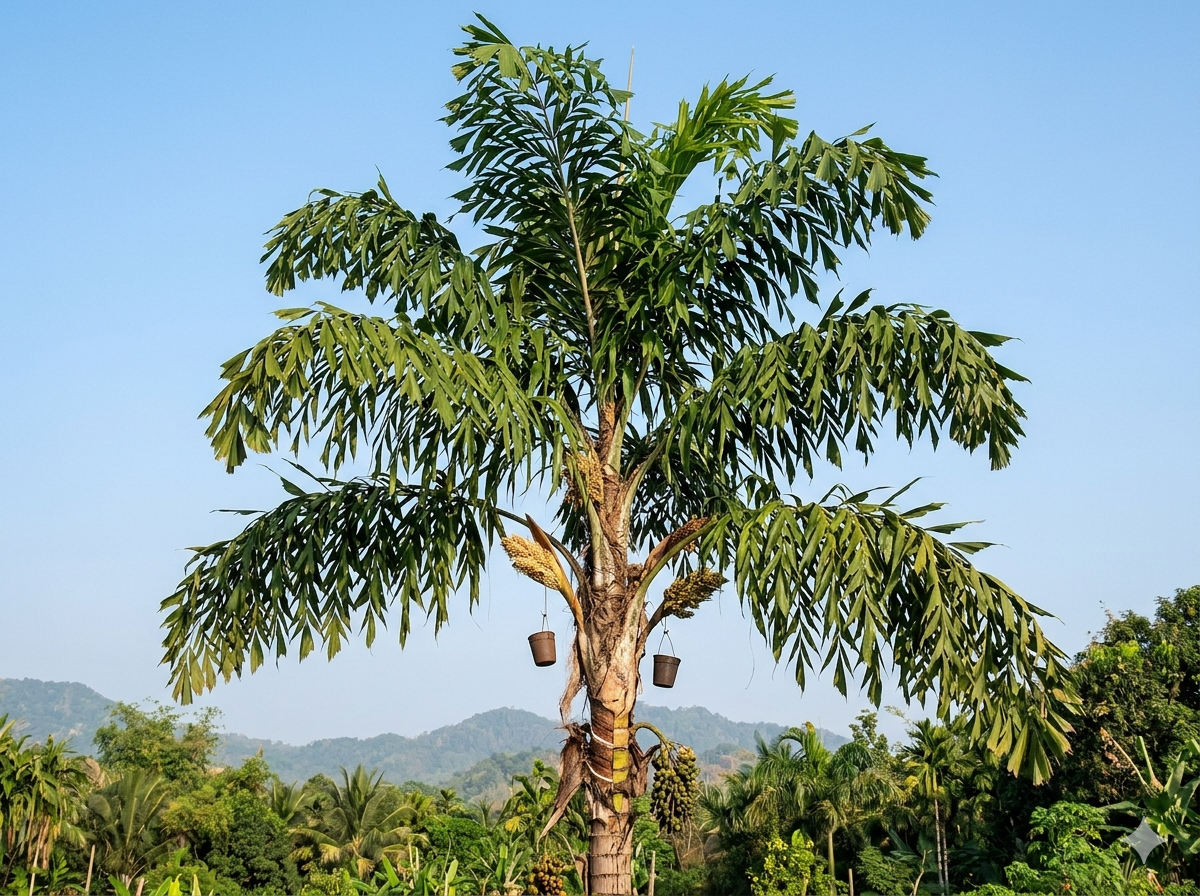
Fishtail Palm Caryota urens Bipinnate Leaf Kerala Toddy — PlantCare
📷 PlantCare
🌴 Palms & Himalayan Trees

Fishtail Palm / Wine Palm / Toddy Palm फिशटेल पाम / टोड्डी पाम / मारी

Caryota urens Family: Arecaceae (Palm family) | NATIVE Indian subcontinent

Fishtail Palm — world's only monocot with BIPINNATE leaves (fish-tail leaflets = unique!). Kerala best quality toddy: Rs.30,000-60,000/tree/year. ⚠️ Orange-red fruits DANGEROUSLY TOXIC (raphides → throat swelling emergency). MONOCARPIC (top→bottom 2-4 years). Plan succession planting!

📏 10–20 metres | Monocarpic! | World's only monocot with bipinnate leaves ⏳ 20–40 years before flowering + death | MONOCARPIC — plan succession! 📈 Moderate — 2–3 ft/year | Monocarpic TOP-TO-BOTTOM 2-4 years 📍 Tropical humid — Western Ghats (Kerala, Karnataka, TN), Eastern Ghats, NE India. ⚠️ Native. Not protected. Freely planted. Sap own trees freely. Toddy: state excise license. 💰 Not timber — sap + fiber primary. Sap: Rs.30,000-60,000/tree/year prime tapping.
📤 WhatsApp
Fishtail Palm Bipinnate Fish-Tail World Only Monocot Kerala Toddy Best Quality Rs30k-60k ORANGE-RED FRUITS DANGEROUSLY TOXIC WARNING Monocarpic Top-Bottom 2-4 Years Succession Kitul Fiber Rs20-40 Palm Jaggery Karupati Rs80-200 Raphides Calcium Oxalate Emergency

Fishtail Palm — world's only monocot BIPINNATE leaves (fish-tail unique!)। Kerala best quality toddy: Rs.30,000-60,000/tree/year। ⚠️ Orange-red fruits DANGEROUSLY TOXIC (raphides → throat swelling emergency)। MONOCARPIC (top→bottom 2-4 years)। Succession plan करें!

Fishtail Palm (Caryota urens) — Fishtail Palm / Wine Palm / Toddy Palm / Kitul Palm / Sago Palm / Jaggery Palm / Mari / Kittal — is one of India's most economically important and botanically distinctive native palms, found naturally in the forests of the Western Ghats, Eastern Ghats, and moist areas of South India and Northeast India. The tree's name comes from its extraordinary leaves — each leaflet has a ragged, bipinnate triangular form that looks exactly like the tail of a fish. This unique bipinnate leaf structure (twice-compound — the only monocot with this leaf type) makes Fishtail Palm instantly identifiable. The tree is critically important for multiple reasons: the sap produces one of the best quality palm wines and jaggery (the famous "toddy" of Kerala and Karnataka); the pith yields edible sago starch; the tree is monocarpic (dies after flowering once in its lifetime — a single spectacular event lasting 2-4 years from top to bottom); and it produces abundant fiber. The Fishtail Palm's sap contains raphides (calcium oxalate crystals) that cause intense skin and throat irritation — making the raw sap toxic but the processed products (jaggery, toddy, vinegar) safe after processing removes these. In Kerala, the Fishtail Palm's toddy industry is one of the most culturally significant and economically important cottage industries.

Fishtail Palm (Caryota urens) — फिशटेल पाम / Toddy Palm / Mari / Kittal — India का most economically important + botanically distinctive native palm। Western Ghats, Eastern Ghats, South India + NE India के moist forests में naturally। Leaves: each leaflet ragged bipinnate triangular = fish tail जैसा। Unique bipinnate leaf (twice-compound — only monocot with this leaf type)। Instantly identifiable। Critically important: sap = best quality palm wine + jaggery (Kerala + Karnataka famous "toddy"); pith = edible sago starch; MONOCARPIC (lifetime में once flower then die — 2-4 years spectacular top-to-bottom event); abundant fiber। Raw sap: raphides (calcium oxalate crystals) = skin + throat irritation — TOXIC but processed products (jaggery, toddy, vinegar) = safe। Kerala: toddy industry = most culturally significant + economically important cottage industries।

🌴 Overview & Quick Facts / परिचय और मुख्य तथ्य

🔬 Scientific NameCaryota urens — Family: Arecaceae | NATIVE Indian subcontinent
⚠️ MONOCARPICDies after flowering ONCE — but flowering takes 2-4 years (top to bottom). Plan succession planting!
📏 Height / ऊंचाई10–20 metres | Stout trunk | Distinctive fish-tail leaflets
Lifespan / आयु20–40 years before flowering + death | Produces suckers for succession
🍶 Sap Value3-5 litres sweet sap/day | Best quality toddy/jaggery palm in India | Rs.30-80/litre fresh neera
🌡️ Climate / जलवायुTropical humid — Western Ghats (Kerala, Karnataka, TN), Eastern Ghats, NE India. 1,500-3,000mm rainfall.
⚖️ Legal Status / कानूनीNative. Not specially protected. Sap tapping freely from own trees. Toddy: state excise license. Freely planted.
💰 Value / मूल्यFresh neera: Rs.30–80/litre | Jaggery: Rs.80-200/kg | Toddy wine: Rs.30-80/litre | Fiber: Rs.20-40/kg

🌿 Parts & Their Uses — हर अंग का उपयोग

🍶
Sap / रस (Neera + Toddy + Jaggery)
PRIMARY economic value. Tapping: cut the inflorescence stalk, collect sweet sap. 3-5 litres/day. Fresh (neera): sweet, nutritious. Fermented 6-8 hours: toddy/kallu — mildly alcoholic, traditional Kerala. Fermented more: wine. Boiled concentrated: palm jaggery (karupati) — Kerala's prized natural sweetener. Vinegar: further fermentation. Market: neera Rs.30-80/litre. Jaggery Rs.80-200/kg. One tree: Rs.30,000-60,000/year income in prime tapping phase.

PRIMARY economic। Tapping: inflorescence stalk cut, sweet sap collect। 3-5 litres/day। Fresh neera: sweet, nutritious। 6-8 hours ferment: toddy/kallu — mildly alcoholic, Kerala traditional। More ferment: wine। Boil concentrated: palm jaggery (karupati) — Kerala's prized sweetener। Vinegar: further ferment। Market: neera Rs.30-80/litre। Jaggery Rs.80-200/kg। One tree: Rs.30,000-60,000/year prime tapping।
🌿
Leaves / पत्ते (Fish-Tail Ornamental)
Unique bipinnate leaves with ragged fish-tail leaflets — THE most distinctive palm leaf in India. Ornamental: highly prized for tropical garden aesthetics. Young leaves: traditional thatching material for temporary structures. Leaf midrib: fiber source. Leaflet edges: sharp, serrated — handle with gloves. The extraordinary leaf architecture makes Fishtail Palm one of the most photographed palms in Indian botanical gardens.

Unique bipinnate fish-tail leaflets — THE most distinctive palm leaf India में। Ornamental: tropical garden aesthetics highly prized। Young leaves: traditional thatching temporary structures। Leaf midrib: fiber source। Leaflet edges: sharp, serrated — gloves handle। Extraordinary leaf architecture = Indian botanical gardens में most photographed palms।
🌾
Sago / साबूदाना
Pith of trunk contains edible sago starch — similar to Sago Palm (Metroxylon sagu). Harvested from trunks of trees that have begun their flowering process. Processing: trunk cut open, pith extracted, starch washed out, dried. Traditional food in some South Indian and Northeast Indian tribal communities. Not commercially significant in India — Cycas and Tapioca are more common Indian sago sources. Nutritional: primarily starch, low protein.

Trunk pith = edible sago starch — Sago Palm जैसा। Flowering process begin trees से harvest। Processing: trunk cut, pith extract, starch wash + dry। South Indian + NE Indian tribal communities traditional food। India में commercially significant नहीं — Cycas + Tapioca more common। Primarily starch, low protein।
🧵
Fiber / रेशा
Stem fiber (kitul fiber): very strong black fiber extracted from leaf base sheaths. Uses: weaving, rope making, brooms, brushes. Sri Lanka: kitul fiber from Caryota urens is important traditional craft material. Karnataka, Kerala: limited but traditional use. Market: Rs.20-40/kg raw fiber. Processed fiber products: Rs.100-300/kg craft goods. Broom making: important traditional use in South India — kitul fiber brooms durable, valued.

Stem fiber (kitul fiber): very strong black fiber leaf base sheaths से extract। Weaving, rope, brooms, brushes। Sri Lanka: important traditional craft। Karnataka, Kerala: limited traditional use। Market: Rs.20-40/kg raw। Processed craft goods Rs.100-300/kg। Broom making: South India traditional — kitul fiber brooms durable, valued।
💀
Monocarpic Death / एकबार फूल = मृत्यु
UNIQUE property. Fishtail Palm is monocarpic — flowers once in entire lifetime then dies. Flowering starts at TOP and progresses DOWN over 2-4 years. During this period: enormous quantities of seeds produced. After lowest inflorescence fruits ripen: tree dies completely. Management: plant succession from offshoots (produced in first 15 years). Never clear all trees simultaneously — stagger ages for continuous sap supply. This lifecycle is spectacular to witness.

UNIQUE property। Monocarpic — entire lifetime में once flower then die। TOP से DOWN progresses 2-4 years। Period में: enormous seeds produce। Lowest inflorescence fruits ripen → tree completely die। Management: offshoots से succession plant (first 15 years produced)। Never all trees simultaneously clear — stagger ages continuous sap। This lifecycle spectacular to witness।
⚠️
Raphides Toxicity / राफाइड्स विषाक्तता
⚠️ IMPORTANT: All fresh raw parts of Fishtail Palm contain calcium oxalate raphides — needle-like crystals that cause intense burning, irritation and swelling of mouth, throat, and skin on contact. NEVER eat raw fruit, sap, or plant parts. Processing (boiling, fermentation, drying) neutralizes raphides. Fruits: bright orange-red when ripe, attractive-looking but DANGEROUSLY TOXIC — keep children away. Raphide contact: wash affected area with cold water immediately. Seek medical attention for throat swelling.

⚠️ IMPORTANT: All fresh raw parts = calcium oxalate raphides। Intense burning, irritation, swelling mouth, throat, skin। NEVER raw fruit, sap, plant parts eat। Processing (boiling, fermentation, drying) = raphides neutralize। Fruits: bright orange-red, attractive-looking but DANGEROUSLY TOXIC — children away। Contact: cold water wash immediately। Throat swelling: medical attention।

🌍 Kerala Toddy Industry & Monocarpic Wonder / Kerala Toddy और Monocarpic Wonder

⚡ Key Facts / मुख्य तथ्य
🍶 Best Toddy
Best quality toddy + jaggery in India. Rs.30,000-60,000/tree/year prime tapping. Kerala cottage industry.
India का best quality toddy + jaggery। Rs.30,000-60,000/tree/year prime tapping। Kerala cottage industry।
🐠 Fish-Tail Leaf
World's only monocot with bipinnate (twice-compound) leaves. Fish-tail leaflets — instantly recognizable globally.
World का only monocot bipinnate (twice-compound) leaves। Fish-tail leaflets — globally instantly recognizable।
💀 Monocarpic
Flowers ONCE then dies — top to bottom over 2-4 years. Plan succession! Plant offshoots early.
ONCE flower फिर die — top to bottom 2-4 years। Succession plan! Offshoots early plant।
⚠️ Toxic Raw
ALL raw parts toxic (calcium oxalate raphides). Fruits especially dangerous — attractive but TOXIC. Keep children away.
ALL raw parts toxic (calcium oxalate raphides)। Fruits especially dangerous। Children away।
🌾 Sago
Pith yields edible sago starch. Traditional tribal food source South India + NE India.
Pith = edible sago starch। South India + NE India traditional tribal food।
🧵 Kitul Fiber
Strong black kitul fiber from leaf sheaths. Brooms, rope, craft. Sri Lanka important traditional material.
Strong black kitul fiber leaf sheaths से। Brooms, rope, craft। Sri Lanka important traditional।

🌱 Growing Guide / Fishtail Palm कैसे उगाएं

CRITICAL: plant new offshoots every 5-7 years to ensure continuous sap supply. When main tree begins flowering (top inflorescences appear): already have 3-4 year old replacement trees growing. Never let all trees be same age.Tapping starts when inflorescence stalks emerge (Year 15-20). Cut the stalk tip, collect sap twice daily (dawn + evening). Bandage cut between collections. One inflorescence: 3-5 litres/day for 3-6 months. Process to neera/jaggery immediately. Toddy: state excise license needed.Orange-red ripe fruits are DANGEROUSLY TOXIC (raphides). Remove or fence off fruiting trees near children's areas. Fallen fruits: collect and bury. Do not leave on ground accessible to children or animals.1 prime tapping tree (Year 15-25): 4 litres neera/day × 180 days × Rs.50 = Rs.36,000/year. Or convert to jaggery: 4 litres/day → 400g jaggery × 180 days = 72 kg × Rs.150 = Rs.10,800. Fresh neera sale = higher income than jaggery making.
ParameterEnglishHindi / हिंदी
🌱 PropagationSeeds from ripe fruits OR basal suckers (offshoots from base — critical for succession planting). Seeds: remove outer pulp carefully (wear gloves — raphides!). Germination 2-4 months. Offshoots: detach when 50-80cm tall, root easily.Ripe fruits से seeds OR basal suckers (offshoots base से — succession के लिए critical)। Seeds: outer pulp carefully remove (gloves — raphides!)। 2-4 months germination। Offshoots: 50-80cm tall पर detach, easily root।
🌡️ ClimateTropical humid — Western Ghats (Kerala, Karnataka, TN), Eastern Ghats, NE India. 1,500-3,000mm rainfall essential. NOT for dry areas, cold, or frost. Partial shade tolerant (understory in nature).Tropical humid — Western Ghats, Eastern Ghats, NE India। 1,500-3,000mm essential। Dry areas, cold, frost: NOT। Partial shade tolerant (nature में understory)।
Plan successionCRITICAL: every 5-7 years new offshoots plant continuous sap ensure। Main tree top पर inflorescences appear = already 3-4 year replacement trees growing। Never all trees same age।
🍶 Sap tappingTapping: inflorescence stalks emerge (Year 15-20)। Stalk tip cut, twice daily collect (dawn + evening)। Between collections bandage cut। 1 inflorescence: 3-5 litres/day, 3-6 months। Immediately neera/jaggery process। Toddy: state excise license।
⚠️ Raw fruit warningOrange-red ripe fruits DANGEROUSLY TOXIC। Children के पास fruiting trees remove या fence। Fallen fruits: collect + bury। Ground पर accessible to children/animals mat छोड़ें।
💰 Income1 prime tapping tree: 4 litres × 180 days × Rs.50 = Rs.36,000/year। Ya jaggery: 72 kg × Rs.150 = Rs.10,800। Fresh neera = jaggery making से higher income।

💰 Market Value & Legal Status / बाज़ार मूल्य और कानूनी स्थिति

🍶 Fresh NeeraRs.30–80/litre | Rs.36,000/tree/yearFSSAI food license for commercial sale. Own use freely.
🍯 Palm Jaggery (Karupati)Rs.80–200/kg | Kerala premium productFSSAI food license commercial. Freely home.
🍷 Toddy/KalluRs.30–80/litre | Kerala traditionalState excise license required. State-specific rules vary significantly.
🧵 Kitul fiberRs.20–40/kg raw | Craft products Rs.100-300/kgOwn trees freely / freely
❓ Frequently Asked Questions / अक्सर पूछे जाने वाले सवाल
Fishtail Palm and Kerala toddy — the cultural connection: Kerala has one of India's most culturally embedded toddy (kallu) traditions — the local palm wine is part of the social and culinary fabric of Keralite life. While Coconut Palm (Cocos nucifera) toddy is the most common, Fishtail Palm (Caryota urens) toddy is considered the finest quality. The sap: Fishtail Palm sap (called "eerani" or "kithul neera" in Malayalam) is naturally sweeter and has higher sugar content than coconut palm sap. When freshly tapped in the morning and evening, it is a delicious sweet health drink. When left to ferment naturally for 6-8 hours (the time between morning and evening tapping): it becomes mildly alcoholic "toddy" (kallu). Traditional toddy production: toddy-tapping is a skilled traditional occupation in Kerala. Toddy tappers (toddy tapper caste — "Ezhava" traditional occupation) climb the tall Fishtail Palms morning and evening, collect the accumulated sap from yesterday's evening and fresh morning sap. The morning collection is fresh neera (sweet, unfermented). The evening collection of morning-collected sap has fermented to light toddy. Toddy shops (kallu shaap): licensed establishments in Kerala that sell toddy — one of the most distinctive cultural experiences in Kerala. Toddy is served with traditional Kerala snacks. The quality hierarchy: Fishtail Palm toddy > Coconut Palm toddy > Date Palm toddy in quality of flavor. Fishtail Palm toddy: complex, slightly spicy, more complex aromatics. Coconut Palm toddy: milder, simpler. Economic importance: hundreds of thousands of families in Kerala depend on the toddy industry — tappers, toddy shop owners, associated food vendors. State excise: Kerala government licenses and regulates toddy production and sale — licenses are required, quality is controlled. The Kerala toddy industry generates hundreds of crore rupees annually in state excise revenue.

Fishtail Palm + Kerala toddy: Kerala = most culturally embedded toddy tradition। Part of Keralite social + culinary fabric। Coconut Palm = most common but Fishtail Palm = finest quality। Sap ("eerani/kithul neera"): naturally sweeter, higher sugar। Fresh morning/evening = sweet health drink। 6-8 hours natural ferment = mildly alcoholic toddy (kallu)। Traditional production: skilled occupation। Toddy tappers (Ezhava traditional) morning + evening climb। Yesterday's evening + fresh morning sap collect। Morning collection = fresh neera (sweet, unfermented)। Evening collection of morning sap = light toddy। Toddy shops (kallu shaap): licensed establishments। Traditional Kerala snacks के साथ serve। Quality hierarchy: Fishtail > Coconut > Date Palm। Fishtail: complex, slightly spicy। Coconut: milder, simpler। Economic: hundreds of thousands families — tappers, shop owners, food vendors। State excise: Kerala licensed + regulated। Licenses required, quality controlled। Hundreds of crore excise revenue annually।
Monocarpic palms — the once-in-a-lifetime flowering: Monocarpic means "once-fruiting" — the plant flowers and fruits once, then dies. This seems unusual but is actually a coherent evolutionary strategy, particularly for plants in resource-limited environments. Fishtail Palm lifecycle: Juvenile phase (Year 1-15): vegetative growth. The palm grows tall, produces many large leaves, and develops a substantial trunk with stored resources (starch, water). Trunk growth phase (Year 15-25): continues growing taller. If conditions allow: produces basal offshoots (2-5 per tree) during this phase. Critical: save at least 2-3 offshoots for succession. Flowering initiation: when the palm has accumulated sufficient resources, flowering begins — at the TOP of the crown. The topmost inflorescence appears and begins producing flowers (tiny, in masses). Flowering descent (Years 1-4 of flowering): after the top inflorescence, the next lower one emerges, then the next... flowering proceeds from TOP to BOTTOM over 2-4 years. During this: the palm is still alive, still photosynthesizing. Enormous quantities of fruit are produced — a single Fishtail Palm can produce millions of seeds during its flowering phase. Final fruiting: when the LOWEST (oldest) inflorescence's fruits finally ripen: the tree's life cycle is complete. The palm dies. The massive seed production ensures at least some seeds germinate and establish new plants. Why monocarpic: evolutionary rationale: a massive single terminal reproductive event puts ALL available resources into reproduction simultaneously — producing millions of seeds gives a higher chance of establishing many offspring than smaller annual reproductions. This is sometimes called the "big bang" reproductive strategy. Management implication: you cannot reverse monocarpy — once a Fishtail Palm begins flowering, it WILL die after completing the flowering cycle. There is no way to stop it. This is why succession management (having younger replacement trees ready) is absolutely critical for continuous sap production from a Fishtail Palm grove.

Monocarpic palms: "Once-fruiting" — flowers + fruits once, then die। Coherent evolutionary strategy। Fishtail Palm lifecycle: Juvenile (Year 1-15): vegetative growth। Tall grow, large leaves, substantial trunk (starch, water stored)। Trunk growth (Year 15-25): taller continue। Basal offshoots (2-5/tree) — critical: 2-3 save succession। Flowering initiation: sufficient resources accumulated → TOP crown पर begin। Topmost inflorescence flowers। Flowering descent (1-4 years): top → down progressively। 2-4 years। Palm still alive, photosynthesizing। Enormous fruits — millions of seeds single tree। Final fruiting: lowest (oldest) inflorescence fruits ripen → lifecycle complete → die। Massive seed production = many offspring establish। Why monocarpic: ALL resources simultaneously single terminal reproductive event → millions seeds → higher offspring establishment chance। "Big bang" reproductive strategy। Management: monocarpy = CANNOT reverse। Flowering begin = WILL die after completing। Cannot stop। Succession management (younger replacement trees) ABSOLUTELY CRITICAL continuous sap production।
Palm jaggery (karupati) making from Fishtail Palm: Palm jaggery (called "karupati" in Tamil, "karuppetti" in Malayalam, "bellada panakam" in Kannada) made from Fishtail Palm sap is considered the finest quality palm jaggery in India — darker, richer, more complex flavor than sugarcane jaggery or date palm jaggery. Collection: tap fresh sap (neera) early morning and evening. Collect in clean clay pots or food-grade containers. Use fresh sap within 4-6 hours for jaggery — sap that begins fermenting gives alcoholic off-flavor to jaggery. Processing: pour fresh sap into wide, low, heavy-bottomed vessel (traditionally copper or clay). Begin heating on medium flame. Stir continuously as heating begins — prevent scorching on bottom. Stage 1 (liquid): light boiling. Remove any foam (impurities). Stage 2 (concentration): as sap reduces (1-1.5 hours), color deepens from pale yellow to golden to amber. Consistency thickens. Stage 3 (test): drop a small amount in cold water — if it forms a soft ball = nearly ready. Hard ball = too far (becomes brittle). Careful: transition from perfect to too-cooked is rapid. Stage 4 (setting): pour into greased molds (traditionally coconut shell halves, now aluminum molds). Cool undisturbed for 1-2 hours. Result: dark brown, aromatic, intensely flavored palm jaggery with complex caramel + molasses + slightly earthy notes. Properties vs sugarcane jaggery: higher mineral content (iron, calcium, potassium), lower glycemic index, stronger more complex flavor. Traditional uses: South Indian cooking (sambar, rasam, sweets), Onam/Diwali sweets, health food market. Market: Rs.80-200/kg retail. Specialty health food market: Rs.250-400/kg online. Important: quality depends entirely on sap freshness — any fermented sap gives poor, off-flavor jaggery.

Palm jaggery (karupati) making: "Karupati" Tamil, "karuppetti" Malayalam, "bellada panakam" Kannada। Fishtail Palm = finest quality — darker, richer, complex। Cane jaggery से better। Collection: morning + evening fresh sap (neera)। Clay pots/food-grade। 4-6 hours के within use (fermentation = alcoholic off-flavor)। Processing: wide low heavy-bottomed vessel (copper/clay traditional)। Medium flame। Continuous stir। Stage 1 (liquid): light boiling। Foam remove (impurities)। Stage 2 (concentration): 1-1.5 hours। Pale yellow → golden → amber। Thicken। Stage 3 (test): cold water drop — soft ball = ready। Hard ball = too far। Perfect → too-cooked rapid transition। Stage 4 (setting): greased molds (coconut shell halves/aluminum) pour। 1-2 hours undisturbed cool। Result: dark brown, aromatic, intensely flavored। Caramel + molasses + slightly earthy। Vs sugarcane jaggery: higher minerals (iron, calcium, potassium), lower glycemic index। Uses: South Indian cooking (sambar, rasam), Onam/Diwali sweets, health food। Market: Rs.80-200/kg retail। Specialty online: Rs.250-400/kg। Quality: sap freshness ENTIRELY dependent।
Fishtail Palm identification — the unmistakable leaf: Caryota urens is one of the easiest Indian palms to identify because of its extraordinary leaves — unlike any other palm or tree in India. The distinctive feature: bipinnate (twice-compound) leaves. In all other palms: leaves are either pinnate (feather-shaped, single row of leaflets) or palmate (fan-shaped, spreading from central point). In Fishtail Palm: each primary division of the leaf (pinnae) carries secondary leaflets (pinnules), and each pinnule has a distinctive ragged, triangular shape with an irregular, torn-looking margin — exactly like a fish's tail fin. This bipinnate structure with fish-tail leaflets is unique among all monocots globally. Other identification features: Trunk: stout, fibrous, with visible leaf base scars. Often black fiber visible at old leaf bases. Multiple trunks: in younger plants, often clustering from base with multiple stems. Size: mature trees 10-20m. Fresh fruit: bright orange-red small berries in drooping bunches (TOXIC — do not touch without gloves). Inflorescences: large, drooping, cream-colored when in flower. Stem: within a tree that is beginning its monocarpic flowering (top inflorescences visible): the tree will die. Habitat in India: moist forest understory in Western Ghats, Eastern Ghats, NE India. Can be seen in Kerala, Karnataka, TN hill forests, and in Assam, Meghalaya lowland forests. Gardens: planted as ornamental in botanical gardens and tropical gardens across India. The fish-tail leaflet test: pick up any leaflet from the ground under the tree. Hold it up. Look at the shape — if it's triangular with an irregular torn margin at the broad end = Fishtail Palm. No other Indian tree/palm has this exact leaflet shape.

Fishtail Palm identification: Extraordinary leaves — no other Indian palm/tree जैसा। Distinctive: BIPINNATE (twice-compound) leaves। All other palms = pinnate (feather, single row) या palmate (fan)। Fishtail: each primary division (pinnae) → secondary leaflets (pinnules) → each pinnule: ragged triangular shape, irregular torn-looking margin = fish tail fin EXACTLY। Globally all monocots में unique bipinnate। Other features: Trunk: stout, fibrous, leaf base scars। Old leaf bases पर black fiber visible। Multiple trunks: younger plants clustering। Size: 10-20m mature। Fresh fruits: bright orange-red small berries drooping bunches (TOXIC — gloves बिना touch नहीं)। Inflorescences: large drooping cream-colored। Monocarpic flowering beginning tree: top inflorescences visible = WILL die। Habitat: Western Ghats, Eastern Ghats, NE India moist forest understory। Kerala, Karnataka, TN hill forests। Assam, Meghalaya lowland। Gardens: botanical gardens + tropical gardens India। Fish-tail leaflet test: fallen leaflet pick up → triangular + irregular torn margin broad end = Fishtail Palm। No other Indian tree/palm exact shape।
Fishtail Palm fruit toxicity — the raphide danger: The fruits of Caryota urens (and most Caryota species) are among the most immediately dangerous plant toxins a person can encounter in Indian gardens and forests, because the mechanism of toxicity is physical rather than chemical, and causes intense pain within seconds of contact. The toxin: calcium oxalate crystals called raphides. These are needle-shaped microscopic crystals (10-50 micrometers long) bundled in specialized cells called idioblasts. In the ripe orange-red fruits, the flesh is packed with idioblast cells containing thousands of these crystal needles. What happens on contact: when the fruit is touched, pressed, or bitten: the idioblast cells rupture, releasing bundles of needle crystals at high velocity (the cells are under pressure). These needles penetrate skin, mucous membranes, and soft tissue instantly. Effect: immediate intense burning pain, followed by swelling. In mouth/throat: severe swelling can obstruct breathing (medical emergency). On skin: intense burning, redness, hives-like reaction. In eyes: extremely dangerous — severe inflammation. Why dangerous: (1) The mechanism is instant — within seconds of contact. (2) The attractive bright orange-red color and small grape-like appearance can appeal to children who mistake them for berries. (3) Even touching and then touching eyes/mouth can cause injury. First aid: skin contact: wash immediately with large quantities of cold running water (do not scrub — scrubbing embeds crystals deeper). Take antihistamine. Mouth/throat contact: rinse mouth with cold water (do not swallow). Seek medical attention immediately for any mouth/throat involvement — swelling can escalate to breathing difficulty rapidly. Eyes: rinse with clean water (eye wash station if available), seek immediate ophthalmology/emergency care. Important: do NOT use milk or fatty substances to "neutralize" — this is a physical toxin, not chemical. Only mechanical removal with water helps. Prevention: remove fruiting bunches before fruits ripen if trees are near children's areas. Never plant near children's play areas. Teach children to recognize and avoid ALL Caryota fruits.

Fishtail Palm fruit toxicity: Most immediately dangerous plant toxins Indian gardens में। Physical mechanism (not chemical) — seconds में pain। Toxin: calcium oxalate raphide crystals। Needle-shaped microscopic (10-50 micrometers) idioblast cells में। Ripe orange-red fruits: flesh = idioblast cells thousands crystal needles। Contact पर: idioblast cells rupture, crystal needles high velocity release। Effect: immediate intense burning pain → swelling। Mouth/throat: severe swelling breathing obstruct (MEDICAL EMERGENCY)। Skin: intense burning, redness, hives। Eyes: extremely dangerous, severe inflammation। Why dangerous: (1) Instant mechanism — seconds। (2) Bright orange-red color + small grape-like = children "berries" mistake। (3) Touch then eyes/mouth = injury। First aid: Skin: cold running water immediately wash (scrub नहीं — crystals deeper embed)। Antihistamine। Mouth/throat: cold water rinse, MEDICAL ATTENTION IMMEDIATELY (swelling escalate rapidly)। Eyes: eye wash + immediate ophthalmology/emergency। DO NOT: milk या fatty substances (physical toxin, not chemical। Water only)। Prevention: children areas के near fruits before ripe remove। Never near play areas plant। Children को Caryota fruits recognize + avoid teach।
⚠️
AI-Assisted Content — Please Read
AI-सहायता से बनाई गई सामग्री — कृपया पढ़ें

All tools, plant encyclopedias, edible growing guides and blog content on PlantCare are created with the assistance of AI (Artificial Intelligence) and are intended for general informational and educational purposes only. While we strive for accuracy, the information provided may not be complete, current or suitable for every situation, region or individual plant variety.

For health, medical or serious agricultural decisions — always consult a qualified horticulturist, agronomist, Ayurvedic practitioner, medical professional or relevant expert. PlantCare does not take responsibility for outcomes arising from use of this information. Identification results from AI tools (plant identifier, pest identifier etc.) should be verified before taking any action.

इस वेबसाइट पर सभी tools, plant encyclopedias, edible guides और blog content AI (Artificial Intelligence) की सहायता से बनाए गए हैं और केवल सामान्य जानकारी और शिक्षा के उद्देश्य से हैं। स्वास्थ्य, चिकित्सा या गंभीर कृषि निर्णयों के लिए कृपया किसी योग्य विशेषज्ञ से संपर्क करें। PlantCare इस जानकारी के उपयोग से होने वाले परिणामों के लिए जिम्मेदार नहीं है।