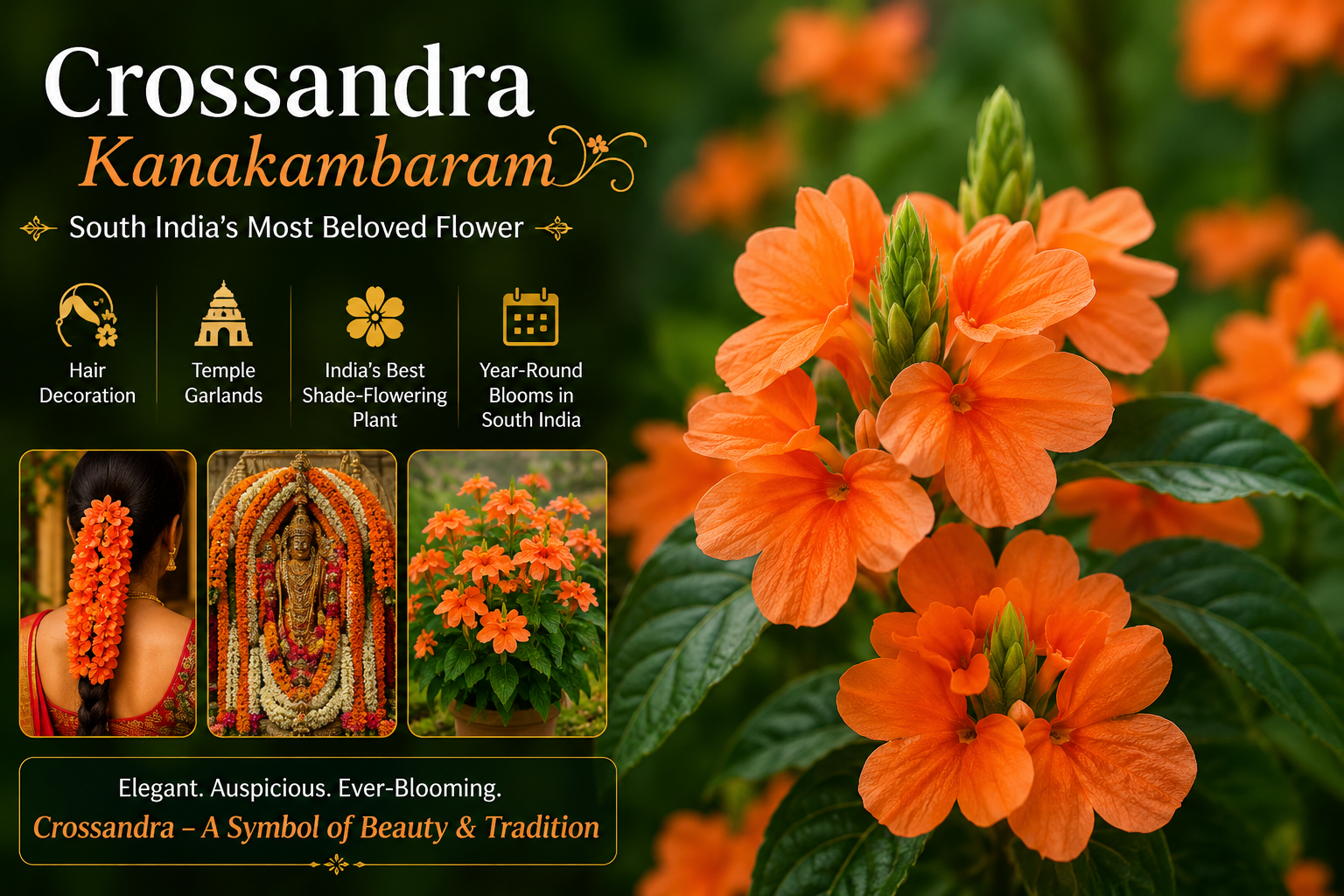
Crossandra Kanakambaram India — South Indian Firecracker Flower Guide
🌿 Ornamental Plants

Crossandra / Kanakambaram कनकांबरम / अबोली

Crossandra infundibuliformis
🔬 Acanthaceae 🌍 India and Sri Lanka — native 🌱 Easy Care ✅ Pet Safe
Photo: Unsplash
Crossandra Kanakambaram Aboli South India Hair Decoration Temple Flower Shade Flowering

Crossandra / Kanakambaram — South India's most beloved flower. Hair decoration, temple garlands. India's best shade-flowering plant. Year-round blooms in South India.

Crossandra / Kanakambaram — South India का most beloved flower। Hair decoration, temple garlands। India का best shade-flowering plant। South India में year-round blooms।

⚡ Quick Reference / एक नज़र में
☀️ Light
Bright indirect to partial shade
💧 Water
Every 4–5 days
🪴 Soil
60% cocopeat + perlite
🌡️ Temperature
18–38°C
💦 Humidity
60%+ — loves humidity
🧪 Fertilizer
Monthly balanced NPK

Crossandra (Crossandra infundibuliformis) — Firecracker Flower or Kanakambaram — is one of South India's most beloved ornamental flowering plants, producing clusters of vivid orange, salmon, yellow and red flowers almost continuously through the year. Native to India and Sri Lanka, Crossandra is deeply embedded in South Indian culture — the orange Kanakambaram flowers are extensively used in hair decoration and temple garlands across Tamil Nadu, Andhra Pradesh, Karnataka and Kerala. The plant thrives in India's warm, humid conditions and tolerates partial shade better than most flowering plants, making it uniquely suitable for the shaded gardens and verandahs of South Indian homes.

Crossandra (Crossandra infundibuliformis) — Firecracker Flower / Kanakambaram — South India का most beloved ornamental flowering plants में से एक। Vivid orange, salmon, yellow flowers — almost year-round। India और Sri Lanka native — South Indian culture में deeply embedded। Tamil Nadu, AP, Karnataka, Kerala में hair decoration और temple garlands। Partial shade में thrive — South Indian shaded gardens perfect।

🌸 What is Crossandra / Kanakambaram? — Complete Information

🔬 Scientific NameCrossandra infundibuliformis
🌿 Common NamesCrossandra, Firecracker Flower, Kanakambaram, Aboli
🇮🇳 Regional Namesకనకాంబరం (Kanakambaram — Telugu/Kannada), அபோலி (Aboli — Marathi), कनकांबरम
👨‍👩‍👧 Plant FamilyAcanthaceae
🌍 OriginIndia and Sri Lanka — native to tropical South Asia
📏 Size30–60 cm — compact bushy shrub
🌱 TypePerennial flowering shrub — evergreen in tropical conditions
ToxicityNon-toxic — safe for pets and children

🌸 Kanakambaram — Cultural Significance

💇
Hair Decoration
Kanakambaram orange flowers strung into small garlands (gajra) are the most popular hair decoration in Tamil Nadu, Andhra and Karnataka — worn daily by women, particularly during festivals, weddings and religious occasions. The vibrant orange contrasts beautifully with dark hair and jasmine white.
🛕
Temple Garlands
Crossandra flowers are a staple of South Indian temple flower markets — used in garlands for deities particularly Vishnu, Murugan and Durga. The bright orange color is considered auspicious and associated with fire, energy and devotion in South Indian temple tradition.
💐
Commercial Floriculture
Crossandra is a significant commercial cut flower crop in Tamil Nadu and Karnataka — grown on 8,000+ hectares in these states alone. India exports dried crossandra garlands and loose flowers to the South Indian diaspora worldwide. Flower market staple at Rs.20-50 per bunch.
🌿
Ayurvedic Use
Crossandra leaves and flowers are used in traditional medicine for skin conditions, wounds and inflammation. The leaf paste applied topically for rashes and minor burns. Root decoction used in traditional medicine for fever and joint pain in South Indian folk medicine tradition.

💧 Crossandra Care — India Specific

⚡ Quick Care Reference
☀️ Light
Bright indirect to partial shade
Best shade-flowering plant
💧 Water
Every 4–5 days
Keep consistently moist
🌡️ Temperature
18–38°C — tropical plant
South India year-round perfect
💦 Humidity
60%+ — loves humidity
Indian monsoon = peak season
🪴 Soil
Rich well-draining mix
60% cocopeat + perlite
🧪 Fertilizer
Monthly balanced NPK
High-P for more flowers
  • India's best shade flowering plant: Crossandra is one of the very few ornamental plants that flowers prolifically in partial shade — making it invaluable for shaded courtyards, north-facing gardens, covered verandahs and under-tree planting where most flowering plants fail. In deep shade flowering reduces — bright indirect light is ideal.
  • Deadhead spent spikes: Remove flower spikes as they finish — this encourages fresh spike production from the base. The plant flowers from multiple stems simultaneously if regularly deadheaded. Without deadheading, energy goes to seed development and flowering slows significantly.
  • Pinch young plants: Pinch growing tips when seedlings reach 15 cm — promotes bushy branching and multiple flowering stems rather than a single-stemmed plant. More stems = more flower spikes = more Kanakambaram for hair and temple.
☀️ Shade level check karo
Sunlight Checker →

❓ Frequently Asked Questions

Main reasons: (1) Too much shade — needs bright indirect light minimum, not deep shade. (2) Cold temperatures below 15°C — North India winters reduce flowering significantly. (3) Not deadheaded — remove spent spikes regularly. (4) Root bound — repot in fresh mix. (5) Pest damage — check for spider mites and mealybugs on undersides. In South India, crossandra flowers almost year-round with basic care.
Stem cuttings: 8-10 cm tip cuttings, lower leaves remove, moist cocopeat mein — 3-4 weeks mein roots. Best season: March-August. Seeds se bhi propagate hota hai — small seeds surface sow, light covering, keep moist — germination 10-15 days. Stem cuttings faster and more reliable. Air layering bhi possible for larger branches.
Yellowing causes: (1) Overwatering — let soil dry slightly between waterings. (2) Underwatering — check if soil bone dry. (3) Root bound — repot to larger container. (4) Spider mite infestation (check leaf undersides for webbing). (5) Cold draft. Crossandra naturally drops lower leaves as it matures — bottom leaf yellowing is normal aging. Multiple yellowing = care issue.