Wood Apple Bel Kaitha Growing India — Sacred Shiva Fruit Encyclopedia
🍎 Fruits

Wood Apple / Bel बेल / कैथा / कवठ

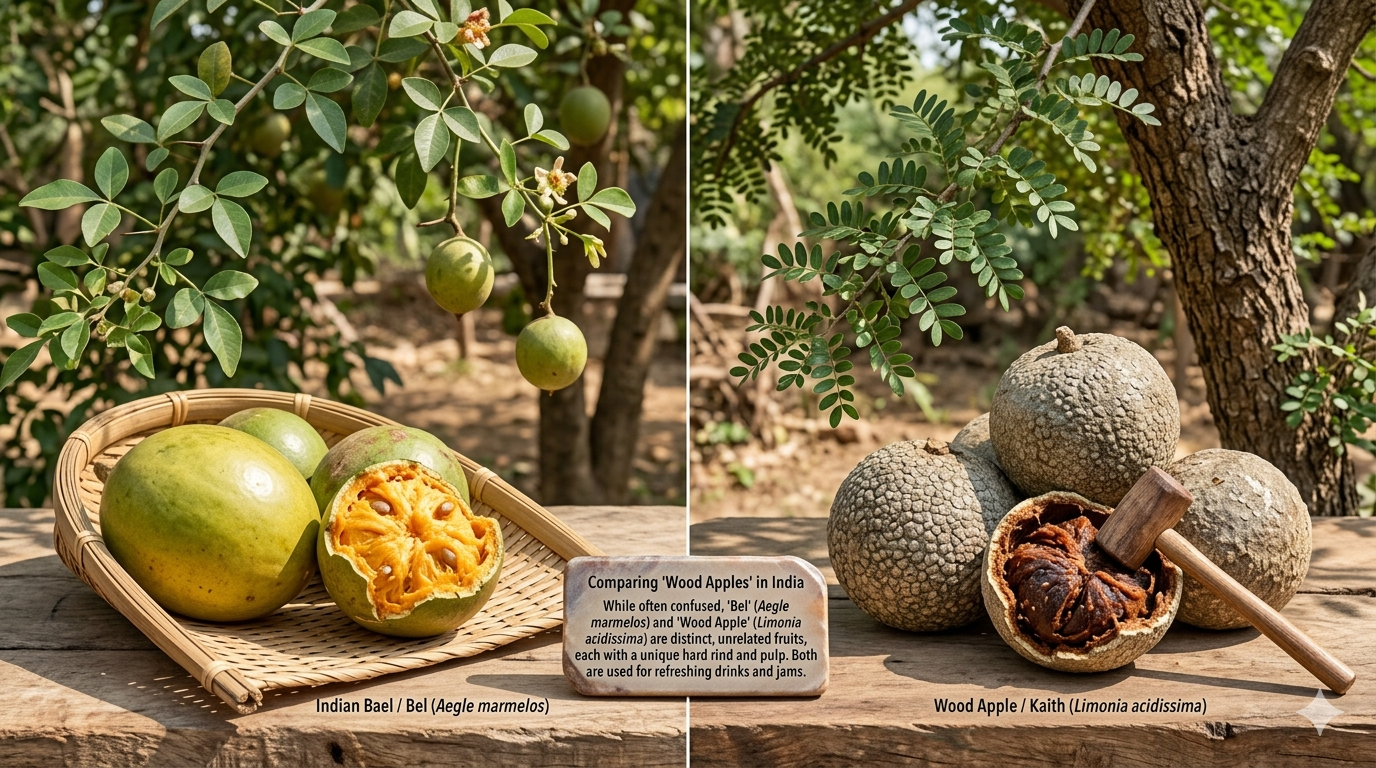
Limonia acidissima (wood apple) | Note: Aegle marmelos = True Bael (more medicinal)
🌱 June-July | Grafted for 4-6 yr | Seedling 8-10 yr | Tree life: 100-200 years ⏱️ Feb-April | Woody shell = months room temp storage | Crack with stone/knife 🌿 Easy Grow ✅ Edible Safe
Photo: PlantCare
Wood Apple Bel Bael Sacred Shiva Bel Patra 200 Year Tree Dual Diarrhea Constipation

Wood Apple / Bel — most sacred Shiva fruit (bel patra). Treats BOTH diarrhea and constipation! 200-year tree. Zero maintenance. Bael vs Wood Apple confusion explained. Puja + medicine.

Wood Apple / Bel — Shiva का most sacred fruit (bel patra)। BOTH diarrhea और constipation treat करता है! 200-year tree। Zero maintenance। Bael vs Wood Apple confusion clear। Puja + medicine।

⚡ Quick Reference / एक नज़र में
🌱 Sowing Season
June-July | Grafted for 4-6 yr | Seedling 8-10 yr | Tree life: 100-200 years
⏱️ Harvest Time
Feb-April | Woody shell = months room temp storage | Crack with stone/knife
🍽️ Edible Parts
Pulp (sharbat, murabba) + Bel patra leaves (sacred puja + medicinal)
☀️ Light
Full sun — loves intense heat
💧 Water
Monthly mature — grows in 400mm rainfall! Extreme drought.
🌡️ Temperature
25-45°C — India's harshest zones ideal
💊
Key Nutrition / पोषण
Fiber (dual action: constipation + diarrhea!), Tannins, Vitamin C, Marmelosin (anti-diabetic)
🍳
Indian Kitchen Uses / भारतीय रसोई
Bel sharbat (digestive drink), bel murabba, bel patra puja, dried pulp powder (medicine)

Wood Apple (Limonia acidissima) — Bel / Kaitha / Kavath — is one of India's most sacred and most medicinally significant fruits, intrinsically linked to Hindu worship of Lord Shiva (bel patra — the three-lobed leaf — is the most sacred offering to Shiva) and simultaneously one of Ayurveda's most prescribed digestive medicines. Native to the Indian subcontinent, the wood apple has been cultivated here for over 4,000 years. The fruit is remarkable — its woody shell (hence "wood apple") houses an aromatic, sticky, intense pulp that is simultaneously astringent, sour and sweet, with a complex flavor unlike any other fruit. India grows wood apple primarily in Uttar Pradesh, Madhya Pradesh, Rajasthan, Maharashtra and Bihar. For home gardeners, wood apple is extraordinary for its resilience — it grows in the harshest conditions, requires no care once established, and is virtually immune to pests and disease. One mature tree serves as a Shiva-worship tree, a digestive medicine dispensary and a flavoring source for generations.

Wood Apple (Limonia acidissima) — Bel / Kaitha — India का most sacred और most medicinally significant fruit। Lord Shiva की worship से intrinsically linked — bel patra most sacred offering। 4,000+ years Indian cultivation। Woody shell + aromatic sticky pulp — astringent-sour-sweet complex flavor। Home garden में: harshest conditions में grows, zero care, pest-immune, generational tree।

🟫 Overview, History & Varieties

🔬 Scientific NameLimonia acidissima (wood apple) | Note: Aegle marmelos is Bael — different fruit, also sacred
🌍 OriginIndian subcontinent — native. 4,000+ years cultivation and worship.
🕉️ Sacred StatusBel patra (3-lobed leaf) = most sacred Shiva offering. Tree itself considered divine.
🌡️ Temperature25-45°C — extreme heat and drought tolerant
⏱️ First FruitSeedling: 8-10 years | Tree life: 100-200 years
💧 Key StrengthGrows in poorest soils, extreme drought — thrives where nothing else does
Common NameRegionNote
🟫 Bel / BilvaNorth India, SanskritMost common North Indian name. Sacred Shiva fruit. Also called Bael.
🟫 Kaitha / KavathRajasthan, MP, MaharashtraRegional names for Limonia acidissima specifically
🟫 Wood AppleEnglishRefers to hard woody shell that must be cracked open
🟫 Curd fruit / Elephant appleSouth India, Sri LankaRegional English names — elephants love the fruit
⚠️ Note: Aegle marmelosOften confusedBael fruit (Aegle marmelos) is DIFFERENT from wood apple — also sacred, also medicinal, even more important medicinally

💊 Nutrition & Health — Bel ke Fayde

Nutrient / CompoundAmountHealth Benefit
🌾 FiberVery high in pulpGut health, constipation relief, cholesterol, blood sugar
🍊 Vitamin C10-30 mg per 100gImmunity, collagen — decent contribution
🛡️ TanninsHigh — astringencyAnti-diarrheal, antimicrobial, gut mucosal protection
🌿 Marmelosin + AegelinBael specific (Aegle marmelos)Anti-diabetic, anti-ulcer, liver-protective compounds
🫀 PotassiumSignificantBlood pressure, heart health
🧬 Coumarins + AlkaloidsPresentAntimicrobial, anti-inflammatory — traditional fever and infection use
  • Bael sharbat — India's most powerful digestive drink: The most famous preparation is Bael sharbat — wood apple pulp soaked in water, strained, sweetened with jaggery. This drink is prescribed in Ayurveda and modern Indian traditional medicine for: acute diarrhea (tannins), dysentery, irritable bowel syndrome, constipation (fiber), summer heat stroke (cooling properties), and general digestive weakness. The same fruit that treats diarrhea (tannins in unripe fruit) and constipation (fiber in ripe fruit) — depending on ripeness. This dual action makes bael one of Ayurveda's most sophisticated digestive medicines.
  • Confusion between Bael and Wood Apple: In India, "Bel" or "Bael" refers to two different fruits often confused: (1) Aegle marmelos — the true Bael fruit, a citrus relative, sacred to Vishnu and Shiva. Round, hard shell, orange-yellow inside, intensely fragrant. Most medicinally important. (2) Limonia acidissima — Wood Apple or Kaitha, a different species, also sacred but less commonly worshipped. Brown sticky pulp, more astringent. Both are valuable, both are grown in India, both have significant Ayurvedic applications. This page covers Limonia acidissima but the medicinal properties overlap significantly with Aegle marmelos.
  • Anti-ulcer research: Both wood apple and Bael (Aegle) have significant anti-ulcer properties — the mucilage and tannins form a protective coating on the stomach and intestinal mucosa. Traditional use for gastric ulcers and acidity is supported by pharmacological research. Bael fruit pulp has been shown to normalize gastric acid secretion in animal models.

🌱 Growing Guide — Puja ka Ped bhi, Dawai ka ped bhi

🌱
From Seed
Wood apple grows readily from fresh seed extracted from ripe fruit. Sow immediately — viability short (2-4 weeks). 2 cm deep, germination 15-21 days at 25-30°C. Seedling to fruiting: 8-10 years (long wait but 100-200 year return). Buy grafted or air-layered plant from nursery for 4-6 year fruiting. June-July planting. True Bael (Aegle marmelos) also available from nurseries — more medicinal, more sought-after.
☀️
Ideal Conditions
Wood apple / Bael thrives in India's harshest zones — specifically: Rajasthan dry heat, UP rocky ground, MP alkaline soil, Bihar waterlogged areas. Literally no Indian soil condition is too extreme for this tree. Grows from sea level to 1200m. Coastal to semi-arid. Frost-tolerant once established. This is India's most geographically adaptable food tree — if you have ground anywhere in India below 1200m elevation, you can grow it.
🕉️
Sacred Planting
Traditional planting: near home temple area or in northeast corner of property (vastu direction for sacred trees). The act of planting Bael is considered auspicious — earning religious merit. Puja requirement: three-lobed bel patra leaves are offered to Shiva in every Monday pooja across India. Having your own tree: spiritually significant, practically provides free puja material throughout life. Plant during auspicious days in Shravana month (July-August) for traditional families.
🏠
Container Growing
60-80L container for initial years — wood apple grows to a large tree but tolerates container management for many years with pruning. Dwarf variety grafted plants available from some nurseries. Container Bael: provides puja leaves year-round and eventual fruit. After 5-7 years in container: ideally transplant to ground for full long-term productivity. The thorny branches (natural protection) require care when pruning.

💧 Growing & Care

⚡ Quick Care Reference
☀️ Light
Full sun — loves heat
India's harshest sun = ideal
💧 Water
Monthly mature — extreme drought
Grows in 400mm rainfall areas
🌡️ Temperature
25-45°C
India's heat champion
🪴 Soil
Any — even waterlogged, alkaline
Most adaptable food tree India
🧪 Fertilizer
Annual compost — zero needed
Grows in completely barren soil
🐛 Pests
Virtually none — naturally resistant
Zero pest management required
  • Zero management once established: Wood apple / Bael is India's most self-sufficient food tree. After establishment (first year watering): requires nothing. No fertilizer, no pest control, no pruning, no irrigation. This makes it the ultimate low-input high-return tree for Indian home gardens — plant and come back in 8-10 years for fruit, with annual harvest of sacred leaves for puja in the meantime.
  • Opening the fruit: The woody shell requires a sharp blow with a heavy knife or stone — crack once around the equator. Twist to separate halves. Scoop out sticky aromatic pulp. Seeds embedded in pulp — remove for smooth sharbat or eat with pulp. The strong aroma when cracking open a ripe wood apple is distinctive and intensely pleasant.

🟫 Harvest, Storage & Culinary Uses

  • Harvest Feb-April when mature: Fruit falls naturally when ripe or harvested when outer shell hardens fully. Store whole at room temperature 3-4 weeks (woody shell protects inside). Once cracked: refrigerate and use within 3-5 days — the pulp deteriorates after opening. Bael sharbat: soak pulp in water, strain, add jaggery — refrigerate 2-3 days. Dried pulp: slow-dried in shade for 3-4 weeks — stores 6+ months.
UseMethodNote
🥤 Bel SharbatPulp soaked in water, strained, jaggery added — cooling digestive drinkPan-India summer + digestive medicine
🍮 Bel MurabbaPulp preserved in sugar syrup — Ayurvedic preserveTraditional digestive health preserve
🌿 Bel Patra PujaThree-lobed leaves offered to Shiva — collected fresh dailyMost sacred use — spiritual significance
🍫 Bel CandyDried compressed pulp with sugar/jaggery — traditional sweetUP, MP traditional confection
🫙 Dried Pulp PowderSun-dried pulp ground to powder — year-round digestive medicineAyurvedic home pharmacy staple
❓ FAQ
Perfect Bel sharbat: (1) Crack ripe wood apple open — heavy knife back or stone against equator. (2) Scoop entire pulp into large bowl. (3) Add 500ml cold water per medium fruit. (4) Mix thoroughly — pulp dissolves partially in water. (5) Strain through strainer, pressing pulp to extract maximum flavor. Discard fibrous residue and seeds. (6) Add jaggery (or sugar) to taste — start with 2 tbsp, adjust. (7) Add pinch black salt — enhances flavor dramatically. (8) Pinch roasted jeera powder — traditional addition. (9) Optional: 1/2 tsp rose water or kewra water — fragrance. (10) Serve over ice or refrigerate. Traditional summer drink: believed to prevent heat stroke, improve digestion, cool the body. In North India: sold by street vendors at railway stations and pilgrimage sites near Shiva temples — demand highest around Shravana month.
Bel patra collection protocol (traditional): (1) Correct leaf: three-lobed compound leaf from Aegle marmelos (true Bael). Single lobed leaves or leaves from Limonia (wood apple) are NOT the traditional puja leaf — though some regional traditions use them. (2) Collection time: before sunrise or in early morning — traditional prescription. (3) Collection day: avoid Sundays and Chaturdashi (14th lunar day) — traditional caution. (4) Direction: face north or east while collecting. (5) Handle carefully: don't bruise or break the leaves. (6) Offer with pointed end (tip) facing toward Shiva lingam — traditional orientation. (7) Significance: three lobes represent tridev (Brahma-Vishnu-Mahesh) or the three eyes of Shiva. (8) Leaves can be offered fresh from your garden daily — the spiritual merit of having your own Bael tree for daily puja is considered significant in Shaivite tradition.
Bel / Wood Apple is actually beneficial for diabetes: (1) Bael (Aegle marmelos specifically) contains marmelosin — shown to have anti-diabetic properties in animal and preliminary human studies. (2) High fiber content slows glucose absorption. (3) Tannins inhibit starch-digesting enzymes. (4) Traditional Ayurvedic use for diabetes management is supported by modern pharmacological research. (5) Low GI relative to other sweet fruits. Bel sharbat without added sugar: made with jaggery (GI 65, better than sugar) in moderate amounts — appropriate for diabetics. Recommended: 200ml bel sharbat (no/minimal sweetener) morning on empty stomach — traditional anti-diabetic practice. Fresh pulp: even better than sharbat for diabetics — no dilution of fiber and active compounds. Modern research increasingly validating traditional Ayurvedic classification of Bael as a diabetes-management plant.
India's most common fruit naming confusion: Aegle marmelos = TRUE BAEL / BAEL FRUIT: Round, 5-12 cm diameter, hard yellowish-green shell. Orange-yellow fragrant sticky sweet-sour pulp inside. Most important medicinally. Sacred to Shiva and Vishnu. Used for bel sharbat, bael murabba, digestion. Three-lobed bel patra leaves from THIS tree for puja. Limonia acidissima = WOOD APPLE / KAITHA / KAVATH: Smaller, darker grey-brown shell. Brown sticky astringent-sour pulp. Less sweet, more astringent. Also medicinal but different compounds. Also used for sharbat. Leaves NOT the traditional puja bel patra. Both grow in India, both called "Bel" in different regions, both considered sacred, both medicinal — the confusion is understandable and ancient. Regional naming: North India "Bael" usually means Aegle marmelos. South India "wood apple" usually means Limonia. Maharashtra "kavath" = Limonia. For maximum medicinal and spiritual value: aim for Aegle marmelos (True Bael) when buying nursery plant — specify this to avoid getting Limonia.
Complete guide — specify TRUE BAEL (Aegle marmelos) or wood apple (Limonia) based on preference: (1) SOURCE: State horticulture nurseries, temple vicinity nurseries often sell Bael. Specify "Bael — Aegle marmelos" not wood apple if you want the traditional puja tree. (2) June-July planting: 60 cm pit, any soil, any location in India below 1200m. (3) Water weekly first year only — then rain-fed. (4) ZERO maintenance after establishment. (5) Thorny plant (especially Limonia) — plant away from children's play areas. (6) First leaves usable for puja: year 2-3. (7) First fruit: year 8-10 (seedling) or 4-6 (grafted). (8) Annual harvest: Feb-April. Why planting Bael is one of India's most meaningful home garden acts: (1) Spiritual — provides daily puja material, auspicious planting. (2) Medicinal — complete home digestive pharmacy. (3) Ecological — one of India's most drought-resistant trees, supports biodiversity. (4) Generational — 100-200 year tree benefiting children and grandchildren.