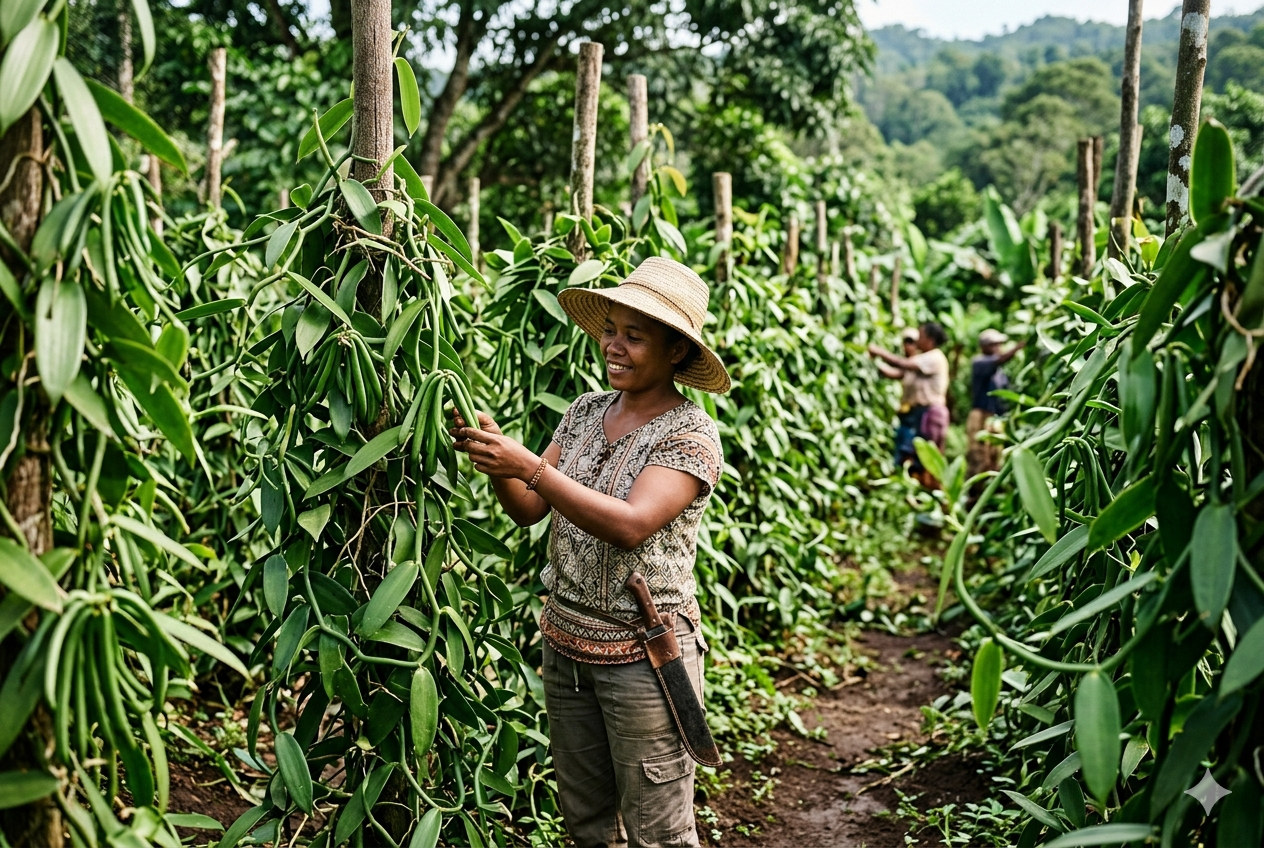
Vanilla Farming India — Hand Pollination Kodagu Most Expensive Spice Encyclopedia
🌾 Crops & Grains

Vanilla वेनिला

Vanilla planifolia (flat-leaved — main commercial) | V. tahitensis (Tahitian)
🌱 June-July rooted cutting | First flower Year 3 | HAND POLLINATE every flower within 12 HOURS of opening! ⏱️ 9 months pod maturation + 6 months curing | Rs.4,000-8,000/kg (volatile: Rs.600 to Rs.60,000 history!) | Patience 5 years 🌿 Expert Grow ✅ Edible Safe
Photo: PlantCare
Vanilla Hand Pollinate 12 Hours No Natural Bee India 9+6 Months Patience Rs600-60000 Volatile Real 200 Compounds Synthetic 1 Compound World #2 Most Expensive

Vanilla — every flower hand-pollinated within 12 HOURS (no natural bee in India!). 9 months + 6 months curing. Price history: Rs.600 to Rs.60,000/kg. Real = 200+ flavor compounds. Synthetic = 1. World's #2 most expensive spice.

Vanilla — every flower 12 HOURS में hand-pollinate (India में natural bee नहीं!)। 9 months + 6 months curing। Price history: Rs.600 to Rs.60,000/kg। Real = 200+ flavor compounds। Synthetic = 1। World का #2 most expensive spice।

⚡ Quick Reference / एक नज़र में
🌱 Sowing Season
June-July rooted cutting | First flower Year 3 | HAND POLLINATE every flower within 12 HOURS of opening!
⏱️ Harvest Time
9 months pod maturation + 6 months curing | Rs.4,000-8,000/kg (volatile: Rs.600 to Rs.60,000 history!) | Patience 5 years
🍽️ Edible Parts
Cured pods (split, scrape seeds) | 200+ flavor compounds vs synthetic vanillin = 1 compound | World's most popular flavor
☀️ Light
Partial shade 50-70% — support tree essential. Full sun = leaf bleach + death.
💧 Water
1500-3000mm | Well-distributed | 2-3 dry months induce flowering | Drip supplemental
🌡️ Temperature
20-30°C | Never frost | Never below 10°C | Kodagu conditions ideal
💊
Key Nutrition / पोषण
Vanillin + 200 complex compounds. Anti-anxiety, antioxidant. Real = incomparable to synthetic.
🍳
Indian Kitchen Uses / भारतीय रसोई
Vanilla extract (home recipe!), ice cream, baking, custard, chocolate flavoring — most universal flavor worldwide

Vanilla (Vanilla planifolia) — Vanilla / Vanille — is the world's second most expensive spice after saffron and the world's most popular flavor, used in billions of products globally — from ice cream to perfume, from Coca-Cola (original recipe) to luxury chocolates. Native to Mexico where the Totonac people cultivated it for centuries, vanilla reached Europe with Hernán Cortés in 1520. India's vanilla cultivation story is relatively recent but extraordinarily promising: vanilla was introduced to Karnataka's Kodagu district and Kerala in the 1990s, and the 2000s saw a dramatic price spike (Rs.4,000-6,000/kg for cured vanilla) that attracted many farmers. The crucial agricultural fact about vanilla that makes it extraordinary: in Mexico, the only natural pollinator is a specific species of Melipona bee — which doesn't exist anywhere else in the world. Every vanilla flower grown outside Mexico must be hand-pollinated — individually, carefully, within 12 hours of opening. This makes vanilla the most labor-intensive crop on earth per unit of value. The vanilla pod takes 9 months to mature after pollination, then requires a precise 6-month curing process to develop vanillin (the main flavor compound). The difference between real vanilla (with 200+ flavor compounds) and synthetic vanillin (one compound from petrochemicals or wood pulp) is the difference between a symphony and a single note.

Vanilla (Vanilla planifolia) — world का 2nd most expensive spice! Most popular flavor globally। Mexico native — natural bee pollinator ONLY in Mexico। Outside Mexico = EVERY flower hand-pollinated (within 12 hours!)। 9 months pod maturation + 6 months curing। Real vanilla = 200+ flavor compounds। Synthetic vanillin = 1 compound। India Karnataka + Kerala = promising cultivation।

🌿 Overview, Classification & Cultivation Zones

🔬 Scientific NameVanilla planifolia (flat-leaved — main commercial) | V. tahitensis (Tahitian)
📅 SeasonPerennial vine | Planted June-July | First flowering: Year 3 | Peak: Year 7-12
🌡️ Temperature20-30°C | Humid tropical | 1500-3000mm rainfall | 60-85% humidity
💧 Water1500-3000mm | Well-distributed | Dry period 2-3 months induces flowering
⏱️ DurationFirst harvest Year 3 | Peak Year 7-12 | Productive 12-20 years
🌾 Yield0.5-1.5 kg cured vanilla/vine/year | 300-600 kg/ha at peak
ParameterIndia Cultivation Zones
🌿 Best RegionsKodagu (Coorg) Karnataka, Idukki Kerala, Wayanad Kerala, Nilgiris Tamil Nadu
🌡️ Climate NeedHumid, warm, 1500m max altitude, never frost, never temperature below 10°C
🌲 Support TreeSilver oak, arecanut, teak, Gliricidia — living support preferred
🌿 Shade50-70% — partial shade essential. Full sun bleaches and kills.
💧 IrrigationDrip irrigation supplemental — dry spell of 2-3 months induces flowering naturally
⚠️ RiskHand pollination skill essential. No natural pollinator in India.

🪴 Planting, Pollination & Care

🌱
Planting
Rooted stem cuttings (3-4 node) from healthy vines. Root in nursery bags 45-60 days. Pit: 30 × 30 × 30 cm. Rich organic compost-filled. Plant at base of support tree. Spacing: 2.5-3 m between vines. Train vine to support. Pinch at 1.5-1.8m height initially — encourages lateral shoots which bear flowers. Never let vine grow vertical only — horizontal or looped sections bear flowers. Mulch at base: 15-20 cm — moisture and organics. Shade first 2 years: 70%. Gradually reduce to 50% as vine matures — more light improves flowering.
🌸
Hand Pollination — THE Skill
Vanilla flower anatomy: male (anther) and female (stigma) separated by a flap (rostellum) — prevents self-pollination. Natural: only Melipona bee in Mexico bridges this gap. Hand pollination: (1) Flowers open 6-12 AM only. (2) Work must complete within 12 hours. (3) Use toothpick or thin stick: lift the rostellum flap gently. (4) Press pollen mass (pollinium) from anther onto sticky stigma. (5) One pollination per flower. One vine: 5-10 flowers open daily during season. This daily morning task is the most critical skill in vanilla cultivation — success rate determines income. Practice on first flowers — improves with experience. 80-90% success rate target.
🧪
Fertilizer & Care
N: 30-40g per vine (organic preferred — fish emulsion, neem cake). P: 20g. K: 50g — important for pod quality. Compost: 2-3 kg per vine annually. Magnesium: MgSO₄ 0.5% foliar spray — common deficiency. Trace elements: boron, zinc foliar spray. Organic: essential for premium vanilla market — major buyers (International Flavors & Fragrances, Givaudan) require organic certified. Shade management critical — regular trimming of shade trees to maintain 50% light during flowering. Irrigation: drip daily in dry season. Withhold irrigation for 2-3 months before expected flowering — stress triggers bloom.
⏱️
The Long Wait
Vanilla cultivation requires extraordinary patience: Year 0: plant cuttings. Year 1-2: establish, no flowers. Year 3: first flowers — first pods! Small crop. Year 4-5: increasing production. Year 6-8: first good commercial crop. Year 10-12: peak production. Even after pollination: pod takes 9 months to mature. After harvest: 6 months curing. So: from planting to cured vanilla to market = 4-6 years first time. This timeline explains vanilla's price — genuine cost of patience. Investment calculation: initial cost per hectare (cuttings, support trees, shade, labor, irrigation): Rs.3-5 lakh. Income starts Year 3-4. Payback: 5-7 years. Then: 10+ years of potentially very good income. Long-term thinking required.

🌿 Disease Management & Challenges

⚡ Key Pests & Diseases
🌿 Root Rot
Fusarium oxysporum — most serious
Good drainage + Trichoderma + Metalaxyl drench
🍂 Leaf Blight
Phytophthora meadii
Bordeaux 1% spray — preventive
🐛 Vanilla Bug
Scirtothrips dorsalis
Dimethoate spray — young shoot protection
🌿 Stem Rot
Bacterial — Erwinia
Avoid waterlogging + copper spray
🐛 Snail/Slug
Pod surface damage
Metaldehyde bait — moist conditions
🌾 Pod Splitting
Premature splitting — cultural
Harvest at right time — water management
Tool / ResourceUse for Vanilla
📅 Crop Sowing CalendarVanilla planting + dry season (flowering induction) schedule
💧 Drip Irrigation GuideDrip setup for vanilla — dry spell management for flowering
🧪 Fertilizer CalculatorOrganic nutrition schedule — buyer certification requirement
🔍 Pest IdentifierRoot rot early signs — critical for 4-year-invested vine protection
🌱 Companion Planting GuideVanilla + arecanut / vanilla + coffee intercrop design

🌿 Harvest, Curing, Economics & Real vs Fake Vanilla

  • Harvest pods at 8-9 months when tip turns yellow: Green pods turn yellow-green at tip — harvest signal. Full mature pod: 15-25 cm long. Pick individually by hand (clip with scissors near base). Pods very fragile — handle with care. Curing process (6 months): (1) Killing: immerse in 65°C water 3 minutes or expose to sun 3 days — stops enzyme activity. (2) Sweating: wrap in blankets daily, alternate with sun exposure — 10-14 days. (3) Slow drying: shade dry 30-40 days. (4) Conditioning: storage in closed containers 2-3 months — vanillin develops fully. Final product: dark brown, wrinkled, aromatic pods. Vanillin content: 1.5-3%. Price: Rs.4,000-8,000/kg (market fluctuates wildly — Rs.600/kg low to Rs.60,000/kg peak in 2005-2006).
Real vs Synthetic VanillaDetail
🌿 Real Vanilla200+ flavor compounds — vanillin + 200 others. Complex, warm, floral. Rs.4,000-8,000/kg.
⚗️ Synthetic VanillinSingle compound (C8H8O3) from lignin (wood pulp) or petrochemicals. Flat, one-dimensional. Rs.200-500/kg.
🔬 CastoreumHistorical "natural vanilla flavor" from beaver glands — still technically possible as GRAS. Rare today.
🌿 Madagascar vanillaWorld's premium benchmark — Bourbon vanilla. India vanilla: comparable quality from Kodagu.
💰 Market priceVolatile: Rs.600-60,000/kg range in 20 years — highest commodity price volatility of any spice.
🎯 India opportunityOrganic certified Kodagu vanilla directly to European buyers — premium positioning viable.
❓ FAQ
India vanilla farming — realistic profit and risk assessment: Revenue potential (good year): 300 kg cured vanilla/ha × Rs.6,000/kg = Rs.18,00,000/ha gross. After cost Rs.3,00,000-4,00,000: net Rs.14-15 lakh/ha. Sounds extraordinary — but the risks are severe. Price volatility: vanilla is the world's most price-volatile spice. Price history: 2005: Rs.60,000/kg (peak). 2010: Rs.800/kg (crash). 2018: Rs.40,000/kg (Madagascar cyclone). 2023: Rs.4,000-8,000/kg. A crop growing at Rs.800/kg may sell for Rs.6,000/kg or Rs.600/kg — completely unpredictable. Disease risk: root rot can kill 4-year-invested vines rapidly. One bad monsoon = massive losses. Pollination dependence: bad pollination season (rain, labor shortage) = minimal crop from otherwise healthy vines. Market access: cannot sell at mandi. Needs direct buyer (organic certified European buyer, Indian flavoring companies, cooperative). Individual farmer marketing is extremely difficult. India-specific challenges: (1) No organized vanilla market — unlike cardamom or pepper. (2) Buyers few — limited bargaining power. (3) Curing knowledge limited — curing errors destroy value. Who should grow vanilla: farmers already growing spice crops (cardamom, pepper, coffee) with existing shade system. Access to training (ICAR-IISR Kozhikode, Spice Board). Assured buyer before planting — ideally contract with flavoring company or FPO with export linkage. Don't grow without: market linkage, training, patience (5+ year horizon), diversified income so vanilla isn't survival crop.
Homemade vanilla extract: Ingredients: 5-6 vanilla pods (cured, pliable — Grade B preferred for extract). 200ml alcohol: vodka 40% (neutral) or rum (adds character). Glass bottle/jar with tight lid. Method: (1) Split vanilla pods lengthwise with knife. Scrape beans out — add both pods and beans to bottle. (2) Pour alcohol over pods — fully submerge. (3) Seal tightly. (4) Store in cool dark place — shake gently every week. (5) Minimum: 8 weeks for basic extract. Better: 6 months for full flavor development. Use: 1 tsp (5ml) extract = 1 vanilla pod in most recipes. Extraction chemistry: ethanol dissolves vanillin and other flavor compounds from the pod. The longer the extraction, the more complex the flavor. Non-alcoholic option: glycerin extraction — substitute vegetable glycerin for alcohol. Slower extraction, slightly different flavor profile. Not as potent. Indian context: alcohol-based extract requires imported vodka/rum (expensive) or domestic spirit. Alternative: vanilla sugar. Place split pods in airtight jar with 500g sugar. After 2 weeks: vanilla-scented sugar for all baking uses. Lasts months. Easier for households avoiding alcohol. Cost comparison: 6 pods + 200ml vodka = Rs.1,800-4,000 → 200ml pure vanilla extract. Market: Rs.400-1,200 for 100ml commercial (often synthetic). Quality: homemade extract with good pods is incomparably superior to commercial. Makes excellent gift. Premium pods from Kodagu Karnataka for superior homemade extract — support Indian farmers while making superior product.
Vanilla hand pollination — complete technique: Equipment: toothpick, matchstick or thin bamboo sliver. Optional: magnifying lens for beginners. Best done: 7 AM - 11 AM (flowers fully open). Timing critical: flowers open one day only. By afternoon: partially closed. By evening: too late — flower closes permanently. Flower anatomy: pale yellow-green, trumpet-shaped, fragrant. Inside: column (combined male-female organ). On top of column: cap covering anther (pollen mass). Below cap: rostellum (flap separating male from female). Stigma: sticky surface below rostellum. Step-by-step: (1) Identify open flower — look for fully expanded petals, visible column. (2) Gently hold flower with one hand — don't squeeze. (3) With toothpick: lift the cap on column tip — pollen mass (pollinium) visible as yellowish waxy mass. (4) With toothpick tip: scrape/lift the rostellum flap (small curved flap) — expose stigma surface below. The stigma: shiny, sticky when receptive. (5) With same toothpick: transfer pollen mass from cap to exposed sticky stigma. Press gently — should adhere to sticky surface. (6) Done — flower will close. Successfully pollinated flower: forms a small pod at its base within 5-10 days. Unpollinated flower: falls off within 1-2 days. Common mistakes: (1) Tearing the rostellum — stigma damaged. (2) Too rough — pistil damaged. (3) Working after 11 AM — reduced receptivity. (4) Rain during pollination season — rinse pollen away, reduces success. Practice: first season — practice on some flowers without expecting success. By second season: technique improves dramatically. Target: 80-90% set rate = good. Professional pollinators in Reunion Island (Bourbon vanilla): 90-95% — specialized skill developed over career.
Vanilla price volatility — the economics: Madagascar dominance: 80% of world vanilla from Madagascar. This concentration is the primary vulnerability. Natural disaster impact: Madagascar cyclones destroy crops — 2017 Cyclone Enawo destroyed 30% of crop. Price immediately tripled to Rs.40,000+/kg. Recovery takes 3 years (vine establishment + pod maturation). Supply inelasticity: planting more vanilla NOW doesn't help for 3 years. Cannot respond quickly to price signals. Demand inelasticity: vanilla is non-negotiable in ice cream, chocolate, beverages — demand continues regardless of price. Short supply + inelastic demand = extreme price spikes. Speculation: commodity traders and fragrance companies stockpile at spikes — adds speculative premium. Price crash mechanism: when prices spike, more farmers plant vanilla. 3 years later: excess supply = price crash. This boom-bust cycle repeats. Industry response: (1) Synthetic vanillin use increases when real vanilla expensive. (2) Diversification to non-Madagascar sources (India, Indonesia, Uganda, Tahiti). (3) Long-term contracts at fixed prices (Nestlé, Mars type large buyers). India opportunity: this volatility is actually India's opportunity. Building consistent supply (non-Madagascar source), organic certified, direct-to-buyer relationships allows premium pricing INDEPENDENT of commodity market fluctuations. The buyers who value quality above spot price: willing to pay Rs.5,000-8,000/kg consistently for certified traceable Indian vanilla vs waiting for Rs.40,000 peaks or buying inferior Rs.600 crop.
Identifying real vs adulterated vanilla: Whole pods: (1) Appearance: dark brown to black (properly cured), pliable/flexible (not brittle), oily/moist surface, visible white crystals of vanillin on surface (frosting) = excellent quality. (2) Aroma: intensely complex — sweet, floral, woody, slight smoky undertone. Should smell like the best ice cream but more complex. (3) Length: Grade A pods: 15-20 cm+. Grade B: shorter, for extract. (4) Feel: should bend without breaking. (5) Vanilla extract test: genuine vanilla extract in alcohol shows complex aroma immediately. Synthetic: sharp, one-dimensional "vanilla candy" smell. Adulterations in market: (1) Tonka bean: contains coumarin — similar vanillin aroma but illegal food additive (liver toxin). Used to adulterate real vanilla pods. Detection: coumarin has sweeter, "almond-like" note. HPLC testing detects. (2) Vanillin-soaked pods: real pods soaked in synthetic vanillin solution to fake quality. Detection: excessive vanillin uniformly (real pods have vanillin more concentrated in seeds). (3) Over-extracted pods: sold as complete. Detection: pods that have been extracted look hollow, less oily, pale. (4) Storage tell: genuine pods improve with age (like wine). Improve after 1 year properly stored. Adulterated: deteriorate faster. Consumer protection: buy from reputed sources (Spice Board India certified, Kerala cooperative, Kodagu origin labeled). Price reality check: if "real vanilla" pods sell below Rs.2,000/kg — suspect. Quality costs. India vanilla (Kodagu, Wayanad): genuinely high quality — support domestic producers for both quality assurance and farmer livelihood.
⚠️
AI-Assisted Content — Please Read
AI-सहायता से बनाई गई सामग्री — कृपया पढ़ें

All tools, plant encyclopedias, edible growing guides and blog content on PlantCare are created with the assistance of AI (Artificial Intelligence) and are intended for general informational and educational purposes only. While we strive for accuracy, the information provided may not be complete, current or suitable for every situation, region or individual plant variety.

For health, medical or serious agricultural decisions — always consult a qualified horticulturist, agronomist, Ayurvedic practitioner, medical professional or relevant expert. PlantCare does not take responsibility for outcomes arising from use of this information. Identification results from AI tools (plant identifier, pest identifier etc.) should be verified before taking any action.

इस वेबसाइट पर सभी tools, plant encyclopedias, edible guides और blog content AI (Artificial Intelligence) की सहायता से बनाए गए हैं और केवल सामान्य जानकारी और शिक्षा के उद्देश्य से हैं। स्वास्थ्य, चिकित्सा या गंभीर कृषि निर्णयों के लिए कृपया किसी योग्य विशेषज्ञ से संपर्क करें। PlantCare इस जानकारी के उपयोग से होने वाले परिणामों के लिए जिम्मेदार नहीं है।