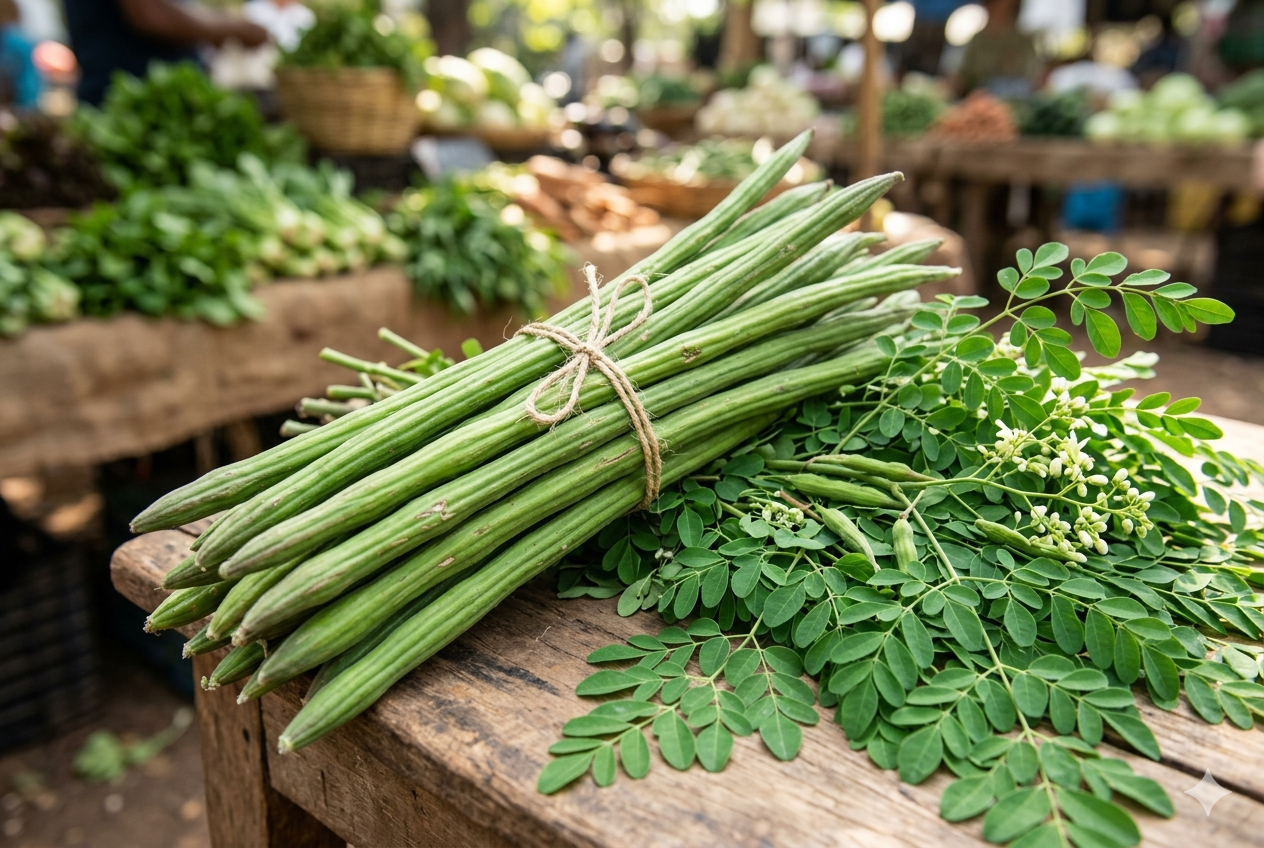
Drumstick Moringa Sahjan Growing India — Miracle Tree Encyclopedia
🥬 Vegetables

Drumstick / Moringa सहजन / मुनगा / मुरुंगाई

Moringa oleifera
🌱 Year-round (perennial) | Feb-June best planting | Pods: Feb-May peak ⏱️ 6-12 months first harvest | 10-20+ years continuous production 🌿 Easy Grow ✅ Edible Safe
Photo: PlantCare
Moringa Drumstick Sahjan Miracle Tree 20 Year Perennial 7x Vitamin C India Native

Drumstick / Moringa — "Miracle tree" (7x Vit C, 4x calcium, 3x iron). India native. Plant once = 20 years harvest. Cutting propagation fastest. Never waterlog. Frost protect.

Drumstick / Moringa — "Miracle tree" (7x Vit C, 4x calcium, 3x iron)। India native। एक बार plant = 20 years harvest। Cutting propagation fastest। Never waterlog। Frost protect।

⚡ Quick Reference / एक नज़र में
🌱 Sowing Season
Year-round (perennial) | Feb-June best planting | Pods: Feb-May peak
⏱️ Harvest Time
6-12 months first harvest | 10-20+ years continuous production
🍽️ Edible Parts
Pods, leaves, flowers, seeds — ENTIRE plant edible and medicinal
☀️ Light
Full sun — 6+ hours
💧 Water
Every 7-14 days mature — extremely drought tolerant
🌡️ Temperature
25-40°C — tropical. Frost sensitive in North India.
💊
Key Nutrition / पोषण
Leaves: Vit C 244% RDA (7x orange!), Calcium 4x milk, Iron 3x spinach, Protein 9.4g
🍳
Indian Kitchen Uses / भारतीय रसोई
Drumstick sambar, sahjan sabzi, moringa dal, moringa leaf powder, murungai keerai

Drumstick (Moringa oleifera) — Sahjan / Murungai — is India's most nutritionally extraordinary tree-vegetable and what scientists now call a "miracle tree." Native to the sub-Himalayan foothills of India, Pakistan and Nepal, moringa has been cultivated in India for over 4,000 years and is deeply embedded in both Indian cuisine (particularly South Indian cooking) and Ayurvedic medicine. The nutritional density of moringa is staggering: the leaves contain more Vitamin C than oranges, more calcium than milk, more iron than spinach, more potassium than bananas and more protein than most vegetables. For the home gardener, drumstick is perhaps the single most valuable perennial plant possible: grows to a tree in 6-12 months, produces continuously for 10-20 years with minimal care, and virtually every part is edible and medicinal.

Drumstick (Moringa oleifera) — Sahjan / Murungai — India का most nutritionally extraordinary tree-vegetable — scientists "miracle tree" कहते हैं। India, Pakistan, Nepal के sub-Himalayan foothills native — 4,000+ years cultivation। Leaves: oranges से more Vitamin C, milk से more calcium, spinach से more iron! Home gardener के लिए single most valuable perennial plant: 6-12 months में tree, 10-20 years continuous production।

🌿 Overview, History & Varieties

🔬 Scientific NameMoringa oleifera
🌍 OriginSub-Himalayan foothills — India, Pakistan, Nepal. India's own.
⏱️ First Harvest6-12 months from seed | 3-4 months from cutting
🌡️ Temperature25-40°C — drought tolerant, tropical/subtropical
📅 SeasonPerennial — year-round leaves | Feb-May pods (peak)
💚 Edible PartsPods, leaves, flowers, seeds, roots (young) — entire plant edible
VarietyTypeSpecialtyBest For
🌿 PKM-1 (Periyakulam)Annual bearingTamil Nadu TNAU — longest pods (60-90 cm), tender, high yield. Flowers in 6 months from seed.Pods, South India commercial
🌿 PKM-2Annual bearingImproved PKM-1 — even longer pods, higher yield, good tasteCommercial, home garden
🌿 Bhagya (KDM-01)Annual bearingKarnataka — pods 1-1.5m long! High yield, good tasteSouth India, commercial
🌿 Desi LocalPerennial treeTraditional type — smaller pods, very tender, intense flavor. Long-lived tree.Traditional cooking, leaves
🌿 Moringa stenopetalaEthiopian varietyLarger leaves, milder taste — preferred for leaf consumptionLeaf production, supplements

💊 Nutrition & Health — Sahjan ke Kamal ke Fayde

NutrientLeaves (per 100g fresh)Comparison
🍊 Vitamin C220 mg — 244% RDA7x more than oranges
🦴 Calcium185 mg4x more than milk per gram
⚙️ Iron4 mg3x more than spinach
🫀 Potassium337 mg3x more than bananas
💪 Protein9.4g — exceptional for leaf2x more than yogurt
🛡️ IsothiocyanatesSignificantAnti-cancer, anti-inflammatory — research-backed
  • Complete nutrition from one plant: Moringa leaves provide complete protein (all 9 essential amino acids — rare in plants), significant vitamins A, B-complex, C, E and K, calcium, iron, potassium and magnesium. This nutritional completeness makes moringa genuinely valuable in food security contexts — why WHO and UNICEF recommend moringa cultivation in nutritionally vulnerable communities. One handful of moringa leaves (30g) in daily cooking provides meaningful daily nutrition across multiple categories.
  • Blood sugar management: Moringa contains isothiocyanates and chlorogenic acid that reduce blood glucose by inhibiting glucose-producing enzymes. Clinical studies show moringa leaf powder (7g daily) reduces fasting blood glucose by 13% and post-meal glucose by 26% in type 2 diabetics. Traditional Ayurvedic use of sahjan for diabetes management is well-researched by modern pharmacology.
  • Pods (drumsticks) nutrition: The edible pods are lower in nutrients than leaves but still excellent: high fiber, Vitamin C, some protein and minerals. The inner soft flesh of young pods scraped and eaten is nutritious. Seeds inside mature pods are edible — high in oleic acid (same as olive oil) and contain moringa seed oil (ben oil) used in cooking and cosmetics.

🌱 Growing Guide — Ek Baar Lagao, Saalon Fal Pao

🌱
From Seed
Sow fresh seeds directly — moringa seed viability drops rapidly (3-6 months). Remove seed coat (soak overnight, peel), plant 2 cm deep in well-draining soil. Germination: 7-14 days. Grow in nursery bag for 4-6 weeks, transplant when 30 cm tall. Handle taproot carefully — don't damage. Best sowing: February-June. Avoid waterlogging at any stage — moringa taproots rot in wet soil. From seed: first flowers in 6-12 months.
✂️
From Cuttings — Faster!
Much faster than seed: take 1-2m hardwood cutting from mature moringa, plant 50-60 cm deep in prepared hole. Moringa cuttings are incredibly robust — success rate 80-90% even for beginners. First leaves in 2-3 weeks, first pods in 3-4 months. This is the traditional Indian propagation method — moringa cuttings freely shared between neighbors. Ask someone with a mature moringa for a branch cutting — free and faster than seed.
🏠
Container Growing
Large containers (50-80L) for container moringa. Manage height by pruning — container moringa can be kept at 1.5-2m. Full sun essential. Well-draining mix — no waterlogging ever. Water every 5-7 days — drought tolerant once established. Container moringa produces leaves year-round in tropical India and pods seasonally. Excellent for those without ground space who want year-round fresh moringa leaves.
✂️
Pruning for Productivity
Prune to manage height and maximize leaf production. At 1-1.5m height: cut growing tip — forces multiple lateral branches, each producing more leaves and pods than single main stem. Annual hard pruning (cut to 1m height after main pod season) rejuvenates tree, promotes vigorous new growth. Moringa tolerates aggressive pruning — comes back stronger. Pruning is the single most impactful practice for home moringa productivity.

💧 Growing & Care

⚡ Quick Care Reference
☀️ Light
Full sun — 6+ hours
Essential — shade = poor growth
💧 Water
Every 7-14 days mature tree
Drought tolerant — don't overwater!
🌡️ Temperature
25-40°C — tropical
Frost sensitive — protect in North India
🪴 Soil
Sandy loam — excellent drainage
Waterlogged soil = root rot death
🧪 Fertilizer
Annual compost — unfussy
Grows in poor soil — very low demand
✂️ Pruning
Annually — keeps manageable
More pruning = more leaves and pods
  • Overwatering is the main killer: Moringa's taproot rots extremely quickly in waterlogged soil — can kill even established trees within days of flooding. Plant on raised ground or raised beds. In containers: multiple large drainage holes essential. Less water is always safer — established moringa trees survive months of drought with no irrigation.
  • Frost protection in North India: Moringa is frost-sensitive — a hard freeze can kill or severely damage the tree. In North India (Dec-Jan): mulch base heavily, wrap lower trunk with gunny bag, cut back to 1m before frost season. Trees usually recover from light frost damage in spring — new growth from base even if top dies back.

🌿 Harvest, Storage & Culinary Uses

  • Harvest pods at 30-45 cm tender: Young pods: snap in half — if snaps cleanly, tender and edible. Mature pods: fibrous outer, scoop inner soft flesh and seeds. Leaves: harvest young tender tips and leaves — older leaves tougher. Fresh leaves: 2-3 days at room temperature, 1 week refrigerated. Dried leaf powder: dry in shade (not sun — destroys Vitamin C), grind, store 3-6 months. One teaspoon dried leaf powder = significant nutritional addition to any dish.
UseMethodRegion
🫕 Drumstick SambarPods cooked in tamarind-lentil sambar — scrape flesh from pods while eatingSouth India — Tamil Nadu, Karnataka, Kerala essential
🥘 Sahjan ki SabziPods in onion-tomato masala gravy — North Indian styleNorth India — UP, Bihar winter dish
🌿 Moringa DalLeaves added to lentils last 5 minutes — nutrient boostSouth India, Rajasthan — nutritious combination
🌿 Moringa PowderDried ground leaves — add 1 tsp to roti dough, dal, smoothiePan-India — modern health supplement use
🌿 Murungai KeeraiMoringa leaves stir-fried with coconut, mustard — South Indian leafy green preparationTamil Nadu — traditional daily cooking
❓ FAQ
Both have merit: Raw moringa leaves: maximum Vitamin C (heat-sensitive), maximum isothiocyanates (anti-cancer compounds), maximum enzyme activity. Add to salads, blend into chutney, sprinkle on food. Cooked moringa leaves: Vitamin C reduces but other nutrients (iron, calcium, protein) more bioavailable after cooking. Better for digestion. Mineral absorption improves with cooking. Moringa dal or sabzi is excellent. Dried powder: convenience and long storage but Vitamin C reduced, other nutrients concentrated. Best practice: raw leaves in chutney 2-3 times/week + cooked in dal/sabzi 3-4 times/week — gets both benefit profiles. For therapeutic use: raw in smoothie (add to banana-curd blend) masks slight bitterness while delivering maximum benefit.
Eating drumstick pods properly: (1) Young tender pods (30-40 cm): can be cut and cooked entirely, outer skin edible. (2) Mature pods: outer fibrous shell inedible — scrape inner flesh and seeds by putting pod in mouth and drawing through teeth, or cut and scoop with spoon. (3) Seeds inside pods: edible when young and soft (like peas). Mature hard seeds: can be pressed for moringa/ben oil or eaten fried. (4) Flowers: completely edible — add to omelette, dal, pakoda batter. Nutritious and mildly sweet. (5) Leaves from pods: pull from stem, add to sambar last 2 minutes. Traditional South Indian practice of using every part of the pod is nutritionally optimal — seeds and inner flesh have additional protein and fat that the outer pod doesn't.
Differentiated answer: (1) Leaves and pods in normal cooking amounts: SAFE and beneficial during pregnancy. The Vitamin C, folate, iron and calcium are particularly valuable. (2) Moringa root and root bark: AVOID during pregnancy — contains alkaloids (spirochin) that stimulate uterine contractions. (3) Large medicinal doses of leaf extract or powder (above 15g/day): consult doctor. (4) Moringa leaf powder supplements: discuss with gynecologist first — concentrated extracts may have different effects than culinary amounts. (5) Traditional South Indian practice of feeding drumstick sambar to pregnant women is nutritionally sound — the pods and leaves in normal cooking quantities are considered safe and beneficial. The distinction is cooking use vs medicinal supplementation, and avoiding root/bark entirely.
Natural growth: 5-12 meters height over several years. In home gardens with annual pruning: maintained at 1.5-3m — far more manageable and productive. Lifespan: 20-30+ years for traditional variety trees with minimal care. Commercial varieties (PKM-1, PKM-2): treated as annual/biennial for maximum pod production. Record-holding moringa trees in India: over 50 years old, still producing. Productivity increases with age as root system matures — a 10-year-old well-maintained moringa tree can produce 200-400 pods per year in addition to continuous leaf harvest. This makes moringa one of the highest lifetime-value edible garden plants possible — plant once, harvest for a generation.
Fastest method — cutting propagation: (1) Find someone with mature moringa (most South Indian and some North Indian gardens have one). (2) Ask for 1-1.5m hardwood cutting — any thick branch with 3-4 cm diameter. (3) Let cut end dry in shade 2 days — reduces rot risk. (4) Prepare planting hole 50 cm deep, fill with compost + sand mix. (5) Plant cutting with 40-50 cm buried — firm soil around it. (6) Water once at planting, then only weekly. (7) Shade for first week. (8) New leaves appear 2-3 weeks. (9) First pods: 3-4 months. From seed if cutting unavailable: buy fresh seeds, soak overnight, peel seed coat, plant 2 cm deep in small bag, transplant at 30 cm height. 6 months to first pods. One moringa tree = 20 years of free drumsticks and leaves for your family — one of the best single garden investments possible.