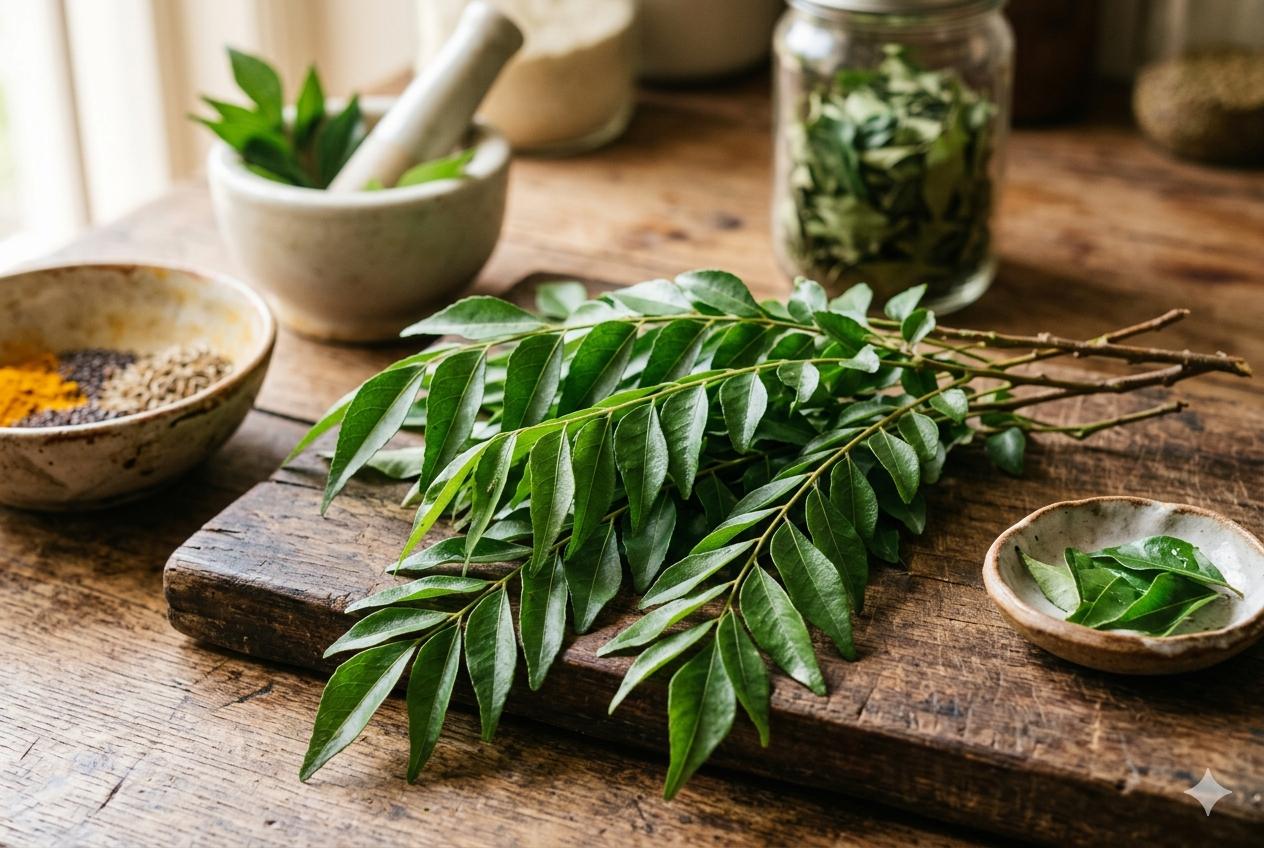
Curry Leaf / Kadi Patta — dried leaves lose 95% aroma (use fresh or frozen ONLY!). Rs.100 nursery plant = 20 years free leaves. Hair oil + 10 raw leaves daily = health tradition.
Curry Leaf / Kadi Patta — dried leaves 95% aroma lose (only fresh या frozen!)। Rs.100 nursery plant = 20 years free leaves। Hair oil + 10 raw leaves daily = health tradition।
Curry Leaf (Murraya koenigii) — Kadi Patta / Curry Patta — is India's most aromatic kitchen garden plant and one of the very few plants where the common name ("curry leaf") literally defines an entire cuisine. Native to India and Sri Lanka, kadi patta has been used in South Indian, Sri Lankan and Southeast Asian cooking for thousands of years and appears in ancient Ayurvedic and Sanskrit texts. The fresh leaf's complex aroma — warm, citrusy, slightly nutty — is completely irreplaceable and incomparably superior to dried curry leaves. For the home gardener, curry leaf is uniquely rewarding: a single potted plant provides a family's complete fresh curry leaf needs year-round for 10-20+ years, requiring only occasional watering and minimal fertilizer. It is simply one of the most useful kitchen herbs possible to grow in tropical India.
Curry Leaf (Murraya koenigii) — Kadi Patta — India का most aromatic kitchen garden plant। Native to India and Sri Lanka — thousands of years South Indian cooking में। Fresh leaf का complex aroma: warm, citrusy, slightly nutty — completely irreplaceable। Home gardener के लिए: एक potted plant = family की complete fresh kadi patta needs, year-round, 10-20+ years। India में most useful kitchen herbs में से एक।
🌿 Overview, History & Varieties
| 🔬 Scientific Name | Murraya koenigii |
| 🌍 Origin | India and Sri Lanka — native. Ancient Sanskrit and Ayurvedic texts mention it. |
| 🌡️ Temperature | 15-40°C — excellent range. Semi-hardy — survives mild frost. |
| ⏱️ Harvest | Leaves from 6-12 months | Continuous harvest for 10-20+ years |
| 🌱 Growth | Perennial small tree — 2-6m outdoor, 60-150cm container managed |
| 💡 Key Fact | Dried curry leaves lose 95% of aroma — fresh is non-negotiable |
| Variety / Type | Specialty | Best For |
|---|---|---|
| 🌿 Regular (Common) | Standard — medium leaves, classic aroma, most widely available | All-purpose cooking, containers |
| 🌿 Dwarf/Gamthi | Slow-growing compact, very small leaves — most aromatic variety | Containers, apartment growing, maximum aroma |
| 🌿 Large Leaf (Broad Leaf) | Bigger leaves, faster growth, prolific — good for large harvests | Large garden, commercial use |
| 🌿 Suvasini (IIHR) | Improved variety — high essential oil, good yield | Commercial essential oil, heavy cooking use |
| 🌿 Wild/Forest type | Smaller leaves, most intense aroma — found in forest margins | Maximum medicinal use, traditional cooking |
💊 Nutrition & Health — Kadi Patta ke Fayde
| Compound | Amount | Health Benefit |
|---|---|---|
| 🌿 Mahanimbine | Alkaloid in leaves | Anti-obesity research — reduces fat accumulation, cholesterol |
| 🩸 Carbazole alkaloids | Multiple types | Antidiabetic, anti-inflammatory, antioxidant — multiple mechanisms |
| 👁️ Vitamin A | High in leaves | Eye health, immunity — beta-carotene form |
| 🦴 Calcium | Significant in leaves | Bone density — curry leaf calcium well absorbed |
| ⚙️ Iron | Significant — with folic acid | Anemia prevention — traditional use for iron deficiency |
| 🛡️ Linalool + Terpinene | Essential oils | Antimicrobial, antifungal — explains food preservation role |
- Hair health — the most famous use: Curry leaf is traditionally considered one of India's most effective natural remedies for premature greying, hair fall and scalp health. The mechanism: curry leaf melanin precursors may support melanocyte activity (pigmentation cells), while the antioxidants prevent oxidative damage to hair follicles. Curry leaf-infused coconut oil (heat coconut oil, add curry leaves, simmer 5 min, strain) applied to scalp is a traditional South Indian hair care practice with growing research support. The iron and beta-carotene in curry leaves also support healthy hair growth through nutritional pathways.
- Blood sugar and cholesterol: Multiple animal studies and some human trials show curry leaf extract reduces blood glucose and total cholesterol. The carbazole alkaloids inhibit starch-digesting enzymes (similar mechanism to diabetes drugs like acarbose) and reduce cholesterol synthesis. Daily consumption of 10-15 fresh curry leaves (eaten directly or in cooking) shows measurable metabolic benefits in regular users — supporting traditional Ayurvedic recommendations.
- Traditional Ayurvedic uses: Kadi patta is classified in Ayurveda as having deepaniya (digestive stimulant), anti-toxic and anti-diabetic properties. Eating 10 fresh curry leaves on empty stomach in the morning is a traditional South Indian health practice for diabetes, digestion and hair health — echoed in modern research findings.
🌱 Growing Guide — Ek Baar Lagao, Saalon Khao
💧 Growing & Care
- Remove flowers for more leaves: When curry leaf plant flowers (produces small white flowers then black berries), it directs energy away from leaf production. For culinary use: remove flower clusters as they appear — this maintains leaf production and prevents the plant from fruiting and slowing. Exception: allow some flowers if you want to collect seeds for propagation.
- Iron deficiency — yellow leaves: Curry leaf commonly shows iron deficiency in container growing — leaves yellow, starting from edges. Treatment: iron sulfate solution (5g in 1L water, soil drench) or rusty nails left in water overnight then used for watering — DIY iron supplement. Ferrous sulfate (from agricultural stores) most effective. Monthly compost prevents most deficiency issues.
- Citrus butterfly caterpillar: Large green caterpillars from citrus butterfly may appear — they grow rapidly and can defoliate a plant quickly. Pick off by hand (wear gloves) — they're large and easy to spot. Not chemically treated as the plant is a food crop harvested fresh. Manual removal sufficient for home gardens.
🌿 Harvest, Storage & Culinary Uses
- Harvest sprigs regularly: Cut entire sprigs (branch tips with 10-15 leaves) rather than individual leaves — this stimulates new growth more effectively. Harvest in morning for maximum essential oil content. Fresh leaves: room temperature 4-5 days. Refrigerator (wrap in damp paper in container): 2 weeks. Freeze whole sprigs in bag — can be used directly from frozen in tadka. Dried leaves: lose 95% of aroma — not recommended. Only use fresh or frozen.
| Use | Method | Note |
|---|---|---|
| 🌿 Tadka (Tempering) | Fresh leaves in hot oil at start of cooking — entire South Indian cooking foundation | Every South Indian dish — sambar, rasam, chutney |
| 🌿 Coconut Chutney | Ground with coconut, green chilli, ginger, tamarind — essential South Indian condiment | Tamil Nadu, Karnataka, Kerala — daily |
| 🌿 Curry Leaf Rice | Paste of curry leaves + spices + sesame + tamarind mixed into rice | Tamil Nadu — temple prasad, traditional |
| 🌿 Hair Oil | Simmer in coconut oil 5-10 min, strain, cool — scalp and hair application | Traditional South India — hair health |
| 🌿 Eat raw | 10-15 fresh leaves chewed on empty stomach — diabetes, digestion, hair | Ayurvedic morning practice — traditional South India |