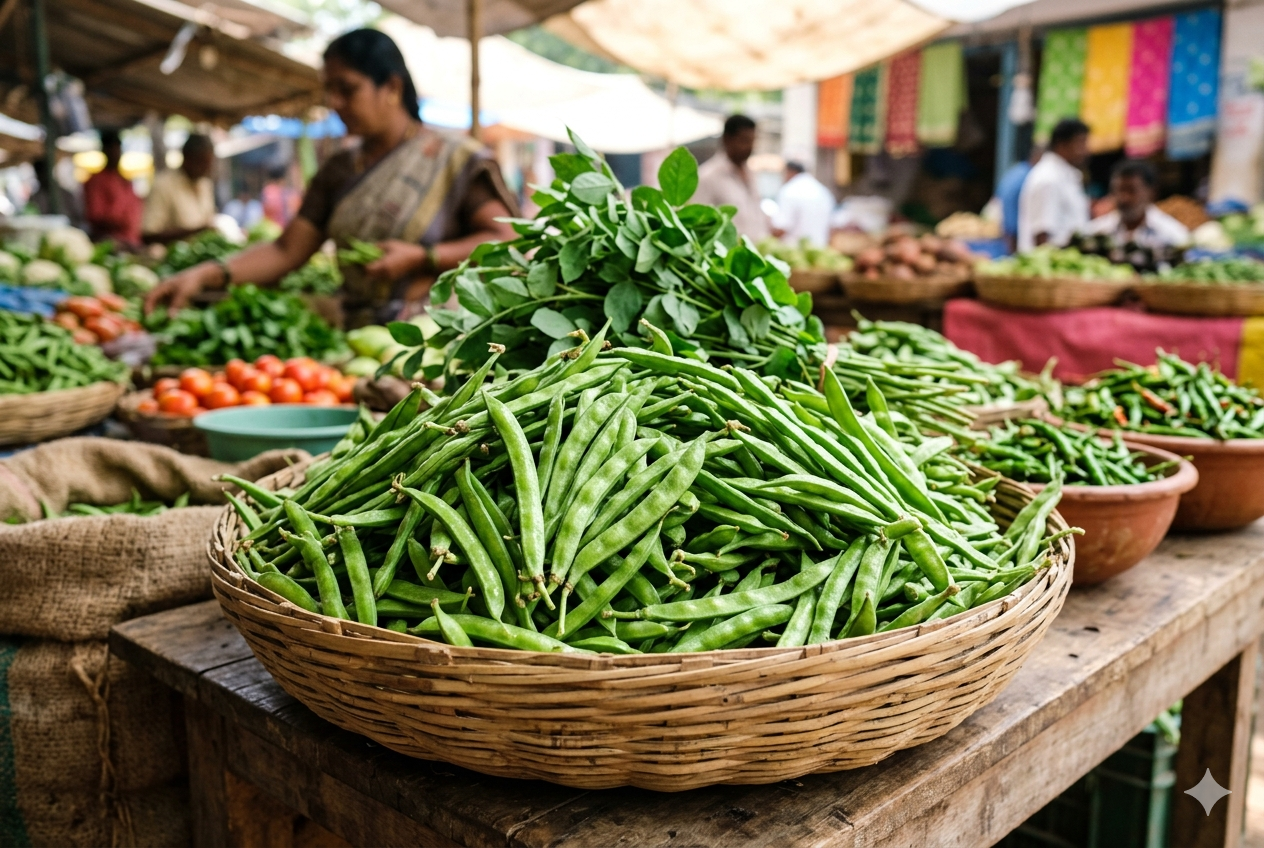
Cluster Beans Guar Growing India — Drought Tolerant Vegetable Encyclopedia
🥬 Vegetables

Cluster Beans / Guar ग्वार / गवार फली

Cyamopsis tetragonoloba
🌱 March-June (summer best) | June-August (kharif) ⏱️ 45-60 days — harvest young pods at 6-10 cm 🌿 Easy Grow ✅ Edible Safe
Photo: PlantCare
Cluster Beans Guar Guar Gum Drought Tolerant Galactomannan Nitrogen Fixing Summer Vegetable

Cluster Beans / Guar — India produces 80% world guar gum (in your ice cream + oil drilling!). Most drought tolerant vegetable. Galactomannan = blood sugar. Nitrogen fixer.

Cluster Beans / Guar — India 80% world guar gum produce करता है (ice cream + oil drilling में!)। Most drought tolerant vegetable। Galactomannan = blood sugar। Nitrogen fixer।

⚡ Quick Reference / एक नज़र में
🌱 Sowing Season
March-June (summer best) | June-August (kharif)
⏱️ Harvest Time
45-60 days — harvest young pods at 6-10 cm
🍽️ Edible Parts
Young pods + dried seeds (guar dal) + leaves (rarely used)
☀️ Light
Full sun — 6+ hours
💧 Water
Every 5-7 days — most drought tolerant vegetable
🌡️ Temperature
25-40°C — peak summer specialist
💊
Key Nutrition / पोषण
Galactomannan fiber (blood sugar), Protein 3.6g, Folate 35% RDA, Iron, Calcium
🍳
Indian Kitchen Uses / भारतीय रसोई
Guar ki phali sabzi, guar besan sabzi, guar dal, guar achaar

Cluster Beans (Cyamopsis tetragonoloba) — Guar / Gawar — is one of India's most heat and drought-tolerant vegetables and a crop of extraordinary global economic importance that most Indians don't know about. Guar is native to the Indian subcontinent and has been cultivated here for 2,000+ years. India produces 80-85% of the world's guar — primarily in Rajasthan, Haryana and Punjab. The remarkable secret: guar seeds are processed into guar gum, a thickening agent used in oil drilling (hydraulic fracturing/fracking), food processing (ice cream, baked goods), paper, textiles and pharmaceuticals globally. The humble vegetable in your sabzi is also a billion-dollar industrial crop. For home gardeners: guar is uniquely heat-adapted, producing abundantly in 35-40°C summers when most other vegetables fail.

Cluster Beans (Cyamopsis tetragonoloba) — Guar / Gawar — India का most heat और drought-tolerant vegetable और extraordinary global economic importance। India 80-85% world's guar produce करता है। Secret: guar seeds → guar gum → oil drilling, ice cream, pharmaceuticals में use — billion-dollar industrial crop! Humble sabzi mein यही vegetable है। Home gardeners के लिए: 35-40°C summers में जब other vegetables fail — guar abundantly produce करती है।

🫘 Overview, History & Varieties

🔬 Scientific NameCyamopsis tetragonoloba
🌍 OriginIndian subcontinent — native. 2,000+ years cultivation.
💡 Global SecretIndia produces 80-85% world guar — seeds processed into guar gum for fracking, food, pharma
🌡️ Temperature25-40°C — most heat tolerant common vegetable
⏱️ Harvest45-60 days from sowing — fast crop
🌱 SeasonsMarch-June (summer — best) | June-August (kharif)
VarietyTypeSpecialtyBest For
🫘 Pusa MausamiOpen pollinated (IARI)Dual season — summer + kharif, good tender pod yieldHome garden, all India
🫘 Sharad BaharOpen pollinatedLate kharif — tolerates slightly cooler season-end tempsLate sowing
🫘 HG-75Open pollinatedHaryana — high pod yield, commercial varietyCommercial Haryana, Punjab
🫘 Local Desi (Rajasthani)TraditionalExtremely drought-tolerant, intense flavor — traditional Rajasthan sabziRajasthan, arid conditions
🫘 Soft Pod typesVariousLess stringy, more tender — preferred for vegetable use vs grain useHome garden eating quality

💊 Nutrition & Health — Guar ke Fayde

NutrientPer 100gHealth Benefit
🌾 Dietary Fiber4g — excellentGut health, cholesterol reduction, blood sugar management
💪 Protein3.6g — high for vegetableComplete protein with all essential amino acids — legume quality
🫀 Folate140 mcg — 35% RDADNA synthesis, pregnancy health, cardiovascular
⚙️ Iron1.4 mgAnemia prevention — legume iron source
🦴 Calcium57 mgBone health, muscle function
🌿 GalactomannanSignificant (guar gum precursor)Prebiotic fiber — feeds beneficial gut bacteria, slows glucose absorption
  • Galactomannan — the medicinal fiber: Guar beans contain high galactomannan — the same fiber processed commercially as guar gum. Galactomannan is a powerful soluble fiber that slows glucose absorption (blood sugar management), reduces LDL cholesterol absorption and acts as a prebiotic feeding beneficial gut bacteria. Eating fresh guar pods provides this beneficial fiber naturally — the reason traditional Indian populations who ate guar regularly had lower diabetes incidence.
  • Nitrogen-fixer — soil improver: Like all legumes, guar fixes atmospheric nitrogen through root nodule bacteria (Rhizobium). Plant guar in summer when soil is bare, incorporate plants after harvest — releases fixed nitrogen for next crop. Guar's drought tolerance makes it an excellent summer green manure in water-scarce Indian gardens and farms.

🌱 Sowing Guide — India's Summer Survivor

🔥
Heat Champion
Guar thrives when other vegetables fail. Sow March-June for summer harvest — perfectly suited to 35-40°C Indian peak summer. Kharif sowing: June-August for monsoon crop. Minimum soil temperature 20°C for germination. Unlike most vegetables that struggle in May-June heat, guar is entering its peak production period. Ideal for filling summer garden gaps when other crops have finished.
🌱
Sowing Method
Direct sow — guar dislikes transplanting. 2-3 cm deep, 15-20 cm apart, rows 30-40 cm. Germination: 5-8 days in warm soil. No pre-soaking needed but 4-6 hours soak speeds germination. Thin to 15 cm apart. Dwarf bushy types: no support needed. Tall climbing types: simple 1-1.5m support. Sow densely for tender young pod harvest — thinned seedlings edible as microgreens.
🏜️
Drought Tolerance
Guar is one of the most drought-tolerant vegetables — established plants survive on minimal water. In Rajasthan, guar grows with only monsoon rainfall — no irrigation. For home gardens: water every 5-7 days once established (2-3 weeks after sowing). This makes guar ideal for gardeners who travel, for terrace gardens without daily watering, and for summer when water conservation matters.
🏠
Container Growing
Excellent container vegetable — compact bushy types especially. 15-20L container sufficient for 2-3 plants. Minimal water requirement makes container growing manageable. Full sun. Monthly compost top-dress. Bushy varieties: no staking needed. One 20L container: yields 300-500g pods over 6-8 weeks. Multiple containers staggered for continuous supply through summer months.

💧 Growing & Care

⚡ Quick Care Reference
☀️ Light
Full sun — 6+ hours
Heat lover — more sun = more yield
💧 Water
Every 5-7 days — drought tolerant
Most water-efficient vegetable
🌡️ Temperature
25-40°C
Peak production in Indian summer
🪴 Soil
Sandy loam — well-draining
Tolerates poor soil — nitrogen fixer
🧪 Fertilizer
Minimal — fixes own nitrogen
Phosphorus + K only
✂️ Harvest
Every 4-5 days — young tender
Mature pods stringy, tough
  • Harvest young — stringiness key: Pods become stringy and tough as they mature. Harvest at 6-10 cm when pods snap cleanly. Regular harvesting keeps plant producing — mature pods signal the plant to stop. Peak production: 45-75 days from sowing. After peak: allow some pods to dry fully on plant for seed saving — guar seeds are fully viable and easy to save.
  • Minimal pest pressure: Guar is naturally resistant to most common pests — one of the least-sprayed vegetables in India. Occasional aphids on shoot tips: neem oil spray. Pod borer in monsoon: BT spray if severe. Overall the most low-maintenance summer vegetable possible.

🫘 Harvest, Storage & Culinary Uses

  • Harvest young at 6-10 cm: Pods should snap cleanly — if they bend without snapping, too mature. Every 4-5 days during peak season. Room temperature 3-4 days. Refrigerator 5-7 days in paper bag. Blanch and freeze 3-4 months. Dry mature pods: shell for guar dal (dried beans) — excellent protein source, store 1-2 years.
DishMethodRegion
🥘 Guar ki Phali SabziStir-fried with mustard seeds, besan coating — dry preparationRajasthan — daily summer staple
🫘 Guar Besan SabziPods tossed in roasted besan + spices — Rajasthani signatureRajasthan — village cooking tradition
🍛 Guar DalDried shelled guar beans cooked as lentil substituteRajasthan, Gujarat — protein-rich dal
🫙 Guar AchaarTender pods in mustard oil + spice pickleNorth India — summer pickle tradition
🌿 Guar Leaves SabziYoung tender leaves as leafy green — rarely done but nutritiousTraditional rural use — zero waste cooking
❓ FAQ
Stringiness prevention and reduction: (1) Harvest early — 6-8 cm pods have minimal strings. (2) Top and tail pods + pull string along both sides before cutting — removes main fiber strands. (3) Cut into small pieces — shorter cuts = less noticeable strings. (4) Blanch 2-3 minutes before sabzi making — softens fibers significantly. (5) Pressure cook briefly (1 whistle) if making gravy — fibers break down. (6) Choose soft-pod varieties specifically labeled for vegetable use — lower fiber content. The snap test at harvest is the best prevention: if pods don't snap cleanly, they're already too mature — use for seed saving instead.
Different seasons, different strengths: French beans (rajma ki phali): cool season (Oct-Feb), more tender, milder flavor, higher Vitamin C, better raw eating. Cluster beans (guar): hot season (March-Sept), more heat/drought tolerant, higher fiber (galactomannan), higher protein, higher folate, more intense flavor. They're complementary — not competing. Grow French beans in winter, guar in summer for year-round bean supply. Nutritionally: guar has higher galactomannan fiber (blood sugar benefit) and folate. French beans have higher Vitamin C and are more tender. Both are excellent — choose by season, not preference.
Guar gum is extracted from the endosperm (middle layer) of guar seeds. It's 75-85% galactomannan — the soluble fiber that makes it an exceptional thickener and stabilizer. Commercial uses: oil well drilling (largest market — keeps fracturing fluids viscous), ice cream (prevents ice crystals), baked goods (improves texture), paper, textiles. Home extraction: technically possible but not practical — requires separating seed layers and milling endosperm. Better approach: eat fresh guar pods regularly — you get the galactomannan directly as beneficial dietary fiber without processing. The commercial guar gum in your ice cream and the sabzi on your plate come from the same remarkable plant.
Simplest summer vegetable growing: (1) March-April: buy guar seeds from any agricultural shop (very cheap — Rs.20-50 per 50g). (2) Prepare pot or bed in full sun location — sandy loam or any well-draining soil. (3) Sow 2 cm deep, 15 cm apart — no pre-treatment needed. (4) Germination in 5-8 days. (5) Water every 5-7 days — no more needed once established. (6) No fertilizer required — it fixes its own nitrogen. (7) Harvest from day 45 onwards every 4-5 days. (8) Season lasts 8-12 weeks. (9) Allow last pods to dry for seeds — free supply for next year. Total investment: Rs.50 seeds + soil + water. Return: 1-3 kg fresh guar phali over the season from one container. Easiest summer vegetable with lowest water requirement.
Guar is scientifically one of the best vegetables for diabetes: (1) Galactomannan fiber directly slows glucose absorption — viscous fiber forms gel in gut that slows digestion. Clinical studies show guar gum supplementation (equivalent to eating 200g fresh guar pods daily) reduces post-meal glucose spike by 20-30%. (2) High fiber + protein combination reduces overall meal glycemic response. (3) Low glycemic index (GI ~18) — doesn't spike blood sugar itself. (4) Folate in guar supports cardiovascular health (diabetics at elevated cardiovascular risk). (5) Nitrogen-fixing ability is irrelevant to diabetes but supports sustainable growing. Practical: include guar ki sabzi 4-5 times per week during summer season — natural galactomannan delivery. Best summer diabetes vegetable along with karela.