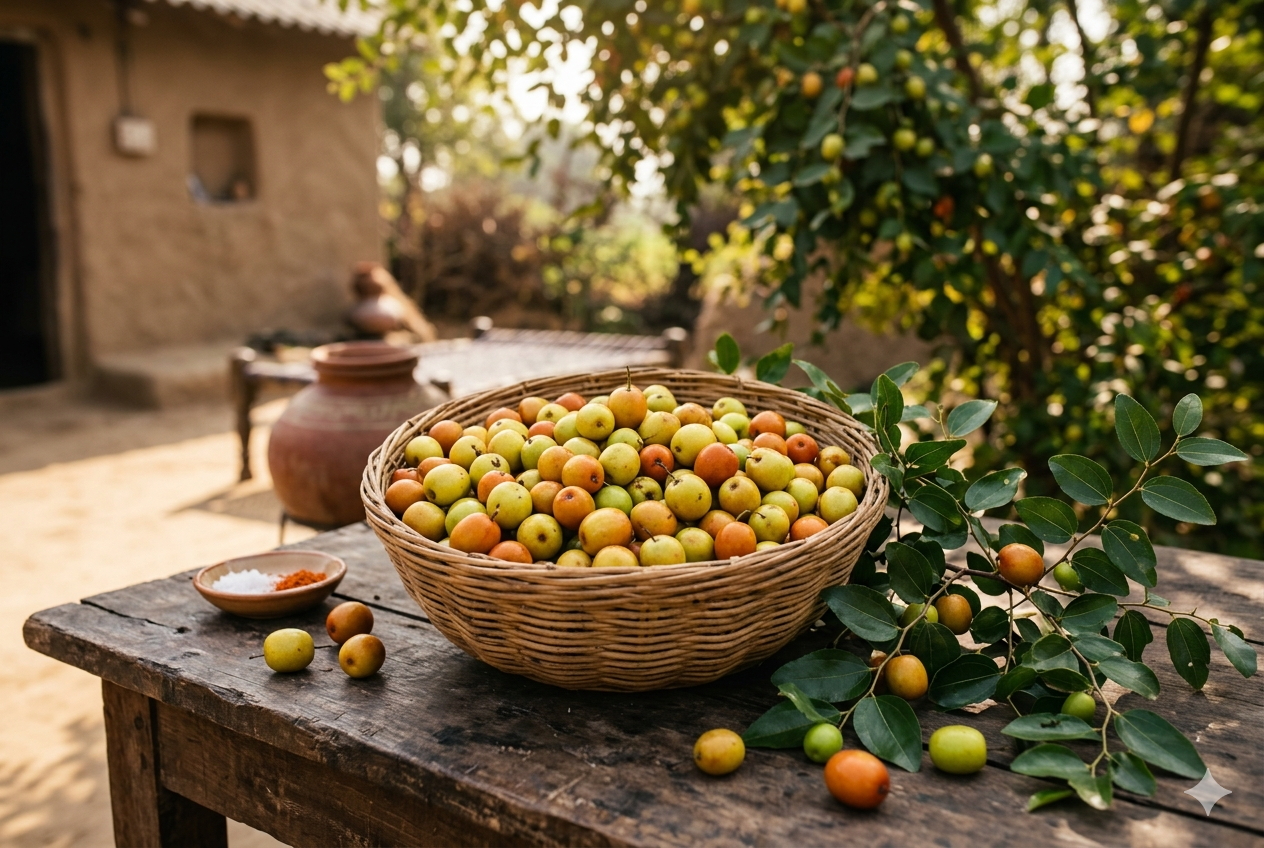
Ber / Jujube — Ramayana's Shabari fruit. India's toughest tree (50°C + 6 month drought!). Annual pruning essential. Jujubosides for anxiety+sleep. Vitamin C 77% RDA.
Ber / Jujube — Ramayana का Shabari fruit। India का toughest tree (50°C + 6 month drought!)। Annual pruning essential। Jujubosides = anxiety+sleep। Vitamin C 77% RDA।
⚡ Quick Reference / एक नज़र में
🌱 Sowing Season
June-July or Feb-March | Grafted recommended | Annual pruning essential
⏱️ Harvest Time
Grafted: 2-3 years | Oct-March harvest | 25-30 years productive
🍽️ Edible Parts
Fruit (fresh, dried, candy, pickle) + leaves (anti-anxiety tea)
☀️ Light
Full sun — loves intense heat
💧 Water
Monthly mature — survives 6 months without water!
🌡️ Temperature
10-50°C — widest temperature range of any Indian fruit tree
💊
Key Nutrition / पोषण
Vitamin C 77% RDA, Jujubosides (sleep/anxiety), Fiber, Iron, Potassium
🍳
Indian Kitchen Uses / भारतीय रसोई
Fresh with salt-chilli, ber achaar, ber candy, ber jelly, leaf tea
Ber (Ziziphus mauritiana) — Indian Jujube / Indian Date — is one of India's most ancient, most drought-tolerant and most nutritionally underappreciated fruits. Native to South Asia and cultivated in India for over 4,000 years, ber appears in Sanskrit literature, Ramayana (Lord Rama received ber from Shabari) and Ayurvedic texts as a healing fruit. India is the world's largest ber producer, growing extensively across Rajasthan, UP, Haryana, Maharashtra and Andhra Pradesh. What makes ber extraordinary: it grows in the harshest conditions where almost nothing else fruits — extreme heat (up to 50°C), severe drought, alkaline soils, waterlogging — earning its reputation as the "poor man's apple" of arid India. For home gardeners, ber is possibly the single most resilient fruit tree in India — plant once, almost never water again, and harvest abundantly for 25-30 years.
Ber (Ziziphus mauritiana) — Indian Jujube — India का most ancient और most drought-tolerant fruits में से एक। Sanskrit literature और Ramayana में mention — Lord Rama को Shabari ने ber दिया। India world का largest producer। Extraordinary: 50°C heat, severe drought, alkaline soil, waterlogging — सब tolerate। "Poor man's apple of arid India"। Home garden में: plant once, almost never water, 25-30 years abundant harvest।
🔴 Overview, History & Varieties
🔬 Scientific Name
Ziziphus mauritiana
🌍 Origin
South Asia — native. Ramayana and Sanskrit literature mention it.
💧 Drought Tolerance
Extreme — survives 50°C, severe drought, poor/alkaline/waterlogged soil
🌡️ Temperature
10-50°C — widest temperature range of any Indian fruit tree
⏱️ First Fruit
Grafted: 2-3 years | Seedling: 4-5 years | Productive: 25-30 years
📅 Season
Oct-March — winter fruit. Peak Dec-Feb.
Variety
Region
Specialty
Best For
🔴 Umran (Elephant Ber)
Haryana, UP
Very large fruit (40-60g), sweet — India's premium ber. Export quality.
Fresh eating, premium market
🔴 Gola
Rajasthan, UP
Medium round, sweet, prolific — most popular all-India variety
Home garden, all India
🔴 Kaithali
Rajasthan
Flat oval, good yield — arid conditions specialist
Rajasthan, dry regions
🔴 Sanaur-5
Punjab — NHRDF
Large, sweet, early maturing — North India commercial
Commercial North India
🔴 Desi small (wild type)
All India — wild/semi-wild
Very small, very sweet when fully ripe — intense flavor. Grows everywhere.
Wild harvest, jelly, candy
💊 Nutrition & Health — Ber ke Fayde
Nutrient
Per 100g
Health Benefit
🍊 Vitamin C
69 mg — 77% RDA
Higher than many citrus fruits — immunity, collagen, iron absorption
🌾 Fiber
1.8g
Gut health, cholesterol management, blood sugar
⚙️ Iron
0.48 mg
Anemia support — with high Vitamin C = enhanced absorption
🫀 Potassium
250 mg
Blood pressure, heart health, fluid balance
🛡️ Saponins + Flavonoids
Significant
Anti-anxiety, sedative (traditional use for sleep), anti-inflammatory
🔥 Calories
79 kcal
Moderate — apple-like caloric density
Anxiety and sleep — traditional Ayurvedic use: Ber seeds contain jujubosides and saponins — compounds with documented sedative and anxiolytic properties. Traditional Ayurvedic use of ber for anxiety, insomnia and mental restlessness has pharmacological support. Chinese jujube (Ziziphus jujuba — close relative) is the world's most researched sedative herbal fruit, with clinical studies confirming sleep improvement. Indian ber (Z. mauritiana) shares many of the same compounds. Eating 10-15 ripe ber fruits in evening may genuinely support sleep quality — a traditional practice worth continuing.
Nutrition for arid India: In Rajasthan and other dry regions where fresh fruits are scarce, ber historically provided crucial Vitamin C and minerals during winter — the only season in arid India when the land produces fruit abundantly. Ber's extraordinary drought tolerance combined with nutritional value made it a food security crop before the concept existed. Today, it remains the most accessible fresh fruit for rural Rajasthan.
🌱 Growing Guide — Kab aur Kaise
🌱
Grafted Plant Recommended
Buy grafted plant (Umran or Gola) from nursery for reliable quality and early fruiting (2-3 years). Cost: Rs.150-400. Seedlings available cheaper but fruit quality variable (5-8 years to fruit). Best planting: June-July (monsoon) or February-March. Ber is one of the easiest fruit trees to establish — virtually no transplant failures in normal conditions.
☀️
Ideal for Harsh Conditions
Ber thrives where other fruit trees fail: (1) Rajasthan desert conditions. (2) Waterlogged low-lying areas. (3) Alkaline/saline soils. (4) Rocky ground with minimal soil. (5) Coastal areas with salt spray. (6) Drought-prone regions with 250mm annual rainfall. If your garden location is "too harsh" for other fruit trees — plant ber. It will succeed where nothing else does.
🏠
Container Growing
60-80L container — ber is one of India's best container fruit trees. Annual pruning keeps compact. Full sun. Water every 10-14 days mature (drought tolerant). Beautiful ornamental when fruiting — hundreds of small red fruits on branches. Container ber: fruits in 2-3 years (grafted), 100-300 fruits per season. Terrace/balcony: excellent choice for India's hot climate zones.
✂️
Annual Pruning
Ber fruits on current season's growth — annual pruning after harvest (March-April) is essential. Cut back 50-60% of previous season's wood, leaving 2-3 buds on each shoot. This dramatic pruning: (1) Maintains manageable tree size. (2) Promotes vigorous new growth with more fruiting points. (3) Improves fruit size. Without pruning: tree becomes large and unproductive with small fruits. Ber tolerates even more aggressive pruning — cutting to knee height is possible and recovers fully.
💧 Growing & Care
⚡ Quick Care Reference
☀️ Light
Full sun — loves intense heat
More sun = sweeter fruits
💧 Water
Monthly mature — extreme drought
Survives 6 months without water!
🌡️ Temperature
10-50°C — widest range
India's toughest fruit tree
🪴 Soil
Any — literally any soil works
Sandy, clay, alkaline, waterlogged
🧪 Fertilizer
Annual post-monsoon NPK
Grows with zero fertilizer
✂️ Pruning
Annual after harvest — critical
Skip pruning = poor fruiting
Powdery mildew on fruit — most common problem: White powdery coating on developing ber fruits during humid conditions. Sulfur dust or wettable sulfur spray at first sign. Neem oil spray preventively during fruit development. Once visible: act quickly — spread fast on ber. Primarily cosmetic with minor quality impact — infected fruits still edible.
Fruit fly in monsoon crop: If ber has a second unseasonal fruiting during monsoon months, fruit fly is more active. Standard protein bait traps manage. Main winter crop (Dec-Feb) has much lower fruit fly pressure — one of the reasons ber is better than most fruits for natural/low-spray growing.
🔴 Harvest, Storage & Culinary Uses
Harvest at yellow-green to full red: Ber is edible at several stages: green-yellow (crisp, tart — like apple), light red (sweet-tart, crisp), deep red (very sweet, slightly soft, maximum flavor). Shake branches, collect fallen fruits. Room temperature: 5-7 days. Refrigerator: 2-3 weeks. Dry: traditional dried ber (chhuhara) — halve, remove seed, sun-dry 10-14 days — 3-4 months storage. Excellent dried snack, concentrated nutrition.
Use
Method
Region
🔴 Fresh Eating
Raw with salt + chilli — crisp apple-like texture
Pan-India winter street food
🫙 Ber ka Achaar
Green ber in mustard oil + spices — tangy pickle
North India — winter preserve staple
🍬 Ber Candy
Sugar-coated dried ber — sweet-sour preserved snack
Commercial and home preparation
☕ Ber Leaf Tea
Boil young leaves — anti-anxiety, digestive tonic
Traditional Ayurvedic remedy
🍯 Ber Jam/Jelly
High pectin — sets naturally. Deep red color.
Home processing, preserve season
❓ FAQ
Easiest fruit tree growing guide: (1) Buy grafted Gola or Umran from nursery (Rs.150-300). (2) June-July planting: dig 60 cm pit, fill with any available soil + 3 kg compost. (3) Plant, water once, mulch around base. (4) Water weekly first month, then monthly — that's it. (5) Annual: post-monsoon fertilizer (NPK 100g per tree). (6) March-April every year: prune 50% after harvest — essential for good next year crop. (7) First fruits: 2-3 years (grafted). (8) Productive for 25-30 years. Why ber is India's most recommended beginner fruit tree: zero pest management needed, survives total neglect, produces despite harsh conditions, fruits in winter when other fruits are scarce, and one mature tree (5-10 years) produces 50-200 kg per season — incomprehensibly abundant for one tree.
Comparison: Indian Ber (Z. mauritiana): smaller fruit, more drought-tolerant, better for tropical India, higher Vitamin C, shorter season. Chinese Jujube (Z. jujuba): larger fruit, more sedative compounds, more research on sleep benefits, better for temperate climates (North India), longer fresh storage, better dried form. Growing both is ideal: Indian ber for tropical and semi-arid regions (Rajasthan, Maharashtra, AP). Chinese jujube for cooler North Indian climates (Punjab, UP, Himachal) where it performs better. Chinese jujube increasingly available in Indian nurseries — worth growing in North India as complement to Indian ber.
Annual ber pruning (March-April, after harvest ends): (1) Identify: previous year's fruiting shoots (brownish, zigzag growth pattern — distinctive). (2) Cut back each shoot to 2-3 buds from the main branch. (3) Remove dead wood completely. (4) Open up the canopy — remove crossing branches for light penetration. (5) Remove any water shoots (vigorous vertical non-fruiting growth from main branches). (6) Overall target: reduce tree volume by 50%. (7) Apply copper paste or pruning sealant to large cuts. (8) Fertilize immediately after pruning — new growth begins within 2-3 weeks. What to expect: tree looks severely cut back initially. By June-July: vigorous new growth emerges. By December: these new shoots bear fruit. Without annual pruning: ber becomes large, unproductive, fruits become small. With pruning: maintains compact size, large fruits, high yield year after year.
Ber for sleep and anxiety — traditional and research-based: (1) Fresh ber fruit: eat 15-20 ripe ber in evening 2-3 hours before sleep. Jujubosides in fruit have documented sedative effect. (2) Ber seed powder: dry and grind ber seeds, 1 tsp in warm milk at bedtime. Seeds have higher jujuboside concentration. (3) Ber leaf tea: boil 10-15 young ber leaves in 300ml water 10 minutes. Strain, drink with honey before bed. (4) For anxiety: regular daily fruit consumption (10+ ber per day during season) may provide cumulative calming effect. Mechanism: jujubosides bind to GABA receptors (same receptors targeted by benzodiazepine anxiety drugs — but gentler, less side effects). Clinical note: research primarily on Chinese jujube (Z. jujuba) which shares key compounds. Indian ber has less clinical evidence specifically but pharmacologically similar compounds. Natural food — safe daily consumption.
Yes — ber is considered safe and beneficial for diabetics: (1) Moderate GI (40-55 depending on variety and ripeness) — lower than most fruits. (2) Fiber content slows glucose absorption. (3) Saponins in ber fruit may improve insulin sensitivity. (4) Ber polyphenols show anti-hyperglycemic activity in animal studies. (5) High Vitamin C with iron = improved anemia management common in long-term diabetics. Practical: 10-15 ber per sitting — manageable diabetic portion. Earlier stage (green-yellow): lower GI than fully ripe. Avoid ber candy and ber achaar with excess sugar/oil — the fresh fruit benefits without these processing additions. Traditional Indian winter diet of ber as daily fresh fruit snack (rather than processed sweets) is an excellent diabetic dietary practice.