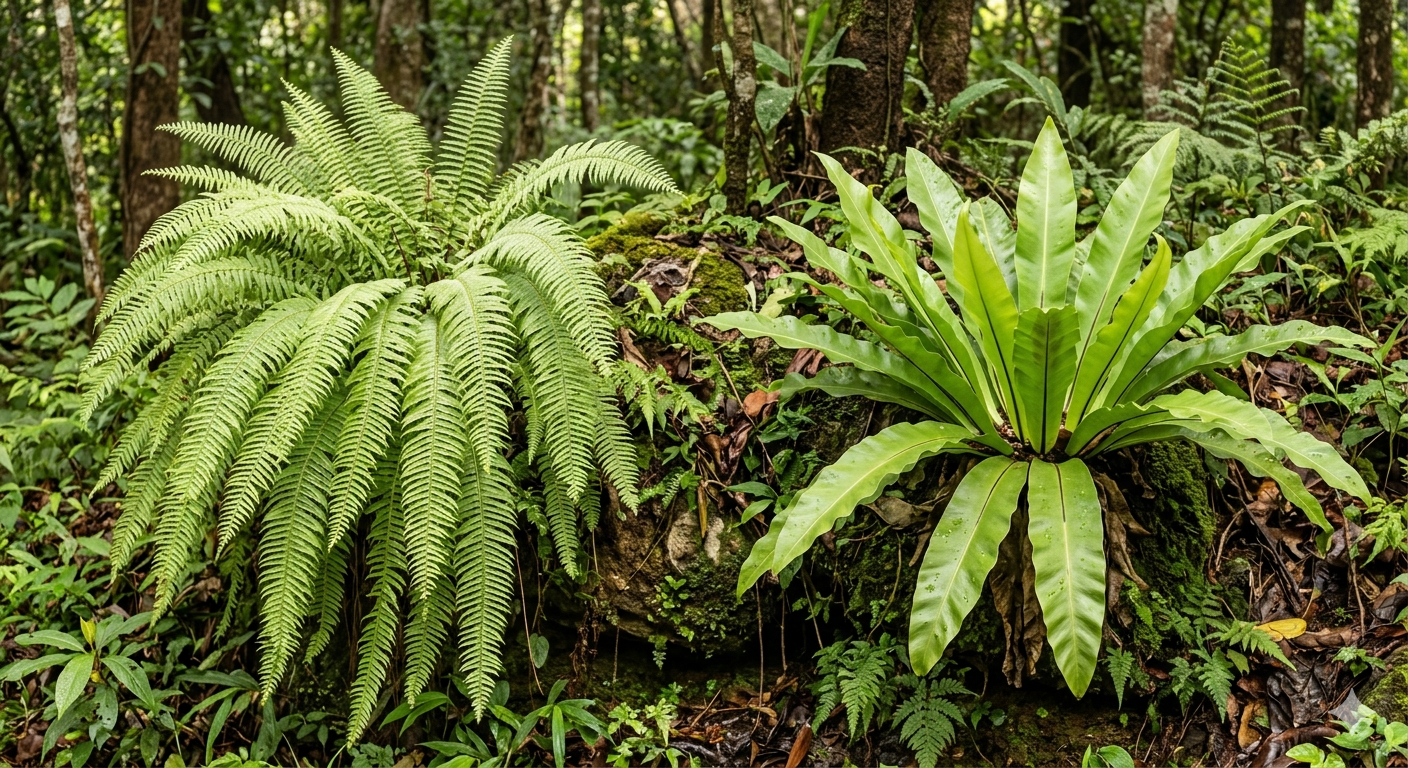
Boston vs Bird's Nest fern comparison — humidity needs, city-wise suitability, AC room tolerance and clear decision guide for Indian gardeners.
Boston vs Bird's Nest fern — humidity comparison, city-wise suitability, AC room tolerance और Indian gardeners के लिए decision guide।
Boston Fern and Bird's Nest Fern are India's two most widely sold and most distinctly different indoor ferns — and choosing between them is one of the most consequential plant decisions an Indian gardener can make. Boston Fern (Nephrolepis exaltata) with its classic feathery, arching fronds and Bird's Nest Fern (Asplenium nidus) with its bold, glossy, strap-like fronds look completely different, thrive in different specific conditions and have dramatically different success rates in various Indian home environments. This guide gives you the honest, complete comparison so you choose the right fern for your specific conditions — and then succeed with it.
Boston Fern और Bird's Nest Fern — India के two most widely sold और most distinctly different indoor ferns हैं। इनके बीच choose करना Indian gardener के most consequential plant decisions में से एक है। दोनों look completely different, different conditions में thrive करते हैं। यह guide honest comparison देती है।
🌿 Meet India's Two Most Popular Ferns
⚖️ Side-by-Side Comparison
Side-by-Side Comparison
| Feature | Boston Fern | Bird's Nest Fern |
|---|---|---|
| 🌿 Leaf type | Feathery, divided, cascading arches | Glossy, undivided strap leaves, rosette form |
| ☀️ Light | Low to medium indirect only | Low to medium indirect only |
| 💦 Humidity need | 70%+ mandatory — very demanding | 50–60% — more tolerant |
| 💧 Watering | Never dry out — daily check in summer | Slightly more drought tolerant |
| 🌡️ Heat tolerance | Low — struggles in Indian summer | Moderate — handles Indian heat better |
| ❄️ AC room tolerance | Poor — crispy fronds within days | Moderate — handles AC better |
| 🏠 Display style | Hanging basket — fronds cascade | Tabletop, shelf — upright rosette |
| 🌱 Beginner suitability | Challenging in most Indian homes | Good — most India-friendly fern |
| 💰 Price India | Rs.50–200 | Rs.100–350 |
| 🏙️ Best Indian cities | Mumbai, Chennai, Kerala, Kolkata | All cities — most adaptable |
🌿 Boston Fern — Complete India Guide
Boston Fern — Complete India Guide
- Honest assessment: Boston fern is genuinely difficult in dry-climate Indian cities (Delhi, Rajasthan, Bangalore in summer). In humid coastal cities (Mumbai, Chennai, Kochi, Kolkata) — it thrives with basic care. The difference is humidity — and humidity is the one thing most Indian homes can't easily provide without a humidifier.
- Where Boston Fern succeeds in India: Bathroom with a window (best), humid coastal city outdoor covered position, indoor with daily misting 3× + pebble tray + other humidity-loving plants grouped together, or room with humidifier (Rs.800–2,500).
- Watering: Never allow soil to dry out — Boston fern's fine roots die rapidly in dry soil. Check soil daily in summer. Morning watering only — never evening (leaves should be dry by night). Water-sensitive to mineral content — RO or rainwater strongly preferred.
- Display: Hanging basket near bright north-facing window in bathroom. The cascading frond display is most dramatic when the plant is large and healthy — achieving that requires the above conditions consistently.
🌿 Bird's Nest Fern — Complete India Guide
Bird's Nest Fern — Complete India Guide
- India's most beginner-friendly fern: Asplenium nidus's thick, undivided leaves lose moisture far more slowly than Boston fern's feathery fronds — making it dramatically more tolerant of the dry conditions typical of Indian interiors and AC rooms. It's the right starting point for any Indian gardener wanting to try ferns.
- Care: 5–7 day watering interval (vs daily for Boston). Handles 50–60% humidity (vs 70%+ for Boston). Tolerates slightly higher temperatures. All of these make it genuinely manageable in most Indian homes without a humidifier.
- Central "nest" care: Bird's Nest Fern's central rosette where leaves emerge must never have water sit in it — it causes crown rot, the plant's most common fatal problem. Water around the base only, never directly into the central rosette.
- New frond emergence: New fronds emerge slowly from the central crown — tightly coiled, expanding over 2–3 weeks. Gentle handling of new fronds is important — they tear and damage easily when young.
🎯 Which to Choose — Decision Guide
Konsa Choose Karein — Decision Guide
| Your Situation | Choose | Why |
|---|---|---|
| 🏠 Mumbai, Chennai, Kochi, Kolkata home | ✅ Either — both work | Natural humidity supports both. Boston more dramatic display. |
| 🏠 Delhi, Rajasthan, Pune, Bangalore (dry) | ✅ Bird's Nest only | Boston will struggle without humidifier. Bird's Nest manageable. |
| ❄️ Heavy AC room | ✅ Bird's Nest only | Boston crispy in AC rooms. Bird's Nest handles it. |
| 🚿 Bathroom with window | ✅ Boston Fern! | Bathroom humidity supports Boston's demanding needs perfectly. |
| 🌱 First fern, beginner | ✅ Bird's Nest | More forgiving, more India-friendly, easier to succeed. |
| 🎨 Want hanging basket display | ✅ Boston Fern | Bird's Nest doesn't cascade — only Boston gives the classic hanging fern display. |
| 💰 Have humidifier | ✅ Either | Humidifier solves Boston's main challenge — both thrive. |
🌿 Shared Fern Care Tips for India
Dono ke liye Shared Fern Care Tips
- Never in direct sun — for both: Both ferns evolved on forest floors under deep canopy. Even morning direct Indian sun scorches both species permanently.
- RO or rainwater preferred — for both: Both ferns react to chlorine and minerals in tap water with brown frond tips. RO water dramatically improves both species' health in Indian conditions.
- Remove dead fronds promptly — for both: Dead brown fronds harbor pests and fungal spores. Remove at base with clean scissors as soon as they die.
🔧 Problems & Fixes for Both Ferns
| Problem | Which Fern | Cause | Fix |
|---|---|---|---|
| 🟤 Brown crispy frond tips | Both (Boston more extreme) | Low humidity / tap water | Mist daily (Boston) or weekly (Bird's Nest). RO water. |
| 🟡 Yellow fronds | Both | Overwatering or low light | Let soil dry slightly. Better light. |
| 💧 Crown rot | Bird's Nest (critical) | Water sitting in central rosette | Water around base only — never in crown. Usually fatal if severe. |
| 🌿 Mass frond drop | Boston Fern | Low humidity or moved position | Immediate humidity increase. Don't move frequently. |
| 🕷️ Spider mites | Both (Boston more prone) | Low humidity | Neem oil spray. Dramatic humidity increase. Daily misting. |